
Skip to content
ELCA Blogs

Faith Lens

January 11, 2026 – Preparing the Way for New Things

Prepare

This week’s Gospel reading is brief and familiar, so looking back at Matthew’s opening chapters helps us see the context for Jesus’ baptism and the figures who prepared the way.

Matthew begins with a genealogy, reminding us that Jesus’ story is rooted in humble beginnings. Then we meet Joseph, who responds to angelic messages with courage—adopting Jesus, honoring his vow to Mary, and protecting the Holy Family from Herod’s wrath. Next comes the Magi, who defy Herod’s orders through civil disobedience, ensuring Jesus remains safe.

Finally, some years later, John the Baptist appears in the wilderness, preaching repentance and baptizing in the Jordan. Crowds gather—Jews and Gentiles alike—as John calls out injustice among both the royal family and religious leaders. Like the prophets before him, John points beyond himself to the One who is greater, preparing hearts for Christ’s arrival.

As many worshipping communities affirm baptismal promises on this Baptism of the Lord Sunday, these chapters remind us that even Jesus entered the waters with guidance and support. From the start, Matthew shows that discipleship is communal—woven through family, neighbors, and prophetic voices. Jesus’ life bears witness to this truth: we walk the journey of faith together, grounded in God’s promises and strengthened by one another.

Opening Exercise

Did you make a resolution this year? Maybe your resolution matches one of these most popular resolutions from a recent YouGov.com US poll.

  • What immediate thoughts do you have about this list? 
  • How many of these most popular resolutions are personal or internally focused? 
  • How many are community-based or externally focused? 
  • What do you believe these resolutions say about our society or culture?

Texts to Read Aloud

Isaiah 42:1-9

Matthew 3:13-17

Preparing the Way for New Things

A power couple in the ancient Roman pantheon, deities Janus and Jana were guardians of beginnings, transitions, and
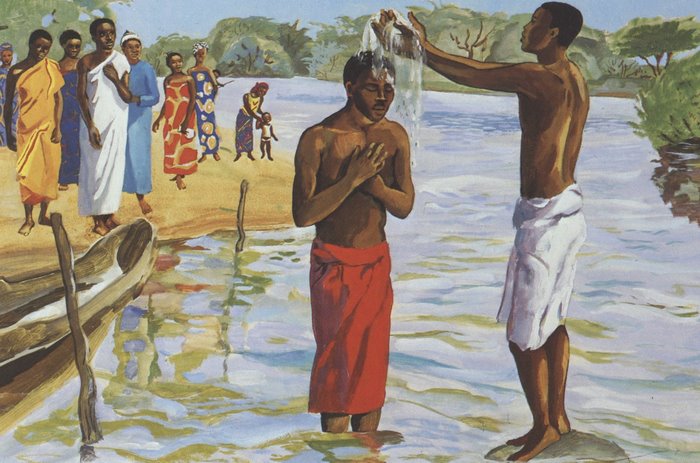
John baptizes Jesus*

doorways. They were often depicted with two faces—one older, looking backward, and the other younger, looking forward—symbolizing reflection on the past and anticipation of the future. This duality makes them central to the New Year, as January—the first month—is named after Janus. Since before Jesus’ time, people have embodied this double gaze at the start of a new year: looking back with wisdom and forward with hope. That perspective helps us read today’s Gospel, where something new happens at the Jordan River.

Matthew’s brief account of Jesus’ baptism is a hinge moment. Jesus arrives from Galilee; John hesitates. Jesus insists. The waters receive him. The Spirit descends like a dove, and a voice from heaven declares, “This is my Son, the beloved.”

Why does Jesus insist on baptism? He does not need repentance like the others John baptized. Yet, Jesus chooses solidarity—stepping into our story to launch God’s new creation. As at Christmas, this is another incarnation moment. “To fulfill all righteousness” is not a checkbox; it’s a covenantal act—God joining humanity and opening a path forward. The Spirit’s descent and God’s voice make this a communal blessing: God’s life poured out for the world in a very public way for the first time in Matthew’s Gospel. This is not just an origin story for Jesus’ public ministry—it’s a sacramental reveal of God’s way in the world: relational, embodied, transformative.

Standing beside Jesus in the water is John—a trending wilderness prophet dressed in camel’s hair, eating locusts, and calling out the injustices perpetrated by kings and religious elites. John is popular—very popular. Crowds flock to him: Roman soldiers, Jews and Gentiles, rich and poor. He calls people back to covenant faithfulness, modeling a kind of fiery devotion to God and neighbor that is not dressed in fancy robes or crowns.

John could have refused to baptize Jesus because this was a new and different kind of baptism. He could have grown jealous or seen Jesus as a threat. He could have capitalized on or even monetized his wilderness fame. Instead, he uses his influence to spotlight Jesus. His viral quote: “He must increase, but I must decrease” (John 3:30). Instead of trying to gain more followers, John freely chooses to point many away from himself and loose his flock to Jesus’ care. That’s not just humility—it’s a countercultural resolution in a world obsessed with riches, followers, and fame. If John had a New Year’s resolution, it might read: “Less me, more Messiah.”

So what does this mean for our double gaze this January—looking back with wisdom and forward with hope? This new year and this holy day give us a chance to revisit our baptismal identity. It’s an opportunity to reaffirm our baptism daily and to let the promises made at baptism define this new year. It’s an invitation to posture ourselves like John in practicing prophetic hospitality—using your influence to point to Jesus in tangible ways for the good of creation or aligning more fully to what the Church is already doing, bringing justice to broken systems and communities. 

Finally, may we stay open to the new things God may be doing in our life together, even if it causes a moment of hesitation, as we look to Jesus daily and follow after his ways in 2026.

Reflection Questions

  1. What all happens at Jesus’ baptism in Matthew 3:13–17? 
  2. Why does John the Baptist hesitate to baptize him?
  3. How does baptism reflect both remembrance and new beginning?
  4. John uses his influence to point others to Jesus instead of building his own fame. This year, what is one concrete way you could “decrease” and point others to Jesus—one action you can commit to for the next month (examples: a weekly act of service, a social-media habit, inviting a friend to church or youth group, joining a justice project)?

Closing Activity

Ask each person to choose one promise from the Baptismal covenant (“Affirmation by the Assembly,” Evangelical Lutheran Worship, p. 237), or to create a new year’s resolution based upon one of these promises. Write it down or discuss ways that the group might make these resolutions come alive and really stick in 2026.

Closing Blessing or Prayer

Consider closing with a Remembrance of Baptism. Prepare a bowl of water and use the words from the Thanksgiving for Baptism in Setting One (ELW, p. 97) or a similar liturgy. After speaking the liturgy, make the sign of the cross on each person’s hand or forehead with water, encouraging them to remember their baptism. Use chosen names to honor each person as they present themselves today.

If a Remembrance of Baptism is not possible or is already part of your worship, consider another closing. Psalms are not just ancient poetry—they are prayers. Psalm 29 offers a powerful reminder that, despite the turmoil in our world and nation, God reigns above all. God does not condone evil but calls us to honor God’s will and partner with our Creator in bringing wholeness to a broken world. Close by reading Psalm 29 together as a prayer.

Biography

Aaron Shoppa serves as the Program Director for Youth Ministry with the ELCA. His greatest joy in this vocation is connecting with other youth leaders across the nation and deeply listening and engaging with their hopes and concerns as they live out this important ministry. While not at work, Aaron keeps busy chasing three young kids around the house and attending to his millennial midlife-crisis by planting way too large of a vegetable garden. 

* JESUS MAFA. John baptizes Jesus, from Art in the Christian Tradition, a project of the Vanderbilt Divinity Library, Nashville, TN. https://diglib.library.vanderbilt.edu/act-imagelink.pl?RC=48290 [retrieved January 7, 2026]. Original source: http://www.librairie-emmanuel.fr (contact page: https://www.librairie-emmanuel.fr/contact).


January 13, 2013–Expectations

Contributed by Brian Hiortdahl, Chicago, IL


Warm-up Question

Did you make any New Year’s resolutions?  How are you doing so far?

Expectations

It is reported that December 22, 2012 happened.  It was the day after the “end of the world” predicted because an ancient Mayan calendar cycle expired on December 21.  The date inspired an apocalyptic movie released three years ago and plenty of “doomsday” preparations around the globe as many people expected the world to end:


Discussion Questions

  •  If you knew for certain the world would end tomorrow, what would you do today?
  • When have you expected something that did not actually happen?  How did you feel afterward?
  • What are you excited or worried about right now–what are you currently expecting?  How will you probably react if things turn out differently than you anticipate?

Scripture Texts (NRSV) for Sunday, January 13, 2013 (Baptism of  Our Lord)

Isaiah 43:1-7

Acts 8:14-17

Luke 3:15-17, 21-22

(Text links are to Oremus Bible Browser. Oremus Bible Browser is not affiliated with or supported by the Evangelical Lutheran Church in America. You can find the calendar of readings for Year C at Lectionary Readings.)

For lectionary humor and insight, check the weekly comic Agnus Day.


Gospel Reflection

The vibe around John the Baptist was probably similar to that of last December.  Luke writes that “the people were filled with expectation, and all were questioning in their hearts concerning John, whether he might be the Messiah.”  Long standing prophecy was finally (maybe, probably?) about to come true, and they would be there to see it!

John had his own expectations:  “one who is more powerful than I is coming….He will baptize you with the Holy Spirit and fire.  His winnowing fork is in his hand, to clear his threshing floor and to gather the wheat into his granary, but the chaff he will burn with unquenchable fire.”  Earlier he had warned his listeners that “the ax is lying at the root of the trees; every tree therefore that does not bear good fruit is cut down and thrown into the fire.”  John was expecting a Messiah armed with blades of judgment who would come and clean house.

What John got instead was hard time.  Did you notice that there are verses cut out of the middle of the gospel reading?  They inform us that Herod put John in prison.  From there, John got rumors and reports about Jesus, who didn’t quite fit the profile he was expecting, so he sent two of his followers to ask him, “Are you the one who is to come, or are we to wait for another?”

Jesus’ response is a summary of his ministry:  “Go and tell John what you have seen and heard: the blind receive their sight, the lame walk, the lepers are cleansed, the deaf hear, the dead are raised, the poor have good news brought to them.  And blessed is anyone who takes no offense at me.” (Luke 7:19-23)

This is probably not exactly what John or the people were expecting from a Messiah.  In the way he goes about his ministry, Jesus seems to be listening not to the voices around him as much as he is focused on the voice above him:  the voice at his baptism which said, “You are my son, the Beloved; with you I am well pleased.” 

Discussion Questions

  •  How do you imagine John responded to Jesus’ answer?
  • What are your expectations of Jesus?  Does he meet them, disappoint them, exceed them, change them?
  • To what voices in your life do you most often listen?
  • How do you listen to the Voice that spoke love and pleasure at your baptism?  How does God’s word to you compare or contrast with others’ expectations of you?

Activity Suggestions

  •  Wash something–hands, dishes, body, clothes, whatever.  When you do so, follow Martin Luther’s advice, making the sign of the cross in remembrance of your baptism.
  • Talk with your parents, godparents, and/or someone who was present at your baptism, and look at photos if you have them.  What do they remember most?  How have their hopes and expectations for you changed since that day?
  • Plan a baptism party.  (I annually host one around January 17, the anniversary of my baptism.  Yes, there will be cake.)  This Sunday, when we celebrate the Baptism of Our Lord, is a great time to do this as a group.

Closing Prayer

Thank you, loving God, for your unexpected goodness and grace to us.  Thank you for naming us your own in holy baptism and calling us to follow Jesus in lives of service and blessing to others.  Help us who are surrounded by so many voices to keep listening to yours.  Amen

January 7-14, 2009 – Dropping the ball on New Year’s night

Warm-up Question: If you are already baptized, do you remember the date and place? Who were your sponsors?

In New York City, the first-ever Times Square celebration on New Year’s Eve occurred in 1904. Originally named Longacre Square, the name was changed after the New York Times opened their new headquarters in that district. The Times Tower was the second-tallest building in Manhattan at the time, anchoring the intersection of Broadway, 7th Avenue and 42nd Street.

The owner of the Times newspaper spared no expense in preparing a spectacular New Year’s Eve celebration. After a full-day street festival, fireworks were set off and at midnight over 200,000 people cheered with noisemakers of all kinds. The celebration could be heard nearly thirty miles north on the shores of the Hudson River. The entire building remained lit up for the evening and the area quickly replaced former gathering places while capturing the attention of the nation and the world.

At the end of 1907 when New York banned the fireworks display, the owner of the Times arranged to have an iron and wood ball that weighed nearly 700 pounds lowered from the buildings flag pole at midnight to signal the transition from 1907 to 1908. For nearly 100 years, the same sign making company has been responsible for the lowering of the ball. Even after the New York Times outgrew Times Tower in 1914 and moved to West 43rd Street, the celebration in Times Square continued to grow as a part of America’s cultural fabric.


While the original building has been stripped down and transformed into another company’s headquarters, the celebration of New Year’s Eve in Times Square has continued to draw international attention. With modern technology, it is estimated that over one billion people watch the ceremony every year. The lowering of the ball has become an international tradition as people welcome the new year.

Discussion Questions

  • Do you make New Year’s resolutions? Why or why not? If you do, what is the most successful resolution you have made and why? What was the least successful and why?
  • New Year’s marks a time of hope and change for many people. What other events promote hope or change for people? Why do we need or not need these events?
  • If you could only celebrate one event a year, what would it be and why?
  • What are the names of the seasons on our liturgical calendar? What does each season celebrate or mark? Why is each season or time period on the church calendar important? Refer to Evangelical Lutheran Worship or the ELCA Worship Web site for planning, if needed.

Scripture Texts (NRSV) for Sunday, January 11, 2009.
(Text links are to
oremus Bible Browser. Oremus Bible Browser is not affiliated with or supported by the Evangelical Lutheran Church in America. You can find the calendar of readings for Year B at Lectionary Readings.)

For lectionary humor and insight, check the weekly comic Agnus Day.

Gospel Reflection

New Year’s Eve marks a time of transition for many people around the world. For some it is a time of hope, for others a time of celebration, and for many it is a time to make new promises and set new goals. We call them resolutions, and they are often set to improve on goals already accomplished or on goals we hope to achieve. Either way, these goals and promises mark a new beginning for us.

John the Baptist’s ministry was different than prophets and teachers of the past. It was different because he was “proclaiming a baptism of repentance for the forgiveness of sins.” (Mark 1:4) Many came, many were baptized, and many confessed their sins. This confession, however sincere, still lacked one thing. It lacked the element of mission. (Even whole-hearted repentance can still be self-centered.)

God’s relationship to humanity has many transitions, new beginnings, and promises. Think of God’s actions for Abraham, Noah, Moses, Ruth, Elizabeth, and Mary to name a few.
When Jesus walked up to John to be baptized, there was more than a new beginning or a ritual. Jesus’ baptism marked a transition in the beginning of the fulfillment of God’s promise to all humankind through the Christ child. “I baptize you with water, but he will baptize you with the Holy Spirit.” (vs. 8)

It is in Christ’s word, deeds, and actions from that point forward through which we understand the gift of mission we receive with the guidance of the Holy Spirit. All the way to the cross, and through Christ’s death and resurrection, our own baptisms bring us renewal and transition every day. As members of the body of Christ, we live out our baptism every day so that the world might know the transforming love of God.

Discussion Questions

  • What is the largest crowd you have ever been in? What was the experience like? Why were you there?
  • Read Mark 1:8 again. What does it mean to be baptized in the Holy Spirit? Is this a proclamation of our mission as the body of Christ? As individuals? If so, what does this mean for us?
  • How does our congregation celebrate baptisms? What are the responsibilities of the parents, sponsors, and congregational members described during the baptismal celebration and liturgy?
  • Do you mark your baptismal anniversary with any kind of celebration or ritual? Why or why not?

Learn more about the sacrament of Baptism at the ELCA Worship Web site for Frequently Asked Questions.

Activity Suggestions

  • Participate in the “Affirmation of Baptism” found in Evangelical Lutheran Worship, page 234.
  • Ask your pastor or congregation’s leaders to see the congregation’s baptismal records for the last year (or two). Send a thank you, birthday card, or letter of encouragement to parents and/or sponsors to commemorate the baptisms in the congregation. If this is not possible, try surveying as many members of the congregation as possible to see how many can remember the date of their baptism. Start a bulletin board with postcards or notices that members can fill in. The postcards could read: “I’m__________ and I was baptized in ________ (city) on __________ (date).”
  • Take turns completing this sentence: “Being baptized means that I…”, or “I live out my baptism each day by…”
  • Choose a hymn to sing from the Baptism of our Lord (page 1178) or Holy Baptism (page 1183) topical sections of Evangelical Lutheran Worship.

Closing Prayer

Prayer for Daily Renewal, Evangelical Lutheran Worship, page 86:

Almighty God, by our baptism into the death and resurrection of your Son, Jesus Christ, you turn us from the old life of sin. Grant that we who are reborn to new life in him may live in righteousness and holiness all our days, through your Son, Jesus Christ our Lord. Amen.

Or…

Almighty God, you renew us and restore us through baptism into the death and resurrection of Jesus. Guide us to holiness and righteousness as we live out your word. Amen.

Contributed by Matthew R. Nelson
Walla Walla, WA