
Contributed by David Delaney, Salem, VA
Warm-up Questions
- What kind of people get your attention – I mean really get your attention for a good long period of time, maybe for as long as that person is willing to talk? Can you think of anyone you know – celebrity, friend, or otherwise – whom you would be very willing and happy to listen to non-stop for ten minutes, or an hour, or a day? What is it about such a person that makes you pay attention? New ideas? Personal charm? Fantastic stories? Outrageous language? Alluring promises? Disaster waiting to happen?
- Imagine for a bit what must have gotten people’s attention about John the Baptist. Mark’s Gospel says that people from the whole area (maybe a 20-30 mile radius), including “all the people of Jerusalem” were coming to see him. Maybe he was just an oddity for people in need of entertainment. Maybe people heard about him and wanted to know what all the fuss was about. But maybe he was a brave voice saying a new thing to a group of people who had kind of given up because of their situation. What do you think? What intrigues a group of people who are overtaxed, ruled by an occupying foreign power, feeling abandoned by God, and just in general watching their hopes and dreams fade?
Person of the Year
 At the end of each year, news organizations and publications release their editorial choices for “newsmaker of the year” or a similar title. For 2011, many names came to the top: Republican Presidential Candidate Rick Perry, Pope Benedict XVII, Harold Camping (remember him? He was the guy who predicted the end of the world for May), Apple Founder Steve Jobs, and as always, the President.
Yet Time Magazine named as Person of the Year “The Protestor,” not a specific individual, but anyone – from the Tea Partiers to the Occupy Movementeers to the Egyptian and Syrian Protestors – who takes a stand against what they think is unjust power and wealth concentrated in the hands of a few. Recall that the so-called “Arab Spring” of protests in northern Africa began in Tunisia not by a great philosopher or statesman, but when an otherwise unknown man named Mohamed Bouazizi set himself on fire after claiming he was slapped by a policewoman. Many, many important and notable people could have been named to the top news spot for 2011, but in the end it was people whose names had never really been mentioned before.
Notice that in the story of Jesus’ baptism which is our focus this week, Jesus himself is a bit player. Most of the action and all of the dialogue are from John the Baptist and the “voice from heaven.” Lots of important and notable people – including John the Baptist – could have been called by God to be the ones who would deliver the news about the coming Kingdom of God, as Jesus does in verse 15, and then to carry it all through Galilee and on to Jerusalem and the cross. But Jesus seems to come out of nowhere, at least in Mark’s gospel. And in some ways, that makes perfect sense. His place of birth (Bethlehem) had some history behind it, but his hometown of Nazareth was a village so small and insignificant that it was not mentioned in any other sources of the day. The other gospels have portions of Jesus’ ministry set there, but Mark doesn’t even mention Nazareth except when he is identifying Jesus. When John announced that one was coming who would be even greater (more popular?) than he was, surely everyone expected Time’s Person of the Year, a great national leader, a great religious figure, someone of fame, power, and stature. Who would have thought that the man that heaven would have identified as God’s beloved and well-pleasing Son would be this uncredentialed person from the middle of nowhere?
Discussion Questions
- Does Jesus ever surprise you, coming out of nowhere to join in the work of your life like he did John’s?
- Think back over your past year. Who would have been your personal “Person of the Year,” the person most influenced your life for good or ill?
- How carefully do we watch for God or listen for a voice from heaven when those who are seemingly small and insignificant cross our paths?
Scripture Texts (NRSV) for Sunday, January 8, 2012 (Baptism of Our Lord)
(Text links are to Oremus Bible Browser. Oremus Bible Browser is not affiliated with or supported by the Evangelical Lutheran Church in America. You can find the calendar of readings for Year C at Lectionary Readings.)
For lectionary humor and insight, check the weekly comic Agnus Day.
Gospel Reflection
It’s possible that the way we probably imagine the baptism of John – as people stepping into water, being washed or dipped, and then stepping out again – may not be the best way to visualize it. Although it is rarely depicted this way, it is just as likely that we should imagine these people standing on the opposite bank of the Jordan from Judea, looking back west in agony over the economic and personal oppression brought by the Roman Empire as well as the deep sense of hurt and resentment at this pagan power having possession of the promised land that was supposed to have belonged to the Jews. As they stood in the same place the original Israelites under Joshua had stood prior to their entry into the promised land, filled with despair and hope that God would finally do something, they would then come across the river again, just as the first Israelites had done, but this time being washed as they went, signifying that here was a people ready to occupy their promised land once again, not by virtue of their fighting or political skill, but by their repentance, that is, their readiness to be the representatives of God’s gracious law and mercy. When we are baptized, we too are walking through a little re-creation of the Jordan river, waters that take us from being a people of no homeland to being a people of God’s own land. Only now the land is no longer a section of real estate, but is instead our lives, remade in the pattern of Christ’s self-giving death and resurrection. As the Israelites crossed the Jordan to a life of freedom and responsibility, and as John’s followers crossed the Jordan to a life of discipleship and witness, so we carry our baptism with us as a reminder, always speaking to us of God’s hopeful declaration of a promised land – the community of God’s people now and the hope of the life to come.
Discussion Questions
- Sometimes we dream of spending time with celebrities or meeting famous and important people. Would we want to meet John the Baptist? Hang out with him? Follow his fashion example? Share his special diet? If John the Baptist came to your town, or even your church, what would the reaction be?
- In all of the gospels, John is always the one who “prepares the way” for the coming of Christ. He also prepares people to hear and receive the good news of God’s love and grace. How have people done that for you over the years and who have those people been? And what are some ways you can be that person for others?
- Notice that verse one is more of a title than a sentence. We might paraphrase it as a sentence: “Good news begins here! … with Jesus the Messiah, the Son of God!” except that the very next verse goes back to a passage of good news from hundreds of years earlier, from the prophet Isaiah. Doesn’t this also show us that proclaiming the good news doesn’t just start with talking about Jesus, but looking back and seeing how God has been hard at work in the lives of a person or a group of people, preparing them over time to be receptive to Christ once he appears? How do we see God working like that in ourselves or in others or in our schools or in our families or in the society around us?
- The Judean wilderness was a rocky desert, watered only by the occasional natural spring, a place where it was easy to become disoriented and dehydrated. In the history of God’s people, the wilderness had always signified two things: death to those who were sent there, and the possibility of new life. When in our own lives do we experience that kind of barrenness?
- When we hear “a baptism of repentance for forgiveness of sins” we probably think we know what that means because of baptisms we have seen in our churches, and we know what “repentance,” “forgiveness,” and “sins” are. So we conclude that in John’s day people with guilty consciences were lined up by the water and by being baptized were no longer guilty for their evil deeds. But we probably do better to reexamine what the Judeans’ experience with those ideas was. “Sin” was not just something one did wrong, it was an awareness of a broken relationship with God. “Forgiveness” was not only the cancellation of guilt, but the restoration of relationship on the basis of God’s freely-given grace. “Repentance” was an acknowledgement of our responsibility for breaking that relationship in the first place and the desire and willingness to turn in directions that would not disrupt that relationship in the future. What are our own definitions of these words?
- When John promises that Jesus will baptize with the Holy Spirit, what does that mean? In the Christian tradition, the Holy Spirit is the third member of the Trinity. To baptize means to dip or immerse, so John says that Jesus will make it so that you are completely surrounded – as close as water is to your skin when you are walking through the Jordan – with the same love that he and his Father share. What does this kind of promise mean to us? Are we drawn to the promise of that kind of intimacy and honesty with God that this would bring?
- Students of Mark’s gospel point to the connection between 1:10 – the heavens being torn open – and 15:18 – where the curtain of the temple (which was a tapestry of a vision of heaven) is torn in two. Both images – the one at the beginning of the gospel and the one at the end – speak of the complete removal of any obstacle between God and God’s people with the arrival of Jesus. Yet we still often feel like God is absent from our lives or from the tragedies and injustices of the world. What kinds of things still separate us like a curtain from God? Can we have closeness with God at the same time as we experience God’s distance, silence, or hiddenness?
Activity Suggestions
- Baptism is our adoption into God’s family as God’s child, and God is “very pleased” (Mark 1:11) that this is so. As a way of testing how your life would be affected if you always had a reminder of that gracious truth, take an index card and write the words of verse 11, starting with your own first name, “_____, You are my beloved child; with you I am well pleased.” Fold this index card and carry it around with you all week, in a pocket or purse where you will come across it often. Then pay attention to how hearing this word from God – a reminder of your adoption – changes the way you think about yourself and the world around you.
- Take a look at the John the Baptist story in the other three gospels. If possible, obtain the page from “Synopsis of the Four Gospels” that has all four versions side-by-side or find a column chart of the four versions of the story on the internet. Notice that there are various differences, but also that Jesus’ baptism is one of the stories of Jesus that is in all four gospels and is a very important part of the gospel narrative. What might some of the differences mean in terms of the special emphasis each gospel writer is trying to make?
Closing Prayer
Almighty God, you have invited people throughout history to be both servants and children. Bring us with the Israelites of old, the disciples of John, and Jesus himself, through the cleansing waters of the Jordan to lives of repentance and joy, so that our lives may be places of your promise and that others may be inspired and invited to join us in your gentle and glorious kingdom. Through Jesus Christ our Lord, who lives and reigns with you and the Holy Spirit, one God, now and forever. Amen.


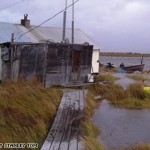 A warming climate is having adverse effects on the Eskimo village of Shishmaref, Alaska. As the ice melts gradually earlier in the spring and forms later in the fall, the coast is beginning to erode—and the houses built along it are in danger of falling into the sea. One house has succumbed to the erosion already and thirteen more have been moved inland to protect them from meeting the same fate. Only one house remains—that of Shelton and Clara Koreok, only feet from the edge. Shelton refuses to move, no matter what the danger, because he fears that moving would mean losing everything he knows.
 The National Aeronautic and Space Administration (NASA) along with Jet Propulsion Laboratories (JPL) and some partners from other countries around the world have been working diligently to find a way out for a stuck Mars rover named Spirit. Spirit has been stuck for over six months now in an area where the ground is made up of very fine, soft sand. The six wheels (one of them has not been working properly for quite a while now) cannot seem to get the traction needed to move forward in any significant way. NASA is not giving up on Spirit, which along with its twin, Opportunity, has continued to function well for five years longer than the originally planned mission of three months. Teams here on earth are working with sample rovers in artificially created environments trying to recreate the actual conditions in order to find the perfect solution…to find a way out. Some of the attempts range from trying various wheel directions and speeds, to having Spirit try to dig itself out with its robotic arms. Just before the Thanksgiving Day weekend, Spirit was commanded to move its wheels forward. NASA indicated that the rover completed a spin which should have equaled a total of 13 feet. The rover actually only moved 0.2 inches forward, 0.1 inches to the left, and 0.1 inches further down into the sand.