Skip to content
ELCA Blogs

Faith Lens

December 7, 2025 – Repentance and Rest

Opening Activity Part 1

Set Up: As you gather with people, have a jar of gummy worms and a jar of honey at each table being used for this activity. Hand out at least two gummy worms, if not more, and preferably blue in keeping with the Advent season. The jar of honey is only for decoration purposes, reminding everyone of John the Baptist’s meal of honey with locusts.

Invite all participants to think of each gummy worm as a physical reminder of something that they have done over which they feel grubby. They do not have to share what these are. Remind them that we are all human, make mistakes, and need to reassess our words and actions. Some examples could be:

  • a mean word shouted at someone
  • a nasty comment left on social media
  • not sharing from our abundance
  • holding ill-will towards those who are different

Remind all the participants that these grubby feelings and actions are a part of what makes us messy humans. It is important, then, that we accept that we have made mistakes and will continue to make mistakes in the future. When we do, we will feel grubby again and again. Instead of being afraid to come to terms with our words and actions, our faith teaches us to face them head-on, make amends, and choose a different future.

Read Text Aloud

Matthew 3:1-12

Rest as Repentance

This gospel lesson reminds us that the holiday season is not simply about beautiful lights and presents. Our faith tradition also invites us to pause, reassess our words and actions, and take corrective action. Amid cheerful music and tinsel-covered trees, we hear the strong words from John the Baptist:

“Repent, for the kingdom of heaven has come near.” … “You brood of vipers! Who warned you to flee from the coming wrath?  Therefore, bear fruit worthy of repentance …” (Matt. 3:2, 7b-8a)

In not mincing words, John the Baptist firmly invites us to reconsider what it means to live as messy humans all the while claiming to be followers of God. He is inviting us into repentance as part of what people of faith are called to practice.

According to the likes of the Apostle Paul, Saint Augustine, and Martin Luther, sin is selfishly turning inwardly into one’s own self. Adversely, Repentance is generously turning outwardly towards God and the neighbor.

Repentance looks like letting go of our angry comments, setting aside our selfishness, and then choosing to be kinder, more generous, and open to what God might want us to do. In a seemingly strange way that can only be experienced by those who choose this path, repenting allows us to rest.

Through repentance we are freed from anger, selfishness, and hatred. In repenting and bearing new fruit, we taste the sweetness of what being a follower of Jesus is and can be for us in this world.

In my context (Minneapolis, MN), many of my beloved neighbors are being demonized. Angry, selfish words have been shared from the highest levels of power. This implicates all of us, whether we agree with the words or not, because we are all a part of this society. The prophet John is inviting us to remember that, as people of faith, we need to repent. What will it look like for us to set aside the angry, selfish words put forth by our leaders so that we can rest in the sweetness of a new way?

Opening Activity Part 2

Focus on how important it is to remember that we are not broken, but simply human. And that even in our biggest mistakes we are still beloved children of God. Not only that, but we will continue to make mistakes (big ones and small ones) over and over again. However, as people of faith, we are asked to always be reassessing our words and actions, make amends, and choose a different future.

This is the way that God invites us into deep rest. Repentance actually frees us from the words, actions, and feelings that often weigh us down. Repentance is a sweet gift from God who understands (and loves) the humans God created.

  • What does repentance look like for Jesus followers today?
  • Once again, think about the words, actions, and/or feelings that are making you feel grubby today.
    • Remind them that, even in our deepest mistakes, God still loves us. However, as people of faith, we have the sweet release of repentance.
  • Finally, invite participants to silently set aside their angry thoughts, words, and actions. Then, lead them in a prayer of repentance such as:

“Most merciful God, we confess that we are captive to sin and cannot free ourselves. We have sinned against you in thought, word, and deed, by what we have done and by what we have left undone. We have not loved you with our whole heart; we have not loved our neighbors as ourselves. For the sake of your Son, Jesus Christ, have mercy on us. Forgive us, renew us, and lead us, so that we may delight in your will and walk in your ways, to the glory of your holy name. Amen.[1]

Closing Activity

Invite all participants to think about how they might make amends and/or choose a different future way of speaking, acting, thinking, or feeling.

If anyone is comfortable sharing their thoughts, have them do so. If not, share that they can talk to a pastor, deacon, or lay leader so that they can come up with plans for amends privately.

Remind them that repentance is not to shame us for being human, but it is a sweet release that allows us to rest. It is also a part of what we are called to do as people of faith, especially during the Season of Advent.

Ending Prayer

It is very important that the pastor, deacon, or lay leader speak the words of forgiveness to everyone who has participated. They may choose to say:

“God, who is rich in mercy, loved us even when we were dead in sin, and made us alive together in Christ. By grace we have been saved. In the name of + Jesus Christ, our sins are forgiven. Almighty God strengthen us with power through the Holy Spirit, that Christ may live in our hearts through faith. Amen.[2]

Immediately after this, invite all participants to eat their gummy worm(s) and enjoy the sweetness of repentance as they rest in God’s forgiveness.

[1] Evangelical Lutheran Worship, pg. 95

[2] Evangelical Lutheran Worship, pg. 96, edited.

Bio

David Larson-Martínez is a consecrated deacon of the Lutheran Diaconal Association and an ordained pastor serving at Holy Trinity Lutheran Church in Minneapolis, MN. A graduate of Valparaiso University and Luther Seminary, he grew up in Cuernavaca, Mexico and now happily calls the Twin Cities home. David treasures his large cross-border family—his mom, five siblings, and a growing crew of nieces and nephews who live in both Mexico and the United States.

January 19, 2014–Who Needs Christ?

Contributed by Scott Mims, Virginia Beach, VA


Warm-up Questions

  • Who is the most famous or important person you have ever met, and what was the experience like? Or alternatively, if you could spend an afternoon with any one real person, currently alive or from the past, who would it be and why?
  • What is the most meaningful part or worship for you?  What makes it so meaningful?

Who Needs Christ?

shutterstock_124884124editAmidst all of the holiday advertising last month, one Times Square billboard drew national attention.  Sponsored by American Atheists, its message sparked a lot of coverage and debate, both in the news and online, with one New York State Senator calling for it to come down. The following is an excerpt from the press release which accompanied the billboard’s launch:

Using motion graphics, the billboard proclaims, “Who needs Christ during Christmas?” A hand crosses out the word “Christ” and the word “NOBODY” appears. The display then says “Celebrate the true meaning of Xmas” and offers a series of cheery words: family, friends, charity, food, snow, and more. The commercial ends with a jovial “Happy Holidays!” from American Atheists and displays the organization’s website.

Now that January has come and our schedules and lives are getting back to some sort of post-holiday “normal,” it may be hard to think in terms of Christmas. But the question posed by the billboard is an important one for us to think about.  “Who needs Christ during Christmas?”  Or even more simply, “Who needs Christ at all?”  Increasingly people in our culture agree with the sign’s message.  Roughly one fifth of adults in the U.S. – and a third of young adults under 30 – claim no religious affiliation. Yet the witness of the Scriptures is that God is indeed present and active in our world and in our lives, and so during these Sundays after Epiphany we focus on exploring who the baby in the manger is and why and how his birth is good news for all people.


Discussion Questions

  • What are your reactions to the message of this billboard?  What do you think its sponsors are trying to say and how do you feel about that?
  • Many people these days claim to be “spiritual but not religious.”  What do you think that means?
  • What are some of the reasons that people might have for not being “religious?”  For not being spiritual?
  • Can you be a follower of Jesus without being religious?  Without being spiritual?
  • Have you ever experienced a negative reaction or “push back” from other people because of your faith?  If so, how did you handle the situation?

Scripture Texts (NRSV) for Sunday, January 19, 2014 (Second Sunday after Epiphany)

Isaiah 49:1-7

1 Corinthians 1:1-9

John 1:29-42

(Text links are to Oremus Bible Browser. Oremus Bible Browser is not affiliated with or supported by the Evangelical Lutheran Church in America. You can find the calendar of readings for Year C at Lectionary Readings.)

For lectionary humor and insight, check the weekly comic Agnus Day.


Gospel Reflection

Who is John the Baptist?  Who is Jesus?  Who are we?  These are some of the questions that John (the gospel writer) addresses today as we continue our journey through the Epiphany season.

So first, who is John the Baptist?  Despite his great popularity and powerful appeal as a preacher and prophet, John is not the Messiah.  We hear this quite plainly, both in the opening words of the gospel (Jn. 1:6-9) and in John the Baptist’s own reply to those who come seeking to know what he is up to (Jn. 1:19-23).  Rather, John is “the voice of one crying out in the wilderness, ‘Make straight the way of the Lord.’” As such, his divine purpose is to reveal to Israel – and ultimately to the world – the Messiah (Jn. 1:31)

What then does John reveal?  First, that the person whom he was sent to make known is Jesus and that Jesus is “the Lamb of God who takes away the sin of the world.” Two times John uses this image to describe Jesus in today’s gospel.  It is an image that has connections both to the sacrificial system surrounding the Jewish Temple and to the Exodus event in which the blood of a lamb caused the final plague to pass over the households of the Israelites.  What’s more, Jesus will be crucified for the sake of the sin of the world on the day in which the Passover lambs are slaughtered (Jn. 19:14, 31, 42). This central part of Jesus’ identity is what we often sing about during Holy Communion after the bread and wine have been consecrated: “Lamb of God, you take away the sin of the world, have mercy on us….”

Jesus is also the one upon whom the Holy Spirit descends and remains.  Unlike last week’s gospel reading from Matthew, we do not actually get to witness Jesus’ baptism in John’s gospel.  Instead, we hear John the Baptist’s witness – his testimony about Jesus – as sort of a flashback.  For John himself, this was the sign that he was looking for (Jn. 1:33).  Not only is the Holy Spirit the marker of Jesus’ true identity and the power of God at work in and through him, the Spirit is the gift the Jesus gives to those who believe and follow him (Jn. 20:21-23).

Finally, in terms of who Jesus is, John makes an astounding claim: “And I myself have seen and have testified that this is the Son of God.”  In my congregation we read the opening section of John’s gospel as part of our candlelight services on Christmas Eve.  In a darkened sanctuary illuminated by the glow of a hundred or so candles we hear about the Word of God becoming flesh, about the One who is the “true light” of the world, about God’s only Son through whom we have all received grace upon grace.  John the Baptist points to Jesus as being this One.  It is a claim, of course, that many today deny.

Which brings us to the third question this passage addresses: Who are we?  In the second part of our gospel reading John the Baptist’s witness – his sharing of his faith in who Jesus is – moves two of his own followers to find out more about this “Lamb of God.”  Seeing them following him, Jesus asks them, “What are you looking for?” For all who read John’s gospel, this is more than simply a casual question.  It is a question that we are asked, too.  When it comes to the future, when it comes to our lives, when it comes to Jesus, what are we looking for?  And, like the two disciples, are we ready to accept Jesus’ invitation to us to “Come and see?”

So, what did they “see” when they were with Jesus that day?  We aren’t told, only that, whatever it was, it led these two seekers to a point where it was no longer John’s witness but their own experience of being with Jesus that caused them to follow him.  One of them, Andrew, is so moved that he, in turn, also becomes a witness, inviting his brother, Simon to come and see.  Simon, who we also know as Peter, became one of the most central disciples in the whole gospel story.  At this point there is a lot yet to happen before he truly begins to understand what it means for Jesus to be Lamb of God and Messiah.

Perhaps that is also something for us to take away from our gospel for this week.  It is not perfection in understanding or completeness of knowledge that John (the gospel writer) is aiming for in his account of God’s great love for us in Jesus.  John is aiming for faith – that we might come to believe in Jesus ourselves and, in believing, to discover true and abundant life.  Here, by the Jordan River, he looks back to the very beginning, to the mysterious and powerful proclamation of his opening words, and, at the same time, forward to the cross, to the very place where the image of Jesus as Lamb of God finds its fulfillment.

Discussion Questions


  • The following are some of the titles and epithets that people have given to Jesus.  Which one(s) is (are) most meaningful to you? Why?


Son of God           Emmanuel                   Prince of Peace           Man or Sorrows

Good Shepherd     Lamb of God              Friend of Sinners        Teacher

Lord                      Light of the World      Bread of Life              Messiah


  • Who in your own life has shown / brought you to Jesus?  In what ways have they witnessed to their faith?
  • John the Baptist’s role was to point other people to Jesus.  If, as they say, actions speak louder than words, what are some practical, real-life ways that you might help other people know about Jesus and experience his love?
  • Why do you need Jesus?

Activity Suggestion

Act out the gospel lesson.  Try to imagine why Andrew is so eager to introduce others to Jesus.  What about Jesus do you think made him so excited that he couldn’t wait to tell Simon Peter?  Have you ever had the chance to invite someone else to “Come and see?”  If so, how did it go? Have those acting other parts give typical reactions to talking about Jesus with friends and acquaintances.  Talk about how this story might be seen as a model for doing evangelism.

Closing Prayer

Gracious and loving God, in the waters of baptism you name us and claim us and make us your very own.  Thank you for your love and for the forgiveness and new life that is ours through Jesus. As we seek to be his followers in our often messy and complicated world, place into our lives people and events who will remind us of who and whose we truly are.  Help us, in turn, to be living signs of your love and grace in the lives of those around us.  In Jesus’ name we pray.  Amen.

December 15, 2013–A Step Forward or Backward?

Contributed by Brian Hiortdahl, Overland, KS


Warm-up Question

What are you hoping for this Christmas?  What are you expecting?  Are your hopes and expectations the same, or are they different?

A Step Forward or Backward?

shutterstock_151122242edit

photo by marco rubino /shutterstock

Last month, a coalition of powerful world nations struck an initial deal with Iran, setting limits on its nuclear program while easing economic sanctions against the country.  Reaction to this breakthrough step has been mixed, with some praising it as a step forward toward stability, transparency, and peace, and others condemning it as a step backward that allows Iran to become more volatile, establishes a worrisome negotiating precedent, and makes the world more dangerous:


Discussion Questions

  • Do you think this historic deal is a step forward or backward?  Why?
  • What do you think Jesus would have to say about this development?
  • Is there a comparable situation in your local community?  Who or what threatens peace and safety in your school or your neighborhood or your church?  What should be done about it, and who needs to talk together to work on a just solution?


Scripture Texts (NRSV) for Sunday, December 15, 2013 (Third Sunday of Advent)

Isaiah 35:1-10

James 5:7-10

Matthew 11:2-11

(Text links are to Oremus Bible Browser. Oremus Bible Browser is not affiliated with or supported by the Evangelical Lutheran Church in America. You can find the calendar of readings for Year C at Lectionary Readings.)

For lectionary humor and insight, check the weekly comic Agnus Day.


Gospel Reflection

John the Baptist wasn’t sure whether he could trust Jesus or not.  John held high ethical standards of righteousness and high expectations of a purifying Messiah who would clean house, clearly and decisively separating good from evil.  John’s undiplomatic clarity helped land him in prison when he preached against the adulterous shenanigans of the royal family, so he was unable to experience Jesus’ ministry firsthand.  He did get rumors and reports, however, of Jesus’ teaching and healing, which were full of power but not punishment.  John focused on an ax lying at the root of the trees; Jesus preached about sowing seeds.  John warned about a winnowing fork and a consuming fire; Jesus blessed the humble and warmed the heart.  John’s preaching was direct and confronted political power brokers; Jesus told strange stories that invited people without power into mysterious hope.

John sent his students to Jesus, therefore, with a typically direct question: “Are you the one who is to come, or are we to wait for another?”  Jesus sent back a typically indirect, what-do-you-think reply:  “Go and tell John what you hear and see: the blind receive their sight, the lame walk, the lepers are cleansed, the deaf hear, the dead are raised, and the poor have good news brought to themAnd blessed is anyone who takes no offense at me.”  He then praised John to the crowds and pointed to a new reality, “the kingdom of heaven,” which would surpass anything John could imagine, even though he was the greatest prophet ever to prepare its way.

John is left to wonder:  Is Jesus a step forward, or a step backward?  Is his bottom up, lift the lowly approach the surprising way that God has chosen to right the world, or is it an exercise in naive futility?  Is he bringing peace or being too soft?

Discussion Questions

  •  Read Matthew 3:1-17 and 4:12-23.  What do the preaching of John and Jesus have in common?  How do they differ?  What does each preacher teach us about God?
  • Would you rather have Jesus or John at the negotiating table with Iran?  Why?
  • How is Jesus portrayed in media and popular culture?  What are our present day expectations of him, and are they realistic?
  • If someone asked you about Jesus, what would you tell them?
  • Traditionally, the season of Advent stresses the second coming of Jesus.  What do you think Jesus will look like when it happens?


Activity Suggestions

  • As a group, make a list of typical holiday expectations.  Do these lead to hope and joy or to disappointment?
  • Write a letter to your senator expressing your opinion about the deal with Iran, grounding your position in your Christian faith.

Closing Prayer

Come, thou long expected Jesus.  Prepare us for the kingdom of heaven, set us free from misguided expectations, and open our eyes to see the surprising gifts of grace you bring to us and to all the world.  Amen.

January 13, 2013–Expectations

Contributed by Brian Hiortdahl, Chicago, IL


Warm-up Question

Did you make any New Year’s resolutions?  How are you doing so far?

Expectations

It is reported that December 22, 2012 happened.  It was the day after the “end of the world” predicted because an ancient Mayan calendar cycle expired on December 21.  The date inspired an apocalyptic movie released three years ago and plenty of “doomsday” preparations around the globe as many people expected the world to end:


Discussion Questions

  •  If you knew for certain the world would end tomorrow, what would you do today?
  • When have you expected something that did not actually happen?  How did you feel afterward?
  • What are you excited or worried about right now–what are you currently expecting?  How will you probably react if things turn out differently than you anticipate?

Scripture Texts (NRSV) for Sunday, January 13, 2013 (Baptism of  Our Lord)

Isaiah 43:1-7

Acts 8:14-17

Luke 3:15-17, 21-22

(Text links are to Oremus Bible Browser. Oremus Bible Browser is not affiliated with or supported by the Evangelical Lutheran Church in America. You can find the calendar of readings for Year C at Lectionary Readings.)

For lectionary humor and insight, check the weekly comic Agnus Day.


Gospel Reflection

The vibe around John the Baptist was probably similar to that of last December.  Luke writes that “the people were filled with expectation, and all were questioning in their hearts concerning John, whether he might be the Messiah.”  Long standing prophecy was finally (maybe, probably?) about to come true, and they would be there to see it!

John had his own expectations:  “one who is more powerful than I is coming….He will baptize you with the Holy Spirit and fire.  His winnowing fork is in his hand, to clear his threshing floor and to gather the wheat into his granary, but the chaff he will burn with unquenchable fire.”  Earlier he had warned his listeners that “the ax is lying at the root of the trees; every tree therefore that does not bear good fruit is cut down and thrown into the fire.”  John was expecting a Messiah armed with blades of judgment who would come and clean house.

What John got instead was hard time.  Did you notice that there are verses cut out of the middle of the gospel reading?  They inform us that Herod put John in prison.  From there, John got rumors and reports about Jesus, who didn’t quite fit the profile he was expecting, so he sent two of his followers to ask him, “Are you the one who is to come, or are we to wait for another?”

Jesus’ response is a summary of his ministry:  “Go and tell John what you have seen and heard: the blind receive their sight, the lame walk, the lepers are cleansed, the deaf hear, the dead are raised, the poor have good news brought to them.  And blessed is anyone who takes no offense at me.” (Luke 7:19-23)

This is probably not exactly what John or the people were expecting from a Messiah.  In the way he goes about his ministry, Jesus seems to be listening not to the voices around him as much as he is focused on the voice above him:  the voice at his baptism which said, “You are my son, the Beloved; with you I am well pleased.” 

Discussion Questions

  •  How do you imagine John responded to Jesus’ answer?
  • What are your expectations of Jesus?  Does he meet them, disappoint them, exceed them, change them?
  • To what voices in your life do you most often listen?
  • How do you listen to the Voice that spoke love and pleasure at your baptism?  How does God’s word to you compare or contrast with others’ expectations of you?

Activity Suggestions

  •  Wash something–hands, dishes, body, clothes, whatever.  When you do so, follow Martin Luther’s advice, making the sign of the cross in remembrance of your baptism.
  • Talk with your parents, godparents, and/or someone who was present at your baptism, and look at photos if you have them.  What do they remember most?  How have their hopes and expectations for you changed since that day?
  • Plan a baptism party.  (I annually host one around January 17, the anniversary of my baptism.  Yes, there will be cake.)  This Sunday, when we celebrate the Baptism of Our Lord, is a great time to do this as a group.

Closing Prayer

Thank you, loving God, for your unexpected goodness and grace to us.  Thank you for naming us your own in holy baptism and calling us to follow Jesus in lives of service and blessing to others.  Help us who are surrounded by so many voices to keep listening to yours.  Amen

January 8, 2012–Person of the Year

Contributed by David Delaney, Salem, VA

Warm-up Questions

  •  What kind of people get your attention – I mean really get your attention for a good long period of time, maybe for as long as that person is willing to talk?  Can you think of anyone you know – celebrity, friend, or otherwise – whom you would be very willing and happy to listen to non-stop for ten minutes, or an hour, or a day?  What is it about such a person that makes you pay attention?  New ideas?  Personal charm?  Fantastic stories?  Outrageous language?   Alluring promises? Disaster waiting to happen?
  • Imagine for a bit what must have gotten people’s attention about John the Baptist.  Mark’s Gospel says that people from the whole area (maybe a 20-30 mile radius), including “all the people of Jerusalem” were coming to see him.  Maybe he was just an oddity for people in need of entertainment.  Maybe people heard about him and wanted to know what all the fuss was about.  But maybe he was a brave voice saying a new thing to a group of people who had kind of given up because of their situation.  What do you think?  What intrigues a group of people who are overtaxed, ruled by an occupying foreign power, feeling abandoned by God, and just in general watching their hopes and dreams fade?

Person of the Year

At the end of each year, news organizations and publications release their editorial choices for “newsmaker of the year” or a similar title.  For 2011, many names came to the top:  Republican Presidential Candidate Rick Perry, Pope Benedict XVII, Harold Camping (remember him?  He was the guy who predicted the end of the world for May), Apple Founder Steve Jobs, and as always, the President.

Yet Time Magazine named as Person of the Year “The Protestor,” not a specific individual, but anyone –  from the Tea Partiers to the Occupy Movementeers to the Egyptian and Syrian Protestors – who takes a stand against what they think is unjust power and wealth concentrated in the hands of a few.  Recall that the so-called “Arab Spring” of protests in northern Africa began in Tunisia not by a great philosopher or statesman, but when an otherwise unknown man named Mohamed Bouazizi set himself on fire after claiming he was slapped by a policewoman.   Many, many important and notable people could have been named to the top news spot for 2011, but in the end it was people whose names had never really been mentioned before.

Notice that in the story of Jesus’ baptism which is our focus this week, Jesus himself is a bit player.  Most of the action and all of the dialogue are from John the Baptist and the “voice from heaven.”  Lots of important and notable people – including John the Baptist – could have been called by God to be the ones who would deliver the news about the coming Kingdom of God, as Jesus does in verse 15, and then to carry it all through Galilee and on to Jerusalem and the cross.   But Jesus seems to come out of nowhere, at least in Mark’s gospel.  And in some ways, that makes perfect sense.  His place of birth (Bethlehem) had some history behind it, but his hometown of Nazareth was a village so small and insignificant that it was not mentioned in any other sources of the day.  The other gospels have portions of Jesus’ ministry set there, but Mark doesn’t even mention Nazareth except when he is identifying Jesus.  When John announced that one was coming who would be even greater (more popular?) than he was, surely everyone expected Time’s Person of the Year, a great national leader, a great religious figure, someone of fame, power, and stature.  Who would have thought that the man that heaven would have identified as God’s beloved and well-pleasing Son would be this uncredentialed person from the middle of nowhere?

Discussion Questions

  • Does Jesus ever surprise you, coming out of nowhere to join in the work of your life like he did John’s?
  • Think back over your past year. Who would have been your personal “Person of the Year,” the person most influenced your life for good or ill?
  • How carefully do we watch for God or listen for a voice from heaven when those who are seemingly small and insignificant cross our paths?

Scripture Texts (NRSV) for Sunday, January 8, 2012 (Baptism of Our Lord)

 Genesis 1:1-5

Acts 19:1-7

Mark 1:4-11

(Text links are to Oremus Bible Browser. Oremus Bible Browser is not affiliated with or supported by the Evangelical Lutheran Church in America. You can find the calendar of readings for Year C at Lectionary Readings.)

For lectionary humor and insight, check the weekly comic Agnus Day.

 Gospel Reflection

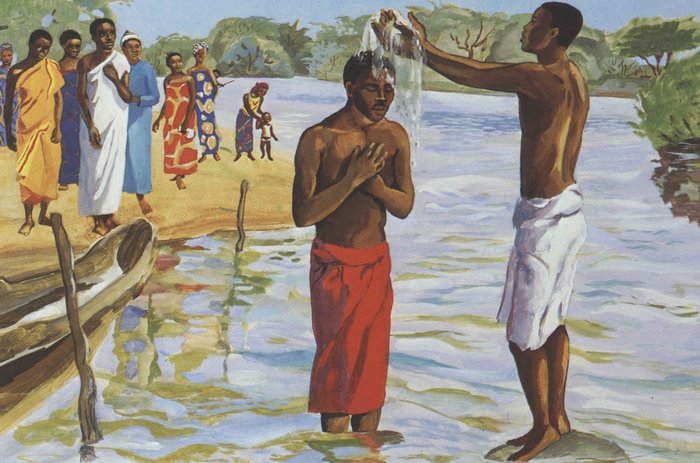
It’s possible that the way we probably imagine the baptism of John – as people stepping into water, being washed or dipped, and then stepping out again – may not be the best way to visualize it.  Although it is rarely depicted this way, it is just as likely that we should imagine these people standing on the opposite bank of the Jordan from Judea, looking back west in agony over the economic and personal oppression brought by the Roman Empire as well as the deep sense of hurt and resentment at this pagan power having possession of the promised land that was supposed to have belonged to the Jews.  As they stood in the same place the original Israelites under Joshua had stood prior to their entry into the promised land, filled with despair and hope that God would finally do something, they would then come across the river again, just as the first Israelites had done, but this time being washed as they went, signifying that here was a people ready to occupy their promised land once again, not by virtue of their fighting or political skill, but by their repentance, that is, their readiness to be the representatives of God’s gracious law and mercy.   When we are baptized, we too are walking through a little re-creation of the Jordan river, waters that take us from being a people of no homeland to being a people of God’s own land.  Only now the land is no longer a section of real estate, but is instead our lives, remade in the pattern of Christ’s self-giving death and resurrection.  As the Israelites crossed the Jordan to a life of freedom and responsibility, and as John’s followers crossed the Jordan to a life of discipleship and witness, so we carry our baptism with us as a reminder, always speaking to us of God’s hopeful declaration of a promised land – the community of God’s people now and the hope of the life to come.

Discussion Questions

  • Sometimes we dream of spending time with celebrities or meeting famous and important people.  Would we want to meet John the Baptist?  Hang out with him?  Follow his fashion example?  Share his special diet?   If John the Baptist came to your town, or even your church, what would the reaction be?
  • In all of the gospels, John is always the one who “prepares the way” for the coming of Christ.  He also prepares people to hear and receive the good news of God’s love and grace.  How have people done that for you over the years and who have those people been?  And what are some ways you can be that person for others?
  • Notice that verse one is more of a title than a sentence. We might paraphrase it as a sentence:  “Good news begins here!  … with Jesus the Messiah, the Son of God!”  except that the very next verse goes back to a passage of good news from hundreds of years earlier, from the prophet Isaiah.  Doesn’t this also show us that proclaiming the good news doesn’t just start with talking about Jesus, but looking back and seeing how God has been hard at work in the lives of a person or a group of people, preparing them over time to be receptive to Christ once he appears?  How do we see God working like that in ourselves or in others or in our schools or in our families or in the society around us?
  • The Judean wilderness was a rocky desert, watered only by the occasional natural spring, a place where it was easy to become disoriented and dehydrated.  In the history of God’s people, the wilderness had always signified two things:  death to those who were sent there, and the possibility of new life.  When in our own lives do we experience that kind of barrenness?
  • When we hear “a baptism of repentance for forgiveness of sins” we probably think we know what that means because of baptisms we have seen in our churches, and we know what “repentance,” “forgiveness,” and “sins” are.  So we conclude that in John’s day people with guilty consciences were lined up by the water and by being baptized were no longer guilty for their evil deeds.  But we probably do better to reexamine what the Judeans’ experience with those ideas was.  “Sin” was not just something one did wrong, it was an awareness of a broken relationship with God.  “Forgiveness” was not only the cancellation of guilt, but the restoration of relationship on the basis of God’s freely-given grace.  “Repentance” was an acknowledgement of our responsibility for breaking that relationship in the first place and the desire and willingness to turn in directions that would not disrupt that relationship in the future.  What are our own definitions of these words?
  • When John promises that Jesus will baptize with the Holy Spirit, what does that mean?   In the Christian tradition, the Holy Spirit is the third member of the Trinity.   To baptize means to dip or immerse, so John says that Jesus will make it so that you are completely surrounded – as close as water is to your skin when you are walking through the Jordan – with the same love that he and his Father share.  What does this kind of promise mean to us?  Are we drawn to the promise of that kind of intimacy and honesty with God that this would bring?
  • Students of Mark’s gospel point to the connection between 1:10 – the heavens being torn open – and 15:18 – where the curtain of the temple (which was a tapestry of a vision of heaven) is torn in two.  Both images – the one at the beginning of the gospel and the one at the end – speak of the complete removal of any obstacle between God and God’s people with the arrival of Jesus.  Yet we still often feel like God is absent from our lives or from the tragedies and injustices of the world.  What kinds of things still separate us like a curtain from God?   Can we have closeness with God at the same time as we experience God’s distance, silence, or hiddenness?

Activity Suggestions

  • Baptism is our adoption into God’s family as God’s child, and God is “very pleased” (Mark 1:11) that this is so.  As a way of testing how your life would be affected if you always had a reminder of that gracious truth, take an index card and write the words of verse 11, starting with your own first name, “_____, You are my beloved child;  with you I am well pleased.”  Fold this index card and carry it around with you all week, in a pocket or purse where you will come across it often.  Then pay attention to how hearing this word from God – a reminder of your adoption – changes the way you think about yourself and the world around you.
  • Take a look at the John the Baptist story in the other three gospels.  If possible, obtain the page from “Synopsis of the Four Gospels” that has all four versions side-by-side or find a column chart of the four versions of the story on the internet.  Notice that there are various differences, but also that Jesus’ baptism is one of the stories of Jesus that is in all four gospels and is a very important part of the gospel narrative.  What might some of the differences mean in terms of the special emphasis each gospel writer is trying to make?

Closing Prayer

Almighty God, you have invited people throughout history to be both servants and children.  Bring us with the Israelites of old, the disciples of John, and Jesus himself, through the cleansing waters of the Jordan to lives of repentance and joy, so that our lives may be places of your promise and that others may be inspired and invited to join us in your gentle and glorious kingdom.  Through Jesus Christ our Lord, who lives and reigns with you and the Holy Spirit, one God, now and forever.  Amen.