
Skip to content
ELCA Blogs

Faith Lens

April 12, 2026 – Peace Be With You

Prepare:

Jesus’ disciples are familiar with fear. Throughout the gospel of John, we hear that Jesus’ followers are filled with fear, especially of the Jewish authorities. To proclaim Jesus as messiah is to face expulsion from the synagogue and separation from family and friends. Following Jesus comes with fear and risk. This fear is compounded at Jesus’ death. He tries to prepare his disciples for his death and resurrection, but they are unable to comprehend these predictions.

After Jesus’ death, the disciples’ fears are intensified by grief. They had hoped for Jesus to rebuild Israel into a great nation and end Roman occupation. They also had hoped to be at his side when he did it. But now their leader and friend, as well as their status and hopes for the future, are all lost. They are unsure of their standing in the Jewish community and unable to trust in the news of Jesus’ resurrection. Consequently, the disciples have no idea what to do next.

Into this situation of fear and uncertainty, Jesus shows up. Jesus shows up, gifting the disciples with his peace and the Holy Spirit. These gifts empower the disciples to begin planning for a new future of proclaiming Christ’s love to others.

Opening Exercise:

Listen to the hymn Let There Be Peace on Earth or read the lyrics.

Discuss together what you felt and heard as you listened to the hymn.

  • What lyrics stood out to you?
  • What does it mean for peace on earth to begin with you?
  • The hymn emphasizes seeing others as our family. How does seeing others as family help promote peace on earth?

Text Read Aloud:

John 20:19-31

Peace Be With You

If you are like me and my congregation, you have been praying for peace. A lot. Praying for peace in our world is a regular worship practice. It has certainly felt needed in the last month as we have watched the war between Iran and Israel and the United States. Amid the violence and loss of life, we pray for God’s mercy and presence. Among the fear and chaos of war, we pray for Jesus’ peace, hoping this ceasefire holds.

The time after Jesus’ death was filled with fear and chaos. The disciples were hiding in a locked room. They didn’t trust
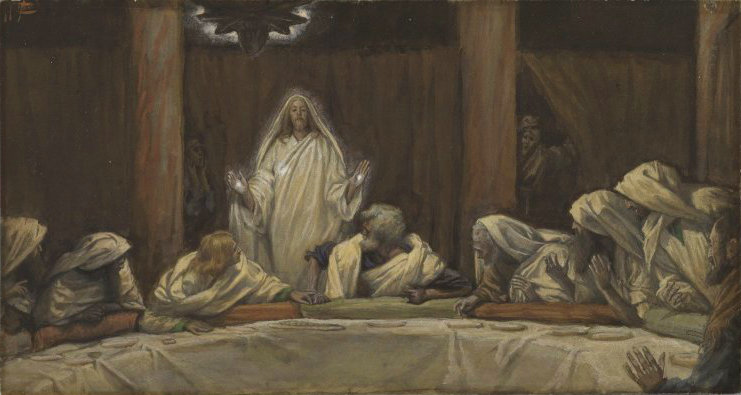
James Tissot, The Appearance of Christ at the Cenacle, 1886–1894. Public domain, via Wikimedia Commons.

the message from Mary Magdalene that Jesus was risen. They were afraid of the religious leaders. They had no idea what to do next. So, alone and afraid, they hid.

Into their fear and chaos, Jesus shows up and proclaims not once but three times, “Peace be with you.” In some ways, we could say Jesus’ proclamation of peace changes nothing. The disciples are still alone in a locked room, afraid of what will come next. Yet, in other ways Jesus’ proclamation of peace changes everything. Jesus’ greeting of peace offers reassurance to the scared disciples. It does not change the disciples’ present circumstances, but it changes the disciples. Blessed with Jesus’ peace, the peace that passes all understanding, the peace that provides calm even in a chaotic world, the disciples are empowered to go out and begin their ministry.

Peace Be With You

Jesus’ peace does not yet equate a world in harmony. We know that on this side of heaven, we will not know a world without war and violence, pain and strife. Unfortunately, this is what we do as humans. This does not mean, however, we are left in fear and despair. Instead, Jesus blesses us with the peace that passes all understanding. Jesus’ peace gives us the ability to trust in God’s presence and provision even when surrounded by fear and chaos. Jesus’ peace gives us hope, even when the world gives us so many reasons for worry and despair. Such a peace moves us to action.

As we await Jesus’ second coming and the redemption of the world, we do not simply accept the violence of the world. We are called to share Jesus’ peace with those around us. As the hymn states, let there be peace on earth and let it begin with me. We, like the early apostles, have received the gifts of Jesus’ peace and are empowered to go out and share that peace with others.

Reflective Questions:

  • How do you think Jesus’ disciples felt before Jesus arrived? How did their emotions change after Jesus arrived?
  • Jesus tells the disciples, “as the Father has sent me, I am sending you.” What are the disciples sent out to do? How are we, as Jesus’ disciples, also sent out?
  • What was a time where you felt at peace? Share what makes this memory special to you. What provided you with peace?
  • What are some ways you find peace when you are feeling anxious?

Closing Activity:

Brainstorm three ways your group can work for peace: one within your congregation, one in your community, and one in our country.

Some ideas to get you started:

  • Write cards to a group or family in need of encouragement
  • Reach out to a different faith community to learn about their ministry and build relationships of understanding
  • Volunteer with an organization working for the good of your community

Let there be peace on earth and let it begin with you!

Final Prayer:

Holy God,

We ask that you draw near to us when we are feeling anxious or afraid. Fill us with your peace and empower us to share your peace with others. Amen.

Bio

Amy Martinell serves as the Associate Pastor of Congregational Care at Gloria Dei Lutheran Church in Sioux Falls, SD. Amy shares her life with her husband, three kids, a disinterested cat, and a disobedient beagle. She loves reading, baking, and swimming.

April 15-22, 2009 – Sad news surrounds joyful Easter celebration

Contributed by Pastor Jay Gamelin
Columbus, OH

Warm-up Question: Think of a time when you got hurt (physically, emotionally, spiritually, or otherwise). What’s the most important thing you learned from that experience

In the weeks leading up to Easter this year, sad news filled nearly every newspaper and broadcast. In just over a week, there were five mass murders in the U.S. alone, from Oakland, CA, to Binghamton, NY, killing nearly 40 people. In Italy, just as that predominantly Roman Catholic country was beginning to celebrate Holy Week, a massive earthquake killed at least 260 people. Violence continues in Iraq and Afghanistan, as well as in other war-torn corners of the globe. And all over the world, people continue to struggle with a devastated economy.

All this news has surrounded what for Christians ought to be the most joyful time of the year. Figuring out how to celebrate on a tighter budget in the midst of difficult times is an ancient challenge, and one that the faithful will face again as they gather to celebrate the festival of the resurrection and the bright, seven-week season of Easter that follows.

Discussion Questions

  • Have you ever tried to celebrate something (Christmas, Easter, your birthday, family weddings, etc.) while also having to deal with sad news? How did that go?
  • What did your family do for Easter this year? Was anything different than years past?
  • How do you think the families of people who died in the shootings in the U.S. felt during the Easter celebration this year, especially if they were Christians?
  • What do you think Jesus would say to folks who were trying to celebrate Easter while also finding themselves homeless after the earthquake in Italy?

Scripture Texts (NRSV) for Sunday, April 19, 2009.

(Text links are to oremus Bible Browser. Oremus Bible Browser is not affiliated with or supported by the Evangelical Lutheran Church in America. You can find the calendar of readings for Year B at Lectionary Readings

For lectionary humor and insight, check the weekly comicAgnus Day.

Gospel Reflection

The week after Easter is a peculiar Sunday in the church. On most Sundays, the appointed readings are different each year, following a three-year cycle. But every year, on the week after Easter, we hear this story about Thomas, the disciple who asked for proof. That makes me wonder: What’s so important about this story that the church asks us to read it every year during this time?

It seems to me we could answer that question with two words: doubt and scars.

Isn’t it a bit jarring that just one week after the lilies and the brass, the egg hunts and family gatherings, the joyful shouts and songs filled with “Alleluia!,” all of a sudden we run into doubt and scars? What happened to butterflies and bunnies?

The church is trying to tell us something. From the beginning, the joyful news of the resurrection had to be spoken, heard, sung, and lived by people whose lives were not very joyful. “He is Risen!” did not put an end to the suffering and persecution, death and danger that those first Christians lived with. In fact, their claim that Jesus, whom the Empire had tried to destroy, was in fact living and reigning as the true King of Creation, made things even worse for the faithful.

In the midst of danger and suffering, it’s normal for a little doubt to creep in. Thomas asked, and for good reason, to see the same proof that Jesus handed — literally — to the other disciples. For Thomas, as for most of the citizens of Jerusalem, the resurrection had not changed anything. Well, not anything they could see anyway. Life was still hard, and death was still at hand. So before Thomas took the message of “He is risen!” very far, he needed to be sure he wouldn’t just be telling a cruel joke to people who needed some real, meaningful hope.

Legend has it, Thomas ended up taking that message very far indeed — all the way to India! So whatever Jesus showed him was good enough.

What Jesus showed him were scars. Jesus was alive, but his body still had the marks of what he had suffered. His own flesh would not let him, or us, forget about the real tragedy and death he endured. Knowing that Jesus was still a marked man helped Thomas know that God still understood the danger and the risk of living faithfully in a broken world. Those scars gave Thomas’s own scars holy meaning: doubt and danger are still abundant, but God’s love and life are more abundant still.

We, too, live this Easter faith in a dead and dying world. Thanks be to God, Jesus lives and breathes in the midst of our doubts, bearing the scars, and yet overflowing with life. Alleluia! Amen.

Discussion Questions

  • If you were Thomas, what proof would you ask for to know that the resurrection — rising death — was real?
  • What does it mean to you that Jesus still has the scars on his resurrected body? If God could raise him from the dead, why didn’t God take the scars away, too?
  • Do you have any scars (physical or otherwise)? Where does God fit into the stories about how you got your scars?
  • What difference does “He is risen!” make in your own life? If “He is risen!” actually made your life more challenging and dangerous, would you still tell it to your friends and neighbors? Would it make a difference to them?

Activity Suggestions

  • Get a laminated map of the globe and some Vis-à-vis overhead pens. Invite folks to draw or write on places on the map where the world is scarred or marked. Play some music during this time (anything from Taizé songs to an iPod mix of thoughtful or thought-provoking music like The Fray’s “You Found Me”). After they’ve had some time to write, draw, or circle places, ask them to share why they drew or wrote what they did. Then ask where they think God is in all the world’s scars.
  • Have youth draw temporary tattoos (any non-permanent marker pen will do fine) on their arm, wrist, or ankles. (Draw it on paper first. Some may choose not to draw on themselves — a valid choice that should be respected.) What mark would you draw that would describe your faith and your doubts in your life? What invisible scars do you have that you could make “visible”? Where does Jesus fit into this picture? Have them share as they are comfortable.

Closing Prayer

Jesus, you lived and died and live again, feeling in your own body how hard life can be. Help me see your love and grace in the midst of the entire world’s, and my own scars. Be patient with me, and accept my doubts even as you give me faith. Amen.