Skip to content
ELCA Blogs

Faith Lens

April 7, 2013–What’s in a Name?

Contributed by Lindean Barnett Christianson, Bozeman, MT


Warm-up Question

  • Do you have a nickname? What is it? Who gave it to you? Why? Do you like it? Why/why not?
  • If you could change your name, what would you choose? Why?

What’s in a Name?

The cardinals of the Roman Catholic Church elected Cardinal Jorge Mario Bergoglio to be the 266th pope on March 13, 2013. Thousands of pilgrims and tourists crowded the square in front of St. Peter’s Basilica at the Vatican, waiting to learn not only who was elected, but also the name he would take for himself. Since the 11th century it has been customary for a pope to choose a new name upon his election to the office (the first pope to take a new name was elected in the 6th century).

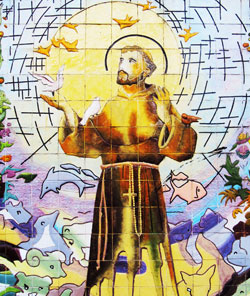
shutterstock_53792359editThe new pope, former archbishop of Buenos Aires, Argentina, was already known for his love for the poor and his own simple lifestyle. His choice of the name Francis, after St. Francis of Assisi, indicates his intention to continue his focus on and devotion to the poor.

In an interview with journalists from the Vatican and Latin America, Pope Francis said that as the votes stacked up in his favor, a fellow cardinal from Brazil told him , “Don’t forget the poor.”  The new pope added, “Right away, with regard to the poor, I thought of St. Francis of Assisi, then I thought of war. Francis loved peace and that is how the name came to me.”

The new pope said he also thought of St. Francis of Assisi’s concern for the natural environment and how he was a “poor man, a simple man, as we would like a poor church, for the poor.”

This is the first time a pope has chosen the name Francis, and many Catholics, and non-Catholics alike, are hoping Francis’ new name is an indicator of changes and reform to come.


Discussion Questions

  • What do you know about St. Francis of Assisi?  If you need to do some research, look up the story of his life.  What would a congregation heavily influenced by his vision of faith look like?  How would taking his values seriously affect your life?
  • The papal name Cardinal Borgoglio took has been seen as a reflection of his priorities as a Christian.  If you were elected pope what name would you take to reflect your understanding of what is important in being a Christian?  Why would you choose that name?  (The name need not be a famous one; you might pick “Fred” because of a custodian who embodies the gospel for you.)

Scripture Texts (NRSV) for Sunday, April 7, 2013 (Second Sunday of Easter)

Acts 5:27-32

Revelation 1:4-8

John 20:19-31

(Text links are to Oremus Bible Browser. Oremus Bible Browser is not affiliated with or supported by the Evangelical Lutheran Church in America. You can find the calendar of readings for Year C at Lectionary Readings.)

For lectionary humor and insight, check the weekly comic Agnus Day.


Gospel Reflection

The Gospel according to John doesn’t tell us where Thomas was on the evening of that first day of the week, the day of resurrection. We only know where he wasn’t: in the locked room with the rest of the disciples. Jesus shows up, wounds and breath and all, but when his colleagues give him the play-by-play Thomas simply cannot believe it. He says he needs not only to see, but also to touch, Jesus, in order to believe.

For wanting to experience what the rest of the disciples experienced, Thomas has received the nickname “Doubting Thomas” from history. John never calls him that. According to John, Thomas’s nickname is “the Twin,” though the gospel doesn’t elaborate on why.

A week later Jesus gives Thomas what he asked for and Thomas confesses his faith: “My Lord and my God!” Here, the one who doubts is also the one who believes and proclaims. Jesus, however, does not commend Thomas for this confession. Instead, he pronounces a blessing on those “who have not seen and yet have come to believe,” on us.

Discussion Questions

  • What nickname would you give Thomas? Why?
  • Who has helped you come to faith in Jesus? How have they done that?
  • What do you think about the phrase “Seeing is believing”?  How about its reverse, “Believing is seeing”?
  • Gospel-writer John steps into his story when he addresses his readers and says, “These [signs] are written so that you may come to believe that Jesus is the Messiah, the Son of God, and that through believing you may have life in his name.” What do you think of this purpose statement?

Activity Suggestions

  • Think of positive and encouraging nicknames for the people in your discussion group or others you all know (pastor, youth leader, etc.).
  • Write thank you notes to those who have shared their faith in Christ with you (confirmation or Sunday School teachers, baptismal sponsors, mentors, etc.).
  • Bless each other using Jesus’ words: Name, blessed are you who has not seen and yet has come to believe. Amen

Closing Prayer

God of new life, Jesus breathed the Holy Spirit into his disciples. Send your Spirit also to us, that we who have not seen yet may come to believe that Jesus is the Messiah, the Son of God, and that through believing we may have life in his name. Fill us with your peace, and send us into your world. Amen

April 22, 2012–It’s a Miracle!

Contributed by John Wertz, Blacksburg, VA


Warm-up Question

Can you think of something that you would describe as a miracle?

 It’s a Miracle!

On Good Friday, a Navy fighter jet lifted off from a base in Virginia Beach, Virginia.  The jet suffered a severe mechanical.  The pilots tried to return to the base, but it quickly became apparent that they were in trouble.  After a short flight, the jet crashed into an apartment complex and destroyed over 40 units.  Amazingly, no one was killed.

According to witnesses and experts, several factors combined to prevent a larger tragedy.  The pilots managed to dump fuel which helped prevent a larger fire.  They waited until the last possible moment to eject from the plane so they could try and guide the plane as long as possible.  The plane hit an empty courtyard and because the accident occurred in the middle of the day, most people were not home at the time of the crash.  After the accident, people on the ground were able to pull the pilots away from the flames to prevent them from suffering further injury.  A total of seven people were hurt, but all of them were out of the hospital within two days.

The response from leaders in the area was clear.  According to the Associate Press article “Virginia Beach Mayor Will Sessoms took to Twitter on Saturday to celebrate the fact no lives were lost, calling it a “Good Friday miracle.” Adm. John C. Harvey, commander of U.S. Fleet Forces, said he was “quite surprised, to be honest”, that no one had died, calling it an “amazing miracle.”  Gov. Bob McDonnell told The Virginian-Pilot newspaper that the lack of loss of human life was “an act of divine providence.”


Discussion Questions

  • The leaders in the area clearly viewed the fact that no one was killed as a miracle.  Do you agree?  Why or why not?
  • How would you define a miracle?

Scripture Texts (NRSV) for Sunday, April 22, 2012 (Third Sunday of Easter)

 Acts 3:12-19

1 John 3:1-7

Luke 24:36b-48

(Text links are to Oremus Bible Browser. Oremus Bible Browser is not affiliated with or supported by the Evangelical Lutheran Church in America. You can find the calendar of readings for Year C at Lectionary Readings.)

For lectionary humor and insight, check the weekly comic Agnus Day.


Gospel Reflection

Mary Magdalene, Joanna, Mary the mother of James and the other women returned and announced the good news.  The tomb was empty.  Jesus had risen from the dead.  Peter ran to see the empty tomb for himself, but he didn’t see the angels or risen Lord.  The disciples on the road to Emmaus returned and shared their encounter with Jesus, but hearing about something miraculous is not the same as experiencing it yourself.  So when Jesus appeared to the disciples, it should be no surprise that the disciples were startled and terrified—or that they initially believed that Jesus is a ghost.

The disciples are trying to make sense of this miraculous event.  Trying to understand how the horrible death they witnessed on Friday night could be overcome.  Trying to understand how God could accomplish something so miraculous.  Encountering Jesus’ ghost would be a little easier to believe, but after touching and seeing his wounds and sharing a meal with him, the disciples are convinced that Jesus has risen from the dead.  It’s a miracle!  Christ’s presence moves them from fear to acceptance, from confusion to clarity.

Miracles, by definition, are occurrences that defy a rational explanation, but for the disciples, the miracle of the Resurrection offered clarity and brought understanding.  Jesus’ resurrection makes it clear that God’s power is greater than the power of death.  Jesus’ resurrection makes it clear that God, through Jesus, is on a mission to love, bless and forgive the whole world.  Jesus’ resurrection makes it clear that as “witnesses of these things”(Lk 24:48), the disciples are called to go and share this miraculous good news with the world.

In this Easter season, we, like the disciples, hear the amazing, miraculous news of the Resurrection.  Like them, we may have moments of doubt and uncertainty.  This truly is an amazing story and although you and I may not be able to touch Jesus’ wounds or watch him eat a piece of fish in person, we can still encounter the risen Jesus today.  We encounter Jesus through the story of what God has done and is doing for God’s people.  We encounter Jesus as we experience God’s presence through the bread and wine of communion and as we are surrounded by the community of God’s people.  We encounter Jesus as we hear God’s Word through the story of the scriptures.  As we, like the disciples, encounter Jesus we can believe the miracle of the tomb empty, receive forgiveness of sin, and rejoice in the hope that thanks to the resurrection we have the promise of eternal life with God.

Discussion Questions

  •  How do you think you would have reacted if you had been in the room with the disciples?
  • What is the first question you would have asked Jesus?  How do you think he would have responded?
  • How can you be a witness to the resurrection in the world today?

Activity Suggestions

Jesus calls us to be witnesses to the good news of the resurrection.  Try one of the following activities this week or develop one that fits your particular community.

  • Create favorite scripture passage posters and place them around the church.
  • Look in the “Contact” list in your phone and text one person who doesn’t have a church home to invite them to worship or a church event
  • Write a handwritten note to someone in the congregation or community who is not able to come to worship
  • Give time to a service project as a way of sharing God’s love.

Closing Prayer

Loving God, we give you thanks for the empty tomb and the risen Jesus.  Fill us with the joy of your love, help us to know your presence in our lives, and inspire us to be your witnesses, sharing the story of the resurrection and your unbreakable love with those around us.  Amen.

February 5, 2012–Helping People in Need

Contributed by John Hougen, Melrose Park, PA

Warm-up Question

Do you believe political leaders can make a difference in the lives of people who are sick, hungry, homeless, and fearful?

Helping People in Need

As the Republican Party selects its nominee for President and President Obama makes his case for re-election, many campaign sound-bites are about “creating jobs.” We are hearing very different ideas about whether government or the private sector should take the lead. Voters must decide: who has the best ideas and experience that can be used to put people to work.

Candidates say or imply that creating jobs is the best way to help people in need. They want us to share their belief that if jobs are created people will earn salaries and have the means to feed and house their families, pay the doctors’ bills, send the kids to college, and take care of other problems.

While the debate about jobs goes on, the rising tide of human needs which will not be solved by job creation gets brief attention from the candidates, and is reported on the inside pages of newspapers, late in newscasts, and below the headlines on the internet. In the state and city where I live, the number of people relying on food banks is dramatically up and food stamp recipients have to meet new and stricter criteria to qualify. The number of people with disabilities who receive Medicaid has been cut, and the waiting list of persons with disabilities who want to be considered for Medicaid has increased by tens of thousands. Too many people are homeless or living in substandard housing. Too many people are trapped in their homes by fear of violence on the streets where they live.

We can hope and pray that new jobs will be created and contribute to helping people in need, but there are people in need who can’t wait until new jobs are created; and there are people whose needs cry out for other kinds of help: help that will not come with better employment statistics. People of faith are called to address such problems with thoughts, words, and deeds.

Discussion Questions

  • What kinds of human needs do you see in your community? To supplement what you know firsthand, search the internet for statistics to discover the scope of the problems you see. For hunger/food insecurity, you might start with elca.org/hunger, and then see what you can find out about hunger in your city, county, or state.
  • Share stories of how you or people you know respond to hunger, homelessness, and other human needs. From your examples, pick out two or three “best practices,” and talk about why these responses are effective.
  • Have you supplemented personal and congregational responses to human needs with “advocacy?” Within elca.org, search for “Advocacy.” You will be led to information that begins: “ADVOCACY is how the ELCA works to overcome the effects and root causes of hunger and poverty through administrative, legislative, and judicial actions in the public sphere, as well as through corporate actions in the private sphere.”  Discuss whether you think advocacy will contribute positively to meeting human needs.

Scripture Texts (NRSV) for Sunday, February 5, 2012 (Fifth Sunday After Epiphany)

Isaiah 40:21-31

1 Corinthians 9:16-23

Mark 1:29-39
(Text links are to Oremus Bible Browser. Oremus Bible Browser is not affiliated with or supported by the Evangelical Lutheran Church in America. You can find the calendar of readings for Year C at Lectionary Readings.)
For lectionary humor and insight, check the weekly comic Agnus Day.

Gospel Reflection

In the Gospel text assigned for last Sunday (January 29: Mark 1: 21 – 28), we heard Mark’s report of Jesus’ visit to the synagogue in Capernaum. There Jesus taught “with authority” and cast out “unclean spirits” (demons). Onlookers were amazed. Not only did Jesus come across as more authoritative than recognized authorities (the scribes), but an unclean spirit spoke through a man it possessed and said to Jesus, “I know who you are, the Holy One of God.” The onlookers believed the testimony of the spirit, for, in those days, people thought one supernatural being – such as an unclean spirit – could recognize another supernatural being – such as “the Holy One of God.” Last week’s Gospel text prepares us to see the significance of this week’s text, which immediately follows. Jesus is authoritative. Jesus is Holy and “of God.” We should pay attention.

What Jesus says and does in Mark 1: 29 – 39 provides a good model for helping people in need. He surrounds himself with trusted friends (verse 29 mentions the disciples Simon, Andrew, James, and John). Working with others is almost always more effective in meeting human needs than working alone. Next, Jesus responds to the need that is closest at hand. After Jesus enters Simon’s mother-in-law’s house, he cures her fever. We also should respond first to those in need who are close at hand. And, Mark’s narrative reveals the purpose of all healing and helping: “[Jesus] lifted her up, … and she began to serve them.” You and I and all people in need are (in God’s intentions) healed, forgiven, and helped so that we may serve others.

After Jesus heals his hostess, word spreads, and others who are sick or possessed are brought to Jesus for healing. Jesus doesn’t stop with one act of kindness; he expands his efforts to help others. However, he recognizes that he must have balance in his life, so after curing many, he suspends his helping and healing for a time. He sleeps; and “In the morning, … he went out to a deserted place and there he prayed.” He took care of himself, both physically and spiritually. Even though there were still more people to help in Capernaum, Jesus seems to be at peace with not helping everyone. Instead he moves on to other towns and synagogues beyond Capernaum, expanding his efforts to the region (both “proclaiming his message” and healing). We, too, should link proclamation and helping in our efforts. And, we could follow Jesus’ example and develop a regional (and even global) approach by cooperating with other houses of worship and participating in advocacy for more compassionate public policies.

To summarize: a good strategy for helping others is provided by Mark 1: 29 – 39:

  • Surround yourself with trusted friends.
  • Respond to needs that are close at hand.
  • Equip those you help so they may serve others.
  • Expand your efforts, helping people beyond those close at hand.
  • Practice self-care: enhancing your own physical and spiritual well-being.  
  • Be at peace with the fact that you cannot help everyone.
  • Help others both locally and regionally (even globally). 

Discussion Questions

  • Which steps in this model for helping are you confident you can do? Which steps seem most daunting?
  • The other texts assigned for Feb. 5, especially Isaiah 40: 21 – 31 and Psalm 147 praise God for acting creatively and compassionately in this world.  Do you think it is possible for people to become God’s allies in some of the divine actions mentioned in Isaiah 40 and Psalm 147? Which ones? If people are able to cooperate with God in doing praiseworthy actions, what do God and people need from each other to  make the cooperative effort successful?

Activity Suggestions

  • Create a scenario or two in which your group (trusted friends) follows the steps outlined above, selecting a specific need close at hand, figuring out how you would help meet it, and how you could move beyond it, practice self care, and so on.
  • Follow through with one of your scenarios, checking in with the group after each step to see whether you are following the strategy suggested by Mark 1: 29 – 39, or if you have wandered off the path pioneered by Jesus.

Closing Prayer

Open our eyes, Lord, so we may see human needs which are close by. Open our hearts, Lord, so we may be filled with your gift of holy compassion. Open our hands, Lord, so we may be generous, giving of ourselves as we help others. Fill our imaginations with wisdom, and energy, so we can be creative and effective allies for you. With you and others whom you inspire, enable us to serve people in need. Amen.

January 29, 2012–Hollywood and Demons

Contributed by Aaron Matson, Toronto, SD

Warm-up Question

Do you like scary movies? What’s the scariest movie you’ve seen?

Hollywood and Demons

At least since the 1973 movie, The Exorcist, Hollywood has been scaring audiences (and selling lots of tickets) with images of the devil, demons, and demon possession. The last few years have seen movies like The Exorcism of Emily Rose and The Devil Inside have continued the formula. It seems like demons have been added to the list of go-to villains in horror movies, along with Jason, Freddie, and Michael Myers.

So why is the idea of demons so scary? Well, the idea of evil, supernatural entities lurking about ready to do us harm is pretty alarming, I suppose. But maybe our fear also has to do with our lack of understanding about them, and about evil itself. We Christians have set teachings, beliefs, or dogmas about lots of things—baptism, communion, even the Triune God—but we don’t really have any set beliefs about demons or the devil. We have the witness of some biblical stories, and some legends and stories passed down from ancient and medieval Christians, and that is about it.

What we Christians are called to do though, is renounce them. Right before we baptize, and affirm our baptism in confirmation, we confess our faith in God with the Apostles’ Creed and we renounce the devil and all his forces, the powers of this world that defy God, and the ways of sin that draw us from God.


Discussion Questions

  •  Have you seen any movies that used demons or the devil as a villain? What did you think of how they were portrayed?
  • What have you heard about the devil or demons? What do people think the look like and act like?
  • Why do you think it is important for us Christians to renounce the devil and all the forces that defy God as we celebrate baptism? Do you think this should be a part of worship more often? Why?


Scripture Texts (NRSV) for Sunday, January 12, 2012 (Fourth Sunday after Epiphany)

Deuteronomy 18:15-20

1 Corinthians 8:1-13

Mark 1:21-28

(Text links are to Oremus Bible Browser. Oremus Bible Browser is not affiliated with or supported by the Evangelical Lutheran Church in America. You can find the calendar of readings for Year C at Lectionary Readings.)

For lectionary humor and insight, check the weekly comic Agnus Day.


Gospel Reflection

In the gospel reading, the people are astounded by the authority of Jesus’ teaching. They are even more astounded by the authority Jesus’ has over the unclean spirit. He commands the spirit to shut up and go away—and the spirit obeys.

But before Jesus casts out the unclean spirit, it recognizes Jesus for who he is – the holy one of God. Others may not know who exactly this Jesus is, but in the Gospel of Mark, all the spirits know exactly who Jesus is and the power he has. The question the spirit asks, “What have you to to do with us?” might be better translated, “What is all this to you and me?” In other words, the unclean spirit spirit is saying “You have special power. You can see I’m pretty powerful, too. Who are you going to side with – powerful beings, or with these lowly humans? Have you come to destroy us?”

Jesus sides with us lowly humans, and shows the power he has over unclean spirits. In the ancient world, unclean spirits were thought to be the cause of disease, mental illness, and all sorts of tragedy and misfortune. They were a part of the chaos and disorder that afflicted humanity, like the waves of a stormy sea tossing around a small boat. As we see later in Mark, Jesus has the power to calm the chaos of stormy seas. As Martin Luther writes, Jesus has freed us from sin, death, and the power of the devil. That Jesus has come to free us from these powers of evil, chaos, and destruction is good news indeed. Can you imagine the joy and relief—and the wonder—of the people who first saw Jesus’ power over unclean spirits?


Discussion Questions

  •  Have you ever had to confront evil? What gave you strength in that time? If you have not faced evil yet, what in our Christian faith can give you strength to face it?
  • What chaos or stormy seas are causing you pain or stress in life? What calm can Jesus bring to them?


Activity Suggestions

  • Go into the sanctuary and gather around the baptismal font. Review the renunciation of evil and confession of faith in the order of Baptism. End with everyone making the sign of the cross on their foreheads.
  • Search newspapers, or Internet news sites. Where do you see evil? What do you think the Christian witness of Jesus and people of faith can bring to these situations?


Closing Prayer

Holy God, our protector and defender, we ask that you be with us, and all those who face evil powers, chaos, and destruction in life. In times of fear and doubt, strengthen and increase our faith, that we may know you are with us always, and trust, that as powerful as evil may seem, you are stronger yet. Amen.

January 15, 2012–Revelations

Contributed by Scott Mims, Virginia, Beach, VA


Warm-up Question

  • What is your favorite holiday or season in the church (liturgical) year?  What about this season or event is most special to you?
  • We are just starting the season of Epiphany. Epiphany means “revelation,” or “to make someone/something known.”  Going back to your answers from above, what are some of the things that are revealed or made known about God in your favorite celebrations?

Revelations

When Kim Jong Il, then Supreme Leader of North Korea, died unexpectedly on December 17, 2011, his death not only made headlines but raised anxiety on the part of many across the globe. Fearful of problems associated with a power struggle in the North, or even of the nation’s collapse, forces in South Korea were placed on high alert, while other nations sought to reach out through diplomatic channels.

Adding to the uncertainty was the revelation that Kim Jong Il’s youngest son, Kim Jong Un, was his chosen successor.  Little is known outside North Korea of Kim Jong Un who, in his late 20’s, has been hailed by officials and the state media in North Korea with titles such as, “Great Successor, Supreme Leader and Great Leader.”  Most recently, he was officially recognized as the Supreme Commander of North Korea’s armed forces.  While North Korea has called for its people to rally behind Kim Jong Un and to protect him as “human shields,” many around the world continue to deal with the uncertainty of what his age and inexperience may mean for international relations in the years to come.

Discussion Questions

  •  As we begin a new year, how optimistic are you about the way things are going in the world?  How optimistic are you about the future? (You might have your group rate their response on a scale of 1 (very worried/pessimistic) to 10 (very optimistic). )
  • If you are optimistic, what gives you the greatest hope?  If you are not optimistic, what are some of your greatest worries?
  • How much difference do events that happen in other parts of the world make in your own life?  Do you believe that you can make a difference in the world?
  • Note some of the titles given to Kim Jong Un (Great Successor, Supreme Leader, Great Leader, Supreme Commander), what do these say about who or what people hope he will be?

Scripture Texts (NRSV) for Sunday, January 15, 2012 (Second Sunday after Epiphany)

1 Samuel 3:1-10 [11-20]

1 Corinthians 6:12-20

John 1:43-51

(Text links are to Oremus Bible Browser. Oremus Bible Browser is not affiliated with or supported by the Evangelical Lutheran Church in America. You can find the calendar of readings for Year C at Lectionary Readings.)

For lectionary humor and insight, check the weekly comic Agnus Day.


Gospel Reflection

The way in which we read or hear something can make all of the difference.  One way to read these verses is simply as John’s account of how Jesus called his first disciples.  Yet, as a writer, John is a master at drawing in his audience through double meanings and a “deeper”, more personal sense of the story.  Such is the case in this passage as Jesus addresses not just around him, but us as well, with an invitation to life.

In any case, the first three words of this passage, “The next day,” clue us in to the fact that we need to go back a bit to understand what’s going on. As it turns out, this is actually the third “next day” section in the opening chapter of John’s gospel.  In the first section, verses 29 – 34, “the next day” after John the Baptist explains his role to those sent from Jerusalem, he bears witness to Jesus as both the Lamb of God and Son of God.  The “next day” after this                 (verses 35 – 43), his further testimony about Jesus leads two of his own disciples to follow after Jesus.  Jesus, seeing them, asks, “What are you looking for?” When they stammer out, “Rabbi, where are you staying,” Jesus invites them to “Come and see.”  His invitation initiates an ever-widening circle of discipleship as one of the two, Andrew, goes to his own brother, Simon Peter, with the news, “We have found the Messiah.”

So it is that we come to the “next day” of this week’s gospel. Deciding to go to Galilee, Jesus first calls Philip.  Philip, in turn, invites Nathanael saying, “We have found him about whom Moses in the law and also the prophets wrote, Jesus son of Joseph from Nazareth.”  Here, “the law and the prophets” means the whole of the Scriptures for these Jewish believers.  Brushing aside Nathanael’s remark about the insignificance of Nazareth, Philip offers once again the invitation, “Come and see.”  Nathanael does, and his own encounter with Jesus, and Jesus’ ability to “know” and “see” him from afar, not only leads Nathanael to believe in Jesus, it also draws forth a confession of faith: “Rabbi, you are the Son of God! You are the King of Israel!”  Jesus assures him that greater things are yet to come. ‘Very truly, I tell you, you will see heaven opened and the angels of God ascending and descending upon the Son of Man.’

So, as the first chapter of his gospel ends, John leaves us with Jesus heading towards Galilee with a growing group of followers.  Yet, there is a deeper way to hear this passage.  Jesus’ very first words in John’s gospel, “What are you looking for?” are a question to us, as well.  When it comes to life…when it comes to faith, what are we looking for?  Deep down in our bones, what is it that we really need?  In these three “next days,” we hear Jesus being called many things.  John the Baptist calls him “the Lamb of God who takes away the world’s sin” and “Son of God.”  Andrew calls him, “Rabbi” and “Messiah.”  Philip says Jesus is the one, “about whom Moses in the law and also the prophets wrote.”  Nathanael adds that Jesus is, “the King of Israel.”  Is Jesus what we are looking for?  Is he the one that we really need?  The invitation that John offers to us through the rest of his gospel account, and indeed through our own experience of living as followers of Jesus, is simply to “Come and see.”

Discussion Questions

  • Why do you think this particular gospel reading was chosen for today?  In what ways is Jesus being revealed and by whom?
  • When it comes to the titles and names given to Jesus in John 1:29-51, (Lamb of God, Messiah, Son of God, Rabbi, King of Israel, Son of Man) which one is most important or most meaningful to you?  Why?
  • If you had been Philip and Jesus had just walked up to you and said, “Follow me,” would you have gone?  If so, why?  If not, then what further information would you have needed?  What else would you have wanted to know before making such a commitment?  Do you think we have this information now?
  • What does it look like to you to follow Jesus?  Is following Jesus different from believing in him?  Why or why not?
  • Nathanael came to Jesus because Philip invited him to “come and see.”  What do you think would be the best way to invite a friend of yours to “come and see” Jesus today?  What are some approaches that might not work so well with your friends or in your setting?

Activity Suggestions

  • As an opening activity, you might try a Trust Walk experience.  One variation is to have a single leader and the rest of the group blind folded; another variation is to break the group up into partners who take turns being the guide/ blind folded.  Groups with a single leader might have everyone place their hands on the shoulders of the person in front of them, or hold on with one hand to a large rope that connects the whole group.  The goal for the leader(s) is to guide those who follow safely along a route.  The goal for those who are blind folded is to experience what it is like to trust others as they follow.  Debrief:  What was the experience like for you?  Is it easy or difficult for you to trust someone else to guide you?  How is having “faith” like a “Trust Walk?”
  • Going Deeper: For further discussion on the sheer grace of being called to follow Jesus, watch Rob Bell’s short video, Dust (Nooma series).  Though not specifically about this passage, he presents a great take on what being called to “Follow me,” by a rabbi meant in Jesus’ day, and how Jesus’ invitation to Andrew, Peter, James, John, Philip, Nathanael and the rest would have been most unusual.  Talk together about what it means that Jesus calls us to be his followers.  What does it mean to you that Jesus believes in you?  Does this change the way you see yourself as a disciple?
  • Reaching Out: As a group, explore ways to invite your friends to “come and see” Jesus.  How would you go about it?  Would you hold an event of some sort?  Would you invite them to a service project? A retreat?  A play or music festival?  A coffeehouse?  A specially designed worship service?  What activities are you already doing that are, or could be, great places for friends to experience God’s love and grace? How might you use social media or other modern means to invite folks?  What “barriers” might need to be overcome? Brainstorm the possibilities – can you make a plan to try one or more of these possibilities out during this season of Epiphany?

Closing Prayer

Gracious and loving God, we live in uncertain and anxious times, and yet we also have much that gives us hope.  As your Spirit continues to reveal Jesus to us, so help us to respond to his invitation to “Come and see,” that, led and sustained by Jesus’ presence among us, we may live as vibrant and faithful witnesses to your love; through Jesus Christ, our Lord.  Amen!