
Skip to content
ELCA Blogs

Faith Lens

April 5, 2026 – The Interruption of Easter

Prepare

The gloom and despair of Matthew 26-27 hangs over the beginning of chapter 28. Those who had followed Jesus, who had been welcomed by his grace, had lost everything. All of their hopes had been cruelly nailed to the cross with violent and stunning finality. Many of those close to him, fearing for their own lives and darkened by unspeakable despair, hid in a room. Three women who had followed him, however, forced themselves to bring honor to Jesus one last time, heading out early in the morning to anoint his broken, scarred, dead body for burial.

Jesus had interrupted their lives with the call to follow him. It was an interruption that took them places they never dared dream possible.

But now, his execution put paid to all of that.

Until…

Opening Exercise:

When you hear the word, “Easter,” what memories/feelings/images/stories does it conjure up for you?

Text Read Aloud:

Matthew 28:1-10

A Bike Crash and the Empty Tomb

On March 11, 2019, I was finishing up a 20-mile bike ride. I’d been riding the bike paths of Glendale, Peoria, and Phoenix, AZ for over 13 years. To that point I had cycled over 40,000 miles! Starting out the day with an early morning ride was one of the best parts of my day. In fact, it still is!

But that day, about two miles from my house, riding around a corner I had ridden dozens of times, my front tire slipped on some loose gravel and I fell. Hard. My right shoulder and head did battle against the cement path. Thanks to my helmet, my head won. My shoulder, however, lost. Badly.

I wasn’t in pain, but the first thing I noticed, after getting up off of the ground, was that my right shoulder was several inches higher than it should be.

I had blown up all of the ligaments that held my shoulder together. Two weeks later I was in surgery.

That split second interrupted my life for several months. Being right-handed and now in a harness, it interrupted my eating. My teeth brushing. My sleep­­; I slept in an easy chair for 12 months! My ability to type/text. My bathing habits. My ability to show up and lead worship. My ability to drive and hug my grandkids.

Interruptions are a part of life. Moments that can reset the paths of our lives. Some of those interruptions impact us positively: falling in love; graduating high school; starting a job; gaining new friends; moving to a new city. Others can set us back and negatively impact our lives: cancer; the loss of a loved one; divorce; an injury.

Sometimes those interruptions break us.

Easter’s Interruption

Matthew’s Gospel recounts an interruption that not only changed the trajectory of two women’s lives, but one that continues to reverberate to this day; an interruption that changes everything.
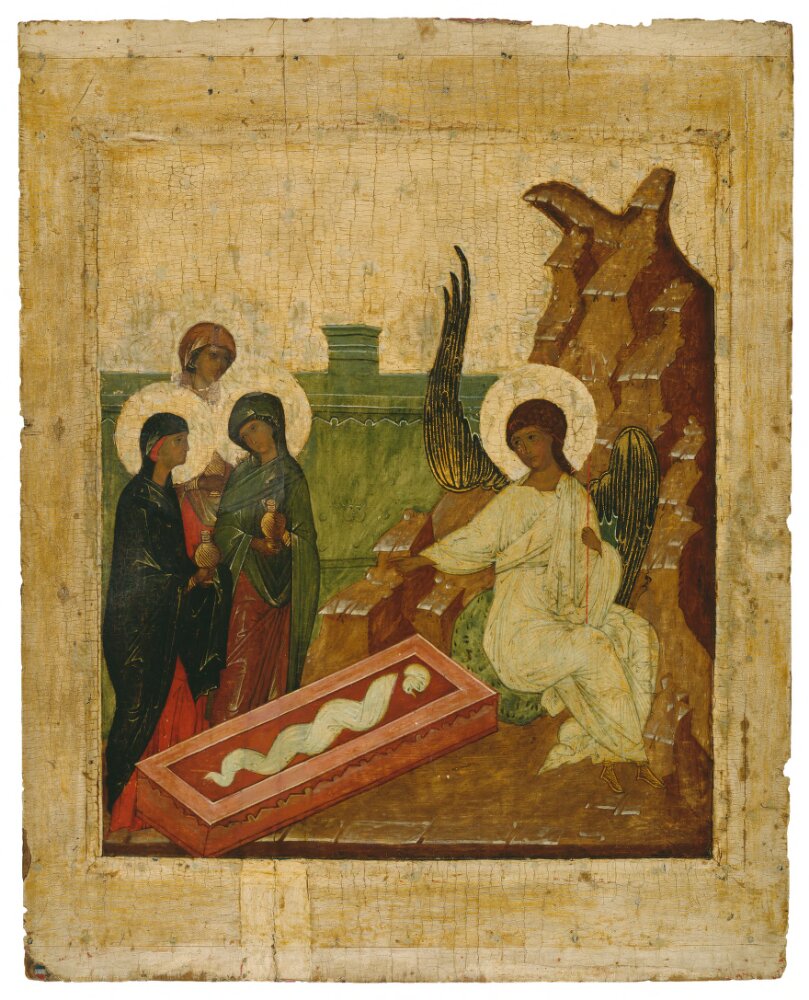
The Women at the Tomb, Novgorod School icon, 15th century. Public domain image via Wikimedia Commons.

2000 years ago God interrupted human history when God’s grace exploded out of a tomb in Jerusalem, interrupting:

  • Death with life
  • Sin with forgiveness
  • Despair with hope
  • Anxiety with peace
  • Grief with the presence of God

For three years, Jesus made his way throughout Israel interrupting people with the call to follow him; to live as loved and forgiven people; to live as loving and forgiving people. It was a call that changed the trajectory of the lives of all who followed him.

Easter’s Interruption

That mission of interrupting people’s lives with God’s grace, however, was seemingly interrupted itself—and finished—when Jesus was crucified.

But God’s grace interrupted that interruption by raising Jesus from the dead. In the process, God interrupted all those interruptions that rob us of life.

Easter, the interruption of God’s grace, changes the orientation of our lives. It roots our lives in God’s love for us. It holds us steady through all the ups and downs and all the interruptions thrown at us in this life.

And that grace, that unconditional love that God has for you and for me, is the one thing in life we can always count on. It’s the one thing that no interruption can ever interrupt.

Today, Jesus, the crucified and risen Savior comes to interrupt your life with grace. He says to you:

  • You are mine
  • You’re my child
  • I love you

No matter what life throws your way, I will always be there for you. I will always have your back.

So follow me as I interrupt your life with my grace!

Reflection Questions:

  • How do you think the women felt when the Angel of the Lord interrupted their visit to the tomb?
  • Think back to one or two positive and negative interruptions in your life. How did they affect you?
  • Why or how does Jesus’ resurrection change everything?
  • How has the call of Jesus interrupted your life?

Closing Activity:

As a group, or as individuals, think about one practical way that you might interrupt the life or lives of someone with a tangible expression of God’s love for them.

Final Blessing:

Choose someone to pray this blessing over the group:

I pray that, according to the riches of his glory, he may grant that you may be strengthened in your inner being with power through his Spirit and that Christ may dwell in your hearts through faith, as you are being rooted and grounded in love. I pray that you may have the power to comprehend, with all the saints, what is the breadth and length and height and depth and to know the love of Christ that surpasses knowledge, so that you may be filled with all the fullness of God. (Ephesians 3:16-19, NRSVue)

Bio

Tim Wright served as an ELCA pastor for 41 years. He and his wife, Jan, have been married since 1979. They have two adult children, five grandchildren, and two dachshunds. They live in Glendale, AZ. You can access Tim’s Reckless Grace Substack at https://recklessgrace.substack.com/ and his Deep-Grace Diving Podcast at https://open.spotify.com/show/4WPRRpqMtUzyPeqcqbqrgv

He is also the author of the middle school series: The Adventures of Toby Baxter. https://www.timwrightbooks.com/

December 15-21, 2010–What’s a Gift?

Contributed by Paul Baglyos, St. Paul, MN

Warm-up Question

When is a gift not really a gift?

What’s a Gift?

Recently, a woman addressed the following question and comments to an advice column: “How can I get my significant other to be fair to my kids at Christmas? He always makes sure his kid gets really nice stuff and then he will get something really expensive for himself. But my kids and me? For example, last year he got his 10-year-old daughter an iPod Touch that cost $300, but my kids got $50 gift certificates. Then he bought something for his guitar that costs over $400, and I got nothing. This really bothers me.”

Implicit in the woman’s question and comments is the popular sense that the value of a gift is determined by its monetary cost and that gift-giving should exemplify fairness and equity.  In that regard, gifts and gift-giving lose all character of grace and instead become  matters of obligation.

Discussion Questions

  • Imagine the larger story behind the woman’s question and comments.  What do you suppose the man might say in response to the woman?  What do you suppose his daughter and her kids might say to each other, or about each other, after they have opened their gifts at Christmas?
  • Is the man being selfish and cheap?  Is the woman being too demanding?
  • The response to the woman published in the advice column included this opinion: “We don’t think this guy sounds like significant other material.”  Do you agree with that opinion?  Why, or why not?

Scripture Texts (NRSV) for Sunday, December 19, 2010 (Fourth Sunday of Advent)

Isaiah 7:10-16

Romans 1:1-7

Matthew 1:18-25

(Text links are to Oremus Bible Browser. Oremus Bible Browser is not affiliated with or supported by the Evangelical Lutheran Church in America. You can find the calendar of readings for Year C at Lectionary Readings.)

For lectionary humor and insight, check the weekly comic Agnus Day.

Gospel Reflection

Quite a lot was expected of Joseph.  He was told to assume responsibility for his pregnant wife-to-be, and for the unborn child conceived in her womb, even though the child was not his own.  Joseph’s plan “to dismiss [Mary] quietly” was reasonable and fair; after all, her pregnancy might be regarded as a breach of pre-marital trust between them, releasing him from all further obligations.  The angel’s instruction to Joseph, however, required him to surrender all reasonable claims to fairness and to act with a generosity that exceeded obligation.

God, too, acts with a generosity that exceeds obligation.  God’s Christmas gift to the world, the gift of Jesus the Messiah, demonstrates sheer grace on the part of God.  The gift is neither owed nor deserved; it cannot be demanded and it cannot be priced.  God’s generosity is described in this well-known verse from the Gospel according to John: “For God so loved the world that he gave his only Son, so that everyone who believes in him may not perish but may have eternal life” (John 3:16).

Discussion Questions

  • What is the difference between grace and obligation?
  • Think about a time you received a gift you did not deserve–or felt coerced into giving a gift by the demands or expectations of others?    How does the contrast between grace and obligation change the character of “gift”?
  • Why does it seem easier to understand obligation than to understand grace?
  • How do Christians understand life in relation to God’s grace?  How do Christians demonstrate grace in relation to others?
  • In what ways might the church become more fully a community a grace in the world?

Activity Suggestions

  • Imagine that you are Joseph; write a brief letter to an advice column about your situation in relation to Mary and the unborn child she carries.  Now imagine you are an advice columnist responding to Joseph; write a brief reply to his letter.
  • Think of a gift that your church group might give in celebration of Christmas.  What is the gift, and to whom will you give it?  Make plans to do so.

Closing Prayer

O come, O come, Emmanuel.  Be with us, God, in all our days and all our ways, that we might be with you now and forever.  Amen

.

November 19-26, 2008 – Nebraska “Safe Haven” law leads to teen abandonments

Warm-up Question: What circumstances do you think might lead a parent of a teenager to abandon or give up that child?


A Nebraska law meant to allow parents to legally abandon newborns at hospitals has instead led parents to drop off over a dozen teenagers since its passage in July. To date, 20 of the 33 children dropped off at Nebraska hospitals have been teens, including a now-missing 17 year old girl who fled after being dropped off with her younger brother. Eight more children dropped off were 11 or 12 years of age.


Lawmakers are set to convene this week to rewrite the law, excluding all children except infants up to 3 days old from being legally abandoned. Since lawmakers announced plans to rewrite the law, the rate of teen drop-offs has increased as desperate parents sense their time running out.

Safe haven laws exist in every state to prevent prosecution of parents who abandon newborns outside safe public places like hospitals, but Nebraska is the only state without an age limit. Lawmakers could not agree on an age limit when writing the law, so it was passed with just the word “child.”

One mother of an 18 year old stated that she thought her daughter would receive help if she turned her over to the state. The daughter had a mental health condition and had been cutting school, stealing, fighting, and sleeping around. Because of her age, however, the teen had to return home with her mother.

“These are largely families at a point of incredible desperation,” said Wayne Sensor, chief executive of Alegent Health hospitals, where 14 children have been left. “They aren’t bad parents or bad kids. They simply don’t know what services are available out there.”

Discussion Questions

  • Do you think parents should be able to give their kids to the state if they can’t handle them (or think they can’t)? What arguments for and against this can you think of. What types of behaviors do you think might warrant government intervention in a young person’s life?
  • What kind of help might a high school age youth get from a government agency that they can’t get from their parents?
  • What would be your advice to a parent whose child is in serious trouble? What would you suggest they do?
  • Do you think God keeps track of what we do, our motivations, our good deeds, or our sins?

Scripture Texts (NRSV) for Sunday, November 23, 2008.
(Text links are to oremus Bible Browser. Oremus Bible Browser is not affiliated with or supported by the Evangelical Lutheran Church in America. You can find the calendar of readings for Year A at Lectionary Readings.)

For lectionary humor and insight, check the weekly comic Agnus Day.

Gospel Reflection

When I read this passage the first time, I didn’t understand it. After all, Jesus seemed to be saying that we had to minister to the poor and needy (“the least of these”) in order to get into heaven. This seemed to conflict with other scriptures stating that the only thing necessary to have eternal life was to accept Jesus and believed in him. It was “faith verses works,” if you’ve heard that talked about before. God’s grace saves us through our faith, not through anything we do. We can’t work our way into heaven.

Feeling confused, I looked up a commentary on these verses to get an “expert” opinion. What I read gave me an entirely different perspective on these verses.

I assumed, and probably had heard preached before, that the “least of these” that Jesus talked about only referred to the poor. But the commentary said that when Jesus says “the least of these,” he was talking about the treatment of his disciples and all the messengers of his good news in the world. In other words, how people treat the messengers of the good news and how they receive the gospel determines how God will judge them.

Our salvation is definitely a free gift — not something we have to work for or accomplish. A gift does need to be accepted or received though. If we accept that gift, we experience the blessings of God’s kingdom — a kingdom that begins here on earth, right now.

The gospel certainly calls for us to care for people living in poverty or hunger, people being treated unjustly, and others in need. The Bible talks about how necessary service and ministry are to have at the center of our lives, and that it is a responsibility of the church and all people; it’s just not our ticket to heaven. Jesus has done that already, and there’s nothing else we need to do other than accept his gift of love and forgiveness… and start living it in relationship with other people right now.

Discussion Questions

  • Have you ever done a good deed thinking it would win you favor or points with God? What was it you did?
  • When someone tries to talk to you about Jesus and the gift of salvation, how do you respond or feel?
  • How do you feel about talking to other people about Jesus and the gift of salvation? What do think is important to say, and to demonstrate with your actions and behavior?

Activity Suggestions

Find someone in your church who is a “messenger of the gospel.” This could be your pastor, choir director, youth leader, a Sunday school teacher, young person, old person, or a layperson involved in mission work, for example.

Choose one of the following:

  • Interview your chosen person about his or her experiences with sharing the gospel of Jesus. How has she or he been received and treated? What makes that ministry most difficult? What are the joys involved? As a group, write an article about this person. Publish your article online, in the church newsletter, or in a worship bulletin.
  • Ask what your group can do to support the ministry of your chosen person. Perhaps you can help with preparations for a Sunday school class or for youth group time, put together care packages with a mission worker, or prepare a skit or song to reinforce a pastor’s Sunday morning message.

Closing Prayer

O Lord our God, we pray that you would strengthen all your messengers across the world who share the gospel of Jesus with others. We thank you for their service to you and we pray that they would be treated well and provided for. In Jesus’ name we pray. Amen.


Contributed by Jennifer Krausz
Bethlehem, PA