
Note from the Editor:
This week on Faith Lens, we’re revisiting a post from the archive. Originally published several years ago, the article still speaks with quiet strength and hope today. As Advent draws to a close, this reflection offers a grounding reminder at just the right moment: Emmanuel, God is with us. In a season that invites us to name our fears and watch for God’s nearness, this piece remains a faithful word for young people and leaders alike.
One more note: in partnership with ELCA Children’s Ministry and ELCA Youth Ministry, the ELCA Youth Gathering is launching a new quarterly newsletter, Faith Foundations, created especially for volunteer and paid youth ministry leaders. Each issue will include practical resources, ministry insights, and tools you can use right away in your context. Sign up now and get the first issue sent right to your inbox next spring.
Warm-up Question
How many times per week, would you estimate, that you make a choice of what to do or what not to do based on fear?
What Makes You Afraid?
 Fear can be a highly powerful motivator. We can be afraid of consequences (from parents, teachers, coaches, school administrators) or we can be afraid of what happened last time we did that (a small child touching a hot stove). Some of us have phobias – fear of the dark, of spiders, of snakes (to name a few). Did you know that there is even a name for the fear of Santa Claus? Not surprisingly, it’s Clausophobia.
Sometimes fear motivates us in ways we’d rather not talk about. Other times we avoid doing something we’d otherwise do for fear of what our peers might think or say. Or we avoid trying something new for fear of failure.
For some people, these fears can be crippling. PTSD (Post-traumatic stress disorder) and some phobias keep people from acting because of the strong painful memories and fears often associated with past experiences. Researchers in the United Kingdom and in Japan are working on techniques that might allow people to “re-wire” their brains and overcome those fear-filled memories.
Even if our fears are not extremely strong and limiting, fear affects all of us to some degree and can keep us from engaging in life to the fullness that’s intended for us.
Discussion Questions
- What kinds of fears do you have? What are you afraid of? Can you isolate why? Was there a specific experience that made you afraid?
- What are things you wish you could do but are afraid to try?
Read Text Aloud
For lectionary humor and insight, check the weekly comic Agnus Day.
Gospel Reflection
Joseph was afraid. He was afraid to take Mary as his wife, because she was having a baby that wasn’t his. He was afraid of what it would mean for him; he was afraid of what others might think. But he also was afraid to publicly accuse her of infidelity, so he wanted to send her away quietly. But the angel knew what was going on and told him not to be afraid.
Not only did the angel command Joseph not to be afraid but he told Joseph to name the child something that could combat fear. Emmanuel means “God is with us.” God is with us. We are not alone. Perhaps knowing this and trusting this can help to combat the fears that are inside all of us.
Discussion Questions
- When do you need a reminder that God is with you?
- Who do you know who might need a reminder that God is with them?
Activity Suggestions
Make an Emmanuel rock. This can be as simple as taking a small stone and painting a cross (or other symbol) on it. Carry the Emmanuel rock in your pocket. It can remind you that Emmanuel – God is with you. Make tw0 Emmanuel rocks – keep one for yourself and give one away.
Closing Prayer
Good and gracious God, come into our world as Emmanuel. Come into our world and banish fear. Come into our world and banish darkness. Amen.
Written by Seth Moland-Kovash and originally posted on December 18, 2016.


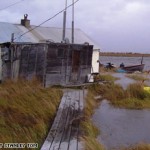 A warming climate is having adverse effects on the Eskimo village of Shishmaref, Alaska. As the ice melts gradually earlier in the spring and forms later in the fall, the coast is beginning to erode—and the houses built along it are in danger of falling into the sea. One house has succumbed to the erosion already and thirteen more have been moved inland to protect them from meeting the same fate. Only one house remains—that of Shelton and Clara Koreok, only feet from the edge. Shelton refuses to move, no matter what the danger, because he fears that moving would mean losing everything he knows.