
Skip to content
ELCA Blogs

Faith Lens

Febrauary 1, 2026 – Blessed by Presence, Not Circumstance

Prepare

This week, the Revised Common Lectionary gives us four meaty texts. They relate to one another, but it is also important to think about them individually.

Micah 6:8 might be the best-known verse of the whole book, but it is important to read it within its literary context. Chapter 6 reads like a court transcript. God has dragged the people of Israel (ancient, not the modern-day state) to court. Creation acts as judge and jury. God starts to list all the ways that God has saved and delivered. The people then ask “How shall we say thank you? With sacrifices? Huge sacrifices? Over the top sacrifices?” And a voice responds, God has told you: “to do justice and to love kindness and to walk humbly with your God” (Micah 6:8, NRSVue).

Psalm 15 echoes the high standards of living that God yearns to see from God’s people in Micah 6. Notice the focus on how people interact with others—their friends, their neighbors, the innocent.

The assigned passage from First Corinthians this week starts with the same verse that last week’s passage ended with. The cross is foolish; it does not make sense when selfish power-hungry human logic is applied. Through Christ, God provides to God’s people wisdom, righteousness, sanctification, and redemption.

Like the other texts assigned for today, Matthew 5:1-12 shows us God’s character—one who saves, delivers, and defies human logic. The Beatitudes (as they are usually called) are not meant to encourage Christ’s followers to seek out/cause suffering for ourselves in order to get closer to God, but to see where and with whom God promises to be and invite us to come alongside them as well.

Opening Exercise

Text Read Aloud

Micah 6:1-8
Matthew 5:1-12

Blessed by Presence, Not Circumstance

If you search #blessed on social media, you will most likely see a seemingly never-ending stream of personal achievements (especially of the athletic variety), the acquisition of material possessions, and the enjoyment of exotic vacation spots.
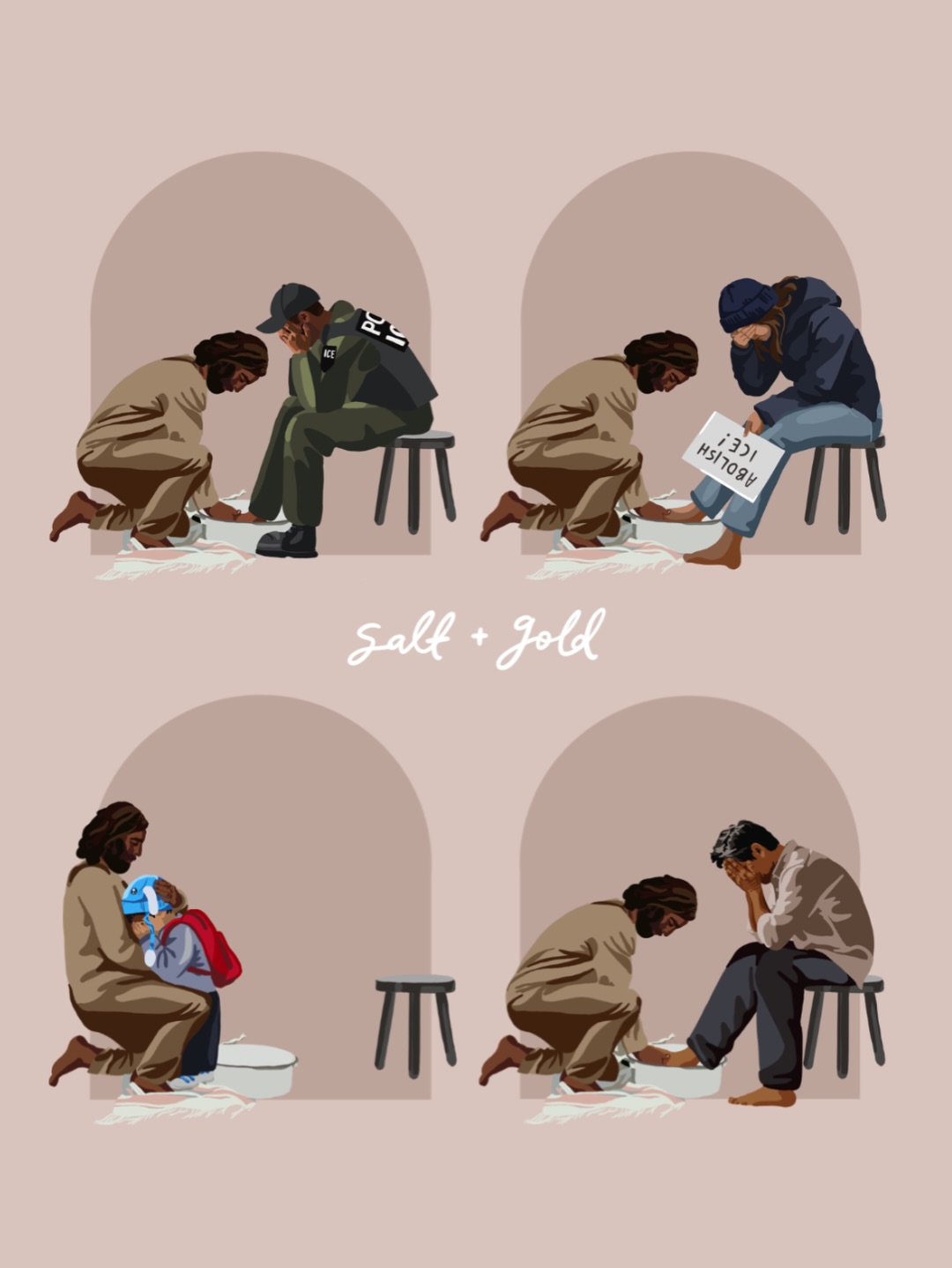
artwork by Salt & Gold Collection

It seems like today’s popular definition of “blessed” is almost the exact opposite of what Jesus had in mind at the Mount of the Beatitudes. A state of blessedness is not something that is earned or even something to be aspired to. It is a statement of promise—God promises to be with all God’s people no matter how bad things get.

Our God is about turning the world upside down—which is why Jesus speaks what seems like foolishness when he calls those in so many terrible situations “blessed.” The poor in spirit, those who mourn, the meek, those who hunger and thirst for righteousness, the merciful, the pure in heart, the peacemakers, and those who are persecuted are not blessed BY their situations. Rather, they are called blessed because God remains with them amid their less-than-ideal situations, promising that things will ultimately be different. This presence and solidarity with those whom society would otherwise cast off is the heart of the good news—no one is out of God’s purview. All are invited into the abundant life of God’s kin-dom.

Too often, though, we lose sight of God’s plan for creation and make up our own. We lose sight of the communal for the individual, turning inward and gazing at our navels. It is this manifestation of sin that leads to the list of Solemn Reproaches that we confess as a community on Good Friday in the style of Micah 6.

Yet, as we confess our complacency with injustice and the ways we work against God’s plan and God’s people, let us also hear the good news that God continues God’s saving action despite us. We do not have to do anything or be good enough to receive “righteousness and redemption and sanctification” from our Lord. Instead, when we are given God’s free gift of grace, we are transformed to “do justice, and to love kindness, and to walk humbly with your God.” When our egos and selfishness are kept in check, we get to experience God’s kin-dom and true plan for creation—where there is more than enough to go around and abundant life for all.

Reflection Questions

  • According to Micah 6:1-8 and Matthew 5:1-12, what do the actions of God tell us about the character of God?
  • According to Micah 6:1-8 and Psalm 15, how does God want God’s people to live?
  • Why do you think that Jesus mentioned the groups/kinds of people that he did in the Beatitudes?
  • If Jesus were preaching the Sermon on the Mount today, what groups/kinds of people would he name in the Beatitudes today?
  • How have you or could you actively work to bless the groups/kinds of people that Jesus included in the biblical Beatitudes or that are on the modern-day list y’all came up with?

Closing Activity

  • Work individually or in small groups to design a visual representation of Micah 6:8 or the Beatitudes—think t-shirt, temporary tattoo, mural, or banner for your worship space. Give each person/group a chance to share about their design as they desire.

Final Blessing—by Sr. Ruth Marlene Fox, OSB

May God bless you with a restless discomfort
about easy answers, half-truths and superficial relationships,
so that you may seek truth boldly and love deep within your heart.

May God bless you with holy anger
at injustice, oppression, and exploitation of people,
so that you may tirelessly work for justice, freedom,
and peace among all people.

May God bless you with the gift of tears to shed with those who suffer
from pain, rejection, starvation, or the loss of all that they cherish,
so that you may reach out your hand to comfort them and transform their pain into joy.

May God bless you with enough foolishness to believe that
you really CAN make a difference in this world,
so that you are able, with God’s grace,
to do what others claim cannot be done.

And the blessing of God the Supreme Majesty and our Creator,
Jesus Christ the Incarnate Word who is our brother and Saviour,
and the Holy Spirit, our Advocate and Guide, be with you
and remain with you, this day and forevermore. Amen.*

Bio of Author

Leslie Weber is a pastor, spouse, mother, daughter, sister, friend, and ally. She serves at Grace Lutheran Church (Chesapeake, VA) and Holy Communion Lutheran Church (Portsmouth, VA). She was born in California, but has lived most of her life on the East Coast, where she has lived in three of the four U.S. Commonwealths (MA, PA, and VA).

*“May God bless you with a restless discomfort…” A four-fold Benedictine blessing by Sr. Ruth Marlene Fox, OSB, 1985, as reprinted on WorldPrayers.org

February 2, 2014–Blessed to Bless

Contributed by David Delaney, Salem, VA


Warm-up Question

Has anyone in your group ever spent time in a very poor area, either as part ofshutterstock_109184036edit your own living experience, or on a mission or immersion trip to a developing country, or heard stories from those who have been to such places?

  • What are some of the words that come to mind when you imagine or recall the lives of those who live day-to-day, hand-to-mouth, or under threat of disease, war, or oppression?  “Miserable,” “unfortunate,” “desperate,” “bitter,” “victim,” and “hopeless” are all words that might come to the minds of many.  Some people might include words that reflect stereotypes of the poor as mostly responsible for their own condition or dismiss poverty with a resigned shrug – “that’s the way the world is.”
  • What would you do if you lost everything?  What would happen if your family disappeared, you had no income and no place to live, and you were left to blame for it all?  That might sound like an extreme scenario, but try to imagine it.  What words would you use to describe yourself then?

Whatever you might say, it is hard to imagine using the word “blessed” to describe someone else or yourself in a situation of poverty or any other kind of severe stress; that must be kept in mind as we reflect on Matthew 5.

Blessed to Bless

Many people use the term “blessed” to refer to some extra experience they have had for which they want to express some gratitude, even if they are not Christian or religious at all.  In mid-January, Sandra Bullock described herself as feeling “overwhelmingly blessed” after receiving an Oscar nomination for her movie Gravity.  Also in mid-January, the manager of the Liverpool soccer team praised one of his players, Daniel Sturridge, as being “genetically blessed” because of his remarkable ability to recover from injuries much faster than normal.

Discussion Questions

  • Are these  good uses of the word “blessed”?  When you read Matthew 5, does it sound like Jesus is describing exceptional situations for exceptional people or the ongoing lives of everyday people?
  • Are there ways for us to start seeing the constant experiences of our daily lives as blessings?

Scripture Texts (NRSV) for Sunday, February 2, 2014 (Fourth Sunday after Epiphany)

 Micah 6:1-8

1 Corinthians 1:18-31

Matthew 5:1-12

(Text links are to Oremus Bible Browser. Oremus Bible Browser is not affiliated with or supported by the Evangelical Lutheran Church in America. You can find the calendar of readings for Year C at Lectionary Readings.)

For lectionary humor and insight, check the weekly comic Agnus Day.


Gospel Reflection

The setting for the many things that Jesus taught throughout the gospels varies greatly, but the physical size of the land where he conducted his ministry was very small – less than the size of the state of Vermont.  Most places could be reached by walking in less than a day, and even a trip from Capernaum to Jerusalem could be done in a little more than three days of brisk walking.  Because there was a lot of travel done for business, government, and military purposes, people could easily see the great difference between the wealthier areas of the country and the poorer ones.  They were often very close together.  Jesus’ hometown of Nazareth was one of the poorest agricultural areas of the county, yet a brief walk to the top of the hill just south of his town would allow someone to see into the Jezreel Valley, one of the agriculturally richest areas of the country.

The traditional site of The Sermon on the Mount (Matthew chapters 5-7), from which this passage comes, is less than a day’s walk from Nazareth and is once again a very rich area.  So when Jesus talks about being blessed, people from all different walks of life and economic circumstances might have been listening to him.  Regardless of all of those differences, we read these verses knowing that everything – even life itself – is a gift from God.  How do you hear that from the standpoint of your own particular setting in life?

Discussion Questions

  • In verse one, Jesus goes up on a mountain to teach and invite his followers to a new kind of “law” for life.   Who does this remind us of from the Old Testament (answer = Moses)?  Do you think Matthew wants us to think of Jesus as replacing Moses or building on what the Israelite law said?  (Look at Matthew chapters 22-23 to see examples of Jesus responding to questions about Israel’s law).
  • If you list all of the various situations listed by Jesus in this set of verses, which ones sound like they are the result of something that has happened to someone (answers: poor in spirit, mourning, meek, experiencing persecution, being lied about), and which sound like qualities that someone might want to adopt or nurture (answers: righteousness, mercy, purity of heart, peacemaking)?  Do they all have something in common?  (Possibly, all are situations in which the presence of God is needed and one might not recognize the need for God’s presence without them, which is why they are a source of blessing).  What do we learn about following Jesus from this?  Is the blessed life an active and willful life, or passive and receptive, or both?
  • These verses in Matthew are traditionally referred to as the “Beatitudes” (pronounced be-AT-i-tudes), from the Latin word “beo” which means to bless or make happy.  There is a story about a child in Sunday School who had never seen or heard the word before and pronounced it “BEAT-i-tudes” and immediately added how much sense that made because these are RULES that BEAT you.  It is easy to see how these sentences that are intended to be comforting could be turned around to become a checklist of things you have to do in order to earn blessings.  How can we avoid thinking about them like that?
  • How do we imagine that these blessings become real in the lives of people who experience the hardships Jesus describes?  Is it simply a direct line from God to the individual?  Or does the community have a role?  Do we who have experienced these things before or who are already equipped with the good news of the gospel and the means to relieve suffering serve on God’s behalf in bringing blessing to others?

Activity Suggestion

  • On a sheet of paper that you will fold up and carry with you this week as a reminder, list the names of actual people you know to whom you can relate in a new way according to this list of promises from Jesus.   Is there someone in your life for whom you only have contempt or conflict?  How can you be “poor in spirit” in your conversations with them?  Do you know someone who is consumed by a lifestyle of destructive behavior or shallow thrill?  Can your “hunger and thirst for righteousness” provide a suggestion of another way to live?  Is there someone in your life who needs mercy and forgiveness from you or others?  Can you show mercy and forgiveness to that person, knowing that it may not be received or returned?   Are you afraid of the consequences of representing the love of God in Christ Jesus to others in word and/or deed?  Recall that the promise of verses 11 and 12 are not just that you have a heavenly consolation for your courage and trouble, but that there may be others nearby who have desperately needed to hear and see the witness of someone who believes that God’s grace can really make a difference.   Who in your life could benefit from that witness? Let this list of people be your personal prayer list for the week and also your reminder that God’s promises for following Christ as described here in Matthew 5 are true!

Closing Prayer

Lord Jesus, giver of every blessing, we rejoice that the wisdom and promises you first shared with your disciples have come down to us and still remain true today.  Help us to come to you as your followers did in those days and to welcome your word with gladness, even as it calls us to repentance and service.   We lift before you for your blessings all those whose spirits call out for relief and righteousness, all who mourn the loss of loved ones, who feel disenfranchised and isolated, and whose fondest desire is that they could feel strong enough to show mercy and forgiveness in the face of persecution and hatred.  Give us along with all your people joy and gladness for the reward that is ours in your kingdom.