
Prepare
Samuel thinks he knows what a king should look like: strong, tall, impressive. Yet, God challenges him on this notion, declaring, “The Lord does not see as mortals see; they look on the outward appearance, but the Lord looks on the heart.” This same theme of seeing beyond appearances in John 9 emerges when Jesus heals a man born blind and invites everyone present to reconsider what true sight really means.
What should be a moment of joy becomes a debate. The disciples assume someone must have sinned. The neighbors doubt what they see. The religious leaders question the miracle itself. Everyone believes they understand the situation; however, Jesus suggests they may be the ones who cannot see.
Blindness in this Gospel is not just physical. It is spiritual; certainty that closes off curiosity, and assumption that prevents compassion.
Lent invites us to examine our own vision. Where might we be confident in what we see — yet missing something deeper? What assumptions do we hold that shape how we view others? What would it mean to let Christ reshape the way we see?
Opening Exercise
Tell of a time you formed a quick opinion about someone but later realized you were wrong.
- What changed your perspective?
- Why do we tend to make snap judgments?
- In what ways are people judged by appearance today? (Clothing, social media, background, politics, ability, reputation.)
- Transition to the text: In today’s Gospel, many people think they see clearly — but Jesus reveals something deeper.
Text Read Aloud
Remembering Rev. Jesse Jackson: Seeing the Whole Story
When news spread of the death of Rev. Jesse L. Jackson, Sr., people across the country began sharing memories. Political leaders, clergy, activists, and community members reflected on his decades of advocacy and his call to “keep hope alive.” Many lifted up his work for voting rights, economic justice, and human dignity. Others remembered moments of controversy or disagreement. As often happens when a public figure dies, stories surfaced: some celebratory, some critical, many complicated.
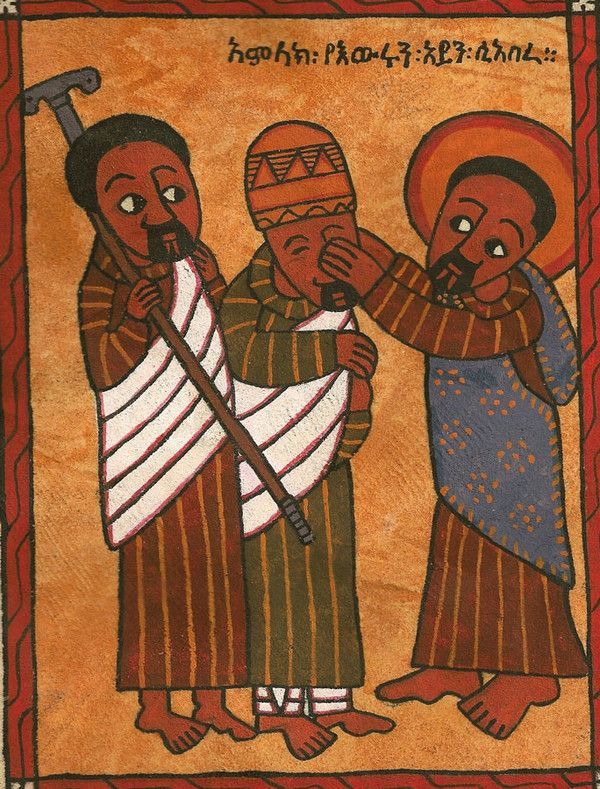
Ethiopian Icon
Public leaders rarely remain just people. Over time, they become symbols. Headlines reduce long lives into a few defining moments. Social media compresses decades into a sentence or a meme. It becomes easy to see only one angle of a life.
But every human story is more than a headline.
Rev. Jackson was shaped by the Black church and the civil rights movement. He preached before he organized. He marched before he ran for office. His faith fueled his public life. Like any leader who speaks boldly about justice, he experienced both admiration and criticism. His life, like all lives, held courage and imperfection, conviction and growth.
Moments of remembrance invite us to pause and ask: What do we choose to see when we look at someone’s life? Do we focus only on the moment that confirms what we already believe? Do we allow space for complexity? Or do we prefer a simpler version?
–
In John 9, a man’s healing should have been simple good news. Instead, it becomes interrogation. People question the man, his parents, and even Jesus. Everyone seems certain about what they are seeing. Yet, they miss the deeper truth unfolding before them.
The irony is sharp. The man who once could not see begins to recognize who Jesus is. Those who claim spiritual clarity refuse to see at all.
Blindness in this story is not about eyesight. It is about assumption. It is about protecting our version of the story rather than remaining open to transformation.
When we remember leaders like Rev. Jackson, we are invited into that same self-examination. It is easy to reduce a life to a headline or a meme. It is harder to hold a whole story with humility.
In 1 Samuel, we are reminded that “the Lord does not see as mortals see.” God looks deeper — into motives, into wounds, into growth, into the long arc of a life.
To live as “children of light,” as Ephesians says, is not simply to shine. It is to see clearly. It is to allow Christ to challenge our assumptions and widen our vision.
The miracle in John 9 is not only that a man gains sight. The greater invitation is that we might, too.
Reflection Questions
- Who do you identify with most in this story and why?
- In John 9 who do you think is blind?
- What shapes how you see public figures or leaders? How do media and culture influence your view?
- Where do you see spiritual blindness today?
- What might it look like to see others the way God sees them?
- Where in your life are you asking Christ for clearer vision?
Closing Activity: If God Made the Meme
In the article, we noticed how lives can be reduced to headlines — even memes. Memes are quick and shareable, but they simplify something complex into one image and one caption. Sometimes we do the same thing with people.
For this activity, imagine God creating a meme about you.
- Not your friends.
- Not social media.
- Not your worst day.
God.
If God were the author — looking at your whole story — what would the caption say?
Remember: God looks at the heart (1 Samuel 16). God sees the full story, not just a single moment. God sees courage forming, kindness growing, gifts emerging.
Create a simple meme on paper or your phone. Draw a quick image or write a caption.
Examples:
- “Still growing. Still loved.”
- “Braver than you think.”
- “Work in progress. Masterpiece in motion.”
- “Light shining, even on hard days.”
- “Beloved. No filter needed.”
Afterward, invite volunteers to share if they are comfortable. Ask:
- Was it hard or easy to imagine God speaking kindly about you?
- How is God’s view different from the world’s quick judgments?
Prayer
God of light,
You see what we cannot. When we reduce ourselves or others to simple labels, YOU see the whole story. Open our eyes. Clear our vision. Help us see others – and ourselves – through your mercy and truth. Teach us to live as children of your light. Through Jesus, the Light of the world.
Amen.
Bio
Rev. Michael Jannett serves as pastor of Community of Grace Lutheran Church in Grayson, Georgia. He brings 25 years of experience in youth ministry and faith formation.