Skip to content
ELCA Blogs

Faith Lens

December 14, 2014–Telling Painful Truth

Bob Chell, Sioux Falls, SD

Warm-up Questions

  • Has a friend ever told you something you knew was true that left you feeling hurt, angry, or sad?
  • Have you ever told a friend something that left them feeling hurt, angry or sad?
  • Was it told to hurt or help? How do you know? Did the friendship weaken or end, get stronger or stay much the same? Why or why not?

Telling Painful Truth

The decision of a grand jury not to indict Darren Wilson for the shooting death of Michael Brown has sparked controversy far from Ferguson, MO.  Some see this as yet one more example of a crimminal justice system which is apathetic at best–and hostile at worst–to the black community.  Others suggest that the whole controversy has been prompted by a rush to judgement before all the fact were known.  Officer Brown was simply doing his job, they suggest.

double-thumbs-edit

As the story has spun out it has become clear that it is hard to know the truth with absolute certainty, that “facts” are not nearly as easy to come by as some might think.  It is not always easy to know, much less tell, the truth when the history is complex and the present is clouded.


Discussion Questions

  • Find someone who disagrees with you about the ‘truth’ of what happened in Ferguson and argue the opposite side of what you believe with them. Discuss how you felt. Did your opinion change at all?
  • What truths should you share with a friend? Some examples:  You have something on your face…  People are talking about you… Did you know that your Mom/Dad/brother/sister…   Why or why not should you tell?
  • How you decide when to tell a painful truth?

Third Sunday of Advent

Isaiah 61:1-4, 8-11

1 Thessalonians 5:16-24

John 1:6-8, 19-28

(Text links are to Oremus Bible Browser. Oremus Bible Browser is not affiliated with or supported by the Evangelical Lutheran Church in America. You can find the calendar of readings for Year C at Lectionary Readings.)

For lectionary humor and insight, check the weekly comic Agnus Day.


Gospel Reflection


People didn’t come out to hear John the Baptist because they liked what he had to say. He talked almost exclusively about repentance and sin. He referred to his congregation as a ‘brood of vipers.’ He dressed like Elijah, an Old Testament prophet and when he attracted crowds he attracted the attention of the religious leaders who questioned his credentials. The people followed him and the religions leaders were suspicious of him for the same reason; he told the truth, John touched peoples need for repentance and forgiveness in a way which allowed people to change.

We know there are things wrong in the world. What happened in Ferguson, Missouri is an example of that. We know, too, there are things wrong in our own lives. Difficult truths we don’t want to face and truths we are unaware of.  The people in Bible times are more like us than unlike us. They loved their families, they wanted to be happy, they wanted to please God and do the right thing—and they, too, weren’t always certain what that was.

Undoubtedly, some were simply curious to see what the fuss was about while the person next to them was full of questions of cosmic dimensions: Why is there something rather than nothing? What should I do with my life?  People full of doubt, regrets, confusion and more came to hear John for the same reason we gather each week around God’s word and God’s promises. We yearn to hear the word that will cut through the clutter and anxiety and pain of our lives and enable us to make sense of things.

There are times in each of our lives when we can see with utter clarity what is important and what we value. When loved ones die or when relationships crash and burn, our hearts tell us what we really value, what is of real value.

The philosopher Heidegger speaks of those moments when we see deeply into the essence of life as “enabling us to understand our being unto death.”  That is a philosophical way of saying we know who we are and what is important. We can see the true value of things. We realize that new phone isn’t as important as family or  when someone we love dies, the things that don’t matter—and realize they never did.

I told you that so I could tell you this: Heidegger says this insight into the essence of life cannot be grasped but only revealed.  It means we cannot figure things out, that there will always be pain and problems in our world and in our lives; difficult truths to face.

We sometimes live with the illusion that if we can only make it until the end of  the semester, it will get better, it will be different. Or, if we only had another chance,  we would do things differently.  There is a part of us that believes if we are given enough time and enough chances we’ll get it right.

John the Baptist says “STOP!”  Turn away from your obsession with yourself. God’s word is breaking into your lives, the living Word of the living God. Telling you you are forgiven. You are loved. You are gifted, valued and treasured.

The next few weeks are weeks of chaos. We have a family tradition at Christmas, perhaps you do too. It’s the family explosion when there are too many people in too small a space for too long a time. Somebody finally gives vent to the tension everyone feels.

If that happens in your home remember John who says, we’ll never get it right, there are no perfect people or perfect presents. There IS a living, loving God who breaks into our lives with words of hope and promise. A promise to be with us as we face our difficult and painful truths.

Discussion Questions

  • Is there a ‘truth teller’ in your family? When is this useful? When is this useless?
  • When is the truth helpful, when is it hurtful?
  • Have you had an experience where you felt the ‘essence of life’ was revealed? Is it a story you like to share or to keep to yourself? Why?

Activity Suggestions

  • Thank a truth teller in your life who told you a hard or difficult truth because they cared about you?
  • Google “how to tell a difficult truth.”  Are there any useful suggestions? Is there a difficult truth you need to tell?

Closing Prayer

God, thank you for breaking into our world in Christ and breaking into our lives with your Spirit of knowledge and truth. Help us to listen to your word, even when it’s a hard word for us to hear. Give us kind and loving hearts so we speak the truth in ways that encourage and help others. In Jesus name, Amen.

December 7, 2014–Invictus

David Dodson, Fort Walton Beach, FL

Warm-up Question

What sort of vestments (special clothing) are worn by people leading your worship services?  Do you feel that these vestments change or enhance your worship and fellowship?

Invictus

A casual glance at the cover of the October issue of Airmen magazine, the official magazine of the United States Air Force, might have left readers stunned.  In the cover photo, a 28-year-old woman with dark hair pulled loosely back holds a large barbell loaded with weights high above her head.  The woman, retired Captain Sarah Evans, looks incredibly strong and athletic.  There is just one surprise: she only has one leg.

shutterstock_125563616edit

During a deployment to Afghanistan, Capt. Evans was diagnosed with stage three bone cancer in her left hip.  Doctors worked quickly to save her life, but were forced to amputate Capt. Evans’ leg below her pelvis.  Some of us, if we had this happen to us, might feel the need to slow down and be limited by this change.  Not so with Capt. Evans.  On the contrary, Evans has become a champion of the Wounded Warrior project, has continued to work for the Air Education Training Command, and has even climbed Mt. Kilimanjaro in Africa!

What brought Capt. Evans to the cover of Airmen magazine, though, was her determination to compete in the Invictus Games, held in Great Britain.  “Invictus” means “unconquered” – an appropriate name for a set of Olympic-like Games in which the wounded warriors of fourteen nations vie against one another in imposing events.  This year was the first for the Invictus Games, which were conceived by Prince Harry of Wales after he saw the inter-service Warrior Games during a visit to Colorado.  Pressure was high for the USA Team at the Invictus Games.  After all, they were not only representing their country, but also the spirit of determination that drove them to keep themselves strong and mighty, even in the face of adversity.  In the end, their victory was so much more than simply winning at an event.  Each competitor showed the triumph of spirit and fortitude over fear and resignation.

And Capt. Evans?  She took home the Gold medal in cycling and the Bronze in the shot-put and the discus.  Sounds like she earned the title of “Invictus”!

For more information on Captain Sarah Evans, visit http://goo.gl/n9QbhO.


Discussion Questions

  • If you could ask one question of a competitor at the Invictus Games, what would you ask?
  • Who is someone that you admire?  What would someone notice about that person right away?

Second Sunday of Advent

Isaiah 40:1-11

2 Peter 3:8-15a

Mark 1:1-8

(Text links are to Oremus Bible Browser. Oremus Bible Browser is not affiliated with or supported by the Evangelical Lutheran Church in America. You can find the calendar of readings for Year C at Lectionary Readings.)

For lectionary humor and insight, check the weekly comic Agnus Day.


Gospel Reflection

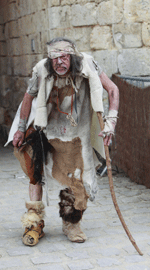
Anyone meeting John the Baptist for the first time would surely know something about him was different.  First of all, this cousin of Jesus dressed far differently from others, wearing “clothing made of camel’s hair, with a leather belt around his waist.”  He also subsisted on strange food: locusts and wild honey.  What a sight he must have been!

It was John, though, who was called to be “a voice calling in the wilderness”, meant to proclaim the coming of Jesus to the people of God.  John was sent to a complacent world to announce something new and incredible to a people desperately in need.  It’s no wonder that he wanted to get people’s attention for that!

John was a “holy man” in the true sense of the world.  “Holy” means “set apart for a purpose”.  John wasn’t worried about fitting in.  John accepted that his faith called him to be set apart for a purpose.  There were certainly those who thought that John was crazy, or at least that he was a bit weird.  In the end, though, it was John’s refusal to conform to his society that helped him preach a powerful witness to God’s people.

Discussion Questions

  • When is it important to conform to what people expect of you?
  • How can you be a powerful witness to your faith by being different from others?
  • Many churches have very different traditions of pastoral vestments and even acceptable dress by members of the congregation.  Why might some people believe that special clothing and vestments are helpful or necessary?  Why might others disagree?

Activity Suggestion

One part of the pastoral vestments in the ELCA is the stole worn behind the pastor’s neck.  This item is a sign and symbol of the ordination of the pastor, and it is laden with imagery and significance.  As a gift to your congregation’s pastor, craft a stole or fabric or paper to decorate and present.  Select a theme for the stole, such as virtues and gifts or Gospel stories.

Be aware that your pastor may or may not elect to wear the stole during a service; stoles are traditionally colored to match the liturgical season.  Regardless, however, your pastor will greatly appreciate the thought and care taken to craft this important symbol!


Closing Prayer

Heavenly Father, you call each of us to a life of holiness.  You give us the strength and the conviction to accept this call, and for this we are always thankful.  We praise you for giving us new life and new purpose with every new morning.  Bless us to be your holy hands to a world longing for your touch.  In Jesus’ name we pray, Amen.

November 30, 2014–Preparing With Hope

Lindean Barnett Christianson, Bozeman, MT

Warm-up Questions

  • What does “Advent” mean to you?
  • What are your favorite preparations for Christmas? Why?

Preparing With Hope

Many American big box stores have had Christmas decorations up and holiday merchandise available since Halloween. It almost seems like “getting ready for Christmas” is more important than Christmas itself. Many have noted that all the spending and preparations are easily divorced from celebrations of the birth of Jesus (that’s why “Jesus is the Reason for the Season” becomes such a popular phrase for some).

shutterstock_192182435edit

In an effort to resist consumerism and to create more meaningful holidays, some families follow guidelines for choosing Christmas presents, if they choose to buy presents at all. In the family of Glennon Melton, blogger author of Carry On, Warrior, each child chooses “One gift you want, one gift the world needs, one gift to wear and one gift to read.”  BloggerChristella Morris asks family and friends not to buy presents for her children, but to give them gifts only of time and love instead

Discussion Questions

  • What do you think of pre-Thanksgiving Christmas decorations? Is there such a thing as “too early”?
  • How do you feel about the approaches to Christmas gift-giving described? Why?
  • Which do you prefer – giving Christmas presents or receiving Christmas presents?

First Sunday of Advent

Isaiah 64:1-9

1 Corinthians 1:3-9

Mark 13:24-37

(Text links are to Oremus Bible Browser. Oremus Bible Browser is not affiliated with or supported by the Evangelical Lutheran Church in America. You can find the calendar of readings for Year C at Lectionary Readings.)

For lectionary humor and insight, check the weekly comic Agnus Day.


Gospel Reflection

It’s the Sunday after Thanksgiving, the first Sunday in Advent, and here we are reading about the end – not the end of the season, but the end of the world as we know it.

The thirteenth chapter of Mark is sometimes called his “little apocalypse” – the revealing, or uncovering, of what has until now been hidden, recorded to affirm that God keeps God’s promises and to encourage the earliest Christians. Jesus’ disciples ask him how they’ll know it’s the beginning of the end, and Jesus’ answer includes all kinds of unrest and natural phenomena.

Jesus concludes his answer with the statement that only the Father knows the exact hour when the Son will come in glory. That frees Jesus’ disciples, then and now, from having to worry and fret over signs and passing seasons. Instead, we are freed to get about the work the master has left for us to do. “Keeping awake” means living every day with God’s promises in mind.   “Keeping awake” means trusting that the Son of Man really will come in power and glory, bringing an end to suffering and death. The message is not one of fear but of hope.

Discussion Questions

  • What does it mean to you to “keep awake?” Is it possible to live not fully “awake” to what’s happening around us? Why is it hard to “keep awake?”
  • How often do you think about the Son of Man coming with “great power and glory?” How could you use the days of Advent to prepare for Jesus’ coming again?
  • What do you understand is the “work” the master has left for you to do? For the church to do?
  • How do typical American preparations for Christmas (shopping, gift-giving, decorating, etc.) help/get in the way of “keeping awake”?

Activity Suggestions

  • Finding alternative ways to celebrate Advent and Christmas is becoming more widespread. Check out the Advent Conspiracy website (www.adventconspiracy.org) together and discuss what you find.
  • In Mark 13:27, Jesus says the “elect from the four winds, from the ends of the earth to the ends of heaven” will be gathered by the angels. The whole people of God is a whole lot bigger than our individual congregations.  Learn about some Advent/Christmas customs from a culture different from your own – perhaps from the traditions of a Companion Synod. (Find your Synod’s Companion Synod here:http://download.elca.org/ELCA%20Resource%20Repository/CSR_By_Synod.pdf )
  • As the first Sunday of Advent, November 30th marks the beginning of a new liturgical/lectionary year. In 2013-2014 the Gospel readings in the Revised Common Lectionary were mostly from Matthew. This year, they will be from Mark. Mark is the shortest of the Gospels, and lends itself to being read aloud. Find a time to read the whole Gospel in one sitting, perhaps assigning “parts,” or taking turns reading. For extra preparation, read the introduction to Mark’s Gospel in a study Bible.

Closing Prayer

Come, Lord Jesus. By your Spirit, keep us awake. Make us aware of your presence with and among us, and prepare us for your coming with great power and glory. Amen

November 23, 2014–How Can We Help?

Pastor Seth Moland-Kovash, Palatine, IL

Warm-up Question

What is it that motivates you to help other people?

How Can We Help?

There are people in need all around us. Some of the need is very obvious and draws our attention. Some of the ways to help draw our attention and become fun – think of the ALS Ice Bucket Challenge from this past summer or the fun that you have together doing things like Walk-a-Thons and Bake Sales. Helping can be fun and we can sometimes see the benefits of our efforts right away. We can see the people gather food they need from a food pantry; we can be thanked by those who receive our care.

shutterstock_185922296edit

But often, helping is a little bit more hidden. A recent article in the Huffington Post illustrates that sometimes that’s because the need is hidden. In this column, a Chicago school-teacher writes about the chronic but largely hidden problem of homeless high school students. Helping in this situation is more difficult. It’s hard to know what to do and how to make an impact. Even if you can help, you might not see the obvious results right in front of you. It’s hard to know whom to help when people are unwilling (for understandable reasons) to let you know they need help.


Discussion Questions

  • How do you make decisions about whom to help in a given situation? How do you make decisions about how to help?
  • Have you ever been unwilling to ask for help even if you really needed it? Why? What can you do differently to let people help you?

Christ the King Sunday

Ezekiel 34:11-16, 20-24

Ephesians 1:15-23

Matthew 25:31-46

(Text links are to Oremus Bible Browser. Oremus Bible Browser is not affiliated with or supported by the Evangelical Lutheran Church in America. You can find the calendar of readings for Year C at Lectionary Readings.)

For lectionary humor and insight, check the weekly comic Agnus Day.


Gospel Reflection

Jesus tells a parable about how people will be judged based on whether or not they helped. He says that people will be judged based on giving food to the hungry, giving something to drink to the thirsty, welcoming strangers, giving clothing to the naked, caring for the sick, and visiting those in prison. Both people who did the right things and those who did not are surprised because they never saw Jesus. This is the memorable line: “Just as you did it [or did not do it] to one of the least of these who are members of my family, you did it [or did not do it] to me.”

Jesus tells us that how we treat other people is how we treat Jesus. Jesus tells us that all of us (and everyone) are members of his family and deserve to be fed, cared for, and loved. I think all of us want to do that. We have good intentions. Sometimes it’s a problem of recognition, just like it was for the folks in Jesus’ story. I don’t think we’re waiting to see Jesus before we help someone. But I do think sometimes we wait until we see a need we recognize or a need that is obvious.

Discussion Questions

  • How does it feel to know that everyone in the world is part of Jesus’ family with you?
  • Do you think you are also “one of the least of these” that Jesus was talking about? Why or why not?
  • How can you learn more about what people need so that you can help?

Activity Suggestions

As the author of the article on homeless high school students suggests, ask at your school what you can do to help fellow students whose need may be hidden. Organize that help through your church or other group.

Closing Prayer

Good and gracious God, empower us to open our eyes and to see the needs of your children so that we may help. Help us to make our needs known so that others may help. Amen.

November16, 2014–Marketing and Stuff

Brian Hiortdahl, Overland Park, KS

Warm-up Question

What responsibility scares you?

Marketing and Stuff

Rikk Wilde became an instant internet sensation for the awkwardness of his presentation of a Chevy truck to the 2014 World Series Most Valuable Player, Madison Bumgarner.  He noted the prize vehicle’s “technology and stuff,” a phrase that Chevrolet has since embraced as part of a new marketing campaign:

shutterstock_11902987edit

http://www.businessinsider.in/Chevy-Had-The-Perfect-Response-To-The-Awkward-World-Series-Trophy-Presentation/articleshow/44996438.cms

A member of the congregation I now serve, who knows Mr. Wilde and his boss, told me that the marketing value of this presentation has been tracked at roughly ten times what was expected for this moment in the national spotlight.  A gaffe became a goldmine.


Discussion Questions

  • What is your most embarrassing moment?  Did something positive come from it?
  • Do you agree with the author’s assessment of how Chevrolet handled this situation?
  • Circus legend P.T. Barnum is credited with saying, “There is no such thing as bad publicity.”  Is that true?  Why or why not?

Lectionary 33

Zephaniah 1:7, 12-18

1 Thessalonians 5:1-11

Matthew 25:14-30

(Text links are to Oremus Bible Browser. Oremus Bible Browser is not affiliated with or supported by the Evangelical Lutheran Church in America. You can find the calendar of readings for Year C at Lectionary Readings.)

For lectionary humor and insight, check the weekly comic Agnus Day.


Gospel Reflection

Jesus tells his disciples a surprising parable of exaggerated proportion:  a master leaves town and entrusts three servants with “a few things”:  a ton of money!  (A talent was more than fifteen years worth of an average worker’s earnings.)  The first two servants trade with the money and return double the original amount.  The third servant digs a hole and buries it in the ground, in accordance with rabbinical wisdom:

This activity shows him prudent and trustworthy. In commenting on the Mishnah, “If he guarded it [money] in the manner of guardians [and it was lost] he is not liable,” the Gemara quotes Rabbi Samuel: “Money can only be guarded [by placing it] in the earth.” In the ancient world, underground was the only safe place… (B.B. Scott, Hear Then the Parable, p. 227)

The surprise is that the master, upon his return, banishes the cautious, “trustworthy” servant with fury. Why?

A possible explanation lies in what does not happen in the parable.  No one loses money in this story’s economic marketplace, a clue that maybe Jesus is not talking about money at all.  If God is the master and we are the servants, as Matthew’s pattern of presenting Jesus’ parables suggests, then we have been entrusted with treasure that no one can afford.  Could that treasure be the miracle of being alive?  Could that treasure be the Jesus, who is the kingdom of heaven in human form…who was buried in the earth too?  (Compare Matthew 13:44!)  Could that treasure be, as Martin Luther wrote, “the most holy gospel of the glory and grace of God”? (Thesis 62)

God’s grace cannot be squandered or wastefully invested.  The only way to lose it is to bury it in fear.  If we trade with grace, exchanging love and blessing, it will only grow.  If we hide it and hoard it, we don’t really know God the way we claim we do.  The kingdom of God is like publicity:  it’s all good, even when it doesn’t seem like it.  Use it or lose it.  (Just ask Chevy!)

Discussion Questions

  • What riches (or “talents”), literally or figuratively, have been entrusted to you?  What do you do with them?
  • Do you agree with what seems to be Matthew’s inference that God can be like a harsh master?  Why or why not?  If not God, who does the master in the story represent?

Activity Suggestions

Invite members of the stewardship committee and the council at your church to share a Bible study on this parable with your group.  What does it have to say to your congregation as a whole about taking chances?

Closing Prayer

Thank you, God, for entrusting so much to us.  Help us to overcome fear and share your blessings boldly with the world, and lead us all to the joy of our master, Jesus Christ our Treasure and Lord.  Amen