
Prepare
In Ezekiel 36The prophet Ezekiel stands in a valley filled with dry bones. Not just bones—very dry bones. The scene feels final. Hopeless. Beyond repair. Then God asks a startling question: “Mortal, can these bones live?”
In John 11, Lazarus has been in the tomb for four days. The community has accepted the ending. Grief has settled in. When Jesus arrives, he does not immediately fix the situation. First, he weeps. Then he calls Lazarus out of the tomb.
Both stories begin with what seems irreversible. Death. Loss. Finality. But God’s Spirit moves where life seems impossible.
Romans 8 reminds us that the Spirit who raised Jesus from the dead is still at work. Resurrection is not only something we wait for someday. It is something God is doing even now—bringing life where the world expects only death.
When violence fills the news and war dominates the headlines, it can feel like we are standing in a valley of dry bones. God’s question to Ezekiel is still worth asking today: Can these bones live?
Opening Exercise
In the past week, have you seen or heard news about war or conflict somewhere in the world?
- Where did you hear about it? (News, social media, school conversations, family discussions.)
- How did it make you feel: confused? sad? angry? powerless?
- Where have you seen someone choose peace instead of conflict?
- It might be something small—a friend standing up for someone being bullied, someone apologizing after an argument, or people from different backgrounds working together.
Transition to the texts: In today’s readings, God brings life to dry bones and calls someone out of a tomb. These stories remind us that even when the world feels broken, new life is still possible.
Text Read Aloud
Appoint one person per reading.
Can These Bones Live?
In Ezekiel’s vision, God asks a haunting question while standing in a valley of dry bones: “Mortal, can
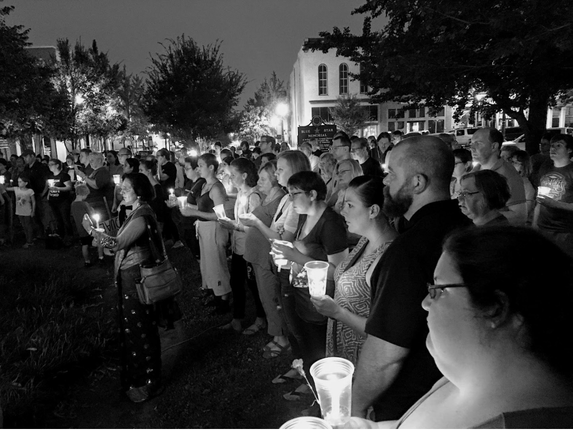
Photo provided by Michael Jannett, taken from public demonstrations of response to racially-charged events and advocacy for working with Muslim neighbors.
these bones live?” It is a question that echoes whenever the world feels overwhelmed by violence.
Recent news about war in Iran has raised fear and concern across the globe. Images of conflict spread quickly through television and social media. For many of us—young, old, and somewhere in the middle—these stories can feel overwhelming. When the world seems filled with violence, it is natural to wonder: Where does peace fit into all of this?
The Christian story speaks directly into that question.
In Ezekiel’s vision, the bones represent a people who believe their future is gone. Yet God breathes life into what appears lifeless. Bones gather. Breath enters. A community stands again.
The same pattern appears in John 11. Lazarus has died. Grief fills the air. Jesus does not deny the pain—he weeps. But the story does not end there. Jesus calls Lazarus out of the tomb. Life returns where death seemed certain.
Peace often begins in moments like this—when people refuse to believe that violence or division must have the final word. Martin Luther King Jr. once said, “Peace is not merely the absence of tension; it is the presence of justice.” (See transcription of that sermon, here.)
In a recent statement responding to the war in Iran, ELCA Presiding Bishop Yehiel Curry urged Christians to pray for those suffering and to continue seeking a just peace that protects human life and dignity. (Click here to read Bp. Curry’s statement. Also see the ELCA’s Social Statement on Peace here.)
For followers of Jesus, peace is not passive. It is the courageous work of building relationships, pursuing justice, and refusing to let fear define how we see one another. Sometimes that work begins with friendship.
Ezekiel 37 dry bones meaning
When I served as a pastor in Murfreesboro, Tennessee, I became friends with members of the Murfreesboro Muslim Youth. I also developed a close friendship with the imam of the local mosque, Imam Ossama Bahloul. These relationships opened my eyes to the depth of Muslim faith, helping me see my Muslim neighbors not as strangers, but as faithful contributors to our community. These friendships changed the way I saw my neighbors and deepened my understanding of how faith can bring people together for the good of a community.
In a world that often feels like a valley of dry bones, friendship can be one way God begins to breathe life again.
Together, we shared meals, gathered for picnics in the park, and worked side by side to feed first responders on Thanksgiving Day. When tensions rose in our community, we stood together in peaceful demonstrations: speaking out against travel bans and resisting efforts by white supremacist groups to recruit followers in our town. Through these experiences, I discovered that peace often begins with small, courageous steps: listening, learning, and refusing to treat others as enemies.
Romans 8 reminds us that the Spirit who raised Jesus from the dead lives within us. That means resurrection is not only a future promise. It is a present calling.
When young people build friendships across differences, speak up for justice, and treat others with compassion, they participate in God’s work of breathing life into places that feel divided or broken.
Ezekiel 37 dry bones meaning
The valley of dry bones may still surround us. But God’s Spirit is still breathing life into the world—often through ordinary people who choose the work of peace. The question God asked Ezekiel still echoes today: Can these bones live? And how might God’s Spirit breathe life through us?
Reflection Questions
- Why do you think Jesus weeps before raising Lazarus? What does that tell us about how God meets people in suffering?
- Where do you see “dry bones”, places that feel hopeless or broken, in the world today?
- How can building relationships across differences be a form of peacemaking?
- What is one way you could practice peace in your school, friendships, or community this week?
Closing Activity: One Act of Resurrection
Peace can feel like a big idea when we talk about war or global conflict. But peacemaking often begins with small choices.
Ask each participant to think of one situation in their daily life where they could bring peace or justice. Examples might include:
- Welcoming someone who feels excluded
- Standing up when someone is mocked or bullied
- Listening to someone with a different background or opinion
- Refusing to spread rumors or hateful comments online
- Learning about another culture or faith tradition
Invite each person to write down one action they will take this week.
Then say:
- In Ezekiel’s vision, God breathes life into dry bones. In John’s Gospel, Jesus calls Lazarus out of the tomb. Sometimes resurrection begins with a single step toward compassion, courage, or reconciliation.
Ask participants to hold their paper and silently offer that action to God.
Prayer
God of life and hope,
When the world feels filled with conflict, remind us that your Spirit still moves among us. Where there is fear, breathe courage.bWhere there is division, plant understanding. Where there is violence, raise up people who seek peace.
Help us follow Jesus, who wept with the grieving and called new life out of the tomb.
Teach us to build bridges, seek justice, and trust that your Spirit is still breathing life into this world.
Through Christ our Lord.
Amen.
Bio
Rev. Michael Jannett serves as the pastor of Community of Grace Lutheran Church in Grayson, Georgia, and has 25 years of experience in youth ministry. Michael is definitely a Disney nerd, an actual nerd (with a Computer Science degree from Georgia Tech), and will eat all of the Reese’s Peanut Butter Cups in your house. He is a husband, father of three, and a lover of football and playing guitar.