Skip to content
ELCA Blogs

Faith Lens

April 4, 2021–Living Your Passion

Steve Peterson, Moorhead, MN

Warm-up Question

Have you ever been so fired up about something you were doing that you lost all track of time.  You lost any sense of being self-conscious about how you were being seen by others, just getting lost in doing something you believed in, found joy in doing?  Can you describe what you were doing and what that experience was like for you?

Living Your Passion

Who do we think of as influential people, people who make a difference in the world, communities, or among family and friends? What qualities do we think of when we think of influential people?  TIME  magazine in early March of this year published a double issue featuring brief articles about those chosen as the 100 next most influential people.  Many of the articles were written by previous Time 100 alumni. 

For example, Greta Thunberg, TIME’s 2019 Person of the Year, writes about Vanessa Nakate, a 24-year-old climate justice champion from Uganda.  Her African country is one the regions of the world most exposed  to the adverse effects of the climate crisis. Nakate is making a difference through her Rise Up movement.  She started the Green Schools Project to transition schools in Uganda to solar energy and champions education and empowerment for girls and youth women. She is a powerful example of what one young woman with passion for something she believes in can do.

The rest of the TIME’s 100 Next list includes, “doctors and scientists fighting COVID-19, advocates pushing for equality and justice, journalists standing up for truth, and artists sharing their visions of present and future.”   Altogether, TIME describes these Next 100 Influential people as being characterized by, in the words of composer, lyricist and actor Manuel Mirander, “clear-eyed hope.”

Discussion Questions

  • What do you think motivates people who have a great positive influence on the world, their communities, and their friends and families?
  • What do you think either blocks or encourages people from “reaching for the stars” in terms of following their beliefs and passions and using their gifts in influencing positive change in the world?

Resurrection of Our Lord

Acts 10:34-43

1 Corinthians 15:1-11

Mark 16:1-8

John 20:1-18

(Text links are to Oremus Bible Browser. Oremus Bible Browser is not affiliated with or supported by the Evangelical Lutheran Church in America. You can find the calendar of readings for Year B at Lectionary Readings.)

For lectionary humor and insight, check the weekly comic Agnus Day.

Gospel Reflection

Of the four gospel accounts of Jesus’ resurrection (Matthew, Mark, Luke and John) Mark’s resurrection story might seem the least fun and satisfying.   Beyond a few common details, it feels like there is more going on in the other gospel’s.  More conversation, more angel intrigue, more dramatic action.  We get the sense in the other gospels that we can linger a bit in satisfaction and delight.  We feel a little more like celebrating after reading the other gospel accounts of the resurrection.  

In Mark, it’s just the facts:  He’s not dead anymore, he has been raised, tell the disciples, you can see him  back home in Galilee, he’s not here. That seems to be the point in Mark; he is risen, get going and meet him in Galilee!  So, they flee in terror and amazement, afraid to tell anyone.  Full stop.  What is this all going to mean for them?

They knew what he was like before rising from the dead… stirring up all kinds of good trouble, holy trouble.  Healing the sick, feeding the hungry, breaking down barriers between people which some powerful people don’t want broken down.  He brought hope to the broken-hearted and release to all kinds of people, including some people not everyone wanted freed.  He brought the Kingdom of God that he talked about.  If that was what Jesus was like before, they must have wondered, what kind of good trouble will he get into now that he had risen from the dead?  And they are supposed to meet him back in the neighborhood! Maybe that’s part of their terror and amazement, wondering what more might happen!

Maybe this gospel’s resurrection story is pretty exciting after all!  Like the disciples, we are told to meet Jesus in our neighborhoods!  Jesus has risen! He is meeting us in our neighborhoods, calling us to live his resurrection life with him. We are not alone.  He is meeting us there; giving us the passion and gifts to make a difference in the world—feeding the hungry, healing the sick, telling the truth, tearing down walls between people by proclaiming and living Jesus’ love for all people, and giving “clear-eyed hope.” Jesus is risen, and he is calling us to live his resurrection hope and be an influence for his hope in our world today.

Discussion Questions

  • How might Jesus be present now in your neighborhood, school, community, and church?
  • Where might you meet Jesus in your neighborhood?  What are some examples of what that might look like, how that might happen?  
  • How might Jesus use your gifts, talents, and passions  to be his presence in your neighborhood and in the world today?

Activity Suggestions

Ask an adult where they see Jesus in your neighborhood and what they think Jesus is doing or would like to do in the neighborhood.  Take a walk or bike ride around your neighborhood.  Where do you see Jesus?  Where do you imagine Jesus’ resurrected presence might  offer someone “clear-eyed hope” and love?  Imagine other neighborhoods you have seen or heard of, anywhere in the world…imagine Jesus in those places…

Closing Prayer

Risen Jesus, thank you for showing us your power over death and all that brings death, sadness, hurt and suffering in the world.  Make us instruments of your resurrection love and power in the world.  Help us to live your resurrection hope in our neighborhoods. Amen

 

March 28, 2021–Provocative Palms

Leslie Weber, Chesapeake, VA

Warm-up Questions

Have participants talk about what their experience of Holy Week has been in the past.  Possible conversation starter questions include:

  • Does the congregation you attend “celebrate” Palm Sunday on its own or combine it with Passion Sunday?
  • What ritual actions are meaningful to you on Palm/Passion Sunday? (waving palms, being part of procession, having a real live donkey, hearing the whole passion story, etc.)
  • Have you ever attended a Maundy Thursday worship service? What do you remember?
  • Have you ever attended a Good Friday worship service? What do you remember?
  • Have you ever attended an Easter Vigil worship service? What do you remember?
  • If you haven’t ever attended a worship service during Holy Week (Maundy Thursday/Good Friday/Easter Vigil), why not?

Provocative Palms

Recently, the Miami Beach City Commission approved an urban forestry master plan.  The goal of the plan is to reduce the proportion of the city’s canopy made up of palm trees to 25% by 2050.  By increasing the number and percentage of other trees that provide more shade in the city, they hope to extra comfort for residents and visitors, while also helping to “reduce urban warming, improve air quality, and absorb more carbon and rainwater.”

The master plan was passed unanimously, but now one city commissioner is speaking out against how the plan is being implemented.  He and his staff are encouraging residents to oppose removal of palm trees as part of construction projects around the city.  He is worried that as the prominence of palm trees diminishes in the city’s overall canopy, the city’s “historic, cultural, and economic brand” will suffer.  The city commissioner’s aide commented “if this plan goes forward, they might as well remove the palm from our City’s official logo.”

The city’s environmental and sustainability director is speaking out in opposition to the city commissioner’s concerns, saying that the “city is not going around chopping down palm trees” and that at 25% of the total canopy, “palms will continue to be a focal point along the city’s roads, greenspaces, and parks,” even while shade trees are planted as a faster rate in order to “maximize the environmental, social, and economic benefits of trees.”

Full article: https://www.miamiherald.com/news/local/community/miami-dade/miami-beach/article249432995.html

Discussion Questions

  • What are the pros/cons of Miami Beach’s plan to reduce the percentage of palm trees in the city’s canopy over the coming decades?  (This is a great chance to practice considering all sides of an argument.)
  • List all the ways that you benefit from trees.
  • What are you, your household, your congregation, and your local government doing in response to or in an effort to slow climate change?

Sunday of the Passion/ Palm Sunday

Isaiah 50:4-9a

Philippians 2:5-11

Mark 14:1—15:47

Mark 15:1-39 [40-47] (alternate)

(Text links are to Oremus Bible Browser. Oremus Bible Browser is not affiliated with or supported by the Evangelical Lutheran Church in America. You can find the calendar of readings for Year B at Lectionary Readings.)

For lectionary humor and insight, check the weekly comic Agnus Day.

Gospel Reflection

Even if you don’t read any of the optional parts (Mark 14 and 15:40-47),  this Sunday’s gospel reading is long.  You may be familiar with the basic story, but the details vary across the four Gospel accounts.  It is easy to overlook some parts during Holy Week.  This is why it is helpful to hear the story as a whole on Palm/Passion Sunday, and then break it up into shorter texts.  During Holy Week we hear short parts of the story, paired with ritual actions (Palm/Passion Sunday—procession with palms; Maundy Thursday—foot washing, Holy Communion, stripping of the altar; Good Friday—procession and adoration of the cross).

It is undeniable that this story is full of people and groups who have different expectations, hopes, and either a readiness or reluctance to change. Just in Mark 15:1-39, we get a glimpse of various people’s values/priorities:

  • The Jewish Leadership (chief priests, scribes, elders, whole council) is in search of a way to get rid of Jesus and keep their position as the religious authority (Mark 14:1).
  • Pilate is amazed by Jesus’ answers (and lack thereof) to the charges brought against him (Mark 15:5) but also wants to keep the crowd calm (Mark 5:15).
  • Jesus Is committed to in-breaking the kin-dom of God. Although he would prefer an easier way, he is committed to doing what needs to be done (Mark 14:36).
  • Barabbas and rebels are willing to kill in order to change the status quo (Mark 15:7).
  • The Centurion sees and confesses that Jesus is “God’s Son,” despite his position and background.

Throughout Jesus’ life, we see God working to turn the world upside down, to reorient people’s priorities, to make our world and lives look a bit more like God’s original intention for a creation where no one lacks anything.

God was never confined to the temple in Jerusalem.  We confess that Jesus is God incarnate, in-fleshed, but the tearing of the temple curtain at the moment of Jesus’ death is a sign.  It wasn’t torn from bottom to top (as it would have been if torn by human hands), but “was torn in two, from top to bottom” (Mark 15:38), as if today God has left the building.  Today God  moves among and through each of us to enact all that for which Jesus preached, worked, and ultimately died and was raised.

Discussion Questions

  • Read the text. What parts of the story jumped out to you as you listened this time?
  • Were there any parts that you did not remember or remembered differently?  (Having a synopsis or parallel edition of the four Gospels would aid in comparing the details between the accounts.)
  • With which character in the story do you most identify and why? How do their values/priorities compare to your values/priorities?
  • How do you feel about change?  Is there is something in your life, congregation, community that might need to end/die in order for something new/better to be established and flourish?

Activity Suggestions

  • Find a creative way to hear and experience the whole Holy Week story.  Examples: there are YouTube videos of the Stations of the Cross, you can a buy or make a set of “resurrection eggs,” or (if it safe to gather and weather permits) walk around the church property or neighborhood, reading a different part of the story in a different location.
  • Make space for everyone to reflect on the story of Jesus’ Passion.  Provide art supplies for doodling, offer paper and pencils for journaling, set up a prayer labyrinth, or any other means of personal or group reflection that your group would find helpful.
  • Palms
    • If you congregation is supplying palms this year, learn about your congregation’s palms:
      • From what company do you order them?
      • Where are they grown?
      • Are they sustainably raised? (think about the environment and labor practices)
    • If your congregation isn’t supplying palms this year, use construction paper (or other craft supplies) to make your own palms to use during the service.  You can search the internet for ideas about how to do this, but an easy one is to trace your hand on green paper, cuts out 5 or so “copies” and then glue them onto a popsicle stick.

Closing Prayer 

Redeeming God, thank you for all that you have given us, especially the gift of eternal, abundant life.  Help us to know and work for your intentions in our lives and our world.  Amen.

March 21, 2021–Of Fruit and Seeds

Dennis Sepper, Rosemount, MN

Warm-up Question

Have you ever had anything go really wrong but it ended up being just what you needed?  What was that like?

Of Fruit and Seeds

At the inauguration of President Joe Biden and Vice President Kamala Harris, the world was introduced to a 22-year-old poet, Amanda Gorman.  Her poem, “The Hill We Climb,” delivered with such poise and passion, launched her into the spotlight of fame.  Sitting just feet away from her that day was former First Lady Michelle Obama.  In the February 18/February 23, 2021 issue of Time magazine, Ms. Obama interviewed Amanda Gorman about that day and about her work.  At one point Ms. Obama asked Amanda about the influence art can have on social change.  Ms. Gorman answered “Absolutely.  Poetry and language are often at the heartbeat of movements of change.”  She noted how words and images can convey meaning.  She then recalled how at a Black Lives Matter rally she saw a banner that read, “They buried us but they didn’t know we were seeds.”  The image that those words conveyed touched Ms. Gorman very deeply.

From small beginnings, when things look at their worst, great things can arise and grow and bear much fruit.  In many ways Ms. Gorman was correct.  Women won the right to vote after many thought the movement was dead and buried.  Same with the abolitionist movement, the civil rights movement, the LGBTQ movement, and many others.  Many of those who worked for the above rights never saw the fruits of their labors, but, unknown to them, they were the seeds that bore fruit many years later.  

Discussion Questions

Listen to or read Amanda Gorman’s poem, “The Hill We Climb”

  • What seeds do you think Amanda Gorman is planting in her poem?
  •  What fruit do you think Amanda Gorman is hoping her seeds will bring forth?

Fifth Sunday in Lent

Jeremiah 31:31-34

Hebrews 5:5-10

John 12:20-33

(Text links are to Oremus Bible Browser. Oremus Bible Browser is not affiliated with or supported by the Evangelical Lutheran Church in America. You can find the calendar of readings for Year B at Lectionary Readings.)

For lectionary humor and insight, check the weekly comic Agnus Day.

Gospel Reflection

This week’s gospel begins in a curious way.  Jesus and the disciples are in Jerusalem anticipating the Passover feast.  Some Greeks are also in the city and finding Philip, a follower of Jesus, they ask to see Jesus.  However, notice that Jesus never goes to see the Greeks nor does Jesus invite them to come to him.  Instead Jesus sees this request from the Greeks as a sign that his hour has come to be crucified and to die (The gospel writer John always sees Jesus’ death as an act of glory.  That is why Jesus says, “The hour has come for the Son of Man to be glorified.”)

Then Jesus creates a very interesting image:  “Very truly, I tell you, unless a grain of wheat falls into the earth and dies, it remains just a single grain; but if it dies, it bears much fruit.”  This image only makes sense when we know that Jesus is in Jerusalem for the last time.  Within days he will be arrested, tried, crucified, and will die.  Jesus is the grain and the cross is the instrument that places Jesus in the earth.

But we also know what happens three days after that. Jesus rises from the dead and you and I become the fruit of that grain dying and rising.  The fruit we bear is the proclamation of the gospel, the announcement of God’s grace and salvation and service to others that Jesus has shown in his service to us.  Indeed, Jesus is telling the truth; as we lose our lives in service to others we find it.  We see that real power lies in giving it to others, that we are leaders when we become servants to others.  This is the fruit we bear because Jesus became that grain of wheat  laid in the earth.  He rose to become the mighty branch from which we live, and move and have our being. 

But there is more.  In our baptism we proclaim that we also die with Jesus and rise to newness of life (see the beginning declaration of the Holy Baptism service, Evangelical Lutheran Worship, page 227, and St. Paul’s words in Romans 6:4).  In that way, we are also seeds…seeds which bring forth peace, justice, love.  Every act of love, mercy and forgiveness, however small, can be a seed of change in the world. We might never see the fruit of the seed we plant, but we trust that God will cause it to grow and bear fruit.

We are both fruits of Jesus’ grain of wheat and seeds in our own right.  Good news indeed!

Discussion Questions

  • What things do you have a passion for?  Sports?  Music?  Climate change?  Rescue animals?
  • Where and how were the seeds for that passion planted in you?  Was it something you saw on social media?  Was it something someone said to you or told you about?
  • Seeds and fruit are not just a part of an individual’s life; they are also a part of a community’s life.  What kind of fruit does your church community bear?  What seeds are your church planting in the neighborhood where it is located?  How can you be a part of that fruit bearing and seed planting?

Activity Suggestions

Ask an adult family member how they came to pursue their calling (occupation or hobbies or social concerns).  Where were the seeds planted for them in their past to be interested in their calling?  What fruit do they hope to bear in the future?

Closing Prayer

Loving Jesus, throughout your life you sought to plant seeds of love and justice in people and in communities. In this Lenten season, send your Holy Spirit upon us that we might bear the fruit of your death and resurrection wherever we are planted, and by your grace, may we plant the seeds of your love in all those we meet today and every day.  Amen


March 14, 2021–What’s in a Font

Colleen Montgomery, Salem, VA

Warm-up Question

What is your favorite font? Your least favorite font? 

What’s in a Font?

What’s in a font? 

 A recent episode of NBC’s Zoe’s Extraordinary Playlist contained a conversation between Mo (Alex Newell) and Max (Skylar Astin) about the menu for their new restaurant. Mo brings immense creative and relational wisdom to the duo, while Max is the details and tech part of the team. Mo asks Max to help decide on a font, saying the font needs to be something that both shows whimsy and strength. Max responds, “Like Cambria?”

Perhaps for Max, Cambria is a whimsical font, but most people would not describe it in that way. As silly as it may seem, people have strong font preferences and oftentimes intense reactions to particular fonts. We recognize fonts that go with a particular brand or that are used on a particular social media platform. Our teachers ask for papers to be written in a particular font. Our employers might have similar requests as well. And I bet if you ask your pastor, they have a set font that they print their sermons in each week. (I used to be exclusively Century Gothic, but have made the shift to Calibri in recent months.)

But did you know that even fonts can be political? 

A CNN article summarizes the findings of a 2019 study published in Communications Studies that researched the political polarization of fonts. “What’s in a font?: Ideological Perceptions of Typography,” breaks down which fonts are seen as more conservative or liberal and begins to explore the use of such fonts in political campaigns. They invite reflection on people’s reactions to the font and the formatting of messages, not just on reactions to the content alone. It seems that the font we use to tell the story may influence how people read it. 

Discussion Questions

  • Is there a story or message you would dismiss entirely based on font alone? 
  • What other things, previously perceived as neutral, have become politically polarized in recent months? 

Fourth Sunday of Lent

Numbers 21:4-9

Ephesians 2:1-10

John 3:14-21

(Text links are to Oremus Bible Browser. Oremus Bible Browser is not affiliated with or supported by the Evangelical Lutheran Church in America. You can find the calendar of readings for Year B at Lectionary Readings.)

For lectionary humor and insight, check the weekly comic Agnus Day.

Gospel Reflection

John 3:16 is one of the most well known verses in the whole bible. If people know any verse by heart, John 3:16 is probably it. We see it on billboards, social media posts, sports jerseys, and bumper stickers. Lutherans see this verse as one of grace and evidence of God’s love. However, not all Christians interpret the verse in this way. Even this most dear biblical verse can be used in a political and divisive manner. 

Some look at Jesus’ words, made to Niccodemus in the middle of the night, as an exclusionary verse. A directive about who is in and who is out of heaven. Some interpret this verse, especially the second half of the verse, to say that only those who believe and confess Jesus as Lord will be saved and permitted into heaven. With this interpretation, this verse becomes divisive, exclusionary, and even threatening. 

Yet, with a closer examination of the verse and continuing reading, we see more clearly the Lutheran interpretation of grace and inclusivity. Jesus does not say that just those who believe in him will be given eternal life. He is not making an exclusive statement. Jesus only says that those who believe will be given eternal life. He does not make any statement about those who do not believe in him here. Moreover, Jesus goes on to say in 3:17 that Jesus has come not to condemn the world, but rather to show love and to save the world. As Lutherans, we profess that it is the grace of God that saves us, and there is nothing we can do—including believe in God on our own- that can save us. 

Jesus’ words are often political and can be divisive. However, the gospel of Jesus invites, rather than excludes. It brings in, rather than casts out. It goes to the margins and the shadow places to bring hope and new life. The radical love of Jesus may cause some to walk away, however it is this radical love that I need, and maybe you need too. 

Discussion Questions

  • What other biblical verses have you heard used in an exclusionary way? How have you come to interpret them through a lens of grace? 
  • How does this radical love of Jesus empower you to live your daily life and interact with people who are different from you? 

Activity Suggestions

  • Use Canva (canva.com)  or another graphic design program to create a poster sharing the radical love of John 3:16-17 (or another favorite verse). Share these on your own social media or on the churches platforms. 
  • Look at your church’s website and social media accounts. Are the fonts, images, and content welcoming? Do they proclaim the gospel that your church believes in? 
  • John 1 tells us Jesus is the Word of God and that all life came into being through Jesus. Including you! This means that Jesus loves all of you and your handwriting is one of Jesus’ favorite fonts. Draw a picture of yourself (stick figures allowed) and write Jesus loves me on your body. Or, take a washable marker and write it on your actual body. 

Closing Prayer

Dear Jesus, You are the Word of God made flesh. Empower us to live out the gospel with all that we are: our bodies, our minds, and our words. Remind us daily of your grace and love for us and help us to share that grace with others. Amen. 


March 7, 2021–What Belongs?

Jeremy Serrano, Concord, CA

Warm-up Questions

  • Do you have symbols that are important to you? If so, what are they?
  • What do those symbols mean to you?
  • How do you show they are important?

What Belongs?

Some people watch the Super Bowl to see the best football teams play each other, but for others it is all about the commercials. The 2021 broadcast was no exception. One commercial from a car company hit all the right points for many in the audience, yet left others feeling uneasy. 

It begins with a wide shot of a long road and man driving down it. After a few seconds of light music in the background, a voice says, “There’s a chapel in Kansas standing on the exact center of the lower forty-eight. It never closes. All are more than welcome to come meet here in the middle. It is no secret that the middle is a hard place to get to lately.” As sweeping shots of Americana imagery glide across the screen of wheat fields, trains, and houses (all with the car companies product in them, of course), the voice continues, “We just have to remember the very soil we stand on is common ground, so we can get there. We can make it to the mountaintop through the desert, and we will cross this divide. Our light has always found its way through the darkness. And there’s hope on the road up ahead.” It is as feel good as a commercial can get, drawing on a sense of collective nostalgia for small town rural America. 

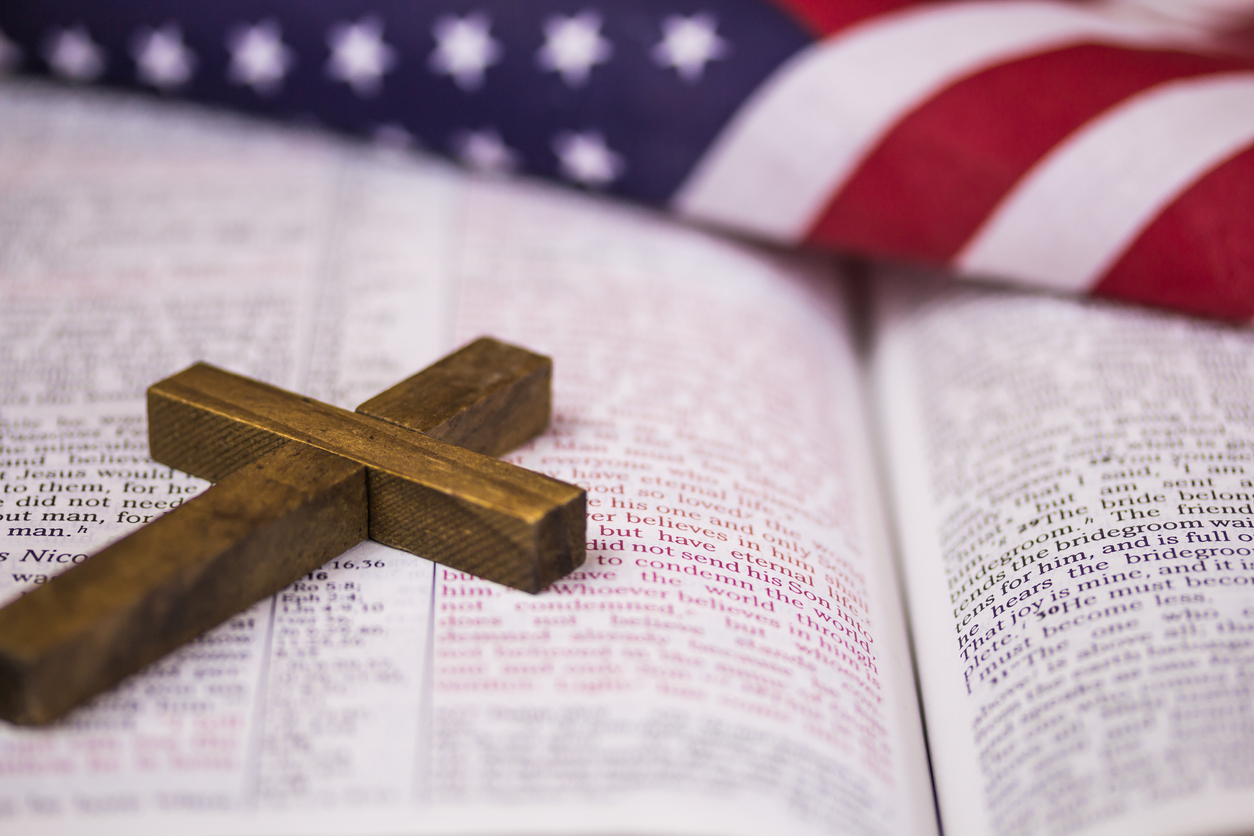
This commercial has some beautiful and touching imagery, and the sentiment behind the speaker’s words is worth pondering. However, for the Christian, there is one image worth questioning. A panning shot inside the chapel shows a lectern with candles in the corner of the room, and, on the back wall, a map of the United States painted as the American Flag. Over the map is a black cross. The two symbols are conjoined as the main focus of the worship space. 

Discussion Questions

  • What does the American flag mean to you?
  • What does the cross mean to you?
  • Do we risk conflating American citizenship with our faith when we mix national symbols with religious ones?

Third Sunday in Lent

Exodus 20:1-17

1 Corinthians 1:18-25

John 2:13-22

(Text links are to Oremus Bible Browser. Oremus Bible Browser is not affiliated with or supported by the Evangelical Lutheran Church in America. You can find the calendar of readings for Year B at Lectionary Readings.)

For lectionary humor and insight, check the weekly comic Agnus Day.

Gospel Reflection

We tend to think of Jesus as more tame and subdued than the author of John shows in today’s lesson. Nevertheless, Jesus enters the temple just before the celebration of Passover and shows that not everything belongs in a worship space. Jesus’ visceral reaction to the sellers and money changers—driving out the animals, pouring out the money collected, turning over the tables—indicates what he feels is appropriate in that space. Just in case his actions are unclear, he says “Take these things out of here! Stop making my Father’s house a market place!” (John 2:16, NRSV).

The main people involved are the money changers. They are a for-profit group who exchange foreign coins into local currency. Worshippers need to buy the animals for the prescribed ritual sacrifices of the temple, and so their services are much needed. 

The timing in John’s gospel is just before the Passover. The celebration of Passover is a multi-day festival which remembers the time God “passed over” the houses of the Israelites during the last of the ten plagues on the land of Egypt (Exodus 11-12). Passover has been one of the most important holidays for the Jewish people since the time of Moses. 

The setting of Jesus’ outburst is the temple. The temple was more than just a local church in a neighborhood; it was the epicenter of Judaism at the time. The Temple was the center, not only of worship and music, but also of politics and society.  It was the central place of both celebration and mourning. But, most important, God promised that it would be the dwelling place of God among the people.

Jesus’ wrath is not directed against those participating in or leading worship, but against those detracting from it. As evidenced by Jesus’ actions and words, he views the money changers and sellers as desecrators of the temple. Jesus says, “ Stop making the house a market place!” (John 2:116b).

Jesus’ prophetic action calls for the worship of God to not be an activity married to commerce. In this action, he shows that some things are not useful for worship, nor is everything that we do in our places of worship worthy of being there.

What incensed some of the 2021 Super Bowl audience with the car commercial was the presence of national symbols in a worship space. Two thousand years ago Jesus used an important holiday to show that not everything is acceptable in the worship space, even if it is useful. In the synoptic versions of this story, Jesus says, “My father’s house shall be called a house of prayer.” Jesus shows that the people working in the temple forgot to make the main thing the main thing.

Discussion Questions

  • Are there any symbols or activities that don’t belong in a Christian worship space? Why not?
  • How do we decide what symbols and activities belongs in the worship space?
  • Do you think Jesus would cleanse any of our churches?  If so, what would he cleanse?

Activity Suggestions

  • While you are online this week, notice where national symbols and religious symbols are intertwined. Pray for both our nation and the Church. 
  • Take a moment to read the ELCA resource, “Are Flags Appropriate in church?”
  • In worship this Sunday, identify as many symbols you can in worship, including clothing, images, and statues.  Look up what those symbols mean. Or call your pastor and talk to them about it.
  • Imagine designing a worship space for your community with only 5 items or symbols.  What would you choose and why?

Closing Prayer

Holy God, you sent Jesus to guide us in all things related to our faith and lives in you.  Show us those things that bring you glory and give us wisdom, through your Holy Spirit, concerning the things that need to be cleansed from us and our communities today. Amen.