
In honor of National Day of Awareness for Missing and Murdered Indigenous Women, Girls, and Relatives (MMIWGR), which is observed on May 5 each year, ELCA Racial Justice Ministries invited Isabell Retamoza to write on this topic.
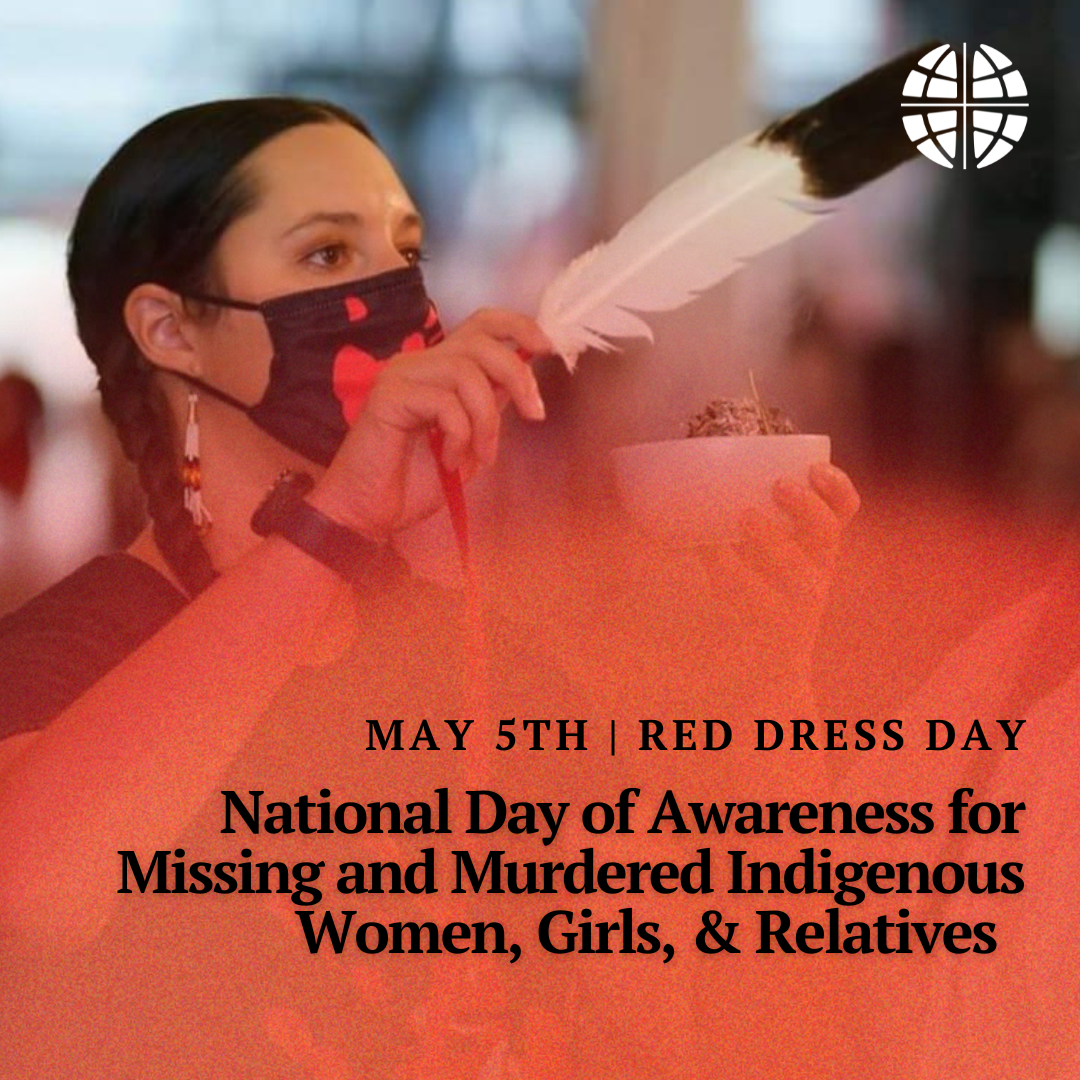
Source: MMIWGR Toolkit Socials
Truth, Honor and Remembrance: MMIW Awareness Day in the ELCA
By Isabell Retamoza
On May 5, communities across the United States will gather in remembrance and solidarity to honor missing and murdered Indigenous women (MMIW), girls and Two-Spirit people[1].
The alarming rates of abduction, disappearance and murder of Indigenous women, girls and Two-Spirit people represent one of the most devastating and ongoing injustices facing tribal nations and Indigenous communities. On some reservations, Native women experience murder rates more than 10 times the national average.[2] Two-Spirit individuals face exceptionally high levels of violence, with studies indicating that between 78% and 85% have experienced gender-based violence, sexual assault or physical violence.[3] These disappearances and deaths are frequently connected to domestic and dating violence, sexual assault, stalking, sex trafficking and other longstanding harms impacting Indigenous communities. Nearly 96% per of the time the perpetrators of this violence are non-Native men.[4]
To honor and remember those lost, many people wear red or paint red handprints across their faces as symbols of visibility for those who have been made invisible. But MMIW Awareness Day is not only about remembrance; it is also a call to truth-telling and advocacy.
MMIW Day of Awareness calls us to:
- Honor the lives of missing and murdered Indigenous women, girls and Two-Spirit people.
- Raise awareness of the disproportionate levels of violence experienced by Indigenous families and communities.
- Support community efforts of grassroots advocacy and organizing to change laws, policies, protocols and resource allocation at the tribal, federal and state levels.
- Share and discuss the history of state-sanctioned violence perpetrated by the U.S. government against Indigenous people and communities to better understand the roots of this crisis and drive meaningful legal reform.
This crisis is neither isolated nor random. It is the result of centuries of state-sanctioned and structural violence. Rooted in colonization and genocide, U.S. policies forcibly removed Indigenous peoples from their ancestral lands, fractured families and kinship systems, and devalued Indigenous culture. These harms continue today through jurisdictional failures, underfunded services, extractive industries built near tribal lands, and systems that repeatedly fail to protect Indigenous women, girls and Two-Spirit people or that hold perpetrators accountable.
For the church, MMIW Awareness Day is also a moment of moral reflection. Christian institutions were often complicit in the systems that enabled this violence, including forced assimilation and boarding schools. Honoring this day meaningfully requires more than acknowledgment; it calls us to recognize the truth expressed through action, solidarity and sustained commitment to justice.
Honoring MMIW Awareness Day in Your Congregation
ELCA congregations can mark May 5 in meaningful and respectful ways, including:
- Wearing red (T-shirts available from the ELCA) and taking pictures.
- Using social media to raise awareness. Use the hashtags #MMIW, #NoMoreStolenSisters, #TruthandHealing and #ELCA 2.
- Organizing a prayer vigil (with this resource).
- Including MMIW in your congregation’s prayers for the day.
- Saying the names of MMIW (especially meaningful if you research and identify MMIW specific to your region or locality) and lighting candles for them during worship.
- Inviting (and compensating) a local Indigenous expert to share on this topic as part of your educational time.
- Inviting (and compensating) local Indigenous musicians to play or sing during worship.
As members of the Evangelical Lutheran Church in America, we are called to bear public witness to truth, even when that truth challenges us. On May 5, may we commit ourselves not only to remembrance but to action that honors Indigenous lives.
For more information on how your congregation can get involved and honor MMIW Day of Awareness on May 5, please visit the ELCA website and download the MMIW Toolkit.

Isabell Retamoza is a citizen of the Cherokee Nation, a law student at the University of Illinois Chicago School of Law and is a member of St. Andrew Lutheran Church in San Diego.
[1] “Two-Spirit is a term used by some Indigenous people to describe roles, responsibilities, and identities that exist outside colonial understandings of gender and sexuality. For many, Two-Spirit is interrelated to expression, language, tradition, and/or ceremony, often carrying inherent responsibilities to the well-being of the land and community.” Understanding The Term ‘Two-Spirit’ — Wabanaki Two-Spirit Alliance, https://w2sa.ca/two-spirit-library/understanding-the-term-two-spirit.
[2] National Indigenous Women’s Resource Center, www.niwrc.org/mmir-awareness.
[3] Balsam, Kimberly F., et al., “Culture, Trauma, and Wellness: A Comparison of Heterosexual and Lesbian, Gay, Bisexual, and Two-Spirit Native Americans, Cultural Diversity & Ethnic Minority Psychology, 2026, vol. 32, issue 2 (April), doi.org/10.1037/1099-9809.10.3.287.
[4] The National Congress of American Indians Policy Research Center, Key Statistics | NCAI, https://www.ncai.org/section/vawa/overview/key-statistics.