Skip to content
ELCA Blogs

ELCA Racial Justice

Truth, Honor and Remembrance: National Day of Awareness for Missing and Murdered Indigenous Women (MMIW) in the ELCA

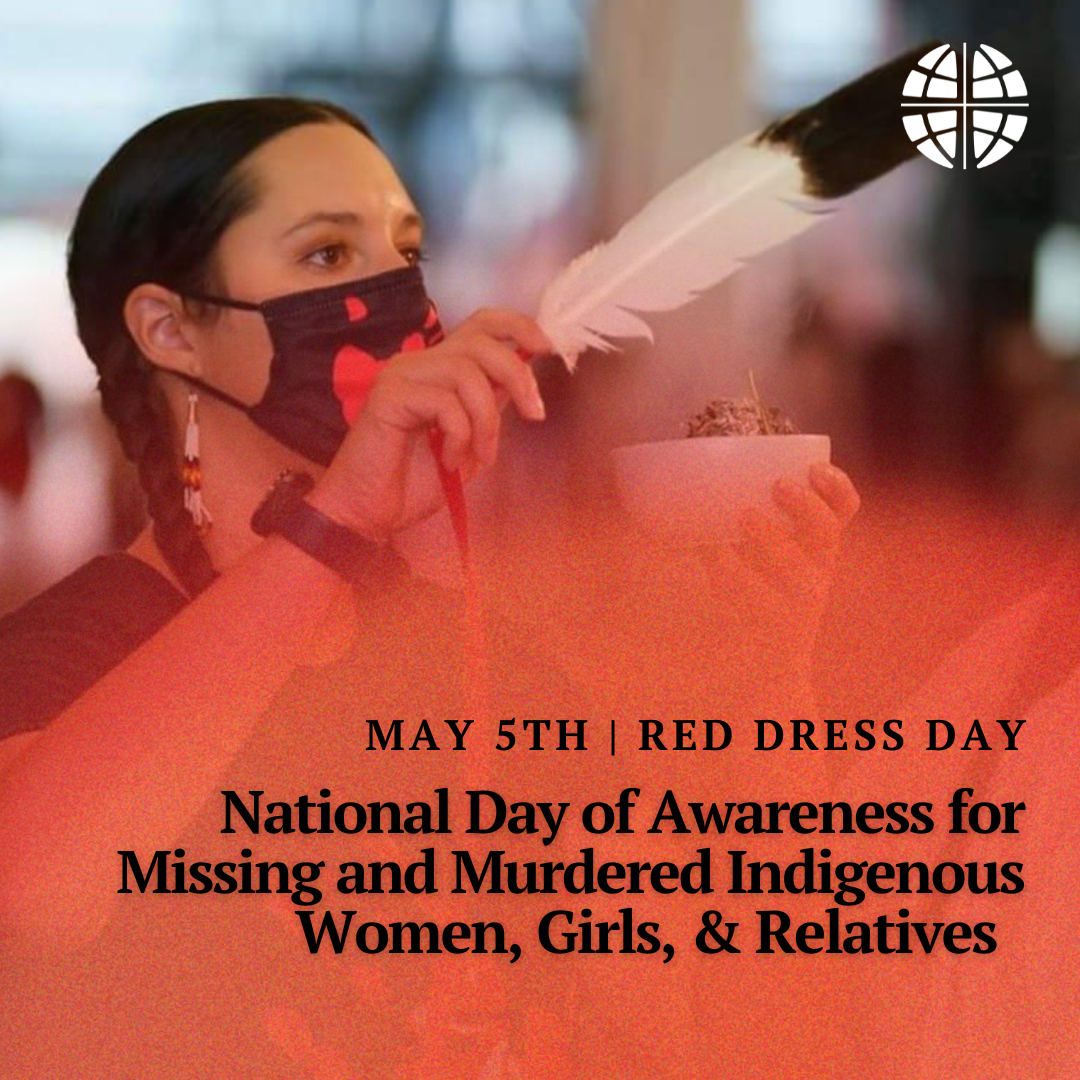
In honor of National Day of Awareness for Missing and Murdered Indigenous Women, Girls, and Relatives (MMIWGR), which is observed on May 5 each year, ELCA Racial Justice Ministries invited Isabell Retamoza to write on this topic.


Truth, Honor and Remembrance: MMIW Awareness Day in the ELCA

By Isabell Retamoza

On May 5, communities across the United States will gather in remembrance and solidarity to honor missing and murdered Indigenous women (MMIW), girls and Two-Spirit people[1].

The alarming rates of abduction, disappearance and murder of Indigenous women, girls and Two-Spirit people represent one of the most devastating and ongoing injustices facing tribal nations and Indigenous communities. On some reservations, Native women experience murder rates more than 10 times the national average.[2] Two-Spirit individuals face exceptionally high levels of violence, with studies indicating that between 78% and 85% have experienced gender-based violence, sexual assault or physical violence.[3] These disappearances and deaths are frequently connected to domestic and dating violence, sexual assault, stalking, sex trafficking and other longstanding harms impacting Indigenous communities. Nearly 96% per of the time the perpetrators of this violence are non-Native men.[4] 

To honor and remember those lost, many people wear red or paint red handprints across their faces as symbols of visibility for those who have been made invisible. But MMIW Awareness Day is not only about remembrance; it is also a call to truth-telling and advocacy.

MMIW Day of Awareness calls us to:

  • Honor the lives of missing and murdered Indigenous women, girls and Two-Spirit people.
  • Raise awareness of the disproportionate levels of violence experienced by Indigenous families and communities.
  • Support community efforts of grassroots advocacy and organizing to change laws, policies, protocols and resource allocation at the tribal, federal and state levels.
  • Share and discuss the history of state-sanctioned violence perpetrated by the U.S. government against Indigenous people and communities to better understand the roots of this crisis and drive meaningful legal reform.

This crisis is neither isolated nor random. It is the result of centuries of state-sanctioned and structural violence. Rooted in colonization and genocide, U.S. policies forcibly removed Indigenous peoples from their ancestral lands, fractured families and kinship systems, and devalued Indigenous culture. These harms continue today through jurisdictional failures, underfunded services, extractive industries built near tribal lands, and systems that repeatedly fail to protect Indigenous women, girls and Two-Spirit people or that hold perpetrators accountable.

For the church, MMIW Awareness Day is also a moment of moral reflection. Christian institutions were often complicit in the systems that enabled this violence, including forced assimilation and boarding schools. Honoring this day meaningfully requires more than acknowledgment; it calls us to recognize the truth expressed through action, solidarity and sustained commitment to justice.

Honoring MMIW Awareness Day in Your Congregation

ELCA congregations can mark May 5 in meaningful and respectful ways, including:

  • Wearing red (T-shirts available from the ELCA) and taking pictures.
  • Using social media to raise awareness. Use the hashtags #MMIW, #NoMoreStolenSisters, #TruthandHealing and #ELCA 2.
  • Organizing a prayer vigil (with this resource).
  • Including MMIW in your congregation’s prayers for the day.
  • Saying the names of MMIW (especially meaningful if you research and identify MMIW specific to your region or locality) and lighting candles for them during worship.
  • Inviting (and compensating) a local Indigenous expert to share on this topic as part of your educational time.
  • Inviting (and compensating) local Indigenous musicians to play or sing during worship.

As members of the Evangelical Lutheran Church in America, we are called to bear public witness to truth, even when that truth challenges us. On May 5, may we commit ourselves not only to remembrance but to action that honors Indigenous lives.

For more information on how your congregation can get involved and honor MMIW Day of Awareness on May 5, please visit the ELCA website and download the MMIW Toolkit.

Isabell Retamoza is a citizen of the Cherokee Nation, a law student at the University of Illinois Chicago School of Law and is a member of St. Andrew Lutheran Church in San Diego.


[1]Two-Spirit is a term used by some Indigenous people to describe roles, responsibilities, and identities that exist outside colonial understandings of gender and sexuality. For many, Two-Spirit is interrelated to expression, language, tradition, and/or ceremony, often carrying inherent responsibilities to the well-being of the land and community.” Understanding The Term ‘Two-Spirit’ — Wabanaki Two-Spirit Alliance, https://w2sa.ca/two-spirit-library/understanding-the-term-two-spirit.

[2] National Indigenous Women’s Resource Center, www.niwrc.org/mmir-awareness.

[3] Balsam, Kimberly F., et al., “Culture, Trauma, and Wellness: A Comparison of Heterosexual and Lesbian, Gay, Bisexual, and Two-Spirit Native Americans, Cultural Diversity & Ethnic Minority Psychology, 2026, vol. 32, issue 2 (April), doi.org/10.1037/1099-9809.10.3.287.

[4]   The National Congress of American Indians Policy Research Center, Key Statistics | NCAI, https://www.ncai.org/section/vawa/overview/key-statistics.


Happy Arab American Heritage Month by guest author Dr. Ryan LaHurd

In observance of Arab American Heritage Month, ELCA Racial Justice Ministries invited Dr. Ryan LaHurd to share his thoughts on this topic with our readers.


April is Arab American Heritage Month. As an Arab American, I might be expected to write about all the great things Arab Americans have contributed to our culture. But as I think about anti-Arab attitudes in the United States and the massive destruction of innocent lives in the Middle East, I must focus on something more substantial.

We used to hear that Inuit people have hundreds of words for snow. The later correction is that they have dozens. But the principle remains: people have words for things that are important to them. In the U.S., we have no useful word for prejudice against Arabs. Some people speak of “anti-Arab racism.” But Arabs are not a race. Arabs are a cultural group from many different countries whose primary language is Arabic. Others describe such prejudice as “orientalism.” But that term denotes anti-Arab stereotypes from early colonialism: the belly dancer, the “camel jockey.” People uneducated, uncultured and unclean.  Since 9/11, we have heard about “Islamophobia.” This word refers not to Arabs but to the religion of most Arabs. Unhelpfully, using it reinforces a common misunderstanding that all Arabs are Muslims and that all Muslims are Arabs. In fact, an estimated two-thirds of Arab Americans are Christian.

So what’s the problem with our having no word for such prejudice? Back to linguistics. We have words for things that are important to us. No word = not something we care about. Furthermore, studies have demonstrated that we notice the things for which we have names. For example, study participants who spoke Russian — which has separate words for blue, light blue and dark blue — were much more likely than English speakers to distinguish lighter or darker hues on blue-colored paint chips.

Prejudice against Arabs and Arab Americans tends to be ignored — except, of course, by its victims. But it exists, and, like all ethnic and racial prejudice, it matters. In the U.S., such prejudice goes back to the earliest Arab immigrants, considered nonwhite and from “inferior” cultures. For example, my family name is transliterated from the Arabic as “Lahoud” (rhymes with “the food”). It means “the one who stands alone” and refers to Jesus, identifying our family’s roots in early Christianity. My grandfather had so much trouble getting jobs because of anti-Arab prejudice that he changed our name to “LaHurd” to make it look and sound French.  He got jobs but lost our history.

People whose lives we do not see, attend to or care about are much less likely to be considered the neighbors Jesus commands us to love and are much more easily dehumanized.  We have seen the tragic effects of such dehumanization recently in Israel, Lebanon and Palestine, where tens of thousands of innocent people, mostly children and women, have died and where millions more lives have been disrupted. Israel encouraged such dehumanization when it built walls and passed laws that eliminated contact between Jews and Arabs. Studies have unfailingly shown that having even a single personal connection with someone of another religion, race or ethnic group significantly reduces one’s prejudice against that group. Social psychologists call this the “contact theory.”

So I urge you to meet an Arab American, preferably a recent immigrant, and to hear their story. If that’s not possible, read such a story. Just be sure it’s a story written by an Arab. In his book The Message, U.S. writer Ta-Nehisi Coates argues, “If Palestinians are to be truly seen, it will be through stories woven by their own hands — not by their plunderers, not even by their comrades.”

As the great 12th-century Muslim philosopher Ibn Rushd wrote: “Ignorance leads to fear, fear leads to hatred, and hatred leads to violence. That is the equation.” That word “equation” reminds me of one last thing — Arabs invented algebra! We’re awesome.


Ryan LaHurd is president of the ELCA’s Association of Lutherans of Arab and Middle Eastern Heritage (ALAMEH). He retired as president of the James S. Kemper Foundation in Chicago. Previously he was president of the Near East Foundation, an operational foundation doing development work in the Middle East and Africa.  From 1994 to 2002 he served as president of Lenoir-Rhyne University in Hickory, N.C.


For more information: please visit Arab & Middle Eastern Ministries in the ELCA

Honoring International Day for the Elimination of Racial Discrimination: Guest Blog writer Dr. Robin Lauermann

In honor of International Day for the Elimination of Racial Discrimination (March 21), ELCA Racial Justice Ministries invited the Dr. Robin Lauermann, Ph.D. to share some thoughts about the annual board retreat held in Montgomery, AL of the ELCA Association of White Lutherans for Racial Justice and their work to end racism and dismantle white supremacy.


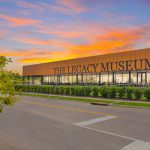
Front exterior of The Legacy Museum, a civil rights museum, explaining the civil rights movement in the US, in Montgomery Alabama, United States. Photo: Equal Justice Initiative

One of the first exhibits in the Legacy Museum. Photo: Equal Justice Initiative/Human Pictures

One of the first exhibits in the Legacy Museum. Photo: Equal Justice Initiative/Human Pictures

The National Memorial For Peace and Justice. Photo by Equal Justice Initiative https://legacysites.eji.org/about/memorial/

The National Memorial for Peace and Justice. Photo by Equal Justice Initiative https://legacysites.eji.org/about/memorial/


In late January, as part of the annual board retreat of the ELCA Association of White Lutherans for Racial Justice, I moved attentively through the Legacy Museum, established in Montgomery, Ala., by the Equal Justice Initiative (EJI). With my mind spinning from its stark and stimulating exhibits, which present the history of white supremacy from slavery to segregation to mass incarceration, I entered the final exhibit hall to see a familiar face: that of Anthony Ray Hinton. My heart leaped in instant recognition, with a mix of lament and joy.

I had learned about Hinton when I first visited Montgomery in 2016 as part of a multistate civil rights tour, meeting with veterans of the movement and visiting such important sites as the EJI offices. Staff members there explained the initiative’s work challenging injustice in the legal system, through both legal representation and policy advocacy. Their remarks expanded what I had learned from the book Just Mercy: A Story of Justice and Redemption, whose author, Bryan Stevenson, is founder and executive director of the EJI.

Due to mistaken identity, Anthony Ray Hinton was wrongly convicted of two murders and spent 30 years on death row. Ultimately EJI secured his release. Most poignant to me was a video that covered Hinton’s reentry into society: the scope of the years taken from him was shown by his learning to use technology unavailable before he was incarcerated — not a cell phone, not satellite radio, but an ATM. An ATM! As soon as Hinton’s book, The Sun Does Shine: How I Found Life, Freedom, and Justice, was published in 2019, I read it and reflected anew on the challenges his story revealed about the criminal justice system.

When I saw Hinton’s face in a museum display, he gazed at me from a row of visitation carrels. He wore prison scrubs and sat in a stark room. I approached the display, lifted a phone handset from the wall and listened as Hinton briefly recounted his story, his gaze never breaking from mine. His visual state contrasted with my knowledge of his freedom, and I thought again of him learning to use the ATM.

I continued around the room, stopping to hear from others. I listened intently to Kuntrell Jackson, who shared how his sentencing to life in prison at age 14; EJI would later represent him before the Supreme Court in a case that would overturn mandatory life sentences for children. Monica Washington told me about her sexual assault by a prison guard; EJI’s complaint would lead to a federal investigation of widespread abuse and to prosecutions of corrections staff. Hinton, Jackson and Washington were just three of the people whose stories were shared in the exhibit and for whom EJI has advocated.

The retreat weekend was both intense and inspiring. In addition to the museum, we visited EJI’s National Memorial for Peace and Justice, which commemorates of racial terror lynchings that began in the South at the end Reconstruction. These visits renewed my lament at the way white supremacy has dehumanized others, disregarding their creation in the image of God. However, the visit also inspired hope, even amid backsliding government policies designed to protect the rights of marginalized communities.  Encounters with history provide us with models of courage and strategy by leaders. The work of EJI shows the possibility of contemporary nonprofit and other collective efforts to promote change. Hinton’s story likewise stands at the crossroads of two legacies: one of disregard and violence, the other of advocacy and hope.


Robin Lauermann holds a Ph.D. in political science and is currently completing a certificate in theological studies at United Lutheran Seminary. She teaches and researches political behavior, institutions and change in U.S. and comparative politics. Robin currently serves as a board member of the ELCA Association of White Lutherans for Racial Justice.

 

Honoring Transgender Day of Remembrance – November 20

To honor Transgender Day of Remembrance which is observed on November 20 each year, ELCA Racial Justice Ministries invited Vicar Vica-Etta Henrietta Steel to share some thoughts with our readers.

Editor’s note: Our author intentionally capitalizes the word queer throughout. While this capitalization may not be congruent with style guidelines, ELCA RJ Ministries supports this style decision.

Each year, on Nov. 20, the Transgender Day of Remembrance is observed across the nation. Each year, the vast majority of the transgender people who are murdered are Black and brown transgender women. People gather to mourn, to light candles, to say the names of those who have been murdered. 

Each year we gather. Each year.

The Transgender Day of Remembrance is a day to call for justice for transgender people. The day of remembrance is a day to call for racial justice. The harm done to our transgender family in this nation, and across the world, is a racial justice issue. 

The transgender community is under constant and growing attack. Over half the states in the nation have enacted or are considering laws that take medical care, safety and opportunities from our transgender family (for more details, see Erin Reed’s “Anti-Trans Legislative Risk Assessment Map: September 2024 Edition”). According to Nature Human Behavior, rates of attempted suicide by youth and young adults have skyrocketed, up to 72%, in states where anti-transgender legislation has been enacted. These laws harm all of us, but the greatest harm is done to those who face multiple marginalizations, specifically BIPOC, disabled or neurodivergent people. Too often, people in America have become injured to the reality of murder and harm. Complacency becomes complicity and the horror of murder being normalized in the broader society is magnified in our marginalized communities. 

I cannot speak here of all the harm done to transgender people. It would be too much for you to read. It is too much for my heart to take. All I can do is share some of what I experience as a Queer woman who is transgender and lesbian. I am white. I tell you this because when I came out to the world, when I lost access to the privilege afforded me as one who had presented as if I were a white man, I learned how much privilege I hold, still. 

When I tell you that I have learned to be wary of police and cautious of men, do you understand that as privilege? My wariness grows from a fear that, if I am arrested, a person who carries authority in a gun will place me in a holding cell with men. I do everything I can to avoid that harm. When I travel alone, I drive the speed limit and obey all traffic laws. If I see police officers at a roadside gas station, I get back on the road and continue driving. I take precautions to make certain it is safe for me to use the same bathroom other women use. (I always travel with a change of clothes and other materials so I can avoid a stop if it isn’t safe.) Do you understand the danger we who are transgender face in this world where our right to exist is open to debate? Where we are not allowed to be present when cis people legislate or argue our fates? Where fear of our existence is sold across the nation for the political gain of those who prosper from harm? Where even people and organizations that claim to be our allies choose silence in the face of open expressions of transphobia? The need to be safe is a real concern. Also, I do not fear being shot by those same police for simply existing. It is my privilege to fear rather than experience the unjust incarcerations that are the reality for far too many Black and brown transgender women (for a more detailed analysis, see the Movement Advancement Project report “Unjust: How the Broken Criminal Justice System Fails Transgender People”). 

I write here to share that it is long past time for us all to speak with and lift the voices of our transgender family, especially the Black and brown women in our circles. The Transgender Day of Remembrance is a day of racial justice. Trans joy and trans uplift are racial justice issues. I hope that we all integrate the work toward justice for and with Queer communities, especially transgender communities, into the work toward racial justice. 

As core work toward racial justice, I urge you to follow the writing of Black transgender women who help everyone understand transgender people’s stories of pain and joy. If you don’t know where to start, I offer the leadership of Imara Jones and her work at TransLash.org. Seek out Transgender Day of Remembrance services in your communities or online. Find and say the names of those murdered each year. I pray that we all begin.


Vica-Etta Henrietta Steel is in ministry at St. John’s Lutheran Church in Madison, Wis. She is also the developer of JustBe Ministry, an inclusive ministry in the public square, rooted in Queer community with a focus toward centering BIPOC Queer voices and the voices of all who have been historically and are currently excluded. She works to lift trans joy in a world that gives us so much pain.


“My Identity is Not Up For Discussion” by Guest Blog Author Rahel Mwitula Williams

In honor of International Day for People of African Descent, which is observed internationally on August 31 each year, ELCA Racial Justice Ministries invited ELCA Director for Innovation and Ideas to share some thoughts about being a person of African descent. For more information on International Day for People of African Descent, visit International Day for People of African Descent – EN | United Nations.


Names carry immense significance. They are a marker of identity, heritage and personal history. Because I am of African descent, my name is a reflection of and connection to my ancestral roots and cultural identity. However, in a world shaped by patriarchy and systemic biases, the journey of owning and explaining one’s name can be a challenging experience. One wants to maintain one’s culture and hold it dear to one’s heart, but this can be difficult because not everything about one’s culture is worth maintaining and, like many other things, culture evolves over time.

In many African cultures names are not merely labels but encapsulate stories, values and histories. A name might signify a particular event, convey hopes for the future or reflect familial lineage. For example, my name is Rahel Mwitula Williams; however, I was born Rahel Norbert Mwitula. Yes, my father’s first name is my middle name because, in our culture, this is a way to trace one’s lineage. So I am Rahel, daughter of Norbert, of the Mwitula clan. I can trace my lineage back through many generations: Rahel Norbert Yoram Mtemibala Mwitula. Here is the breakdown:

  • Rahel, daughter of Norbert.
  • Granddaughter of Yoram.
  • Great-granddaughter Mtemibala.
  • of the Mwitula clan.

When I got married, maintaining my African heritage was important to me, so I made my clan name my middle name, which is not traditional in our culture. In theory I was supposed to be Rahel Jason Williams (yes, you read that right), taking my husband’s full name as per patriarchal custom. However, I went against these cultural norms and decided to go with Rahel Mwitula Williams. Hence, I personally want people to respect and acknowledge my full name as I choose to identify.

Unfortunately I constantly must fight people and institutions to ensure that they say and acknowledge my full, complete name as I identify myself. (And don’t get me started on the difference between Rachel and Rahel.) For example, I found out that I have two email addresses at work, Rahel.Williams@elca.org and Rahel.Mwitula-Williams@elca.org, because it was considered a “good idea” to give people options. However, there is no option with my name. It is what it is — Rahel Mwitula Williams. I decide what I want to identify as, just like any other group fighting for their identity.

Choosing to own and proudly use one’s given name in such an environment is a powerful act of resistance. It is a declaration of my self-worth and an affirmation of my cultural identity. At the same time, society is more patient with those from the global north than with those from the global south. People from the global south are repeatedly asked to come up with a global-north name or nickname but not the other way around.

  • My name is an affirmation of my identity, connecting me to my heritage and personal history. It is a daily reminder of where I come from and the stories of my ancestors.
  • My name gives me the opportunity to educate others about my culture, promote diversity and foster greater understanding and respect.
  • My name breaks stereotypes and challenges the notion that non-Western names are inferior or inconvenient. It confronts the biases ingrained in patriarchal and colonial mindsets.
  • My name empowers me to refuse to conform when I am pressured to change and fit in. It is a statement that I value my identity and heritage, regardless of societal expectations.

I am Rahel Mwitula Williams.


Rahel Mwitula Williams is director for innovation and ideas with the ELCA, having previously served as director of Global Mission funding. Born and raised in Tanzania, East Africa, she migrated to the United States with her family at age 12. Rahel is a member of Shekinah Chapel, a Lutheran church in Riverdale, Ill., where her husband, the Rev. Jason Williams, serves as pastor.

She holds a B.S. in psychology from Loyola University, a Master of Science degree in international public service from DePaul University and an executive scholar certificate in nonprofit management from Kellogg School of Management at Northwestern University.

She is a founder and the creative director of ILAVA, a social enterprise that uses fashion to inspire and implement change around the world

In addition to her roles at the ELCA and ILAVA, Rahel is a nonprofit development executive who specializes in working with major donors, both in the United States and internationally. Rahel achieved a significant personal milestone in 2023 by climbing to the summit of Mount Kilimanjaro, one of her proudest moments.

For more from Rahel Mwitula Williams: 

Who Are the Arab Christians? By Guest Blog Writer Rev. Dr. Niveen Ibrahim Sarras

In observance of Arab American Heritage Month, ELCA Racial Justice Ministries invited Rev. Dr. Niveen Ibrahim Sarras to share her thoughts on this topic with our readers.


People in the West often assume that Arab Christians were converted from Islam to Christianity by Western missionaries. However, Arab Christians have always existed in the Middle East and have enjoyed significant influence in the Arabian Peninsula.

To understand Arab Christians, it helps to know the geography of the peninsula. Arabia, known as Jazīrat Al-ʿArab (“Island of the Arabs”) in Arabic, extends beyond present-day Saudi Arabia, encompassing the Arabian Peninsula (bordered by the Red Sea to the west), the Gulf of Aden to the south, the Arabian Sea to the southeast, and the Gulf of Oman and Persian Gulf (also known as the Arabian Gulf) to the east.

Arabia was inhabited by nomadic bedouins who survived through hunting, mercenary work, trade and raids on other tribes. As noted in Acts 2:11, Arab merchants traveled to Palestine for business. Christian tribes such as the Ghassanids, Lakhmids, Banu Taghlib, Banu Tamim and Nabataeans were spread across the peninsula, originating from Yemen and migrating to the Levant after the destruction of the Marib Dam in the sixth century BCE. By the fifth century CE most of these tribes had converted to Christianity. Arab Christians in the peninsula spoke and prayed in Arabic, yet their liturgical and confessional writings were in Syriac.[1]

In 732 CE, Arab forces influenced by Islam conquered the Levant, a Greco-Roman region that had previously been part of the Byzantine Empire. Muslims spread their Arabic language with each conquest. The Levant was predominantly inhabited by non-Arab Christians, possibly descendants of various ancient civilizations. Christian communities in the conquered territories spoke Greek, Syriac, Coptic, Armenian and Ethiopian languages.[2] Communities in Damascus and Baghdad were predominantly Arameans, using Aramaic for theology and liturgy, whereas those in Palestine, Jordan and Sinai utilized Greek ecclesiastically but Aramaic/Syriac locally. Over time Christians in the Levant and Egypt became Arabized through the imposition of the Arabic language. The Melkite Church was the first to adopt Arabic for worship.[3]

In the eighth century CE, Arabized Christian families in the Levant were drawn to Muslim power, leading them to convert to Islam. Christians held high positions and contributed to intellectual life under Muslim rule but faced pressure to convert. Muslim authorities imposed a poll tax on Arab Christians who refused to convert,[4] so they translated their religious texts into Arabic and developed apologetics to defend their faith. After the Crusades, Muslims imposed harsh policies on Christians, prompting resentment. Arabization accelerated through translation efforts and Islamic influences.

The Ottoman Empire’s occupation of the Middle East, which lasted from 1516 to 1917. led to “Turkification” efforts, and this cultural oppression provoked an Arab nationalist movement. Arab Christians revived the Arabic language and culture, but tribalism frustrated their efforts to form a unified Arab identity. Despite these differing identities, Islam’s influence remains strong among Arab Christians.

In sum, Christians in the conquered territories became Arabized when the Arabic language was imposed upon them. In other words, they are not Arabs by ethnic or race bound but by the Arabic language.


The Rev. Niveen Ibrahim Sarras was born and raised in Bethlehem, Palestine. She is the first Palestinian woman ordained to the ministry of Word and Sacrament in the ELCA. Her passion for the Bible started through attending Sunday school at the Lutheran Church of the Reformation and attending Lutheran school in Bethlehem.

Hungry for a deeper knowledge of Scripture and eager to answer God’s call to ministry, Rev. Sarras earned her Master of Divinity degree from Pacific Lutheran Theological Seminary in Berkeley, Calif., laying the foundation for her ministry of Word and Sacrament. Her academic pursuits led her to the Lutheran School of Theology at Chicago, where she earned a Doctor of Philosophy degree in Old Testament.

Rev. Sarras loves to teach Scripture and theology. She shared her knowledge through programs such as the Lay School of the ELCA East-Central Synod of Wisconsin, where she taught feminist, womanist and mujerista theology. She expanded her horizons by teaching courses such as “Introduction to Feminist Theology” and “An Introduction to Judaism, Christianity, and Islam” in Marathon County, Wis., through the Extension program at University of Wisconsin-Madison.

Rev. Sarras’ scholarly contributions challenge traditional biblical commentaries and offer fresh perspectives on matters of faith and society. Notable among her publications is “Jesus Was a Palestinian Jew — Not White,” which challenges traditional misconceptions about Jesus’ identity and roots. Her scholarly article “Refuting the Violent Image of God in the Book of Joshua 6-12” was anthologized in The (De)legitimization of Violence in Sacred and Human Contexts (Palgrace Macmillan, 2021), offering fresh insights into the violence depicted in the book.

Beyond academia, Rev. Sarras finds pleasure in hiking, biking, baking and immersing herself in books on politics, faith and Scripture, as well as watching documentary movies. In her roles as a pastor and as a scholar, Sarras advocates for critical thinking and encourages others to deepen their understanding of faith.


[1] Sidney H. Griffith, The Church in the Shadow of the Mosque: Christians and Muslims in the World of Islam (Princeton: Princeton University Press, 2012), 9.

[2] Griffith, The Church in the Shadow of the Mosque, 8

[3] Ibid., 49

[4] Kenneth Cragg, The Arab Christian: A History in the Middle East (Louisville: Westminster John Knox Press, 1991), 54.