Skip to content
ELCA Blogs

ELCA Racial Justice

Juneteenth – Know That You Are Free

In honor of Juneteenth, ELCA Racial Justice Ministries invited Dr. Denise Rector to share some thoughts about this federal holiday that many mark as the official end of legalized human enslavement in the United States. For more information on Juneteenth, visit What Is Juneteenth? | HISTORY.


Let’s take a trip back to high school history class:

  1. The history of enslaved people on what would become U.S. soil goes back to 1619.
  2. The Civil War (1861-1865) was fought over slavery. Those of us who were raised in the deep south grew up learning something different. I was taught that the Civil War was about “states’ rights.” The curriculum never bothered to specify that states were fighting for the right to continue enslaving people.
  3. The Emancipation Proclamation declared freedom for enslaved people in Confederate-controlled areas on Jan. 1, 1863.
  4. Before the Emancipation Proclamation, enslavers followed the law when the law supported slavery. Then enslavers broke the law when the law criminalized slavery; many never told those they enslaved that the Emancipation Proclamation had gone into effect in 1863.
  5. In Galveston, Texas, on June 19, 1865, Union troops were the ones who told enslaved people that not only were they free, they had been legally free for nearly two and a half years. The 13th Amendment finally completed the work of the Emancipation Proclamation in 1865.
  6. For extra credit: Stream Ava Duvernay’s stunning documentary 13th and learn the history of the short-lived Reconstruction in Ta-Nehisi Coates’ We Were Eight Years in Power.

Juneteenth is one of many portmanteaus necessary to convey the unique Black American experience throughout U.S. pre-history and history.

I am Black, Lutheran and a historian. No surprise that, for me, freedom and identity are mixed in with thoughts about Juneteenth, my bitterness at the denial of freedom, and the amazing gift of justification by grace through faith.

I have a scene in my imagination. Imagine with me: An enslaved young woman in 1863 or 1864 has heard about emancipation and yet has an enslaver and a Confederate soldier (maybe both) standing in front of her, denying her knowledge of freedom, denying emancipation and restricting her freedom physically.

This imagined scene reminds me that freedom isn’t just a concept. It’s not just philosophical.

Freedom is real. Our freedom in Christ is real. There is no earthly parallel, and I will not cheapen Christ’s gift by forcing a parallel out of the Juneteenth event.

Freedom in Christ is what allows me (and you) to answer profound questions and speak truth in difficult spaces. I can rest in the faith of knowing that Christ has given me a more wonderful, more valuable gift than any of the pain or loss of status I may experience. The actions we Lutherans take are a response to freedom in Christ; they are a way of loving God by loving our neighbor, not a way to earn or deserve that freedom (because we will never earn or deserve it).

There may be people who tell you that you are not free. Know, and live, your freedom in Christ. The things that would deny us our freedom lead us to shrink away from the gift and not serve our neighbor. And if we ever needed to be here for each other — to see, hear and love each other — that time is now. Through this, we can celebrate the justice of Juneteenth and serve this world that God, indeed, loves.


Dr. Denise Rector is an instructor at Trinity Lutheran Seminary at Capital University, where she teaches in the History, Theology, and Society division. She recently earned her Ph.D. from the Lutheran School of Theology at Chicago. Her dissertation focuses on the pastorate and impact of Rev. Earlean Miller, the first African American woman pastor in the LCA/ELCA. Dr. Rector is contributing to a forthcoming essay collection on Black Lutheranism.

Hate Won’t Win: Commemorating the Emanuel Nine

To commemorate the 11th anniversary of the martyrdom of the Emanuel 9 – the Rev. Clementa C. Pinckney, Cynthia Graham Hurd, Susie J. Jackson, Ethel Lee Lance, the Rev. Depayne Middleton-Doctor, Tywanza Kibwe Diop Sanders, the Rev. Daniel Lee Simmons Sr., Sharonda Coleman-Singleton and Myra Singleton Quarles Thompson, our beloved siblings in Christ who were murdered by a self-professed white supremacist and ELCA parishioner while they were gathered for Bible study and prayer at the Emanuel African Methodist Episcopal Church (often referred to as Mother Emanuel) in Charleston, South Carolina on June 17, 2015 – we asked the Rev. Dr, Herman Yoos, former bishop of the South Carolina synod to share some thoughts about this day of repentance.

For more ELCA resources visit:  Commemoration of the Emanuel Nine — June 17 – Evangelical Lutheran Church in America (elca.org)


I was on vacation in the mountains of North Carolina in June 2015 when I received the call about the massacre at Emanuel African Methodist Episcopal Church in Charleston, S.C. I couldn’t believe it at first. Then, later that day, came the shocking news that the massacre had been committed by a young man whose family belonged to one of our ELCA congregations, who was a white supremacist and whose intention was to start a race war that would spread across the nation.

He might have succeeded except for the unexpected words of forgiveness spoken directly to him in court. When the family members of the nine shooting victims were invited by the judge to address the killer, no one was prepared for the words they spoke. Instead of condemning the shooter, each of the nine family representatives said things such as “We hate what you did to our loved one, but we won’t let sin and hate win the day. We forgive you, and we pray that God forgives you too.”

When their words were reported in the media, total strangers, both Black and white, embraced and prayed together on the streets of Charleston. Thousands of people held hands to form a human chain across the Arthur Ravenel Jr. Bridge between Mount Pleasant and Charleston, expressing their mutual humanity and support. Around the clock, people gathered in front of Mother Emanuel Church with wreaths of flowers, sharing their grief. Several months later, the state leaders of the Republican and Democratic parties appeared on TV, calling for the removal of the Confederate flag from the top of the Capitol, which overwhelmingly passed. It is hard to put into words, but I also felt something deep inside stirring and changing me as well.

A week later, I attended the funeral of the Rev. Clementa C. Pinckney, one of the victims. He was pastor of Mother Emmanuel, a South Carolina state senator and a graduate of Lutheran Theological Southern Seminary. There I sat, behind all the AME bishops and ELCA Presiding Bishop Elizabeth Eaton, listening to amazing tributes about his life and the deep faith he so freely shared with others. While listening, I focused on Mrs. Pinckney, her arms around her two daughters. Her dignity and grace were as powerful a witness as the words being preached about her husband.

As I watched her, I felt as if God were saying, “Herman, you see those two girls? You have two daughters also, don’t you? Yet these girls will never again have their daddy read them bedtime stories or pray with them as you did with yours. These girls will never have their daddy wait for them after their first prom, as you did. They will never have their dad proudly walk them down the aisle on their wedding day nor show up at the hospital with flowers when their first baby is born. All because of the sins of white supremacy and racism.” The scales fell from my eyes, scales of white southern privilege that I had never fully recognized until that day. Along with many tears, there came over me a deep sorrow and repentance that changed how I look at everyone.

Over the next four years, I worked with some synod leaders to host 35 screenings of the movie Selma. We began each session by dedicating our time to the families of the nine martyrs and asking God to help us honor them through our words and actions. Their names were read aloud as we prayed for each family. After the movie, in small groups, we asked, “What is God saying to us through this movie, and how can we build bridges of friendship and respect across our racial divides?” Racial reconciliation became the new lens through which I experienced my deepest call as bishop.

In retirement, I hoped that I would never again be faced with this kind of hatred. But here we are again, living in such a time. When the only immigrants admitted to our country legally are white South Africans, then we are facing that same old hate. When other immigrants are violently arrested, placed in unsanitary detention centers or flown to other countries and incarcerated there, then we are captives of that same old hate. When Black, Brown and women officers in the armed forces are fired or discriminated against for promotion, then we are living with that same old hate. When conservative justices of the Supreme Court vote to gut the Voting Rights Act in the name of being “colorblind” while permitting extreme partisan gerrymandering, then we are experiencing that same old hate and just calling it by another name.

My biggest fear for the church today is not declining worship attendance nor lack of financial resources for pursuing God’s mission in the world. No, it is the rising influence of white Christian nationalism in our culture and politics. This reality runs so much deeper than who currently holds office. Presidents come and go, and policies change. But these attitudes of racial hatred, exclusion and fear, reinforced by dominant white male leadership, is a soul sickness that infects not just our country but our congregations as well. Like stubborn weeds that are easy to grow but hard to uproot, these attitudes can be eliminated only by soul-searching, repentance, deep prayer and clinging to the forgiveness and grace of God in Jesus Christ.

My prayer is that we will never forget the martyrs of Mother Emanuel: the Rev. Clementa C. Pinckney, Cynthia Graham Hurd, Susie J. Jackson, Ethel Lee Lance, the Rev. Depayne Middleton-Doctor, Tywanza Kibwe Diop Sanders, the Rev. Daniel Lee Simmons Sr., Sharonda Coleman-Singleton and Myra Singleton Quarles Thompson. May we always remember their families’ forgiveness and join them in their commitment to not let hate win our day.

The Rev. Dr Herman Yoos served as Bishop of the SC Synod from 2008-2020. He is married to Cindy and they have three children and 7 grandchildren.  In retirement, he is a Spiritual Director who works as a group mentor with the Lutheran Theological Southern Seminary (LTSS) of Lenoir-Rhyne University Spiritual Direction program under Dr. Melanie Dobson and teaches Centering Prayer classes to Lutheran Congregations.

Upcoming Events

Racial Justice Ministries invites you to join us for the following events:

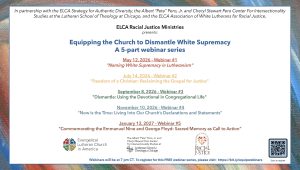
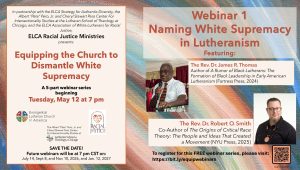
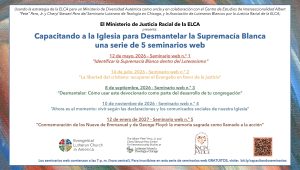
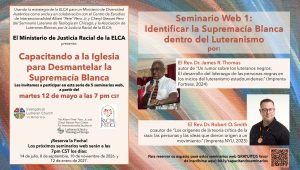
Equipping the Church to Dismantle White Supremacy: A 5-part Webinar Series

To register for this FREE webinar series, please visit: https://bit.ly/equipwebinars


Para reservar su espacio para estos seminarios web GRATUITOS favor de inscribirse aquí: https://bit.ly/equipwebinars


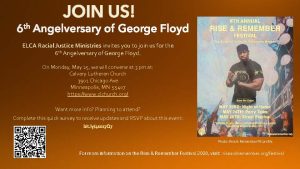
6th Angelversary of George Floyd

To register in English: bit.ly/4s017Q7 En espanol:  bit.ly/4eis0f9

Remembering the Emanuel Nine

June 17th is Emanuel Nine Commemoration and Day of Repentance. The following are shareable resources you can use within your local context for commemorations, services, and personal development. Further information and resources can be found on the ELCA’s Commemoration of the Emanuel Nine – June 17 webpage.


The following paragraph describing this commemoration could be provided for congregations in resources such as service folders.

Emanuel Nine, martyrs, 2015

On June 17, 2015, Clementa C. Pinckney, Cynthia Marie Graham Hurd, Susie Jackson, Ethel Lee Lance, DePayne Middleton-Doctor, Tywanza Sanders, Daniel Lee Simmons, Sharonda Coleman-Singleton, and Myra Thompson were murdered by a self-professed white supremacist while they were gathered for Bible study and prayer at the Emanuel African Methodist Episcopal Church (often referred to as Mother Emanuel) in Charleston, South Carolina. Pastors Pinckney and Simmons were both graduates of the Lutheran Theological Southern Seminary. A resolution to commemorate June 17 as a day of repentance for the martyrdom of the Emanuel Nine was adopted by the Churchwide Assembly of the Evangelical Lutheran Church in America on August 8, 2019. Congregations of the ELCA are encouraged to reaffirm their commitment to repenting the sins of racism and white supremacy which continue to plague this church, to venerate the martyrdom of the Emanuel Nine, and to mark this day of penitence with study and prayer.


In observance of the 10th anniversary of the tragic shooting of the nine martyr at Mother Emanuel African Methodist Episcopal Church in Charleston, SC, Bishop Eaton calls on us to “lament the wounds of the sin of racism that sow seeds of fear, division and hatred. Remembering the nine murders in Charleston is a commitment that our church must never forget.”


Additional Resources

Holding Space

The following reflection is cross posted from the Minneapolis Area Synod of the ELCA blog. The original post can be found here.
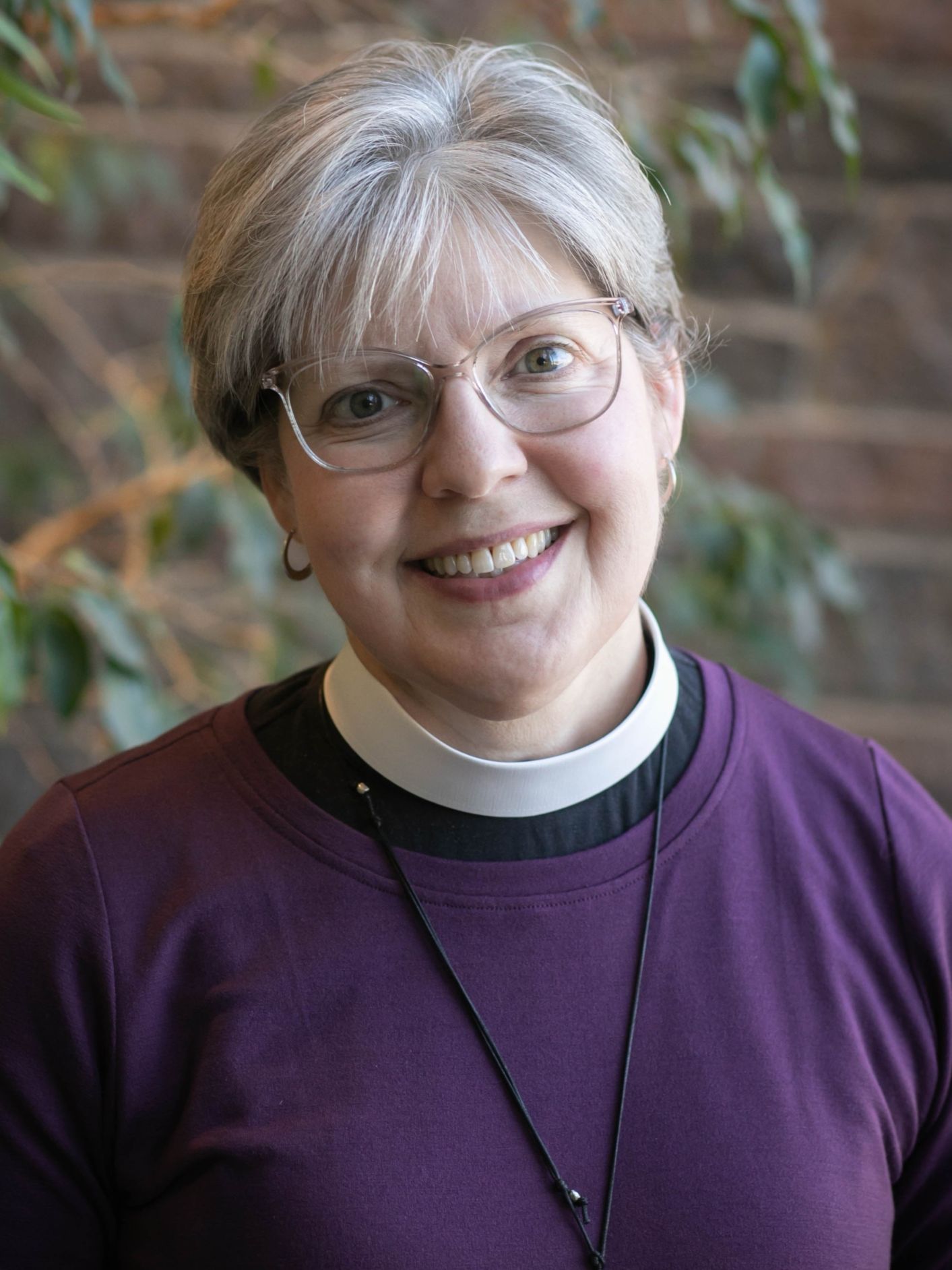

By Bishop Jen Nagel

When the day of Pentecost had come they were all together in one place . .  . Divided tongues, as of fire, appeared among them.”  – Acts 2 

May 25th marked the 5-year Angelversary of the murder of George Floyd. That Sunday evening, as part of the Rise and Remember Festival and at the invitation of the ELCA Racial Justice Ministries, I joined a number of you for a fabulous concert featuring Sounds of Blackness and a moving vigil. We gathered beforehand on the steps of Calvary Lutheran Church, just a block south of George Floyd Square. ELCA Racial Justice Director Jennifer DeLeon grounded us for the evening, reminding us that people come to this event holding both memories and hopes, lament and a call to action. If you haven’t been to George Floyd Square lately (or ever), consider making a pilgrimage and ask for a community guide to share this sacred space with you or your group.  
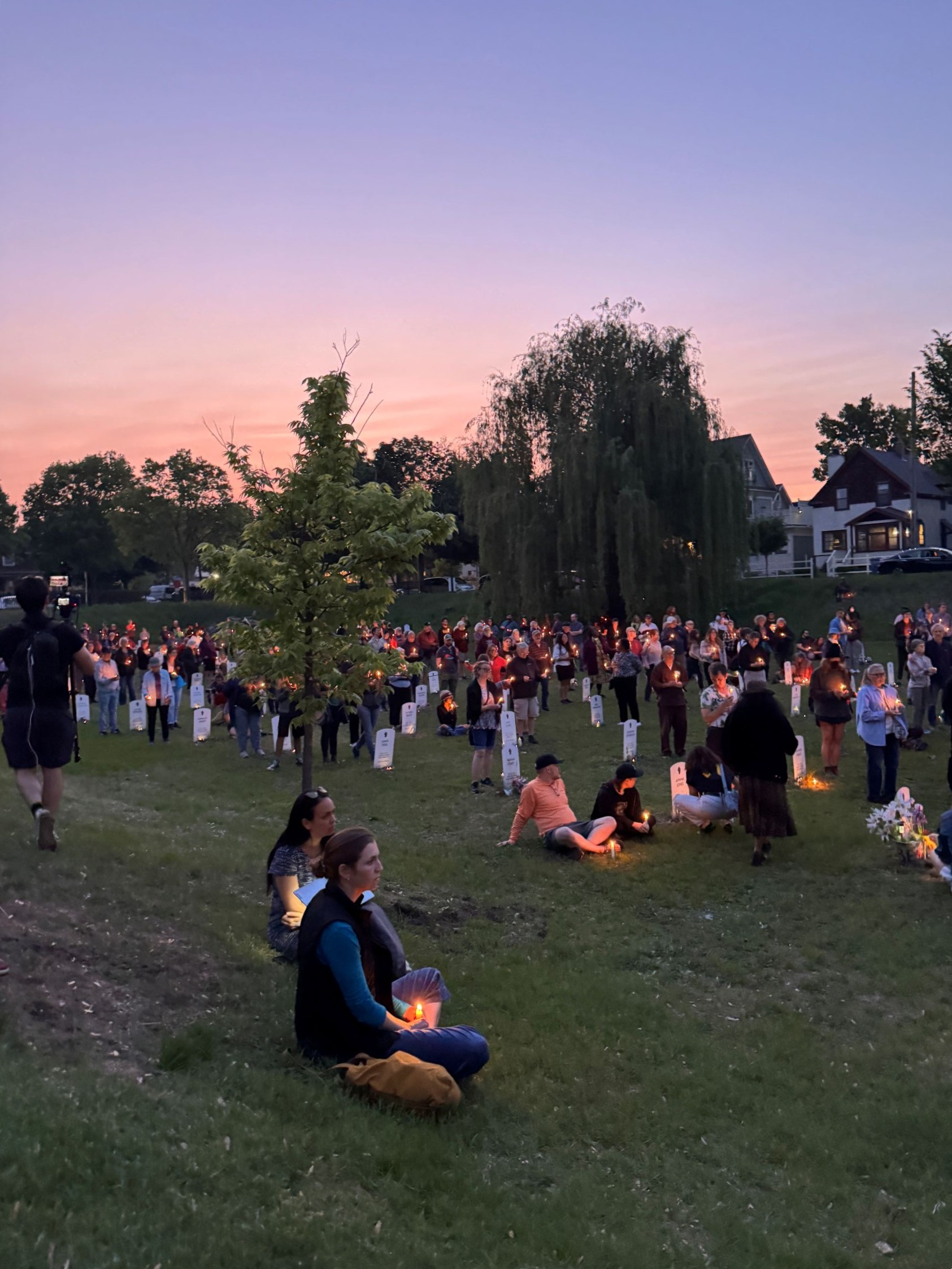
Photo credit: Pastor Melissa Pohlman

The sun was low when the concert ended. Theologian and community leader Jeanelle Austin stepped onto the stage to prepare us for the vigil. Volunteers quietly distributed candles. Now, let’s be clear: These were not the smaller candles we often hold during a Christmas Eve candlelight service, candles that flicker through a few verses of Silent Night and are soon extinguished. Instead, these were large tapers, ready for the long duration of the vigil and all it would include.  


Austin described the plan: With candles lit, Brass Solidarity would lead us north past the spot where George Floyd was murdered, past exhibits and memorials filled with the names and stories of BIPOC individuals from around the country who have been victims of systemic racism and violence. We would turn west and go a block to Say Their Names Cemetery where over a hundred symbolic headstones bear the names of Emmett Till, George Floyd, Philando Castile, Jamar Clark, and dozens more. Anticipating the moment, Austin explained that we should move down into the cemetery and find a headstone where we would “hold space” as the youth and young adult musicians of Kamoinge Strings played several pieces, and then we would close with a prayer.  
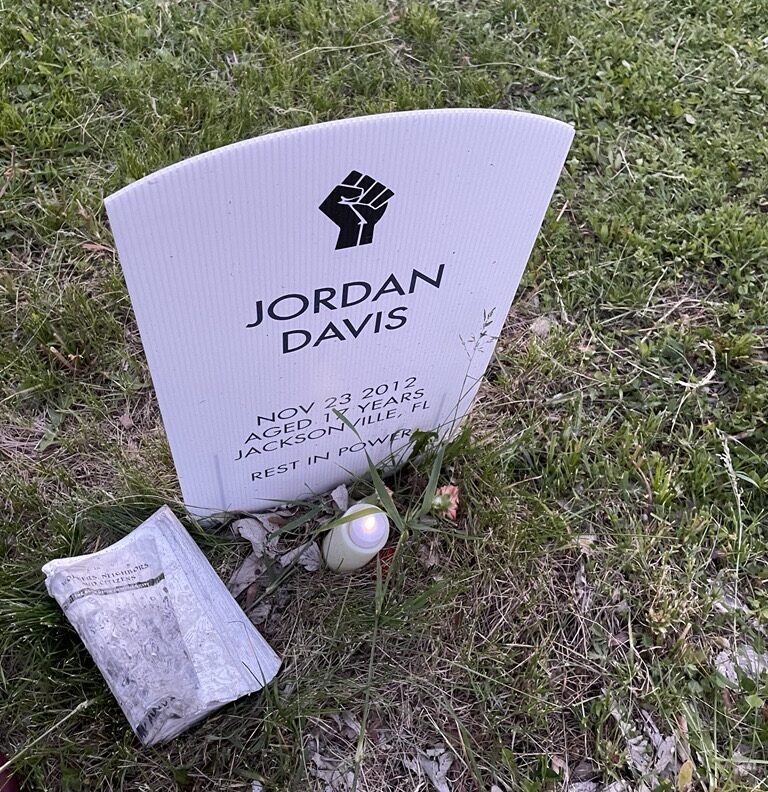
 

Holding space. As the sun set and night came, hundreds of us settled in around the headstones. Some people stood, some sat in the cool grass. Candle flames flickered and wax dripped. Music swelledIt was beautiful and incredibly sad all at once. I held space by the stone of a 17-year-old named Jordan Davis who was killed in Jacksonville, Florida, in 2012.  

Holding space means creating a safe — yet also brave — environment in which people, with all our emotions, can be present and remember. I keep thinking of exercise classes and how they remind me to engage my muscles as I move this way or that. Holding space means figuratively engaging our muscles. It takes time. It makes us tired. It can be uncomfortable. If we do it well, we’ll grow stronger, we’ll gain endurance. I find that holding space is often profoundly moving. It’s holy work.  

In times like these, the temptation is strong to move through these anniversaries – this pain, this trauma – passively, without really engaging. Holding space invites us into the vulnerable recognition that the world is not yet as it should be, and we are called to be present, engaged, honest to the grief and all the moment holds, and ready to be part of the change.  

This Sunday we’ll celebrate Pentecost and the Holy Spirit’s movement. We believe that love is stronger than hate, that life is stronger than death, and that together, by the Holy Spirit’s power, we can be part of God’s new creation. That was my prayer as we held space with the sun setting and the candles flickering. That is my prayer today. May it be so.  

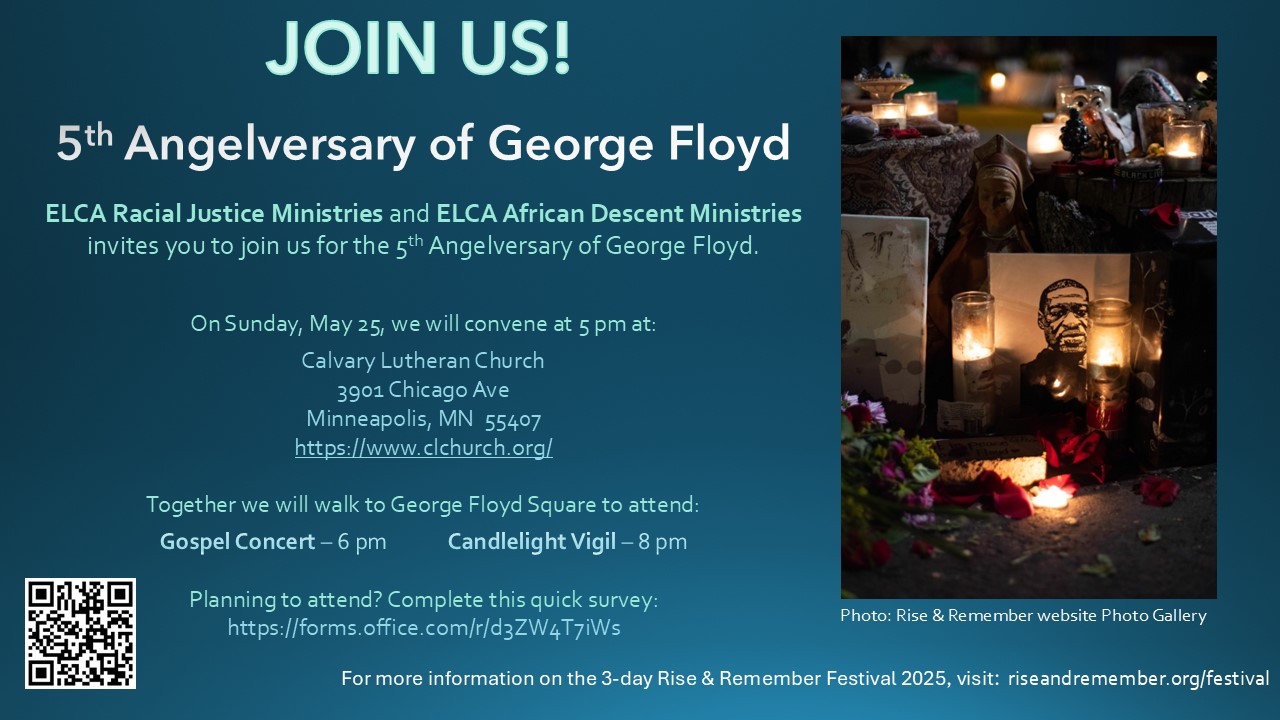
Join Us: 5th Angelversary of George Floyd

ELCA Racial Justice Ministries and ELCA African Descent Ministries invites you to join us at the Rise & Remember Festival in Minneapolis, MN. The 3-day, annual event “exists to hold in remembrance George Floyd and those we have lost unjustly to the pervasive impacts of systemic racism. Activities focus on education, empowerment, healing, celebration, and our collective pursuit for racial justice and equity.”

We hope you will join us for the gospel concert and candlelight vigil on Sunday, May 25. We will meet in front of Calvary Lutheran Church (clchurch.org) at 5 pm.

If you plan to attend, please let us know by completing this short, 6-question survey:  https://forms.office.com/r/d3ZW4T7iWs