
Skip to content
ELCA Blogs

ELCA Racial Justice

Truth, Honor and Remembrance: National Day of Awareness for Missing and Murdered Indigenous Women (MMIW) in the ELCA

In honor of National Day of Awareness for Missing and Murdered Indigenous Women, Girls, and Relatives (MMIWGR), which is observed on May 5 each year, ELCA Racial Justice Ministries invited Isabell Retamoza to write on this topic.
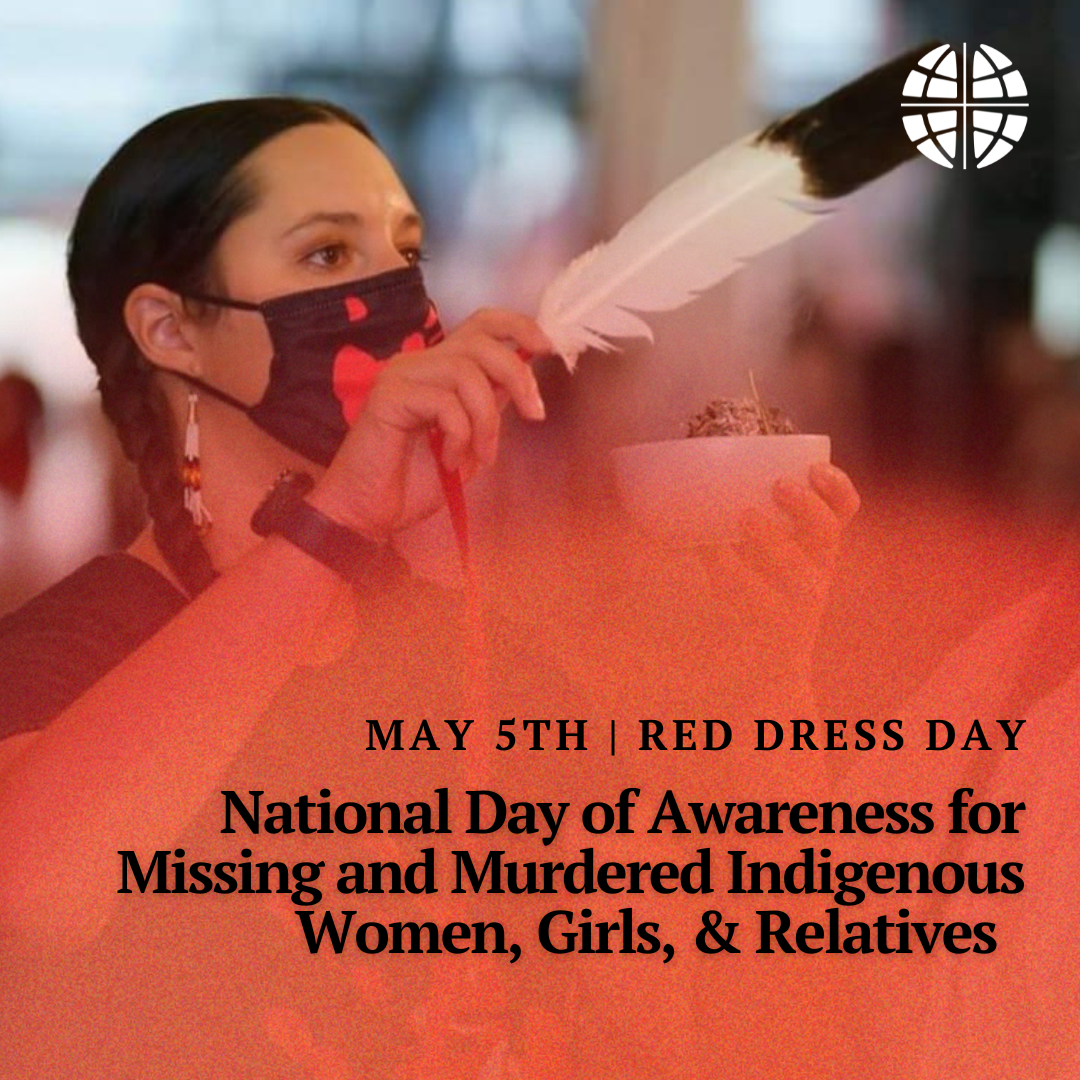

Truth, Honor and Remembrance: MMIW Awareness Day in the ELCA

By Isabell Retamoza

On May 5, communities across the United States will gather in remembrance and solidarity to honor missing and murdered Indigenous women (MMIW), girls and Two-Spirit people[1].

The alarming rates of abduction, disappearance and murder of Indigenous women, girls and Two-Spirit people represent one of the most devastating and ongoing injustices facing tribal nations and Indigenous communities. On some reservations, Native women experience murder rates more than 10 times the national average.[2] Two-Spirit individuals face exceptionally high levels of violence, with studies indicating that between 78% and 85% have experienced gender-based violence, sexual assault or physical violence.[3] These disappearances and deaths are frequently connected to domestic and dating violence, sexual assault, stalking, sex trafficking and other longstanding harms impacting Indigenous communities. Nearly 96% per of the time the perpetrators of this violence are non-Native men.[4] 

To honor and remember those lost, many people wear red or paint red handprints across their faces as symbols of visibility for those who have been made invisible. But MMIW Awareness Day is not only about remembrance; it is also a call to truth-telling and advocacy.

MMIW Day of Awareness calls us to:

  • Honor the lives of missing and murdered Indigenous women, girls and Two-Spirit people.
  • Raise awareness of the disproportionate levels of violence experienced by Indigenous families and communities.
  • Support community efforts of grassroots advocacy and organizing to change laws, policies, protocols and resource allocation at the tribal, federal and state levels.
  • Share and discuss the history of state-sanctioned violence perpetrated by the U.S. government against Indigenous people and communities to better understand the roots of this crisis and drive meaningful legal reform.

This crisis is neither isolated nor random. It is the result of centuries of state-sanctioned and structural violence. Rooted in colonization and genocide, U.S. policies forcibly removed Indigenous peoples from their ancestral lands, fractured families and kinship systems, and devalued Indigenous culture. These harms continue today through jurisdictional failures, underfunded services, extractive industries built near tribal lands, and systems that repeatedly fail to protect Indigenous women, girls and Two-Spirit people or that hold perpetrators accountable.

For the church, MMIW Awareness Day is also a moment of moral reflection. Christian institutions were often complicit in the systems that enabled this violence, including forced assimilation and boarding schools. Honoring this day meaningfully requires more than acknowledgment; it calls us to recognize the truth expressed through action, solidarity and sustained commitment to justice.

Honoring MMIW Awareness Day in Your Congregation

ELCA congregations can mark May 5 in meaningful and respectful ways, including:

  • Wearing red (T-shirts available from the ELCA) and taking pictures.
  • Using social media to raise awareness. Use the hashtags #MMIW, #NoMoreStolenSisters, #TruthandHealing and #ELCA 2.
  • Organizing a prayer vigil (with this resource).
  • Including MMIW in your congregation’s prayers for the day.
  • Saying the names of MMIW (especially meaningful if you research and identify MMIW specific to your region or locality) and lighting candles for them during worship.
  • Inviting (and compensating) a local Indigenous expert to share on this topic as part of your educational time.
  • Inviting (and compensating) local Indigenous musicians to play or sing during worship.

As members of the Evangelical Lutheran Church in America, we are called to bear public witness to truth, even when that truth challenges us. On May 5, may we commit ourselves not only to remembrance but to action that honors Indigenous lives.

For more information on how your congregation can get involved and honor MMIW Day of Awareness on May 5, please visit the ELCA website and download the MMIW Toolkit.

Isabell Retamoza is a citizen of the Cherokee Nation, a law student at the University of Illinois Chicago School of Law and is a member of St. Andrew Lutheran Church in San Diego.


[1]Two-Spirit is a term used by some Indigenous people to describe roles, responsibilities, and identities that exist outside colonial understandings of gender and sexuality. For many, Two-Spirit is interrelated to expression, language, tradition, and/or ceremony, often carrying inherent responsibilities to the well-being of the land and community.” Understanding The Term ‘Two-Spirit’ — Wabanaki Two-Spirit Alliance, https://w2sa.ca/two-spirit-library/understanding-the-term-two-spirit.

[2] National Indigenous Women’s Resource Center, www.niwrc.org/mmir-awareness.

[3] Balsam, Kimberly F., et al., “Culture, Trauma, and Wellness: A Comparison of Heterosexual and Lesbian, Gay, Bisexual, and Two-Spirit Native Americans, Cultural Diversity & Ethnic Minority Psychology, 2026, vol. 32, issue 2 (April), doi.org/10.1037/1099-9809.10.3.287.

[4]   The National Congress of American Indians Policy Research Center, Key Statistics | NCAI, https://www.ncai.org/section/vawa/overview/key-statistics.


Remembering the Emanuel Nine

June 17th is Emanuel Nine Commemoration and Day of Repentance. The following are shareable resources you can use within your local context for commemorations, services, and personal development. Further information and resources can be found on the ELCA’s Commemoration of the Emanuel Nine – June 17 webpage.


The following paragraph describing this commemoration could be provided for congregations in resources such as service folders.

Emanuel Nine, martyrs, 2015

On June 17, 2015, Clementa C. Pinckney, Cynthia Marie Graham Hurd, Susie Jackson, Ethel Lee Lance, DePayne Middleton-Doctor, Tywanza Sanders, Daniel Lee Simmons, Sharonda Coleman-Singleton, and Myra Thompson were murdered by a self-professed white supremacist while they were gathered for Bible study and prayer at the Emanuel African Methodist Episcopal Church (often referred to as Mother Emanuel) in Charleston, South Carolina. Pastors Pinckney and Simmons were both graduates of the Lutheran Theological Southern Seminary. A resolution to commemorate June 17 as a day of repentance for the martyrdom of the Emanuel Nine was adopted by the Churchwide Assembly of the Evangelical Lutheran Church in America on August 8, 2019. Congregations of the ELCA are encouraged to reaffirm their commitment to repenting the sins of racism and white supremacy which continue to plague this church, to venerate the martyrdom of the Emanuel Nine, and to mark this day of penitence with study and prayer.


In observance of the 10th anniversary of the tragic shooting of the nine martyr at Mother Emanuel African Methodist Episcopal Church in Charleston, SC, Bishop Eaton calls on us to “lament the wounds of the sin of racism that sow seeds of fear, division and hatred. Remembering the nine murders in Charleston is a commitment that our church must never forget.”


Additional Resources

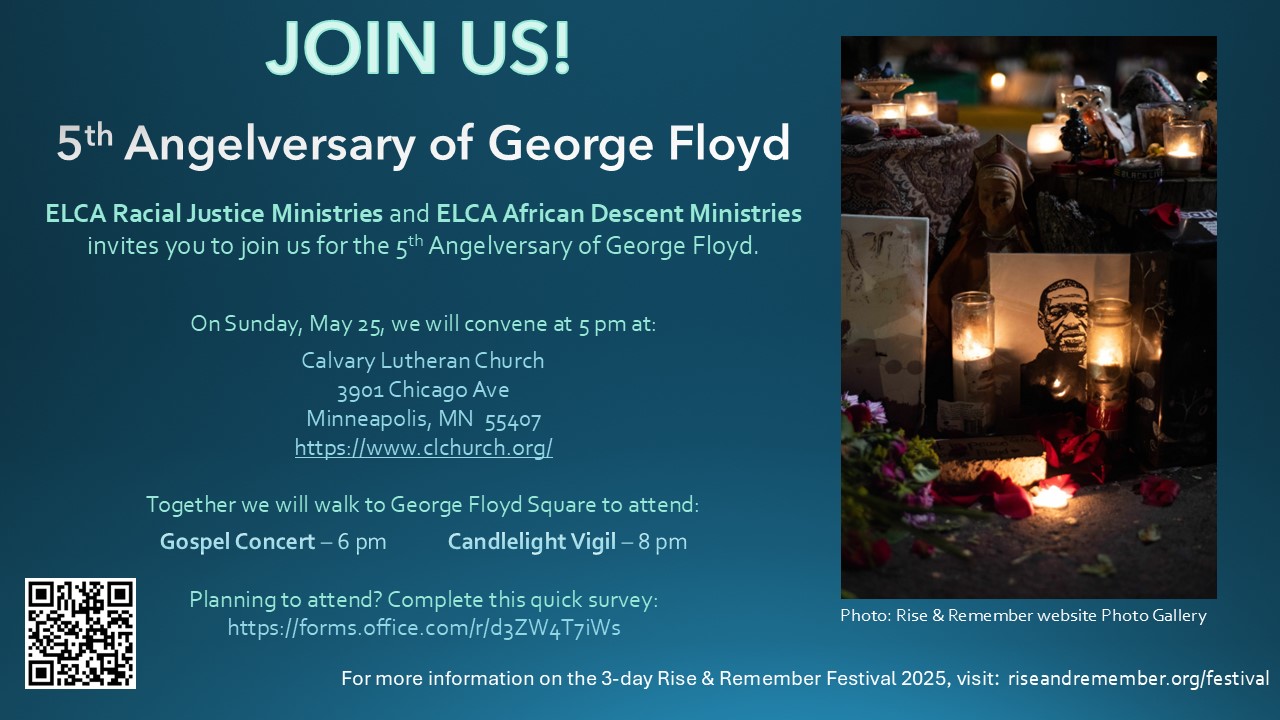
Join Us: 5th Angelversary of George Floyd

ELCA Racial Justice Ministries and ELCA African Descent Ministries invites you to join us at the Rise & Remember Festival in Minneapolis, MN. The 3-day, annual event “exists to hold in remembrance George Floyd and those we have lost unjustly to the pervasive impacts of systemic racism. Activities focus on education, empowerment, healing, celebration, and our collective pursuit for racial justice and equity.”

We hope you will join us for the gospel concert and candlelight vigil on Sunday, May 25. We will meet in front of Calvary Lutheran Church (clchurch.org) at 5 pm.

If you plan to attend, please let us know by completing this short, 6-question survey:  https://forms.office.com/r/d3ZW4T7iWs

Available NOW: DISMANTLE: An Anti-White Supremacy Lenten Devotional

Dismantle: An Anti-White Supremacy Lenten Devotional

This devotional was created in response to the call of the 2019 Churchwide Assembly to condemn white supremacy and racist rhetoric. As you journey through Lent, this resource will challenge you and bring you closer to the radical neighbor-love that Christ demands in the Gospels.

DOWNLOAD | DESCARGAR

Commemoration of the Emanuel Nine: Guest blog writer Desta Goehner

To commemorate the 9th anniversary of the martyrdom of the Emanuel 9 – Clementa C. Pinckney, Cynthia Marie Graham Hurd, Susie Jackson, Ethel Lee Lance, DePayne Middleton-Doctor, Tywanza Sanders, Daniel Lee Simmons, Sharonda Coleman-Singleton, and Myra Thompson, our beloved siblings in Christ who were murdered by a self-professed white supremacist and ELCA parishioner while they were gathered for Bible study and prayer at the Emanuel African Methodist Episcopal Church (often referred to as Mother Emanuel) in Charleston, South Carolina on June 17, 2015 – Desta Goehner, Board President of the ELCA Association of White Lutherans for Racial Justice to share some thoughts about this day of repentance.

For more ELCA resources visit:  Commemoration of the Emanuel Nine — June 17 – Evangelical Lutheran Church in America (elca.org)

See also:  Establishing_June_17th_as_Emanuel_9_Commemoration_and_Day_of_Repentance.pdf (elca.org)

Worship Resources:  Prayers_Litanies_Laments_Emanuel_Nine_Commemoration.pdf (elca.org)


As I gather with my congregation every Sunday for worship, my heart often turns to the Emanuel Nine. On June 17, 2015, nine faithful Black Christians were tragically shot and killed during Bible study at Emanuel African Methodist Episcopal Church in Charleston, S.C. This day stands as a somber reminder of the devastating consequences of racial hatred and violence.

What weighs heavily on my heart is the realization that the perpetrator, someone who grew up in a Lutheran congregation like mine, could commit such a heinous act. It compels me to confront uncomfortable questions about the environments and influences that shaped him — the people he interacted with at home, at school, at church and at work. He was one of us.

This is why White Lutherans for Racial Justice exists within the ELCA. We recognize our collective responsibility as white members of a predominantly white denomination to address the systemic racism that permeates our congregations, our synods, our institutions and our own hearts. The ELCA has issued resolutions, statements and apologies, but we have done very little to repair the ongoing harms caused by racism.

The burden of dismantling racial injustice cannot fall solely on the shoulders of people of color. As a white person, I must actively engage in the work of racial justice and equity. Yet I often shy away from relinquishing my power, my influence, my comfort. I’ve been conditioned to fear discomfort and confrontation, but I cannot allow that fear to paralyze me.

I have succumbed to this fear many times and certainly will again. I have also been the person to ask the hard questions and have felt the repercussions of that. Whiteness tells me to crawl back into my enclave, but my faith calls me out of that space. I trust that the Holy Spirit will lead and guide me as I lament and repent of my participation in white supremacy as a white, liberal, progressive Lutheran cis woman.

Whiteness exerts immense pressure, but I must not let it crush my resolve. I have witnessed how the weight of whiteness has led white leaders to falter, inflicting harm upon others without adequate accountability or restitution. We must acknowledge the risks inherent in naming injustice and asking hard questions that challenge harmful systems and processes.

We need each other in this journey toward racial justice. We need relationships that hold us accountable, that challenge us to confront our biases and privileges. Who are you building relationships with that offer different perspectives? It’s through these connections that our hearts change.

We must follow the leadership of people of color within our church, amplifying their voices and advocating for change. As we approach the 2024 United States presidential election, we cannot wait until after the fact to take action. Black and brown lives are at stake every day, not just during moments of political turmoil.

Commemorating June 17 as a day of repentance within the ELCA is a meaningful step toward acknowledging the legacy of racism within our church. But our work doesn’t end there. Racial justice is not an abstract concept; dismantling the structures of inequality that perpetuate racism requires tangible action. Join us in this ongoing journey toward racial justice. Together we can create a more just and equitable world where the lives of Black and brown people are valued and protected.

Reach out to your ministry leaders and ask them to include prayers of repentance in worship, and use resources on the ELCA Racial Justice website. Invite your congregation to use these resources in worship, in Bible study, on social media and in newsletters. And then notice whether your congregation commemorates June 17. If they do, express your support! If they don’t, gently inquire why not and advocate for change.

We believe in the power of community and the transformative potential of collective action. White Lutherans for Racial Justice welcomes people at all stages of their racial justice journey. Join us!


Bio: Desta Goehner is president of the Association of White Lutherans for Racial Justice and the Director of Thriving Leadership Formation, with 27-plus years of serving in different expressions of the ELCA. She is a trauma-informed spiritual director and a professional Enneagram coach for people and teams in ministry, specializing in conflict resolution, facilitation, leadership and spiritual formation. Desta’s work is dedicated to fostering racial justice, personal growth and healthy, anti-racist leadership in faith communities. For more about her visit linktr.ee/destag.

For more information on The Association of White Lutherans for Racial Justice visit: website|Facebook