In honor of International Day for the Elimination of Racial Discrimination, ELCA Racial Justice Ministries invited the Rev. Aimée Appell, MDiv DMin to share some thoughts about the Triennial Assembly of the European Descent Lutheran Association for Racial Justice and their work to end racism and dismantle white supremacy.
-

- Shari Seifert is pictured with Jennie Leenay, a community leader, fashion designer, and organizer of the People’s Closet, who told the Lutherans during the panel discussion at the Assembly, “We already have a Savior. We don’t need other saviors. We need resources and opportunities. We need people who want to make a friend, to know our names. People who want to have a conversation.”
-

- The day ended with an author event facilitated by Dawn Rundman, of 1517 Media, the ELCA publishing house. The Rev. Angela T. !Khabeb, the Rev. Jenny Sung, Dr. Kelly Sherman-Conroy, Dr. Starr Brown, and Shari Seifert have each authored books and chapters calling white people to bear witness to racial violence and collaborate for racial justice. Seifert said, “I am deeply thankful to my fellow authors who showed up and shared their wisdom.”
-

- The heart of the Assembly was a pilgrimage to the George Floyd Global Square, a living memorial for individuals and organizations to unite, remember, and resist racial injustice with victims and their families. Angela Harrelson, George Floyd’s aunt, and five other community leaders from the George Floyd Global Memorial shared with the assembly about how racial violence affects their families and neighborhoods. Outgoing president Shari Seifert said, “We are so grateful to George Floyd Global Memorial and the community members, Linda Taylor, Marquise Bowie, Jenny Leenay, Kia Bible, Georgio Wright, and Angela Harrelson who shared their stories, encouraged us to act in our communities, and guided us through a pilgrimage through George Floyd Square.” Seifert is also a resident of Minneapolis, a community member at George Floyd Square, and a member of Calvary Lutheran Church, one of the assembly’s hosts.
-

- The Assembly elected new Board members and officers. In the photo above, first row: Dr. Robin Lauermann, PhD, (Lower Susquehanna Synod), Janet L.K. DeVinney (Delaware-Maryland), Rev. Dr. Dawn Roginski, secretary (Sierra Pacific), Kinna Marie Nordstrom Kemp (Arkansas-Oklahoma), Rev. Dr. Aimée Appel (Central States). Second Row: Rev. Dr. Joy McDonald Coltvet (St. Paul Area), Jaye Summerlot (Metro DC), Rev. Michael Wilker, vice president (NE Iowa), Rev. Jennifer Thomas, treasurer (Central States), Desta Running Goehner, president (Southwest California). Not pictured: Rev. Amy Wiegert (Metro Chicago) and Deacon Steven Beumer (Florida Bahamas).
-

- Conie Borchardt from Music That Makes Community leads opening worship.
-

- Organizing and Education teams meet and plan.
-

- Organizing and Education teams meet and plan.
-

- At the worship service, the Rev. Dr. Jia Starr Brown preached. “In Micah 6:8, the prophet reminds us that God requires us to ‘do justice, love mercy, and walk humbly with our God.’ The Hebrew word used for ‘mercy’ is hesed which translates to deep, loving relationship, loyal and unfailing.”
The Triennial Assembly of EDLARJ (the European Descent Lutheran Association for Racial Justice, newly changed to White Lutherans for Racial Justice) was held in Minneapolis, Minn., March 1-3. A large part of our time together was spent in a pilgrimage to George Floyd Square. What I saw and experienced there changed my understanding of love and pushed my thinking about fear, as I witnessed what it means to say that “perfect love casts out fear” (1 John 4:18).
I don’t need to tell you how often our cultural conversation limits love to an emotion. You’ve heard the songs and seen the shows and bought the cards. It is so difficult to find pop culture examples of love beyond romance that when Anna and Elsa’s sister love was the focus of Frozen, it was worthy of commentary. But repeatedly during our pilgrimage and our resulting conversations, we witnessed love as an action.
The community in George Floyd Square has been meeting daily for over a thousand days now to love one another through action. They have brought their individual gifts together to become love for their neighbors. Jennie Leenay used her fashion background to create The People’s Closet, where clothing of all kinds is available for free to those who need it. Similar projects have created a library and a garden center, each tended by volunteers. Marquise Bowie greets visitors and urges them to do the difficult work of love-in-action in their home communities, standing with victims of injustice and educating their neighbors. Community members offer their time and their stories so that pilgrims to the square leave educated about what happened there. And every day, morning and evening, the community gathers, lights a fire in the firepit and checks in, offering mutual support, listening for what is needed and loving one another. With action.
This is the kind of love that casts out fear. As our preacher, the Rev. Dr. Jia Starr Brown, reminded us at the end of our pilgrimage day, action love is the prerequisite for the emotional, sentimental kind of love that we usually talk about. “I do not enter into … relationship with anyone who does not actively work for my overall good: defending my character and advocating for my justice when it is questioned, compromised or stolen. And neither should you.”
This action-love draws us toward one another, even toward those we might not actually like. I don’t have to particularly like someone to provide them with clothing, food, shelter, safety. I just have to love them. And in loving them, I find that I fear them less. I am drawn into their community, and we become family, because family take care of one another. Family love one another, even if they don’t like one another.
1 John (and Martin Luther) remind us that we often give a lot more energy to fear than to love. The power of fear drives our economy — everything from deodorant sales to car sales to the military industrial complex is based in fear. Our political system has become so bogged down by fear that it barely functions anymore. Fear of neighbor, fear of embarrassment, fear of poverty, fear of death, fear of immigrants, fear of “those people.” We give our attention, our time, our money to fear.
This is why we are to fear and love God above all else. If we fear God above death, poverty, embarrassment or (most especially) other people, our neighbors, then we will give our attention, time, money, even our whole selves, to God, who is Love — Love as Action. God is love so deep, so radical, so active, that God could not sit still waiting for us to come to God. God’s active love came to us and showed us just how powerful Love as Action can be. Powerful enough to overcome death and to cast out fear, giving us the strength, courage and love to stand in solidarity with marginalized people throughout our community, and throughout the world.
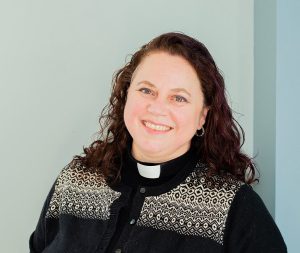
Rev. Aimée Frye Appell holds an M.Div. degree from Luther Seminary in St. Paul, Minn, and her Doctor of Ministry from Columbia Theological Seminary in Decatur, Ga. She has served as solo pastor at Peace Lutheran Church in Washington, Mo., since 2010. Since January 2021 she has served half-time at Peace and half-time as director for evangelical mission in the Central States Synod of the ELCA. She has also lived and worked in Washington, D.C.; Seattle, Wash.; Anchorage, Alaska; St. Paul, Minn.; and Provo, Utah.
Pastor Aimée was ordained in 2010. In her time at Peace Lutheran she has helped the congregation grow into community leaders as a congregation “Bound by Christ, to Break Boundaries.” Together they have spearheaded several initiatives to build inclusion and dialogue in their community, including Vacation Culture School, Stories Matter, a local Juneteenth celebration and a series of community book discussions. In 2017 she received the Humanitarian Award from Church Women United of Franklin County Missouri. In 2018 she and her congregation received the Clergy Renewal grant from the Lilly Foundation.
After sabbatical with her family in South Africa and France, Pastor Aimée began working on a Doctor of Ministry degree, focused on anti-racism in the ELCA. In addition she has worked with the City of Washington to develop its Community Relations Committee, with the goal of building and nurturing inclusive community as their regional demographics change. She serves on the Central States Synod’s Racial Justice Team and on the board of the Association of White Lutherans for Racial Justice.
When not focusing on her call, she can be found spending time with family, knitting, crocheting, reading or gardening. She is mother to four wonderful children – Elinor, Holden, Grace and Abby (as well as three dogs, one cat, a snake, a gecko, a bearded dragon, a bullfrog and a pet rat). She and husband Nelson, who is director of the Washington Public Library, have been married since March 2000.