The following is shared from the Lutheran Advocacy Ministry in Pennsylvania (LAMPa) newsletter for Wednesday, April 9, 2025.
|
||||||||||||||||
|
The following is shared from the Lutheran Advocacy Ministry in Pennsylvania (LAMPa) newsletter for Wednesday, April 9, 2025.
|
||||||||||||||||
|
In honor of Arab American Heritage Month, ELCA Racial Justice Ministries will be elevating the voices of our Arab and Middle Eastern Descent peers and reposting their works from others sources around the ELCA. The following article is cross-posted from Living Lutheran online. The original post can be found here.
April 1, 2025

Rodny Said, a pastor of the Evangelical Lutheran Church in Jordan and the Holy Land (ELCJHL), leads a children’s sermon at the Church of Hope in Ramallah. Photos: ELCJHL

Said leads a bible study with youth during a youth retreat in Jordan.

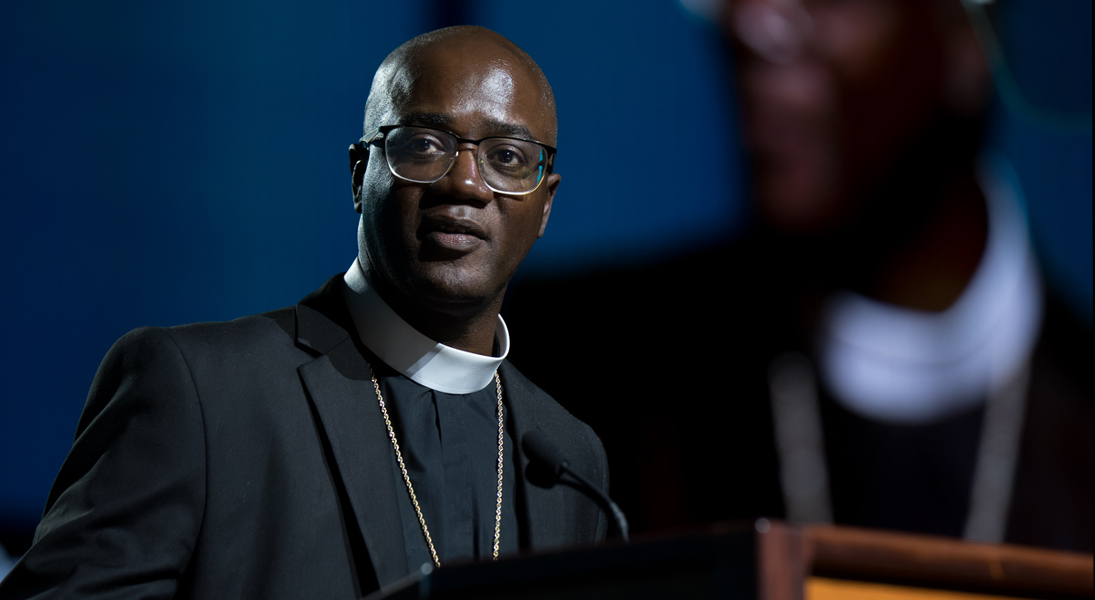
Sani Ibrahim Azar, bishop of the ELCJHL, delivers a sermon at the Church of Hope.
Two spouses living in two places—kept apart by two kinds of government ID.
It may sound like Romeo and Juliet, but that was life for Rodny Said, a pastor of the Evangelical Lutheran Church in Jordan and the Holy Land (ELCJHL).
With a Jerusalem ID, Said could cross the checkpoints between his East Jerusalem home and his congregation, the Lutheran Church of Hope in Ramallah. His wife lived with her parents because she couldn’t enter East Jerusalem with her Palestinian ID.
“We started the process of reunification, as the Israeli government calls it,” he explained during an Advent Pilgrimage 2024 webinar, “but it can take years for a person from East Jerusalem and a person from the West Bank to live together.”
Fortunately, Said’s wife received her permit shortly after the webinar, and the couple can now live and travel together between the two communities.
The webinar series was a program of Sumud, the ELCA’s initiative for justice in Palestine and Israel. Previously the ministry was known as Peace Not Walls, named after the 440-mile barrier wall that the Israeli government was building to separate Palestine from Israel. The wall is complete today.
Sumud, an Arabic word meaning “steadfast,” conveys the determination it takes to be a Palestinian Christian. “Palestinians struggle to get to work, to universities, to churches and schools,” Said noted in the webinar. Since the onset of the Gaza War in 2023, many lost their jobs because they are no longer allowed to work in Israel. Many families are separated even though they live just a few blocks apart.
Life has gotten so difficult that the number of Christian families—already only 1% of the West Bank population—who are leaving is increasing. “They don’t see a future,” he said.
Emigration “means more pressure on us as a Christian community,” Said noted—especially for the ELCJHL, whose six congregations and four schools are supported by only 2,000 members.
“I think the easiest way is to leave,” Said added, “and the hard and painful way is to stay.”
Staying put, enduring and never giving up hope—that’s sumud. Through the initiative, the ELCA seeks to accompany Palestinians in their daily lives and advocate for peace with justice in Palestine and Israel.
For Maddi Froiland, program director for Sumud, a prime goal is making ELCA members more aware of what life under occupation is like.
As someone who spent four years in East Jerusalem and the West Bank—one as a Young Adult in Global Mission (YAGM) volunteer and three years as communications officer for the ELCJHL—Froiland watched Christians live out Luke 6:31 (“Do to others as you would have them do to you”) even with soldiers who had arrested their sons. “The experience,” she said, “made me redefine what it means to be a Christian.”
Froiland said Sumud’s webinar series drew over 100 viewers who heard ELCJHL pastors and youth group members share stories of “resistance through existence” by living and worshiping together under occupation. Attendees heard their main message: Christians living in the Holy Land need to know someone is listening to and supporting them.
The Sumud initiative, Froiland said, “underscores that justice in Israel and Palestine means everyone has dignity and human rights. Right now the people who are lacking human rights are our Palestinian partners.”
Froiland is building synod-level networks of Palestinian Christians, YAGM alumni and others who can share their experiences in the region. “These networks will build communities that are both aware of the context of our siblings in the ELCJHL and are empowered through their faith to advocate for justice in Palestine and Israel,” she said.
A new ceasefire currently being negotiated between Israel and Hamas could open the door for healing and recovery from a war marked by violence and displacement. The ELCA supports that process through Sumud, Lutheran Disaster Response, the ELCA Middle East and North Africa desk, and deployed personnel in the region. Witness in Society, the ELCA’s public advocacy team, continues to advocate for a negotiated resolution to the Israeli occupation of Palestine and to ongoing acts of violence.
On the ground, the ELCJHL creates possibilities for Palestinian Christians. “We do this through offering quality education for our youth, diaconal ministry for the vulnerable, environmental ministry for God’s creation, gender justice ministry and supporting our youth,” said Sani Ibrahim Azar, bishop of the ELCJHL.
“To us, sumud means to stay in our country and continue bearing witness as the Indigenous Christians of this land. This important and meaningful Arabic word … gives us strength—that we are not alone, we have our partners, our brothers and sisters, who will be steadfast in accompanying us.”

In honor of International Day for the Elimination of Racial Discrimination (March 21), ELCA Racial Justice Ministries invited the Dr. Robin Lauermann, Ph.D. to share some thoughts about the annual board retreat held in Montgomery, AL of the ELCA Association of White Lutherans for Racial Justice and their work to end racism and dismantle white supremacy.

Front exterior of The Legacy Museum, a civil rights museum, explaining the civil rights movement in the US, in Montgomery Alabama, United States. Photo: Equal Justice Initiative

One of the first exhibits in the Legacy Museum. Photo: Equal Justice Initiative/Human Pictures

The National Memorial for Peace and Justice. Photo by Equal Justice Initiative https://legacysites.eji.org/about/memorial/
In late January, as part of the annual board retreat of the ELCA Association of White Lutherans for Racial Justice, I moved attentively through the Legacy Museum, established in Montgomery, Ala., by the Equal Justice Initiative (EJI). With my mind spinning from its stark and stimulating exhibits, which present the history of white supremacy from slavery to segregation to mass incarceration, I entered the final exhibit hall to see a familiar face: that of Anthony Ray Hinton. My heart leaped in instant recognition, with a mix of lament and joy.
I had learned about Hinton when I first visited Montgomery in 2016 as part of a multistate civil rights tour, meeting with veterans of the movement and visiting such important sites as the EJI offices. Staff members there explained the initiative’s work challenging injustice in the legal system, through both legal representation and policy advocacy. Their remarks expanded what I had learned from the book Just Mercy: A Story of Justice and Redemption, whose author, Bryan Stevenson, is founder and executive director of the EJI.
Due to mistaken identity, Anthony Ray Hinton was wrongly convicted of two murders and spent 30 years on death row. Ultimately EJI secured his release. Most poignant to me was a video that covered Hinton’s reentry into society: the scope of the years taken from him was shown by his learning to use technology unavailable before he was incarcerated — not a cell phone, not satellite radio, but an ATM. An ATM! As soon as Hinton’s book, The Sun Does Shine: How I Found Life, Freedom, and Justice, was published in 2019, I read it and reflected anew on the challenges his story revealed about the criminal justice system.
When I saw Hinton’s face in a museum display, he gazed at me from a row of visitation carrels. He wore prison scrubs and sat in a stark room. I approached the display, lifted a phone handset from the wall and listened as Hinton briefly recounted his story, his gaze never breaking from mine. His visual state contrasted with my knowledge of his freedom, and I thought again of him learning to use the ATM.
I continued around the room, stopping to hear from others. I listened intently to Kuntrell Jackson, who shared how his sentencing to life in prison at age 14; EJI would later represent him before the Supreme Court in a case that would overturn mandatory life sentences for children. Monica Washington told me about her sexual assault by a prison guard; EJI’s complaint would lead to a federal investigation of widespread abuse and to prosecutions of corrections staff. Hinton, Jackson and Washington were just three of the people whose stories were shared in the exhibit and for whom EJI has advocated.
The retreat weekend was both intense and inspiring. In addition to the museum, we visited EJI’s National Memorial for Peace and Justice, which commemorates of racial terror lynchings that began in the South at the end Reconstruction. These visits renewed my lament at the way white supremacy has dehumanized others, disregarding their creation in the image of God. However, the visit also inspired hope, even amid backsliding government policies designed to protect the rights of marginalized communities. Encounters with history provide us with models of courage and strategy by leaders. The work of EJI shows the possibility of contemporary nonprofit and other collective efforts to promote change. Hinton’s story likewise stands at the crossroads of two legacies: one of disregard and violence, the other of advocacy and hope.
Robin Lauermann holds a Ph.D. in political science and is currently completing a certificate in theological studies at United Lutheran Seminary. She teaches and researches political behavior, institutions and change in U.S. and comparative politics. Robin currently serves as a board member of the ELCA Association of White Lutherans for Racial Justice.

This devotional was created in response to the call of the 2019 Churchwide Assembly to condemn white supremacy and racist rhetoric. As you journey through Lent, this resource will challenge you and bring you closer to the radical neighbor-love that Christ demands in the Gospels.
To honor Transgender Day of Remembrance which is observed on November 20 each year, ELCA Racial Justice Ministries invited Vicar Vica-Etta Henrietta Steel to share some thoughts with our readers.
Each year, on Nov. 20, the Transgender Day of Remembrance is observed across the nation. Each year, the vast majority of the transgender people who are murdered are Black and brown transgender women. People gather to mourn, to light candles, to say the names of those who have been murdered.
Each year we gather. Each year.
The Transgender Day of Remembrance is a day to call for justice for transgender people. The day of remembrance is a day to call for racial justice. The harm done to our transgender family in this nation, and across the world, is a racial justice issue.
The transgender community is under constant and growing attack. Over half the states in the nation have enacted or are considering laws that take medical care, safety and opportunities from our transgender family (for more details, see Erin Reed’s “Anti-Trans Legislative Risk Assessment Map: September 2024 Edition”). According to Nature Human Behavior, rates of attempted suicide by youth and young adults have skyrocketed, up to 72%, in states where anti-transgender legislation has been enacted. These laws harm all of us, but the greatest harm is done to those who face multiple marginalizations, specifically BIPOC, disabled or neurodivergent people. Too often, people in America have become injured to the reality of murder and harm. Complacency becomes complicity and the horror of murder being normalized in the broader society is magnified in our marginalized communities.
I cannot speak here of all the harm done to transgender people. It would be too much for you to read. It is too much for my heart to take. All I can do is share some of what I experience as a Queer woman who is transgender and lesbian. I am white. I tell you this because when I came out to the world, when I lost access to the privilege afforded me as one who had presented as if I were a white man, I learned how much privilege I hold, still.
When I tell you that I have learned to be wary of police and cautious of men, do you understand that as privilege? My wariness grows from a fear that, if I am arrested, a person who carries authority in a gun will place me in a holding cell with men. I do everything I can to avoid that harm. When I travel alone, I drive the speed limit and obey all traffic laws. If I see police officers at a roadside gas station, I get back on the road and continue driving. I take precautions to make certain it is safe for me to use the same bathroom other women use. (I always travel with a change of clothes and other materials so I can avoid a stop if it isn’t safe.) Do you understand the danger we who are transgender face in this world where our right to exist is open to debate? Where we are not allowed to be present when cis people legislate or argue our fates? Where fear of our existence is sold across the nation for the political gain of those who prosper from harm? Where even people and organizations that claim to be our allies choose silence in the face of open expressions of transphobia? The need to be safe is a real concern. Also, I do not fear being shot by those same police for simply existing. It is my privilege to fear rather than experience the unjust incarcerations that are the reality for far too many Black and brown transgender women (for a more detailed analysis, see the Movement Advancement Project report “Unjust: How the Broken Criminal Justice System Fails Transgender People”).
I write here to share that it is long past time for us all to speak with and lift the voices of our transgender family, especially the Black and brown women in our circles. The Transgender Day of Remembrance is a day of racial justice. Trans joy and trans uplift are racial justice issues. I hope that we all integrate the work toward justice for and with Queer communities, especially transgender communities, into the work toward racial justice.
As core work toward racial justice, I urge you to follow the writing of Black transgender women who help everyone understand transgender people’s stories of pain and joy. If you don’t know where to start, I offer the leadership of Imara Jones and her work at TransLash.org. Seek out Transgender Day of Remembrance services in your communities or online. Find and say the names of those murdered each year. I pray that we all begin.
![]()
Vica-Etta Henrietta Steel is in ministry at St. John’s Lutheran Church in Madison, Wis. She is also the developer of JustBe Ministry, an inclusive ministry in the public square, rooted in Queer community with a focus toward centering BIPOC Queer voices and the voices of all who have been historically and are currently excluded. She works to lift trans joy in a world that gives us so much pain.
In the United States, November is Native American Heritage Month. Racial Justice Ministries would like to elevate the voices and work of our Indigenous siblings by bringing attention to the multitude of events by the ELCA’s Indigenous Ministries and Tribal Relations. A full list of offerings for this month can be found here, but there are three events that we would especially like to highlight:
Sunday, November 10, 2024 – ONLINE
7 – 8:30 p.m. Central time
Hosted by the Quaker Church’s Friends Peace Teams, Vance Blackfox and Liz Andress will be joining representatives from Catholic, Episcopal, Presbyterian, Methodist and Quaker faith communities to discuss how churches are re-examining the roles their denominations played in operating Indian boarding schools during the 19th and early 20th centuries, in collaboration with the federal government’s policy of forced assimilation. They will talk about the harm done to Native American families and nations as well as the ongoing impacts on Native communities today. Representatives from these communities will share how they are conducting research and approaching questions of accountability, apology, reparations, and healing.
Monday, Nov. 18, and Tuesday, Nov. 19 – ONLINE
In 2013 the annual American Indian and Alaska Native Symposium at the Lutheran School of Theology at Chicago (LSTC) was renamed in honor of Vine Deloria Jr., an alum of Augustana Seminary in Rock Island, Ill. (a predecessor school of LSTC). The symposium has been held in November every year since it began 16 years ago and is co-sponsored by the Pero Center for Intersectionality Studies at LSTC and ELCA’s Indigenous Ministries and Tribal Relations.
All events will be accessible online, and this year’s symposium will focus on Deloria’s book Custer Died for Your Sins.
At the height of the American Indian Movement and beyond, Vine Deloria Jr. played a significant role in strengthening tribal sovereignty for federally recognized tribes in the United States, from serving as executive director of the National Congress of American Indians to serving as a law professor at the University of Arizona during his retirement and so much in between. In Custer Died for Your Sins, Deloria writes about the challenges posed to Indigenous people by non-Native people, the U.S. federal government, churches and others. He offers new ways of thinking about those challenges and a philosophy for how Native Nations and leaders of the American Indian Movement and others might respond. Deloria offers both pragmatic and philosophical wisdom about moving forward toward justice. We challenge readers to consider the questions “How much has changed?” and “Might we still be dealing with similar challenges even today?” Symposium participants will hear from scholars and leaders, who will reflect on the text and how Deloria might be speaking to us today about the challenges we face and how we should respond.
Vine Deloria Jr. Theological Symposium
Presenter information to be posted here soon!
LINK COMING SOON
NEW: A discussion guide is now available to help readers think more deeply and critically about Custer Died for Your Sins, the wisdom that Vine Deloria Jr offers therein, and the challenges Indigenous people still face today. Download the guide below and begin a Truth and Healing Movement Reading Circle with members of your community.
Thursday, Nov. 28, 2024 – Patuxet (Plymouth, Mass.)
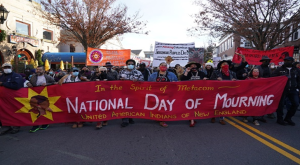
Since 1970 an annual march and rally organized by the United American Indians of New England (UAINE) have taken place on the fourth Thursday in November, a day known as the Thanksgiving holiday in the United States but a day that many Indigenous people and supporters have come to know and commemorate as the National Day of Mourning. This tradition and commemoration serve as a solemn occasion to honor Native ancestors and Wampanoag stories while fostering greater awareness and understanding among the U.S. public about the destructive presence of pilgrims and settlers in and around Patuxet, also known as Plymouth.
You are invited to Patuxet (Plymouth, Mass.) to stand in solidarity with the Wampanoag people and the United American Indians of New England at this year’s National Day of Mourning and to gain deeper insight into their vital mission.
If you are interested in joining us on Patuxet (Plymouth, Mass.) for the National Day of Mourning, please contact Jennifer De Leon, ELCA director for Racial Justice, by clicking HERE.