Skip to content
ELCA Blogs

ELCA Racial Justice

Observing Native American Heritage Month: ELCA Indigenous Ministries and Tribal Relations events

In celebration of Native American Heritage Month which is celebrated in the United States in November, we share the following article which is cross-posted from Living Lutheran. The original post can be found here.


Observing Native American Heritage Month

ELCA Indigenous Ministries and Tribal Relations events

November 12, 2025

Native American Heritage Month

iStock.com/Yulia Novik

ELCA Indigenous Ministries and Tribal Relations is a program team of ELCA Ministries of Diverse Cultures and Communities, which focuses on fostering relationships rooted in mutual respect, spiritual solidarity and cultural understanding. For November, the team is asking the church, its congregations, its members and its affiliated ministries to seek ways in which to observe Native American Heritage Month. Here are two possible ways that you might participate.

Vine Deloria Jr. Theological Symposium | Nov. 10-12

Hosted by the Lutheran School of Theology at Chicago (LSTC) in partnership with Indigenous Ministries and Tribal Relations, the annual Vine Deloria Jr. Theological Symposium honors the renowned Indigenous scholar, activist, theologian and LSTC alum, who died in 2005 at age 72. For the 15th annual symposium, community leaders, students and faith leaders will gather to discuss Indigenous justice, theology and decolonization under this year’s theme, “Challenged and Transformed: A Vision for the Church.”

Throughout his life, Deloria routinely challenged systems of power—the church, the U.S. government, anthropological scientists—to acknowledge the validity of (and pursue justice for) all Indigenous peoples. He tirelessly advocated for Indigenous representation, access, acknowledgement and acceptance. This year’s educational celebration of his legacy will begin with a lecture by Robert Two Bulls, an enrolled member of the Oglala Lakota Oyate who serves the Episcopal Church as missioner for the Department of Indian Work.

Manuel Retamoza, a citizen of the Cherokee Nation and a pastor of both St. Andrew Lutheran Church and the Border Church in San Diego, serves as a planning team member for the symposium. Retamoza, who has previously preached and presented at the symposium, was asked what his hopes are for attendees of this annual event. “I want the attendees to hear how Vine’s words continue to resonate in our culture and within the Christian Church,” he said. “I hope that attendees will leave with a deeper understanding of the complex intersections between the Christian faith, justice and Indigenous rights. I pray that the discussions will inspire a renewed commitment to solidarity, advocacy and action. As Christians, we are called to love our neighbors and seek justice; I hope that this symposium will challenge attendees to consider how they can live out these values in their own lives and communities.”

All are welcome to attend the symposium, which will include a lecture, two panel presentations and a special chapel service, either online or in person. No registration is required. Visit the official event webpage on the LSTC website for more information and links to the Zoom sessions.

National Day of Mourning | Nov. 27

The National Day of Mourning started as a protest demonstration in 1970, in Patuxet (currently known as Plymouth, Mass.), after Wamsutta Frank James of the Wampanoag people, who had been invited to speak at a Thanksgiving celebration, was prohibited from speaking on the continued effects of colonial settlement. Today groups such as United American Indians of New England (UAINE) commemorate that incident by hosting events, activities and demonstrations every fourth Thursday in November to call attention to the ongoing oppression, genocide and struggles faced by Indigenous peoples. The National Day of Mourning offers an alternative Thanksgiving story rooted in truth and shared annually for the sake of increased public education, sustainable remembrance and continuing demands for justice.

On Nov. 27, all are invited to join Jennifer De Leon, ELCA director for racial justice, and other ELCA leaders on Cole’s Hill in Patuxet for a public demonstration. De Leon, in partnership with ELCA Indigenous Ministries and Tribal Relations, has spearheaded many November trips to the National Day of Mourning events hosted by UAINE, which have included participation by synodical bishops, ELCA staff, leaders of affiliate ministries and members of local congregations. In a recent interview with Justice Nichols, program coordinator for Indigenous Ministries and Tribal Relations, De Leon said: “While the focus is on lifting up the ongoing impact of colonization and the theft of Native land on Native peoples today, all forms of oppression were acknowledged—such as the attacks on immigrants and the war on Gaza.”

Nichols also spoke with Phoebe Morad, executive director for Lutherans Restoring Creation. Morad grew up near Patuxet and learned from her Indigenous neighbors that she could show up to National Day of Mourning events and provide support as an uninvited Christian. Morad emphasized the importance of taking accountability through participating in the events every year and actively listening to every speaker. She recounted being present when the granddaughter of Aquinnah Wampanoag activist Wamsutta Frank James read the letter he had attempted to share on that first Day of Mourning. She was also present to witness another young woman, a Palestinian American, “as she conveyed the violent assault on the Indigenous people of her home country,” reminding those gathered that colonialism continues to wreak havoc on the world.

Morad stressed the importance of demonstrating publicly on behalf of the most vulnerable when overindulgence is standard practice and not even your employer expects you to show up. She knows how much showing up over the years helped her to grow as a person, especially in the month of November. “To reflect on these truths on any other, more convenient day, I believe, misses the point,” she said. “The dissonance made every word, every step of the subsequent march together more impactful … especially when I connected later with my extended family around the dining room table.”

To stand in solidarity with Indigenous peoples and further support the Truth and Healing Movement efforts of the Indigenous Ministries and Tribal Relations team, join De Leon, Morad and other ELCA members on Nov. 27 in Patuxet for the annual demonstration.

Learn more

Details for both of these events will be shared on the ELCA’s Truth and Healing Movement webpage. For more information, please contact Vance Blackfox (vance.blackfox@elca.org), director of ELCA Indigenous Ministries and Tribal Relations.

Celebrating National Hispanic Heritage Month

In celebration of National Hispanic Heritage Month which is celebrated in the United States September 15- October 15, we share this message from the Associate of Latino Ministries of the ELCA.

Credit: This image is from the October 10, 2024 Living Lutheran Magazine online post entitled “Thoughts for Thursday during National Hispanic Heritage Month” which can be found here.

For more information on the Association of Latino Ministries of the ELCA:  AML de la ELCA

For more on the Latino Community of the ELCA:  Latino

For more on Hispanic Heritage Month from Living Lutheran, check out these recent articles:  2025, 2024, 2023

The National Day of Remembrance for Indian Boarding Schools: Learning more about the ELCA’s Truth and Healing Movement

In observation of National Day of Remembrance for Indian Boarding Schools which is observed in the United States September 30, we share the following which is cross-posted  from Living Lutheran online. The original post can be found here.


The National Day of Remembrance for Indian Boarding Schools

Learning more about the ELCA’s Truth and Healing Movement

September 30, 2025

Yehiel Curry to be installed as ELCA presiding bishop

The following post is a news release from Living Lutheran online. The original post can be found here. The photo was taken from this Living Lutheran post.


Presiding Bishop Curry

Photo of Presiding Bishop-elect Yehiel Curry from Churchwide Assembly 2025 in Phoenix, AR. Credit: Janine Truppay/ELCA


Yehiel Curry will be installed as presiding bishop of the ELCA on Saturday, Oct. 4, at 2 p.m. Central time at Central Lutheran Church in Minneapolis. Curry will be the first Black presiding bishop of the ELCA.

ELCA Presiding Bishop Elizabeth Eaton will preside at the installation and present Curry with the pectoral cross, the common symbol of the office of bishop in the ELCA.

Kevin Vandiver, a pastor of Lutheran Church of the Reformation in Washington, D.C., will deliver the sermon. Members of the ELCA Conference of Bishops and other invited leaders will participate in the processional.

In celebration of the ELCA’s many partnerships, several ecumenical, interreligious and global partner representatives are invited, including Henrik Stubkjaer, president of the Lutheran World Federation; Sean Rowe, presiding bishop of The Episcopal Church; Jihyun Oh, stated clerk of the Presbyterian Church (U.S.A.); and Larry Kochendorfer, presiding bishop of the Evangelical Lutheran Church in Canada.

Music leadership for the worship service includes the National Lutheran Choir and musicians from St. Olaf College and the ELCA Metropolitan Chicago Synod.

The installation is a public worship service, open to all who wish to attend. The service will also be available via livestream.

Curry was elected to serve a six-year term as presiding bishop on July 30, during the 2025 ELCA Churchwide Assembly in Phoenix. He has served as bishop of the Metropolitan Chicago Synod since 2019 and previously served as mission developer (2009-2012) and pastor (2012-2019) of Shekinah Chapel in Riverdale, Ill. Curry’s first day in office will be Oct. 1.

Curry received a Bachelor of Arts from Lewis University in Romeoville, Ill., in 1995 and a Master of Divinity from the Lutheran School of Theology at Chicago (LSTC) in 2013. LSTC is one of seven ELCA seminaries.

More information about the installation service is available here.

Remembering the Emanuel Nine

June 17th is Emanuel Nine Commemoration and Day of Repentance. The following are shareable resources you can use within your local context for commemorations, services, and personal development. Further information and resources can be found on the ELCA’s Commemoration of the Emanuel Nine – June 17 webpage.


The following paragraph describing this commemoration could be provided for congregations in resources such as service folders.

Emanuel Nine, martyrs, 2015

On June 17, 2015, Clementa C. Pinckney, Cynthia Marie Graham Hurd, Susie Jackson, Ethel Lee Lance, DePayne Middleton-Doctor, Tywanza Sanders, Daniel Lee Simmons, Sharonda Coleman-Singleton, and Myra Thompson were murdered by a self-professed white supremacist while they were gathered for Bible study and prayer at the Emanuel African Methodist Episcopal Church (often referred to as Mother Emanuel) in Charleston, South Carolina. Pastors Pinckney and Simmons were both graduates of the Lutheran Theological Southern Seminary. A resolution to commemorate June 17 as a day of repentance for the martyrdom of the Emanuel Nine was adopted by the Churchwide Assembly of the Evangelical Lutheran Church in America on August 8, 2019. Congregations of the ELCA are encouraged to reaffirm their commitment to repenting the sins of racism and white supremacy which continue to plague this church, to venerate the martyrdom of the Emanuel Nine, and to mark this day of penitence with study and prayer.


In observance of the 10th anniversary of the tragic shooting of the nine martyr at Mother Emanuel African Methodist Episcopal Church in Charleston, SC, Bishop Eaton calls on us to “lament the wounds of the sin of racism that sow seeds of fear, division and hatred. Remembering the nine murders in Charleston is a commitment that our church must never forget.”


Additional Resources

Holding Space

The following reflection is cross posted from the Minneapolis Area Synod of the ELCA blog. The original post can be found here.


By Bishop Jen Nagel

When the day of Pentecost had come they were all together in one place . .  . Divided tongues, as of fire, appeared among them.”  – Acts 2 

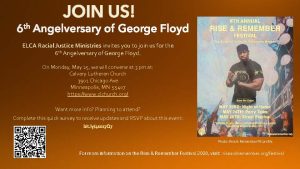
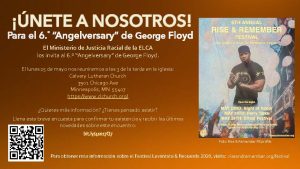
May 25th marked the 5-year Angelversary of the murder of George Floyd. That Sunday evening, as part of the Rise and Remember Festival and at the invitation of the ELCA Racial Justice Ministries, I joined a number of you for a fabulous concert featuring Sounds of Blackness and a moving vigil. We gathered beforehand on the steps of Calvary Lutheran Church, just a block south of George Floyd Square. ELCA Racial Justice Director Jennifer DeLeon grounded us for the evening, reminding us that people come to this event holding both memories and hopes, lament and a call to action. If you haven’t been to George Floyd Square lately (or ever), consider making a pilgrimage and ask for a community guide to share this sacred space with you or your group.  

Photo credit: Pastor Melissa Pohlman

The sun was low when the concert ended. Theologian and community leader Jeanelle Austin stepped onto the stage to prepare us for the vigil. Volunteers quietly distributed candles. Now, let’s be clear: These were not the smaller candles we often hold during a Christmas Eve candlelight service, candles that flicker through a few verses of Silent Night and are soon extinguished. Instead, these were large tapers, ready for the long duration of the vigil and all it would include.  


Austin described the plan: With candles lit, Brass Solidarity would lead us north past the spot where George Floyd was murdered, past exhibits and memorials filled with the names and stories of BIPOC individuals from around the country who have been victims of systemic racism and violence. We would turn west and go a block to Say Their Names Cemetery where over a hundred symbolic headstones bear the names of Emmett Till, George Floyd, Philando Castile, Jamar Clark, and dozens more. Anticipating the moment, Austin explained that we should move down into the cemetery and find a headstone where we would “hold space” as the youth and young adult musicians of Kamoinge Strings played several pieces, and then we would close with a prayer.  


Holding space. As the sun set and night came, hundreds of us settled in around the headstones. Some people stood, some sat in the cool grass. Candle flames flickered and wax dripped. Music swelledIt was beautiful and incredibly sad all at once. I held space by the stone of a 17-year-old named Jordan Davis who was killed in Jacksonville, Florida, in 2012.  

Holding space means creating a safe — yet also brave — environment in which people, with all our emotions, can be present and remember. I keep thinking of exercise classes and how they remind me to engage my muscles as I move this way or that. Holding space means figuratively engaging our muscles. It takes time. It makes us tired. It can be uncomfortable. If we do it well, we’ll grow stronger, we’ll gain endurance. I find that holding space is often profoundly moving. It’s holy work.  

In times like these, the temptation is strong to move through these anniversaries – this pain, this trauma – passively, without really engaging. Holding space invites us into the vulnerable recognition that the world is not yet as it should be, and we are called to be present, engaged, honest to the grief and all the moment holds, and ready to be part of the change.  

This Sunday we’ll celebrate Pentecost and the Holy Spirit’s movement. We believe that love is stronger than hate, that life is stronger than death, and that together, by the Holy Spirit’s power, we can be part of God’s new creation. That was my prayer as we held space with the sun setting and the candles flickering. That is my prayer today. May it be so.