
You remember the story of Jonah and the whale, right? God commands Jonah to preach repentance to his foes in the city of Nineveh. But Jonah wasn’t down with being God’s little messenger. Not about that. Not to them. So, he booked passage on the first ship heading anywhere but there. The Bible tells us plainly that Jonah “ran away from the Lord.”
That worked out about as well as you would expect and after many storms and tribulations Jonah found himself in the belly of a whale; saved from certain drowning by a God with a plan. In the belly of the whale, the reality of the task being asked of him became clear to Jonah. In the belly of the whale, the enormity of the force sending him to Nineveh became clear.
When I announced my intention to go to law school my mother’s family became suspiciously excited. As I went through the application process I talked with them about this school or that. A couple of days would pass, then worked casually into the next conversation somehow would be the stats for that law school’s Criminal Law department. They weren’t subtle. But I of course they thought criminal law. My grandfather was the first Black Genesee County (MI) deputy in the 1950’s. He studied law then finished his career as a magistrate. His only daughter (my mother) was a probation officer briefly. 3 of his 4 sons are, to this day, sworn law enforcement officers. One of them even married a state trooper! Adding a prosecutor to the family would complete the set.
But my distaste for criminal advocacy was years old by then. I was a precocious (read: nosey) kid. I would listen to adult conversations and easily decipher their unimaginative codes. I heard the stories of unnecessarily brutal arrests, cases that went up on scant evidence, hanging judges, and “facilities” (jails and prisons) unfit for humanity. My relatives believed, and still believe, that change can come from within the system and at the very least the system was a little less antiblack during their shifts. But I had no interest in being in the criminal law space. And honestly, I had passively accepted the culture’s prevailing attitudes about crime and criminals. Some neighborhoods simply do require a stronger police presence. I too looked over my shoulder at ATMs for “super-predators.” I took Criminal Law and Evidence because they were required then filled my schedule with Federal Labor and Employment Law, and Alternative Dispute Resolution. I was going to work a standard 9-5 resolving employment contract disputes via forced arbitration clauses (and get filthy rich doing it!) I kept maps of all the exciting places my jet-set lifestyle was going to afford me. Nineveh was not on the itinerary.
After many storms and trials I learned that my skills and talents lay with legislative and executive advocacy. I learned the basics then studied and honed it as the science and the art that it is. I advocated for domestic violence survivors and employees unfairly paid. I advocated for the fair treatment of our immigrant siblings. I advocated for the poor, the unhoused, the mentally ill. I’ve traveled abroad waving the banner for ecological justice and climate change abatement. And then the children. Always the children. I even found time to advocate for more green space in my own neighborhood. Everything and anything except anything that touched on crime or policing. Sure #BlackLivesMatter. But I don’t have to be the spokeswoman for it.
Then I spent I my three days in the belly of the whale. To be more precise the month of October 2019 broke me. It excised whatever small trace of “If you’re not doing anything wrong, you’ve got nothing to fear from the police” remaining in my spirit. Early that month my favorite human, my nephew Xavier, turned 8 years old. He got a new video game that he just loved. He wanted to play it with me. All. The. Time. Sometimes late into the night. We did that. He’s unreasonably scared of spiders. It’s one of those truly annoying things I love about him. I’m constantly called on to go 2 or 3 rooms away and kill the spider that he defiantly heard and is certainly on its way to come and get us. Sometimes he hears them outside. When I’m in a particularly generous mood I go and hunt for his imaginary spiders outside our front door.
Stop right now and Google the name Atatiana Jefferson.
When the news of her death reached the nation something in me broke wide open. It wasn’t just the fact of her death. It’s that her death made headlines for less than one news cycle. I was angry and heartbroken and incensed and grieved and irate and perplexed and exhausted and dying inside. I’m not certain when I was swallowed by the whale. But I was for sure in the belly of the beast; driving along the beautiful California coast from Sacramento to Monterey to offer a keynote address at the synod professional leaders conference– blind through tears. I don’t remember, and it doesn’t really matter what I actually said to the Lord in my car that afternoon. “In my distress I called to the Lord, and the Lord answered me. From deep in the realm of the dead I called for help, and the Lord listened to my cry.”
Through the sacrifice of one beautiful black life, I fortified a voice that advocates for Black bodies.
I’m not yet in Nineveh. I am only now beginning to understand the reality of the task set before me. Through my television screen filled with visions of cities all over the world rallying and rising and rioting I am just now learning the enormity of the source sending me. I am stumbling and fumbling and walking slowly and being led by the Spirit and those who have been on the road longer. I’ve been practicing what I will say when I arrive. I’ve begun saying small snippets in places I would have never dared before. I’ve rallied more. I’ve organized more. Staff meetings are different with me around now (thank you for making space for this, Amy Reumann.) I’ve begun saying in larger and larger spaces that the system we’ve built around crime and punishment requires repentance. I’ve been inviting others into the conversation. But we have not yet arrived in Ninevah. There’s still room for you on the road.
Bio:
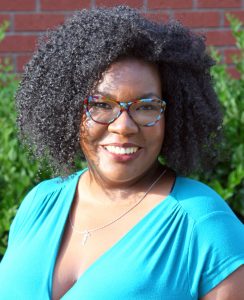
Regina Q. Banks lives in Sacramento, CA where she proudly serves as the Director of the Lutheran Office of Public Policy- California. She is very active in her community, dedicating most of her free time to organizing public advocacy to support a host of social and political causes. She is a lifetime member of Delta Sigma Theta Sorority (a public service organization) and, when permitted, shares her life with an ill-tempered chihuahua named Ender Jay.
 Chicago