
Skip to content
ELCA Blogs

ELCA Racial Justice

The Broken Ones by Shari Seifert

White folks – we need to get past the idea that we need to fix white supremacy for other people – that we can be white saviors coming in to save the brown and black folks in our church.  The truth is that we are the ones that are broken.  Now don’t get me wrong – White supremacy DEFINITELY needs to be dismantled in order to improve the lives of our brown and black siblings.  I just don’t want you to get it twisted.  I want you to realize that we too are harmed by white supremacy.  That what we need is collective liberation.  That we are not the savior.  A brown skinned Palestinian Jewish man named Jesus is.

About our brokenness.  We are seriously lacking in empathy.  When we hear about another black body being shot on the news, we wait “to hear the whole story” before we can lament about the situation.  We find some way to justify what was done.  We find some way to assign blame to the victim.  “Well if he wasn’t walking in the street.”  “If he didn’t speak that way to the police.” “Well he shouldn’t have been selling loose cigarettes.” “Well he did have a realistic toy gun in his hand.”  Somehow we have become okay with state sanctioned executions in the street.  Where oh where is our empathy?  White supremacy tells us that objectivity is possible – that emotions shouldn’t play a role in decision making.  All too often we get stuck in our heads and we forget about our hearts.  We rationalize away some pretty awful things.  White supremacy has us do these things.

White supremacy also tells us that we have a right to comfort.  In church.  White supremacy tells us that we have a right to comfort in church. What?!  Jesus was about flipping power structures, lifting up the lowly  – he was executed by the state for standing up for his friends.  Jesus was intensely political.  But we want the church to “not be political”.  We want the church to be comfortable.  We think talking about race is racist.  We wonder if we could just use some words other than “white supremacy”, which after all isn’t really that big of a problem.  So without thinking about it, we have created the equation that white comfort is more important than black lives.  OUCH.  I know  – its a shocking realization.

I know – some of you are probably super mad right now.  You’re mad because you think I am accusing you of being a white supremacist.  You’re mad because you can’t possibly be a white supremacist – you’re a good person – white supremacy tells you that you have to be perfect.  You can’t have some flaw like white supremacy or racism.  The thing is, white supremacy is not so much about you as an individual as it is about this insidious evil system that we are ALL caught up in and that we ALL suffer from – though in different and unequal ways.  The evil genius of white supremacy is that it operates without you noticing or doing anything to keep it in place.  It is so deep and entrenched that we don’t even notice it or realize that we have anything to do with it.

It’s going to take a lot to root white supremacy out of church folks and its going to be hard, but we HAVE to do the work.  Much harm has been done because we have failed to do the work.   (I often wonder what Dylann Roof learned in his church about racism.  I wonder if he had pictures of white Jesus hanging  in his ELCA congregation.  I wonder what role did our denomination play or not play in his formation.) We are going to have to offer each other an ABUNDANCE of grace.  We are going to have to be okay with not knowing what we are doing and forging ahead on faith.  We are going to have to ask other white folks to give up their comfortable positions because the truth is that white comfort is NOT more important that black lives.
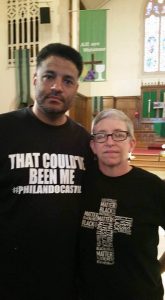
Shari Seifert with her friend David Starks together at Calvary Lutheran Church – Minneapolis following the murder of Philando Castile.

The truth is that we are all the body of Christ together and when part of the body hurts, the whole body should feel it.  We shouldn’t wait “to hear the whole story”.  We should feel it with our whole heart.  As Bishop Eaton said tonight – until white folks care about the death of black lives as if they were their own, nothing is going to change.  Can you join me in hoping and praying for the holy spirt to enter our hearts and move us to compassion and to action?  Can you join me in calling for the dismantling of white supremacy?

Bio: Shari Seifert  lives in Minneapolis with her wife, two sons and the cutest Golden Doodle you have ever seen.  She works as a Realtor and  is committed to working towards dismantling white supremacy in the ELCA.  Shari is currently vice-president of the European Descent Lutheran Association for Racial Justice (EDLARJ),  a member of the Minneapolis Synod racial justice table, her congregation’s Race Equity Committee and Multi-faith Anti-Racism and Healing (MARCH)     She is also on the core planning  team the Multicultural Youth Leadership Experience (MYLE).
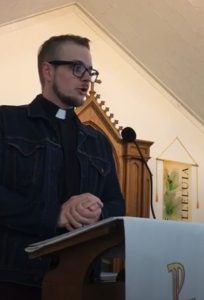
 

Hiding in the Open: White Supremacy on the Great Plains by Kelly France

The ELCA recognizes June, 17 as day of Commemoration of the Emanuel 9 and a Day of Repentance of Racism.  This blog is featured as part of a series to call the ELCA to address white supremacy and racism. To find additional worship materials for June 17, please visit https://www.elca.org/EmanuelNine


3 Then I turned to the Lord God, to seek an answer by prayer and supplication with fasting and sackcloth and ashes. 4 I prayed to the Lord my God and made confession, saying,

“Ah, Lord, great and awesome God, keeping covenant and steadfast love with those who love you and keep your commandments, 5 we have sinned and done wrong, acted wickedly and rebelled, turning aside from your commandments and ordinances. 6 We have not listened to your servants the prophets, who spoke in your name to our kings, our princes, and our ancestors, and to all the people of the land.  (Daniel 9:3-6)


I love living and serving as a pastor in rural communities on the Great Plains. I have spent most of my life in this environment, and my family has been part of this landscape for generations. My identity is tied to this place, and that comes with complex realities and shameful truths. Like anywhere in the United States, has been present in this space since the arrival of white people. It takes different forms in different settings, I cannot speak to how it manifests in other rural environments. Rural spaces are not monolithic.


There are, of course, overt displays of white supremacy. People fly confederate battle flags, hang racist symbols in bars while claiming they are, “just being country,” whatever that means. Hate groups hold rallies to intimidate immigrant communities. We have an abundance of statues and landmarks named after men who committed genocide against our indigenous neighbors. Those obvious examples give cover for the quieter, more prevalent, and just as pernicious ways that white supremacy manifests itself into the daily rhythm of our lives.


This landscape is defined by openness. That this openness has tragically created space for my people to hide how white supremacy is alive and well. It is easy not to see migrant workers when they are the only people standing in a field miles from the nearest town or behind the walls of factories processing our food. It is easy to not see the indigenous communities that our presence has forced onto reservations or to ignore the people of color who live in our communities as our neighbors. It is easy to claim that issues facing communities of color don’t affect us because there is just so much space.


The reality is, regardless of how easy it is to look another way white supremacy damages us all. The stories we pass down from generation to generation about how our rugged ancestors came from Europe with nothing.  How they were tough and brave enough to “tame the land.”  Those stories live on in us, a constant nagging sense of inadequacy. These prideful narratives center on white exceptionalism and yields shame that creates a hardness within us and our communities.


As a result we gloss over the honest parts of these stories, where people were faced with a choice of starvation, conscription, or a boat to a place they had never been. We don’t tell how whole communities shared one window so that everyone’s sod home was up to code when it was to be inspected. We exempt the reality that people of color have been present in every wave of immigration to this area. We certainly don’t spend enough time sitting in the discomfortable truth that we live in this vast and beautiful space only because of the systematic extermination and removal of indigenous people.


I love living and serving here. I delight in meeting our new neighbors who much like large parts of my family, have come fleeing dire situations to find some measure of peace. I am honored when I am invited into holy moments where those whose families have been in this space for thousands of years share their experience with me. I have hope that we can stand against this damaging and pervasive narrative. We value humility, let’s commit to taking an honest look at the ways in which we have participated in the oppression of our neighbors. We value steadfastness, let’s commit to the long process of dismantling white supremacy.  We value community, let’s commit to creating a world where those who have been excluded for so long are shown the dignity, justice, and love.


Kelly France is  the interim pastor at Swedlanda Lutheran Church in rural Hector Minnesota. In his ministry he seeks to build communities that address the injustices of white supremacy and religious intolerance in the rural Midwest.  He serves on the board of the European Descent Lutheran Association for Racial Justice (EDLARJ).