
Skip to content
ELCA Blogs

ELCA Racial Justice

Paying Attention to Discomfort: Identity, Race, Culture, Class & Faith by Claire Schoepp

I don’t know the whole story, but I do know what I saw and heard through my kindergarten eyes and ears. I know what I learned from adults that day. And I know that it left an indelible mark and questions without satisfying answers. I can without a doubt remember the day in kindergarten when I realized that race was a thing that mattered and that I had one.

A class mate of mine was carried out of the classroom by his hands and his feet. He had been throwing a tantrum on the dark blue rug that had the numbers of a clock around the outer edge. (I loved that rug) He was sent to the principal’s office. He never came back to class that day or any day afterwards. I don’t remember his name. I do remember that his skin was darker than the other black kids in my class. I remember thinking that I would never be subject to the same kind of discipline. I remember feeling very uncomfortable.

I was white.

I didn’t have the language of privilege at that age, but that’s what I was learning about.

I am not always good at paying attention to discomfort or heading into situations that might make me encounter it. But it’s worth the attention. It’s worth noticing. Like I told a kid who had just run his first mile before coming to church for Wednesday evening programing, “if it hurts, you have to stretch or it will hurt more.” You have to pay attention to what your body is telling you. Discomfort offers and opportunity for growth. Avoiding it does no such thing.

“This life therefore is not righteousness, but growth in righteousness. Not health but healing. Not being, becoming. Not rest, but exercise. We are not what we shall be, but we are moving toward it. The process is not yet finished, but it is moving on. This is not the end, but this is the road. All does not yet gleam in the glory of God but all is being purified.” -Martin Luther

In my ministry as a parish deaconess, friends with young children and congregation members regularly ask me if I know of or have good resources for talking with their children about race. They share stories of struggling with how to raise their children to recognize and celebrate human diversity as a gift without relying on the language of “color blindness” that they, more often than not, were raised with. Mostly I listen to their stories and celebrate with them the good things they’re already doing. Their questions keep me wondering about what ways the church can partner with parents as they strive in this arena. I know we can meet communities, families, congregations, and children where they’re at and encourage healthy conversations around race where faith and grace are at the center of the conversation. I also know it’s hard to know where to start.

Younger Children & Elementary Children

·       Consider doing a resource audit and see what you notice. This is not meant to make you feel guilty, but to help provide a mirror. I recently had middle schoolers go through the children’s books on my shelf at church and put them into 2 piles: books that had persons of color in them at all and books that had mostly white characters. It was informative. We had great conversations as a result.

·       If your congregation is in the habit of celebrating the saints (or even if it’s not), consider using a children’s sermon to highlight MLK Day, the birthday of Archbishop Desmond Tutu, or Saint Augustine. These leaders in the church were persons of color. There’s a great children’s book by Archbishop Desmond Tutu called “God’s Dream” that you could read on his birthday each year. There’s even a board book version that you could give out as a baptismal birthday gift.

·       Children love to dance and bang on drums. There are great global music songs in the ELW that you can break the ice with by inviting the little ones to dance in the aisles. Setting 7 has a great “Glory” that even a congregation unfamiliar with Latin music can get into. We can celebrate the gift of the gospel with our whole bodies.


Middle Schoolers

·       Middle schoolers are capable of deeper conversations than we sometimes give them credit for. Three days of confirmation class could be spent on race, culture, and class. ELCA World Hunger has downloadable resources on Hunger and the Catechism.

·       Middle Schoolers are busy struggling to broaden their worldview beyond their own “bubbles.” Give them the tools to be courageous by setting an example. The ELCA also has missionaries across the globe. Maybe your congregation could consider sponsoring one and your middle school Sunday School could write them letters.

·       Middle Schoolers LOVE to inform adults about things they “know more” about. What if your middle schoolers were to do a poster series on “You Could Be a Lutheran If . . . ” that explored Lutheranism in America and the world. For example, one poster could be “You Could be Lutheran if you live in Tanzania” because there are more Lutherans in Tanzania than the United States.


High Schoolers

·       ELCA Racial Justice Ministries has a number of downloadable resources that are created for adults, that I think you could adjust for conversations with high schoolers in youth group.

·       Equipping leaders and mentors to engage in conversations around identity, race, culture, class and how we attend to those conversations as persons of faith is perhaps one of the harder things to do. However, youth will want to talk about identity – it’s edgy. Maybe prep your leadership with ELCA Racial Justice Ministries resources like “One Body, Many Members.”

·       In some places Lutherans are reclaiming the practice of sharing personal faith stories and giving testimony. What might it look like to have a testimony series that intentionally asked questions around the intersection of identity, race, culture, and class? What if adults and youth shared stories that were truly vulnerable and didn’t always tie up in a neat bow?

Bio: Claire Schoepp (she/her/hers) is a parish Deaconess at two congregations in Chicago serving as Director of Child and Family Ministries at Luther Memorial Church of Chicago and Administrative Assistant at St. Luke’s Lutheran Church of Logan Square. Claire is grateful to First Immanuel Lutheran Church and Rev. Harry Therwanger for everything. Claire and her spouse, Isaac Schoepp, love living in Chicago where they take in as much theatre as possible.
Ford/Kavanaugh/Columbus Day by Kathryn Haueisen

…and you will know the truth, and the truth will make you free. (John 8:32)

The timing of the debate about appointing Judge Kavanaugh to the Supreme Court after the hearing with Dr. Ford strikes me as ironic. This hotly contested debate unfolded as the country was observing the national holiday still known by most as Columbus Day. For some years now some have been campaigning to change it to National Indigenous People’s Day. In fact my I-phone calendar noted that October 8 was Columbus Day (regional holiday) and Indigenous People’s Day, with the note, “This is not a nation-wide holiday; it may not be observed in our region.”

The story of our country includes the narrative that our European ancestors came here to escape the tyranny of a hierarchy of royalty and high-ranking church leaders. When the Europeans settled here they essentially recreated that hierarchy with different labels. Though we do not have monarchs with numerous layers of aristocracy, we very much have a system in which a few thrive far more than most.

Prestige and Privilege

The elite are often sent off to expensive private schools where they are encouraged to believe they are special, above the rules that govern others, and born to lead by virtue of their family and social connections. Our founding documents about liberty and justice for all only applied to Caucasian men who owned property. That property, originally occupied by indigenous people, was often obtained by ignoring or discrediting the rights of the people here long before Columbus landed on the shores of the Americas.

These assumptions are changing. Change causes anxiety. Anxiety often produces angry outbursts such as we’ve witnessed lately as the #MeToo movement has exposed the dark underbelly of previously unchallenged privileges among some. Though we no longer publically claim that women are the property of men, we often have enforced behaviors that allow women to be treated as such.

A Social Revolution

We appear to be in the midst of a civil war as potentially destructive as the Civil War of the 1800’s. The class system that has evolved over the past four hundred years is hurting a large portion of our population. Growing numbers refuse to suffer in silence.

Today when we acknowledge Christopher Columbus and his explorations we also tell a more accurate account of what happened then. We are starting to talk about the abuses and oppression Columbus and other European explorers inflicted on the people already here. We are slowly, and very painfully, coming to terms with the fallout from the re-creation of a class system that rewards some and excludes most. Not until I started doing extensive research for an upcoming book set in the 1600’s did I learn that Europeans were capturing Native Americans and hauling them back to Europe to sell as slaves. But fessing up to our past injustice does not come naturally. Some textbooks are being rewritten to portray slavery as a wave of immigration from Africa, as though the slaves asked to be brought here in chains. The travesty of the Trail of Tears is being written as some friendly land swap agreement between the Native Americans of the Southwest and the Europeans who needed land to expand. Some are trying to white wash our history by brainwashing our children.

Who Speaks the Truth?

The issue today seems to be whether we will believe people when they tell us this lopsided system is hurting them. If we believe the victims of abuse and injustice, we must work together to render aid and change the system.  What kind of a nation have we become when a woman has to move twice to protect her family because she goes public about a night of personal horror? What kind of people are we when a Senator calling for more time to process the situation also receives death threats? What kind of people are we when we encourage crowds to chant about locking people up for voicing their opinions? What kind of people are we when we justify tearing terrorized toddlers from their mothers’ arms because they didn’t cross into our geography according to our nearly-impossible-to-navigate entry process?

When we promote and favor the few but discredit the many hurt by this system of elitism, we are clearly telling those who suffer that we either do not believe them or we do not care about their plight. I once interviewed a Holocaust survivor. He told me that of all the atrocities he suffered and witnessed, the worse part was when he managed to track down a few surviving relatives. They asked him, “Why are you making up those lies? That never could have happened.”

I Do See Progress

I am a glass half-full sort of person. I see progress. I see more women and minorities in places they certainly would not have been a few decades ago. For example, today nearly one third of our sixty-six ELCA Lutheran bishops are women. I also see more and more men stepping up to address these issues of inequality. I am grateful and encouraged for this progress. I pray it continues.

My grandmother lived in Cleveland when her father was dying in Zanesville, a hundred and fifty miles away. She took a train to be with him, and according to the story told to me, spent the night in the train station. No one would rent a room to a married woman travelling alone in first decades of the 1900’s.

My mother managed our family of three children alone for months at a time when our civil engineer father was out of the country on a project. During one of his trips the bank deducted his paycheck from their account, rather than add it. This of course put the account in the red and caused multiple checks to bounce. The bank would not deal with my mother because she was a woman. She had to get her father, a Federal Reserve banker, to intervene to straighten out the mess.

ONE Nation?

I wonder how many members of the elite have dealt with such issues. We are in the midst of a cultural revolution. Future generations will no doubt have some name for these shifts in power and privilege we’re seeing unfold. For now we are re-thinking our collective assumptions about how we should live and work together as ONE nation, under a God of mercy and compassion, that truly ensures liberty and justice for all people – not just the privileged few.

The original Pledge of Alliance read, “I pledge allegiance to my Flag and the Republic for which it stands, one nation, indivisible, with liberty and justice for all.” This version was amended by Congress in 1954 to: “I pledge allegiance to the flag of the United States of America, and to the republic for which it stands, one nation under God, indivisible, with liberty and justice for all.” Francis Bellamy, a socialist, wrote the original version in 1892. A socialist wrote our Pledge of Allegiance.

I pray calm, wise, and compassionate leaders can guide us out of this contentious corner into which we’ve backed ourselves. We’ve come a long way, but we certainly have a long way to go until we truly are a one nation that provides liberty and justice to all our people.

Bio

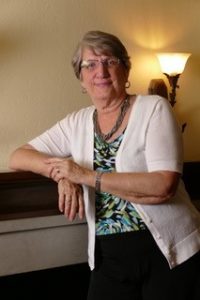
Kathryn Haueisen is a retired ELCA pastor, a consultant with the Mission Investment Fund’s Capital Campaign Services, and an author who blogs about people and places that offer help and hope at www.HowWiseThen.com. She has written devotions, curriculum, and articles for numerous Lutheran publications as well as other consumer and faith-based publications. Her book, A Ready Hope: Effective Disaster Response for Congregations (Alban Institute 2009) prepares communities and volunteers for the long term recovery process that unfolds following a natural disaster.