Skip to content
ELCA Blogs

ELCA Racial Justice

Remember Charlottesville by Bishop James Mauney, ELCA VA synod

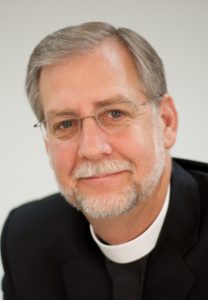
Bishop James Muney of the ELCA VA Synod.

On this Friday, some things bear repeating (written Friday, August 18, 2017):

The first is to repeat my request that all of us lift up the town of Charlottesville, its people, its government and first responders, its injured from last weekend, and the families of Heather Heyer, Lt. Jay Cullen, and Trooper Berke Bates. I ask that you would lift up the congregations of St. Mark and Peace along with the many houses of faith in Charlottesville. In conversations this week with pastors in Charlottesville, we pray for a healing and a strengthening by the Holy Spirit for a returning of this place of people, commerce, culture, and learning to its vibrant sense of well-being and joy.

It bears repeating that we do not talk enough about the outright lie that the color of one’s skin contributes to the value that God has for them or the intelligence that one has or the content of the character of a person. We do not talk enough about the outright lie that says the south wasn’t built on the backs of people sold and regarded as property. We do not talk enough that we are “one nation under God indivisible with liberty and justice FOR ALL.”

It bears repeating, that as a Lutheran Christian I regard my faith as founded upon a Galilean Jew crucified and risen from the dead, from faithful Jewish disciples and apostles of Judea, Samaria, and Galilee and a Pharisee from Tarsus and the key early centers of faith in Damascus and Syria. I give thanks for the crafter of the Nicene Creed, Bishop Athanasius of Alexandria, described as black as tar. I give thanks for Bishop Augustine, Bishop of Hippo in Northern Africa, whose theology shaped the faith of an Augustinian monk named Martin Luther, 1000 years later. My faith has been built upon the shoulders of Jews, Arabs, Africans, Greeks, Christians and martyrs of Asia Minor. It wasn’t until after 800 AD that my Anglo-Saxon ancestors even heard of Jesus Christ. I am honored to be grafted to the tree of faithful Israel that St. Paul speaks to in Romans 9-11.  As Christians we remember Ephesians 4: “There is one body and one Spirit, just as you were called to the one hope of your calling, one Lord, one faith, one baptism, one God and Father of all, who is above all and through all and in all.”

It bears reflection that the great anniversaries of the civil war have also been within our nation rises of white supremacy, particularly following the 50th, where the vast majority of our confederate statues were erected. And we recall the tens of thousands of hooded figures parading in the streets of cities across America in the 1920’s. Rather than let such anniversaries or public parades redraw lines, we should all learn from such events that our strength is in our rich resource of gifted people of all nationalities, cultures, faiths, and languages and the conviction that access to equal opportunity for all results in the strength of a united nation.

A PETITION FOR THE VARIETY OF FACES AND CULTURES

“O God, you created all people in your image. We thank you for the astonishing variety of races and cultures in this world. Enrich our lives by ever-widening circles of fellowship, and show us your presence in those who differ most from us, until our knowledge of your love is made perfect in our love for all your children; through your Son, Jesus Christ our Lord.” (LBW, p. 42)

I will join you in prayer this Sunday and I will be praying for your preaching, teaching, and worship of our Lord who emptied himself and came for us all.

Yours in Christ,
The Rev. James F. Mauney


Racism–a Mix of Power, Privilege and Prejudice by Bishop Bill Gafkjen

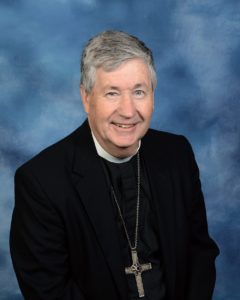
Bishop Bill Gafkjen serves as Chair of the ELCA Conference of Bishops and Bishop of the Indiana-Kentucky Synod of the ELCA.


Racism—a mix of power, privilege, and prejudice—is sin, a violation of God’s intention for humanity. The resulting racial, ethnic, or cultural barriers deny the truth that all people are God’s creatures and, therefore, persons of dignity. Racism fractures and fragments both church and society. [The ELCA’s social statement, Freed in Christ: Race, Ethnicity and Culture][i]


In late July, I was honored and blessed to participate in a joint gathering of the African-Descent Lutheran Association (ELCA) and the Union of Black Episcopalians in Philadelphia. Over meals, in the hallways, and in plenary sessions I was able to listen deeply to the concerns of people of color, especially people of African descent, who are part of the church. I was honored to sit for part of an afternoon with ELCA rostered ministers of African descent and heard stories of painful experiences of marginalization, disrespect, and discrimination in our life together as the ELCA. During the opening worship service, I was invited to bring a greeting on behalf of the I-K Synod and, as its chair, the ELCA Conference of Bishops. In that greeting I thanked these dear sisters and brothers for their partnership in the gospel and for their persistent prophetic witness to the kind of beloved community Christ has made us to be and to how very far we still have to go in realizing that community.

On the flight home, I committed to three things: (1) engage the difficult process of facing and repenting of the ways in which I am complicit in, even a perpetrator of, racism; (2) do what I can in my various leadership roles in the church and as a citizen of this country to surface, challenge, and do something about systemic/institutional racism; and (3) share this with you, the good people of the I-K Synod, in this newsletter and invite you to join me on this journey.

And then Charlottesville happened. There, again, tragically, starkly, we saw the truth of what we said together in a social statement almost 25 years ago: Racism is sin and it fractures and fragments both church and society. Racism robs people of their God-given dignity. It privileges some at the expense of many. Racism kills. And, as a church and for so many of us as individuals, including me, we have done very little to challenge and change this great evil.

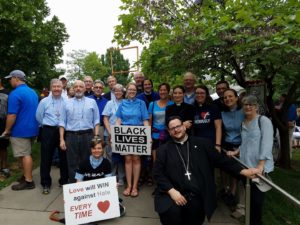
Did you know that the Southern Poverty Law Center – a well-respected group committed to identifying hate, combating intolerance, and dismantling racism – has identified 26 hate groups in Indiana and 23 in Kentucky? Most of them are white supremacist/nationalist groups of the ilk that were part of the troubles in Charlottesville.[ii] Somehow, we need to present a counter-witness to these groups, many of whom try to claim the name of Jesus. We need to step up our presence in the public arena – much like those from the ELCA and others who went to Charlottesville – to work toward a community that honors all, welcomes all, receives the gifts of all, and makes space for all, for every single one, to walk alongside others toward a beautiful future where we actually embody the community Christ has made us to be.

Of course, hate groups are the obvious ones to combat. As individuals, as local congregations, as a synod, as a church, we have a great deal of perhaps less immediately obvious need for self-reflection, confession, repentance, and change to engage ourselves…even and especially for things that are just so much part of the dominant local or broader culture or way of doing things that we don’t even see how they hurt, exclude, and denigrate people of races, ethnicities, and self-identities different from our own. This may be the most challenging and difficult work of all. But, for the sake of our sisters and brothers, for Jesus’ sake, we just have to do it. The love of Christ compels us. “All this is from God, who reconciled us to himself through Christ, and has given us the ministry of reconciliation” [2 Corinthians 5:18].

We will be working on these things synodically this fall. I hope that as the fall school year/program year begins, you will join me in finding ways to face and resist racism and its shadowy siblings. Together, we seek to not be conformed to this world, but transformed by the renewing of our minds, our inmost beings, in the power of the Spirit (Romans 12:1), in families, in congregations, and in our communities.

This will not be easy, sisters and brothers. But, thanks be to God, this hard and necessary work is bathed in promise, for “those who want to save their life will lose it, and those who lose their life for my sake will find it” [Jesus, Matthew 16:25].


Peace be with you,


Bishop Bill Gafkjen


[i] Download a PDF here: http://ow.ly/YEEn30ep7r5

[ii] https://www.splcenter.org/hate-map

A prayer written by Bishop Gafkjen the weekend of the events in Charlottesville can be found here: http://livingcommunion.blogspot.com/