Skip to content
ELCA Blogs

Ecumenical and Inter-Religious Perspectives

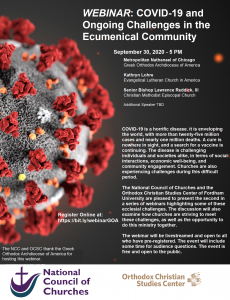
Webinar: COVID-19 and the Ongoing Challenges in the Ecumenical Community


As COVID-19 continues to spread throughout the world the disease is challenging individuals and societies in new and varied ways. Our social interactions, economic wellbeing, and community engagement have all been strained over the past six months. Churches are also experiencing challenges as they seek to adapt.

The National Council of Churches USA and the Orthodox Christian Studies Center of Fordham University are presenting the second in a series of webinars highlighting some of these ecclesial challenges. The discussion will also examine how churches are striving to meet these challenges, as well as the opportunity to do this ministry together.

The webinar will be livestreamed and is free and open to the public, though participants will need to pre-register for the event here. The event will include some time for audience questions and will feature the following speakers:

  • Metropolitan Nathanael of Chicago – Greek Orthodox Archdiocese of America
  • Kathryn Lohre – Evangelical Lutheran Church in America
  • Senior Bishop Lawrence Reddick, III – Christian Methodist Episcopal Church
  • Rev. Monsignor J. Brian Bransfield – General Secretary of the US Conference of Catholic Bishops

We hope you’ll join us on September 30, 2020, 5 pm ET

Register today by following the link: REGISTER


Webinar: Global Responses to Religious Nationalism


Ignore, resist, or engage? Global responses to religious nationalism

The Lutheran World Federation, in partnership with the ELCA and the Indonesia Consortium for Religious Studies, will be hosting a webinar on September 22 to engage questions of responding to religious nationalism on a global scale.

The world has witnessed a rise in religious nationalism in recent years. Political leaders have incorporated it in their platforms in order to turn fear into votes. The use of religious symbols and language has become commonplace across the political landscape, from Delhi to D.C.

What role can we play as public theologians to respond? What is the responsibility of faith leaders in countering such rhetoric? How can we collaborate at local and national levels to support initiatives aimed at promoting more inclusive societies?

This webinar aims to support religious leaders and concerned citizens of all faiths and traditions to respond constructively to religious nationalism. The conversation will span the rise of nationalism associated with versions of Christianity, Hinduism, and Islam. Drawing on insights from India, Indonesia, and the United States of America, the webinar will lift up a variety of perspectives, fueling discussions and reflections of global relevance.

Speakers:

• Sathianathan Clarke, the Bishop Sundo Kim Chair in World Christianity and Professor of Theology, Culture, and Mission at Wesley Theological Seminary. Author of Competing Fundamentalisms: Violent Extremism in Christianity, Islam, and Hinduism 

• Dicky Sofjan, Core Doctoral Faculty in the Indonesian Consortium for Religious Studies (ICRS), the Principal Investigator for a nine-country program entitled “Religion, Public Policy and Social Transformation in Southeast Asia”

• Angela Denker, Lutheran Pastor, writer, speaker. Author of Red State Christians: Understanding the Voters Who Elected Donald Trump 

Moderator:

• Sivin Kit, Program Executive for Public Theology and Interreligious Relations, Lutheran World Federation.

Closing Remarks:

• Kathryn Lohre, Assistant to the Presiding Bishop of the Evangelical Lutheran Church in America and Executive for Ecumenical and Inter-Religious Relations & Theological Discernment.

We hope you’ll join us on Tuesday 22 September 2020
9:00 – 10:30 am CT, 10:00 -11:30 ET

Register today by following the link: REGISTER
 

And Who is My Neighbor?

By Kathryn Mary Lohre

In the parable of the Good Samaritan, the lawyer asks Jesus, “And who is my neighbor?” We, too, are prone to ask this of Jesus – perhaps not in so many words, but with the same intentions. Like the lawyer, we try to arbitrate who is worthy of mercy and love, of neighbor justice. i  Too often we are willing to consider only those who live in closest proximity to us, or whose beliefs are most proximate to ours, as our neighbors. If only we could choose!
In his treatment of the parable, Martin Luther defined our neighbor as “any human being, especially one who needs our help. ii  There is no loophole. Without exception, everyone is our neighbor. The boundless mercy and love of our Creator cannot be contained by the boundaries we create to divide ourselves. What is more is that our neighbors need us, and we need them.

Extending God’s mercy and love to all those in need is central to our Christian vocation, though it is certainly not the exclusive domain of the body of Christ. Our neighbors of other religions and worldviews, too, are dedicated to the well-being of creation and the alleviation of human suffering. Though other religious and spiritual convictions or philosophies may undergird our neighbors’ actions, we share a commitment to the common good. As people, we are bound in our suffering and in our service.

This is critically important in a time when the Oikoumene, the whole inhabited earth, is infected and affected by COVID-19, racism, and injustice. In times of all-consuming death and devastation, our healing practice must be all-inclusive, and our treatment plans must be all-encompassing. To guide and encourage us in these complicated theological and practical matters, we can look to the recently issued joint document of the World Council of Churches (WCC) and the Pontifical Council for Interreligious Dialogue (PCID), “Serving a Wounded World in Interreligious Solidarity: A Christian Call to Reflection and Action During COVID-19 and Beyond.

Solidarity as the body of Christ and with our neighbors of other religions and worldviews is the most effective means for healing all that ails this wounded world. It is also the antidote to our despair. If we read the parable of the Good Samaritan closely, we come to understand that it is precisely through our God-given neighbors that we most readily receive the generosity of God’s mercy and love. Being a neighbor and receiving the neighborliness of others made in God’s image, not only heals our bodies, but buoys our faith and gives us hope. This spiritual refreshment is precisely what sustains us as we work with our neighbors to bind the wounds of the whole inhabited earth, God’s beloved neighborhood.


i. “Neighbor justice” is a term proposed in “Faith, Sexism, and Justice: A Call to Action,” a social statement of the Evangelical Lutheran Church in America. Neighbor justice is rooted in the biblical directive to “love your neighbor as yourself.” This term expresses the idea that faith is active in love and love necessarily calls for justice in relationships and in the structures of society. Neighbor justice is meeting neighbors’ needs across the globe and in our local communities.
ii. Martin Luther, “Letters to the Galatians, 1535,” Luther’s Works.


Kathryn Mary Lohre serves as Assistant to the Presiding Bishop and Executive for Ecumenical and Inter-Religious Relations & Theological Discernment for the ELCA