
By Kristen L. Opalinski
“We will get through this together.” Over the past month, we’ve heard these words spoken countless times by health officials, governors, mayors, presidents, prime ministers, and journalists – but also doctors, nurses, grocery clerks, and other essential workers. Parents have offered these words to comfort their children. Family members have offered them as they mourn the loss of a loved one. Religious leaders have offered them, too, in support of their spiritual communities and as a reassurance of interfaith solidarity in these troubling times. These words have taken on new and profound meaning as humanity’s rallying cry in this time of COVID-19.
As a Christian, these words also took on new meaning for me last week as my family navigated Holy Week while sheltering in place. I reflected anew upon Jesus’ journey, from his palm-fringed entrance into Jerusalem to his death upon the cross and the empty tomb on Easter morning. The isolation he must have felt as he moved from Gethsemane to Calvary seemed rawer and more amplified to me this year. Thankfully, the story doesn’t end with death on Calvary, but with new life and an empty tomb. In the midst of so much pain, confusion and suffering, we also see the very best of humanity shine through. We see on display the daily compassion and courage of medical professionals, the goodness of neighbors helping each other, and the creativity and passion of people of faith.
Religious communities throughout the world are having to reimagine themselves – from the ways in which we worship to how we create community and serve those in need around us. As Lutherans, we believe that we are freed in Christ, and it is through this liberation that we live lives in service to all. On this, the 500th anniversary of Martin Luther’s writing on “The Freedom of a Christian,” we are now faced with perhaps the greatest global challenge of our time – responding to those in need during this time of COVID-19. The needs of so many, not only the sick, but those who are lonely, jobless, homeless and hungry are all around us. I too carry the anxiety of uncertainty through each day. We are all in this together, and it is together that we will get through this.
God created humankind to be in relationship – with God and with each other. In times like these, relationships carry us through in ways that may otherwise seem impossible. In recent weeks I’ve witnessed firsthand the ways in which this time has transformed how we are living out our call to ecumenical and inter-religious relationship building. As one example, Christians across the United States joined together in common witness in unprecedented ways during Holy Week. Three of the nation’s prominent ecumenical bodies – the National Council of Churches in Christ, Christian Churches Together in the USA, and Churches United in Christ – all joined with one voice, standing in solidarity with each other to share a message of hope and to give witness together to the life, death, and resurrection of Jesus Christ. Their joint letter was an invitation and testament to that which binds us together, despite our differences – an emerging theme that continues to permeate across a diversity of religious, cultural and social contexts.
It is perhaps fitting that at this moment of physical disconnection Christian, Jewish, and Muslim communities are now navigating the confluence of their respective holy days this month with greater solidarity and purpose. Easter, Passover, and Ramadan are all reminders of life and equity that move us beyond our isolated spaces to a place of shared humanity. Presiding Bishop Elizabeth Eaton recently joined with Rabbi Rick Jacobs of the Union of Reform Judaism and Dr. Sayyid Syeed of the Islamic Society of North America in a message of interfaith solidarity. Dr. Syeed proclaimed this as, “an opportunity to emphasize the human, global brotherhood and sisterhood, to emphasize that all humans are one family.” Additionally, Rabbi Jacobs reflected that, “No matter how difficult a situation can be, there is the bud of springtime, the ray of light and of hope that sustains us…we are all children of God and that we were put on the earth not simply to care for our own, but to care for all of God’s children.” That is at the heart of our new reality, a reality that forces us to look beyond the walls of our homes to where there are needs in our communities, our nation, and around the world.
Our religious commitments are a catalyst for connection. This realization has become ever clearer over the past month for many of us. Now is the time to reach out not only to loved ones but also to strangers. Life in the time of COVID-19 has forced people of faith far beyond our comfort zones – pushing us all to rethink and reimagine what community and connection looks like. Churches, mosques, synagogues, and temples have embraced virtual gatherings, and also a re-framing of what it means to be gathered together, as distinct religious communities and as interfaith partners.
For the Shoulder to Shoulder Campaign, an interfaith coalition in which many of us work together to counter discrimination and violence against Muslims in the US, this new reality has meant a shift in programing. Shoulder to Shoulder has relied for years on the power of shared physical space as a primary setting for educating and equipping people to join together to bring an end to anti-Muslim bigotry. From the Faith Over Fear trainings to the Ramadan Supper Series, the campaign members are working together to reimagine relationship building while people are sheltering in place at home. This year, the Ramadan Supper Series has been re-envisioned as the Welcome to My Table initiative. Rather than facilitating communities to gather to break the Ramadan fast in interfaith community, “this initiative connects households to households…to virtually share an iftar meal.” On the webpage the message is clear: “We strongly believe that physical distancing should not mean social isolation. It takes extra intention, effort, and creativity to connect with one another in these times, but connection remains so important for our own wellbeing and the wellbeing of our communities.”
In the interfaith solidarity message, Bishop Eaton asks the question, “Where do you see God at work in the midst of this global pandemic?” Perhaps it’s in the nightly cheers that echo across the world for our health workers, the stories of people’s strength and resilience rising up to meet this moment. Perhaps it’s in the shared experiences of new kinds of ecumenical and inter-religious engagement. I imagine for most of us, it’s in all of these places and more.
At home, I see God at work in the vibrant spring blossoms and accompanying songbirds, which bring me hope each day. I know for so many of us it might be difficult to see these signs of new life in the midst of so much death, and that’s OK too. I confess that I sometimes feel like we are still trapped somewhere between Good Friday and Easter morning. But at the same time, I am experiencing anew the promise of life and light we know God has already placed in our midst. We will get through this together.
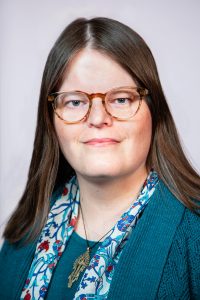
Kristen L. Opalinski serves as the Manager for Ecumenical and Inter-Religious Relations for the ELCA