Skip to content
ELCA Blogs

Lutheran Disaster Response

South Sudan: What It Means to Run for Safety

Megan Brandsrud

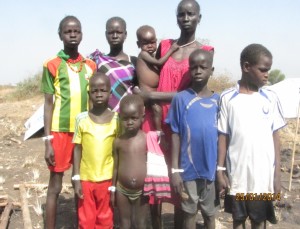
Nyagnet Req and children

Since mid-December 2013, the world’s newest nation, South Sudan, has been the setting of a political crisis turned violent. According to a May 16, 2014, report from the United Nations, more than 1.3 million people have been displaced as a result of the armed fighting, and more than 4 million people are facing acute food insecurity.

Despite an agreement to cease hostilities on Jan. 23, 2014, the violence continues. One of the most fought-over towns is Malakal, the capital of oil-producing northern Upper Nile state. Many people in Malakal have been forced to flee to escape being caught between the warring parties.

Nyagnet Req, the mother of seven children, is one of those people. This is her story.

On Jan. 13, 2014, Nyagnet went to a nearby river to get water for her household. This was part of her daily routine. However, when she was returning home on that day, she witnessed first-hand the disaster as it hit her town. The town had been taken over by heavy armed fighting. Gun shots were flying as parents were running to gather their children. Nyagnet says she only has blurred memories of how fast she ran to collect her children and escape.

“It was the worst day of my life,” Nyagnet says.

Nyagnet and her three sons and four daughters were traveling on foot. After days of walking, they reached the Ethiopian border town, Matar. Matar is one of the entry points in the western region of Ethiopia.

On Jan. 23, 2014, Nyagnet and her family were placed in Lietchor camp. The camp has modest temporary shelters and basic sanitation facilities. Food and clean water are Nyagnet’s primary concerns.

Since Nyagnet and her children had to flee so quickly, she lost contact with her husband, who was working for the government in road construction at the time the clashes occurred in their town. She has no knowledge of where he is, and she has no way to let him know where she is.

Nyagnet’s story is similar to the stories of the many who have had to flee their homes as a result of the conflict in South Sudan. Many families had to leave on a moment’s notice, with no time to grab belongings or supplies, and family separation is one of the most prevalent results of the conflict.

Providing Hope and Healing

Lutheran Disaster Response, in partnership with The Lutheran World Federation (LWF), is providing assistance to accommodate the 20,000 refugees at Lietchor camp. Boreholes are being drilled to construct a motorized water supply system, hygiene supplies are being distributed, and sanitation awareness programs are being implemented. In addition to these life-saving activities, we are working with LWF to provide agricultural livelihood restoration programs.

The months of conflict and the fear of returning home to nothing take a toll on families who have had to leave everything behind for their safety.  Lutheran Disaster Response has been present from the beginning, providing assistance within South Sudan and to refugees in Ethiopia, Uganda, Kenya and Chad. We will continue to be present and provide assistance where it is needed most, for as long as it is needed. Your gifts designated for the South Sudan Conflict Response will help assist those who have been directly impacted.

Who will separate us from the love of Christ? Will hardship, or distress, or persecution, or famine, or nakedness, or peril, or the sword? No, in all these things we are more than conquerors through him who loved us. Romans 8:35, 37

Typhoon Haiyan: Recovery Work Continues Six Months Later

Megan Brandsrud

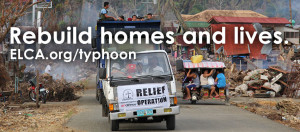
Typhoon Haiyan banner photo

Six months ago, Typhoon Haiyan (known locally as Yolanda) crashed into the Philippines. As one of the strongest storms in recorded history, it affected more than 14 million people and destroyed approximately 1 million homes. More than 6,200 people were reported dead as a result of the storm, and more than one thousand people still remain missing.

Working with Lutheran World Relief, Lutheran Disaster Response was active on the ground in the Philippines days after Typhoon Haiyan made landfall. A lot of recovery work has been done in the past six months. Projects have involved shelter repair, cash-for-work programs, non-food item distributions, livelihood rehabilitation, and water and sanitation intervention programs.

Here is a breakdown of some of the recovery projects in process:

Shelter: Working with Habitat for Humanity Philippines, 1,457 households have received shelter repair kits, which have impacted 7,285 people. Repair kits include things such as plywood, coco lumber, iron roofing sheets, nails, hammers and saws. These kits allow people to return home.

Cash-for-Work: More than 18,000 people have participated in cash-for-work debris removal programs. This means that people are able to contribute to their community by taking part in clean-up efforts, and they can receive money to be able to make prioritized spending decisions that are right for their family. Cash-for-work programs are beneficial because even though millions of people were impacted by the same disaster, they were impacted in different ways and have different needs as they recover.

Water: The availability of clean drinking water was a major concern tackled after the storm, and 240 community water filtration units have been installed in child-friendly places, such as schools.

Delia Moreno is a grandmother to three children. She and her grandchildren were in her home in Maya barangay of northern Cebu when Typhoon Haiyan was approaching. They quickly ran to a neighbor’s sturdier home for shelter.

“We ran for our lives,” Delia said. “I prayed that I would receive God’s graces and survive the storm.”

They all survived the storm, but Delia’s house did not. When they emerged from her neighbor’s home, they saw that all that remained of Delia’s home was a pile of debris.

However, on Nov. 23, just two weeks after Typhoon Haiyan destroyed her home, Delia received a shelter repair kit and with the help of her nephew, she rebuilt her home.

“I am so happy,” she said.

There have been great strides in recovery in the six months since Typhoon Haiyan hit the Philippines, but there is still a long way to go. Thanks to your generosity, Lutheran Disaster Response is able to work with our brothers and sisters in the Philippines as they continue to rebuild and recover. To help provide assistance to those who need it most, you can give a gift to the Lutheran Disaster Response – Pacific Typhoon fund. Donations from people like you allow the church to be present and active in this long journey to recovery.

The one who began a good work among you will bring it to completion by the day of Jesus Christ. -Philippians 1:6

Please visit the Lutheran Disaster Response Facebook page for more photos of Typhoon Haiyan recovery projects.

Disaster Relief Team Travels to New Jersey, Marks 50th Trip

Megan Brandsrud

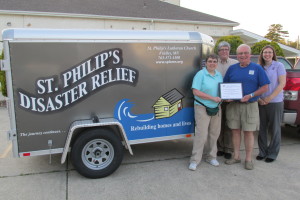
​This week, 33 volunteers from St. Philip’s Disaster Relief Ministry of St. Philip’s Lutheran Church in Fridley, Minn., traveled to New Jersey to assist in Hurricane Sandy recovery projects.

This trip marked St. Philip’s Disaster Relief Ministry’s 50th trip since the ministry formed in 2006.

St. Philip's 50th trip certificate

St. Philip’s Disaster Relief Ministry has traveled around the country meeting people who have been impacted by disasters and helping them rebuild their homes.

“St. Philip’s Disaster Ministry has been a great leader in volunteering to help those impacted by disasters,” Lutheran Disaster Response Program Director Mike Stadie said. “I don’t know of any other ELCA congregation that has helped as many people all over the country. Their commitment to helping those in need is inspirational.”

St. Philip’s Disaster Relief Ministry’s current trip to New Jersey was coordinated by Lutheran Social Ministries of New Jersey (LSMNJ) and A Future with Hope. Please visit LSMNJ’s website for more details about this story and Hurricane Sandy recovery efforts.

Pictured: Members of St. Philip’s Disaster Ministry receive certificate from Lutheran Disaster Response Program Director Michael Stadie and Amy Pennenga, disaster response coordinator for LSMNJ.

Central African Republic: Distributing Seed for the Rainy Season

Megan Brandsrud

​Security in the Central African Republic (CAR) still remains a major issue, as armed fighting and looting continues. According to a May 1, 2014, report from the United Nations, there are approximately 584,000 internally displaced persons (IDPs) in CAR and more than 2.5 million people who are in great need of assistance.

United Nations International Children’s Emergency Fund (UNICEF) says the number of children being treated for severe acute malnutrition in CAR has tripled. This is in large part a result of families missing last year’s planting season because of the violence in the country and thus having a minimal harvest this year. The fighting in CAR has also disrupted many families’ livelihoods, meaning there isn’t money to buy food.

Knowing that food security is a major concern in CAR, Lutheran Disaster Response collaborated with our global companion church, the Evangelical Lutheran Church of the Central African Republic (EELRCA), to provide assistance. From April 17 – April 29, Lutheran Disaster Response, with the EELRCA, distributed seeds and farming tools to people in the Bohong region of CAR who have been impacted by the ongoing armed violence in the country.      Distributing peanut seed

Since the rainy season is approaching in CAR, the seeds are arriving just in time for planting. This will allow farmers to restore their livelihoods and have food for next year.

The supplies included:

  • 12.2 tons of seed for corn
  • 2.7 tons of seed for beans
  • 5.2 tons of seed  for peanuts
  • 2,000 hoes (hand plows)
  • 600 files for sharpening the hoes and other farm tools

More than 2,000 households received seed and farming supplies from the distribution.

The EELRCA is committed to serving as the church even though they are living in the midst of this crisis, and with them, Lutheran Disaster Response is providing assistance to those who need it most.

“We thought that we were abandoned to ourselves, but the church is always thinking about us,” said one beneficiary at the seed distribution.

A woman who received seed expressed how this will help her restore her livelihood. “I am filled with joy,” she said. “I will plant the seed and after harvest, I will eat and sell the surplus. Thanks to all the people [in the USA] who are thinking about us.”

Committed to an inter-faith reconciliation, the EELRCA welcomed anyone who could benefit from the seed distribution. One Muslim man who received seed was happy to be able to plant and harvest food for himself and his neighbors.

Happy beneficiary from Muslim community share a laugh with the women

The need in CAR is still very great, and we will continue to work with our companion, the EELRCA, as we provide assistance to people in CAR who are still being impacted by the violence in their country.

President Golike of the EELRCA will be visiting the ELCA Churchwide Office during the week of May 12. Stay tuned for a new post with an interview with President Golike.

Honoring the 17th Anniversary of the Red River Flood

Megan Brandsrud

Red River 1997 flood 05

In mid-April 1997, following a harsh winter with above-normal snowfall, the Red River of the North flooded the Red River Valley, resulting in the worst flood in the area since 1826. The riverbed that is normally 100 yards became 25 miles wide. The Red River flooded 2,200 square miles in North Dakota, an area twice the size of Rhode Island.

Cities from Fargo, N.D., to Winnipeg were impacted, but none as severely as the greater Grand Forks, N.D., area. Nearly all of Grand Forks’ 52,000 residents had to be evacuated while more than 75 percent of the city was engulfed by the flood.

In the end, the impacted regions experienced more than $3.5 billion in flood damages.

Governmental agencies, non-profit organizations and faith-based agencies from around the country responded to the Red River flood. Lutheran Disaster Response, working through our affiliate, Lutheran Social Services of North Dakota, joined other responding agencies to form the Resource Agencies Flood Team (RAFT) to best provide efficient, relevant service to those impacted by the flood.

Lutheran Disaster Response assisted in providing financial assistance for personal items and home rebuilding, coordinating volunteers for home rebuilding, matching donations with needs, and providing encouragement and spiritual support. Lutheran Disaster Response also loaned out equipment to homeowners for rebuilding and provided sheetrock to Lutheran churches.

Since the 1997 Red River flood, the greater Grand Forks area has implemented changes to prevent a disaster of this size from occurring again. Permanent dirt and clay dikes were constructed in areas of the city, and East Grand Forks, Minn., widened the area next to the river by moving businesses behind a new wall. The downtown businesses of Grand Forks and East Grand Forks are protected by a permanent brick/cement wall system constructed along the riverbank.

On this 17th anniversary of the Red River flood, we turn to God to pay memory to the trial and give thanks for the renewal and hope found in the promise of His love.

Then God said to Noah, “Go out of the ark…Bring out with you every living thing…so that they may abound on the earth.” Then Noah built an altar to the Lord. Genesis 8: 15, 17, 20

Namibia: Cash Grants Help Provide Food Security During Drought

Megan Brandsrud

Namibia cash grantsNamibia is facing one of the worst droughts it has seen in more than 25 years. According to a report from the United Nations, 778,504 people do not have food security, and 169,000 children are at risk of malnutrition.

Certain areas of the country have experienced some rainfall and have started to plant fields, but it is too early to guarantee a secure harvest. Food stocks are depleted and market prices are extremely high for both food and seed.

This situation demands immediate action because people can’t wait for a bountiful harvest; they need food right now. Working with Lutheran World Federation (LWF), Lutheran Disaster Response has added $80,000 to our July 2013 disbursement of $150,000 for those impacted by the drought conditions.

The funds will be used to provide cash grants to 4,860 people living in four of the hardest hit communities in Namibia. The cash grants will help people cover their basic food needs during this transition period before harvest. Money paid out will be stored on a chip card that will be issued to the designated family member. Both male and female heads of households will be included in this distribution process. Unlike in-kind distribution of goods, these cash grants allow families to prioritize their spending based on their own needs, as not all households have the same needs even though they are affected by the same disaster.

Our global companion churches, the Evangelical Lutheran Church in the Republic of Namibia and the Evangelical Lutheran Church in Namibia will help with the implementation of the food security projects.

The drought has caused malnutrition, which has led to disease and death. Children are the most vulnerable to these effects. Thanks to your gifts, we are able to help provide where resources are needed most. We will continue to walk with our brothers and sisters in Namibia and pray for food security.


Who will separate us from the love of Christ? Will hardship, or distress, or persecution, or famine, or nakedness, or peril, or the sword? No, in all these things we are more than conquerors through him who loved us. Romans 8:35, 37