Skip to content
ELCA Blogs

Lutheran Disaster Response

Loving the Neighbor – Guest Post from Rev. Linda Johnson Seyenkulo

Megan Brandsrud

This is a guest post from Rev. Linda Johnson Seyenkulo, an ELCA missionary to Liberia.

I’ve been thinking about the Good Samaritan story lately and the concept of neighbor.

“Who is my neighbor?” the Pharisee asked Jesus. Even if we are not well-versed in Christian faith or the Bible, we know the story of the Good Samaritan and the definition of neighbor. Or do we?

Recently, I was called as a missionary to Liberia, West Africa. Due to the terrible Ebola epidemic that has swept West Africa – most especially Liberia, Sierra Leone and Guinea – I found myself back home in Minnesota, where I grew up.  For a time, I was living in the Minneapolis/St. Paul area of Minnesota. It sounds weird, but I was a missionary to Liberia deployed to Minnesota. I soon found myself connected with the Liberian community in Minnesota, which is home to the largest Liberian immigrant community in the U.S. Approximately 30-40,000 Liberians live and work in Minnesota, many of whom have been in the Minneapolis area for more than 20 years.

Seeing the reality of life for Liberian Minnesotans, given the Ebola crisis in West Africa, brought to mind the concept of neighbor and how it has been playing out in their lives. I had several opportunities to worship, preach and speak at services and events held in Lutheran churches. During some of those opportunities, there were Liberian Minnesotans present and I heard stories about how Ebola in West Africa has affected the Liberian community in Minnesota.

At a memorial service for victims of Ebola attended by about 500 people, there were stories of loss and of Ebola victims who were loved. We heard from the fiancée of the man who died in Dallas, Texas. One man shared about losing 7 family members to Ebola. He and others prayed and testified.

The stories were hard to hear, but what was even harder to hear were the stories of children being bullied at school because they are Liberian and might have Ebola. Or stories from adults who were sent home from work for sneezing or coughing because they are Liberian and might have Ebola. And stories of people’s long-time co-workers and friends (some as long as 20 years) becoming distant and fearful around them because of Ebola. These are people whose only connection to Ebola is that they are Liberian and have relatives living where the epidemic is.

At Lutheran church services in Minneapolis and St. Paul, people shared the same stories of bullying and being ostracized because of being Liberian.

To top it off,  a local politician ran an ad the night before the elections in Minnesota, telling people his opponent would not be able to protect them from Ebola (and by extension seemed to say, “Be afraid of your Liberian friends and neighbors.”)

I need to say that during this same time, the Bishop of the Minneapolis Area Synod spoke at the memorial service for Ebola victims. The Bishop of the St. Paul Area Synod wrote a pastoral letter detailing the realities facing our Liberian brothers and sisters in Minneapolis/St. Paul and the surrounding communities to the congregations under her care. These actions were very important because Lutherans abound in Minnesota and their witness is key to living as neighbors together. It was a start, from a certain level of the Lutheran church. Some of the congregations I met with, many of them fairly recent immigrant churches (within the last 100 years), are starting to be home to more recent immigrants. In addition, a few Liberian Minnesotans shared stories about friends who had not turned away.

In the story of the Good Samaritan, the man from Samaria overlooked everything that his culture and social structure told him. Instead, he saw someone who was human, like him, and needed relationship.

What we sometimes overlook is how hard it is to be neighbor to people who seem different from what we know—especially when that difference is connected to fear and stereotypes that fill our senses. Being a neighbor is a hard and time-consuming process that moves us away from seeing difference and into being connected in real and meaningful ways. It’s living in love, risking in love, being connected in love. Remember, love casts out fear. Things like our fear of Ebola, what we see in media reports about people, and even popular opinion can’t be allowed to take over and keep us from real and true relationship with the neighbor.

I found myself thinking how different some situations would have been if we asked, “Who is my neighbor, and what does it mean to be a neighbor?” Those are not abstract, academic questions.  They are a basic part of being a Lutheran Christian; a basic ethic of how to live the way of Jesus.  Jesus said, “Love your neighbor as yourself.”  It is as simple and as difficult as that.

Ebola Outbreak: Ebola at Christmas and plans for long-term recovery

Megan Brandsrud

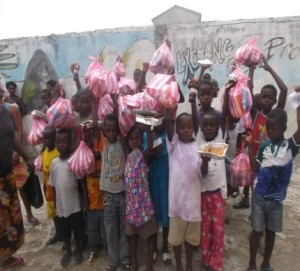
children in Morabie community showing food from distribution

Pictured: Children of Morabie Community in Sierra Leone show food they received. Photo courtesy of Evangelical Lutheran Church in Sierra Leone.

Christmas is usually a time for parties and a time when families travel from all corners to gather together to celebrate. It is a time to join together in worship to celebrate the birth of the newborn king. However, Christmas was different this year in Liberia and Sierra Leone, two countries that continue to fight against Ebola.

In Liberia, even though the number of new cases of Ebola had been declining, large gatherings in the capital city of Monrovia were banned to help prevent people from gathering together and potentially spreading the virus.

Sierra Leone at Christmas had – and continues to have – a higher number of Ebola cases than Liberia. Parts of the country were on total lockdown over the holiday, quarantining people to their homes. Transportation was restricted and shops were closed. The only exception to the lockdown was the permission for Christians to gather at churches for Christmas Day services.

Lutheran Disaster Response, working with our global companion churches, activated food distributions to assist households with food security for the Christmas holiday.

  • Working with the Lutheran Church in Liberia, Lutheran Disaster Response assisted with food distribution in six territories, providing one month’s supply of oil, rice and fish to approximately 1,000 households.
  • Partnering with the Northern Texas – Northern Louisiana Synod, Lutheran Disaster Response worked with the Evangelical Lutheran Church in Sierra Leone to provide food assistance for 275 households in five districts and for approximately 600 children in quarantined homes across six communities.

“The Christmas food distribution was a lifeline for many desperate and needy brothers and sisters in the communities served,” Bishop Thomas Barnett of the Evangelical Lutheran Church in Sierra Leone said. “It brought the Church to the people and enlivened for many the message of love and hope. In short, I am humbly proud to say that our [relationship] with the ELCA continues to be our most empowering and effective tool of evangelism.”

According to a Jan. 30, 2015, report from the Centers for Disease Control and Prevention, that week there were fewer than 100 new confirmed Ebola cases for the first time since June 29, 2014. While the number of new cases of Ebola is declining, Lutheran Disaster Response is still walking with our global companion churches in the affected region as we pray for health and continued prevention. Lutheran Disaster Response is also shifting its focus from immediate response to long-term recovery in Liberia and Sierra Leone by helping strengthen health systems, providing support to orphans and youth affected by Ebola, promoting hygiene and assisting with job creation.

Join us in praying for people in West Africa who have been and continue to be affected by Ebola. We pray for those who have lost loved ones and those who have lost jobs. We also say prayers of thanks for the declining number of new Ebola cases and the recovery work that is being done.

If you would like to support Lutheran Disaster Response’s work in the fight against Ebola, please visit the giving page.

Ukraine: Humanitarian assistance to refugees and IDPs in areas of conflict

The armed conflict in Eastern Ukraine has created a humanitarian crisis. Thousands of homes, factories and mines have been destroyed, and the fertile land of the region has been torn apart, which has damaged the farming legacy in Ukraine.  According to a Jan. 9, 2015, report from the United Nations Office for the Coordination of Humanitarian Affairs (OCHA), 5.2 million people are living in conflict-affected areas, more than 633,500 people are internally displaced, and more than 593,600 people have fled Ukraine for neighboring countries. People are homeless with no social or health infrastructures to help them meet their daily needs. This situation is exacerbated by the current winter weather conditions.

Working with ACT Alliance members Hungarian Interchurch Aid and the Russian Orthodox Church, Lutheran Disaster Response is providing food, water, blankets, diapers and hygiene kits to approximately 20,000 refugees and IDPs who are from conflict-affected areas in Donetsk and Lugansk regions of Ukraine, with particular attention given to women and children. Psychosocial assistance will also be provided to the refugees and IDPs receiving materials.

Please join us as we pray for our brothers and sisters who are running from conflict in Ukraine. We will continue to accompany them and
work with our partners to provide assistance in the midst of this crisis. If you would like to support Lutheran Disaster Response’s work to provide humanitarian assistance in Ukraine, please visit the giving page.

Unaccompanied and Migrant Children: Continuing to welcome, advocate and provide care

OurWork_Disaster_UnaccompaniedMigrantChildren

More than 70,000 unaccompanied and migrant children from Central America arrived in the U.S. in 2014. Most of these children are from Honduras, El Salvador and Guatemala, countries that are facing a host of harsh situations, including drug trafficking, violence, sex trafficking, poverty and exploitation. The migrant children are fleeing and seeking safety.

Lutheran Disaster Response has been engaging global companion churches, U.S. congregations, partners and affiliates who are in the midst of this situation. One partner we are working with is Lutheran Immigration and Refugee Service (LIRS). LIRS has been providing refugee services to families and unaccompanied children for decades.

Through an initial disbursement of $183,700, Lutheran Disaster Response is working with LIRS to create training materials for foster families, develop welcoming centers for families that are newly-released from detention centers and provide advocacy for refugee families and unaccompanied children. We will also continue working with LIRS to plan and coordinate with other U.S. and Central American partners.

We will continue to engage our churches, partners and affiliates to provide education on this situation and to help ensure the safety of children who are fleeing. As a church that is called to love and welcome, we answer the call when children who are running from harm and hunger arrive in our communities.

If you would like to support Lutheran Disaster Response’s work with unaccompanied and migrant children, please visit the response page.

South Asia Tsunami: The Vellipalayam Jubilee Village 10 years after the tsunami

Pictured: A home in the Vellipalayam Jubilee Village. Photo courtesy of Franklin Ishida/ELCA.

Pictured: A home in the Vellipalayam Jubilee Village. Photo courtesy of Franklin Ishida/ELCA.

It has been ten years since an earthquake struck off the coast of Indonesia on Dec. 26, 2004, and caused a tsunami with waves reaching to 100 feet. The tsunami affected 14 countries and killed more than 230,000 people, making it one of the deadliest natural disasters in recorded history.

The ELCA responded immediately by sending a 15-person delegation to affected areas to express solidarity and meet with partners, and ELCA congregations and individuals responded generously by giving more than $11.4 million for tsunami relief and recovery projects. This support allowed Lutheran Disaster Response to not only take action immediately after the storm but to also accompany our brothers and sisters who were impacted over this past decade as they have journeyed on the long road of recovery.

One location where Lutheran Disaster Response and the greater ELCA have been active is in the Tamil Nadu state in India.

“The ELCA’s response and engagement with the South Asia Tsunami began almost as it occurred,” says Chandran Martin, formerly the executive secretary for the United Evangelical Lutheran Churches in India (UELCI) and currently the ELCA Global Mission regional representative for South Asia. “At the time [of the tsunami], the UELCI, a partner of the ELCA, was responding to the aftermath at the relief stage. Empowered by the solidarity with the ELCA, the UELCI was able to deal with several challenges in planning and operations.”

One such challenge that the UELCI and Lutheran Disaster Response took on was including people who had received little to no assistance, the Dalits, who were then known as “the untouchables” in India’s caste system. In the Tranquebar area, where Lutheran missionaries first arrived in India more than 300 years ago, a Dalit community that was impacted was restored and developed into the Vellipalayam Jubilee Village, where 114 permanent homes were built.

In addition to the new homes in the Vellipalayam Jubilee Village, a sense of identity and self-sustenance was emphasized. Development processes for health and education were put into place, which have promoted health awareness and improved health conditions in the area. Micro-financing and self-help groups were created, which resulted in several job markets, including sewing and metal-working.

These steps helped pave the way for a movement toward greater economic justice in the area, according to Martin. “Through the micro-credit process, seven self-help groups have been formed by women in the area. They are seeking a better livelihood through this process, and the communities are gradually taking control of the processes around them.”

While the rebuilding and construction of the Vellipalayam Jubilee Village has ended, the ELCA continues to walk with our brothers and sisters in India who were impacted by the tsunami as they continue to work on capacity building and sustainability. “The communities in Vellipalayam have truly experienced this solidarity, partnership and accompaniment over the past decade,” Martin says.

India: Cyclone Hudhud relief and long-term recovery

Pictured: Damage from Cyclone Hudhud, a storm with 109 mph winds that hit eastern India in October. Photo credit: Lutheran World Service India Trust.

Pictured: Damage from Cyclone Hudhud, a storm with 109 mph winds that hit eastern India in October. Photo credit: Lutheran World Service India Trust.

From Oct. 7 – 14, 2014, Cyclone Hudhud caused extensive damage to India and claimed lives. With 109 mph winds, the cyclone affected 320 villages in India. More than 41,530 homes and 40,000 electric poles were damaged, while more than 1,800 cattle were reported dead and about 205,000 hectares of crop land were destroyed.

Working with Lutheran World Service India Trust (LWSIT), Lutheran Disaster Response has provided $80,000 to assist in the continued relief and long-term livelihood recovery for 1,000 families in Wisakhapatnum and Srikakulam districts of Andhra Pradesh as they address their immediate needs and begin the process of rebuilding.

Relief assistance will be in the forms of food, non-food items, such as tarpaulin sheets for damaged homes, and water and hygiene materials. Long-term recovery will focus on agricultural livelihood restoration and will include rice seed distribution to share croppers so that they will be able to resume planting once the current season is over. We will also assist 300 women supplement their food supply by providing vegetable seeds to them so they are able to grow food at home and meet nutritional needs for their children.

Lutheran Disaster Response will also work with LWSIT to assist 100 families whose homes were hit hardest by providing materials for them to rebuild.

“Cyclones are an unfortunate regular occurrence, especially in eastern India. Between the furies of some of these cyclones, the affect they have on large swaths of populations and their livelihoods, and the impact on people living in poverty, disasters are an ongoing companion to millions of people in India,” says Franklin Ishida, ELCA Global Mission area program director for Asia and Pacific.  “In recent years, the Indian government has done much to mitigate the effect of
such disasters. But the destructive forces of a cyclone like Hudhud are at times unimaginable. The ELCA is blessed to have a companion in India, Lutheran World Service India Trust, who is able to work with those affected by Hudhud and through whom critical relief needs are met.”

Lutheran Disaster Response is committed to working with our trusted partner, LWSIT to walk with our brothers and sisters who were impacted by Hudhud. We pray for their recovery and for their continued safety in living in an area prone to natural disasters. If you would like to support Lutheran Disaster Response’s work in India, please visit the Lutheran Disaster Response giving page.