Skip to content
ELCA Blogs

Lutheran Disaster Response

Nepal Earthquake: Krishna’s story

Megan Brandsrud

​The April 25 and May 12 earthquakes in Nepal affected more than 8 million people. Thanks to your generosity, Lutheran Disaster Response was able to provide assistance right away, working with our partners on the ground – The Lutheran World Federation, Lutheran World Relief and United Mission to Nepal. Since the earthquakes, we have been helping provide for immediate needs with distributions of emergency food packs and shelter kits. Along the way, we have heard many stories of how the earthquakes have affected families and the way of life in villages around the country.

Below is Krishna’s story that has been shared with us from our partner, Lutheran World Relief.

Krishna has lived in the village of Jaubari Dhansar her entire life. Located in the remote Gorkha District of Nepal, it is among the hardest hit by the 7.8 magnitude earthquake that struck Nepal April 25.

In fact, the village is so remote that LWR team had to switch from regular four-wheel drive SUV to a customized Jeep designed to navigate the rough terrain. It took more than two hours to drive less than 20 miles, with no sight of paved road for most of the trip.  It takes the villagers more than four hours and costs $2 in bus rides to get to the nearest town.

Krishna says she feels lucky that her family – including her husband, two sons and pregnant daughter-in-law – weren’t harmed in the quake. It struck during a time when many people in the village are usually outside sitting or working.

While Krishna is thankful to have survived the earthquake, she says she’s lost all her belongings. Her family’s food supply is buried under the rubble and she says it will take them years to rebuild their house on the roughly $8-10 per day income her husband and sons bring home from working in the nearby town. As for herself, Krishna says she’s traumatized. “It feels like the earth is shaking all the time,” she says.

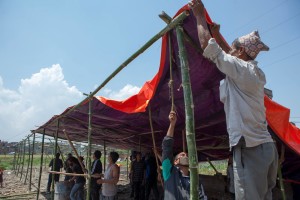
Tarps for temporary shelter Credit - LWR

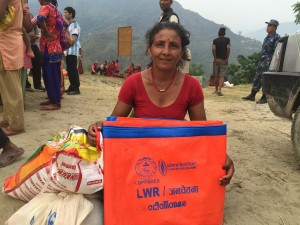
Pictured: Krishna received a temporary shelter kit and food pack during a distribution with Lutheran World Relief and other partners in Nepal.

Krishna said she’s had to borrow food from those who had some left. The food packages LWR distributed that day are designed to last 15 days for a family of five, but she hopes it will last longer. The family also received a 12- by 15-foot tarp to cover the roof of their house.  This will help protect Krishna and her family from the rains, which will intensify during the upcoming monsoon season, which runs from June through September.

The food pack and tarp will help provide for immediate needs for Krishna and her family, and we will continue to work with Lutheran World Relief, The Lutheran World Federation and United Mission to Nepal to provide long-term assistance. We will be there to help families like Krishna’s rebuild their homes and restore livelihoods so we can help them recover and increase their resilience to disasters.

If you would like to continue to support Lutheran Disaster Response’s work in Nepal, please visit the Nepal Area Earthquake giving page.

Follow Lutheran Disaster Response on Facebook and Twitter.

“Innovative Program of the Year” for storm shelter pilot project

Megan Brandsrud

​Lutheran Disaster Response was awarded “Innovative Program of the Year” for its storm shelter pilot project during last week’s National Voluntary Organizations Active in Disaster (NVOAD) annual conference in New Orleans. The award recognized our work with our partners, Upbring (formerly Lutheran Social Services of the South) and Federal Alliance for Safe Homes (FLASH), on this project that assists families in tornado-prone communities.

The pilot project was developed to help people who have been affected by tornadoes by providing resources and technical support to install storm shelters on their properties. During the year-long pilot project, 206 families in the greater Oklahoma City area and 19 families in Louisville, Miss., received storm shelters. We worked with long-term recovery groups in these two tornado-affected areas to identify families who were most vulnerable to tornadoes and to provide case management in the storm shelter selection and installation process.

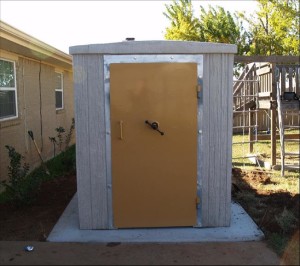
Safe room 2

Pictured: A storm shelter that was selected based on a family’s specific needs and installed on their property.

The storm shelter project is continuing beyond this pilot year, and more storm shelters are slated for installation. The learnings from the pilot will be used to help create and advise national guidelines for other storm shelter programs around the country.

This award comes at a time that serves as another reminder of the importance of storm shelters and disaster preparedness, in general. Today marks two years since deadly tornadoes tore through Moore, Okla., and the surrounding area leaving physical and emotional destruction in their path. We remember the people who were affected by these tornadoes and we hold them in our prayers as we acknowledge that they are still on their journey of recovering and rebuilding. And, we give thanks for our partners who have helped us implement the storm shelter pilot program—a project that provides physical safety and peace of mind for people living in these tornado-prone areas of the country.

Follow Lutheran Disaster Response on Facebook and Twitter.

Nepal Earthquake: Working with partners to distribute relief materials

Megan Brandsrud

​It has been three days since the second earthquake in less than three weeks hit Nepal. (First earthquake: April 25; second earthquake: May 12) Aftershocks are still being felt, which continue to generate landslides. The landslides and debris are blocking roadways, which is making transportation difficult—especially in remote villages. These obstacles combined with the approaching monsoon season are making relief activities a little complicated. However, Lutheran Disaster Response and our partners on the ground are continuing to reach as many people as possible and are committed to providing assistance to those who need it most.

The Lutheran World Federation (LWF)

Working with LWF, we have distributed relief items to 8,957 households (43,703 people) across Bhaktapur, Lalitpur, Rasuwa, Sindhupalchowk and Kathmandu districts. More than 96 tons of rice, 24 tons of lentils, 6,100 tarps, 7,000 blankets and 1,200 bars of soap have been distributed to families. Several other items, such as solar lamps and hygiene packs have also been provided for people who need them most.

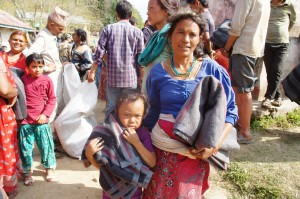
LWF-ACT Alliance distributing blankets to earthquake survivors in Gushel village, Lalitpur. LWF has been doing development work here since 2006. The earthquake has destroyed the entire village.

LWF-ACT Alliance distributing blankets to earthquake survivors in Gushel village, Lalitpur. LWF has been doing development work here since 2006. The earthquake has destroyed the entire village.

Distributing blankets in Lalitpur, a village that was completely destroyed by the earthquake. Credit – LWF

LWF is the lead agency in the ACT Alliance response. Dr. Prabin Manandhar, the LWF country director in Nepal, was recently appointed to the “Disaster Management Coordination Committee” in Nepal that was formed by the Nepalese government. The committee will focus on relief and reconstruction activities, and Dr. Manandhar is one of four people on the committee who is representing international non-governmental organizations in Nepal.

Lutheran World Relief (LWR)

With Lutheran World Relief, we have distributed food packets and shelter items in Gorkha and Lamjung districts. Nearly 2,000 food packets that will be sufficient for 15 days for families of five have been distributed. The food packets consist of rice, sugar, lentils, salt and oil. More than 2,100 tarps that can be used for shelter material have been provided. In all, 2,362 households (11,810 people) have received food packets and tarps, and there are immediate distribution plans for at least 1,000 more families.

Lutheran World Relief is also working with LWF to plan distributions for 9,240 quilts, 1,000 personal care kits and 100 water filtration units that have been shipped to Nepal in coordination with the United Nations.

While continuing to assist in immediate relief, we are working with Lutheran World Relief to assess for long-term responses, including home rebuilding, livelihood rehabilitation and longer-term food assistance.

United Mission to Nepal (UMN)

We are working with UMN on relief activities in Dhading district, Nepal, where UMN has been active for almost 20 years. Trucks, tractors and helicopters are being used to distribute relief items to families in villages that have been hard hit by the earthquake that are difficult to access due to damaged roads and landslides. Some families have walked three to four hours for supplies because that is the closest the trucks and helicopters could get to them, as many of the villages are only accessible by foot.

In Chimchok, food packs, utensils and hygiene kits have been distributed to 723 households.

Over the course of seven helicopter flights, food packs were distributed to 144 households in four villages of Jharlang and two villages of Lapa. The walking paths in these areas have even been destroyed due to broken suspension bridges and landslides.

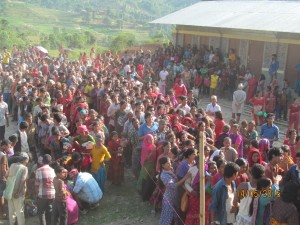
People lined up to receive relief distribution in Jeevanpur, Dhading. Credit - UMN

People line up to receive relief distribution in Jeevanpur, Dhading. Credit – UMN

UMN’s hospitals in Tansen and Okhaldhungaare have not sustained major earthquake damage, so they are both functioning beyond full capacity. All of the beds in each hospital are full, and some beds are being set up in training halls and a new hospital building that is still in the process of being constructed. Some shelters have been constructed outdoors, since some patients are nervous to stay indoors due to continued aftershocks and the fear of another quake.

We give thanks for our wonderful partners and we are grateful to be working with these trusted and experienced organizations to assist people who have been affected by the Nepal earthquakes. More distributions are scheduled and plans are underway to continue reaching people who are living in remote areas. As the immediate relief process moves forward, assessments are also being made for long-term response and the rebuilding phase that will follow.

Please continue to hold the people who have been impacted by these earthquakes in your prayers. If you would like to support Lutheran Disaster Response’s work in Nepal, please visit the Nepal Area Earthquake giving page.

Follow Lutheran Disaster Response on Facebook and Twitter for more updates.

Second major earthquake hits Nepal

Megan Brandsrud

Just a little more than two weeks after thousands of people died in the massive earthquake that struck on April 25, a second earthquake hit Nepal.

Around 12:50 p.m. local time today, May 12, a 7.3-magnitude earthquake struck Nepal approximately 47 miles northeast of its capital, Kathmandu – an area already affected by the April 25 earthquake. The earthquake, while still considered an aftershock of the previous quake, was followed by several strong aftershocks that continue to be felt in the region.

second earthquake location

Photo courtesy of UN OCHA

As of publication time, at least 66 people are reported dead and at least 1,261 people are injured following today’s quake. These numbers may rise as there are many reports of people trapped beneath rubble.

Similarly to the April 25 earthquake, today’s earthquake affected surrounding countries, with reports of loss of life, injury and structural damage in India and Tibet. Landslides were reported in the Himalayas. Many villages on the outskirts of Kathmandu have been severely affected by the earthquake, and they are only accessible on foot, making it difficult to carry out relief efforts.

Houses and buildings that were damaged from the previous earthquake have now collapsed after today’s quake, and new damage to homes and infrastructure is being reported across many of Nepal’s districts.

People are once again leaving their homes to camp out in any available space outside while aftershocks continue and fear of another large earthquake runs rampant.

This level and frequency of seismic activity is not unprecedented, especially in the region of Nepal. The U.S. Geological Survey predicted about a week ago that there was at least a 50 percent chance of a second strong earthquake. Every quake and aftershock causes disruption, which means that tremors will once again increase in frequency and intensity and could take weeks or months to die down. This activity is cause for concern as monsoon season in the region is quickly approaching.

Lutheran Disaster Response was already working with our partners, The Lutheran World Federation, Lutheran World Relief and United Mission to Nepal, to assist in the recovery from the April 25 earthquake when today’s quake hit. All of our partners have reported that they are safe, and the initial recovery work continues while assessments are being made to determine how the response will now expand to include needs from the recent earthquake.

This is a time of uncertainty and fear for the people of Nepal and its surrounding countries, and we hold them in our prayers as we walk with them through every phase of this disaster recovery process. Our work will continue and grow to assist those who need it most.

To join in the response, please visit the Nepal Area Earthquake response page. Your gifts will be used in full (100 percent) to assist in the growing need for recovery projects as seismic activity in the region continues.

Nepal Area Earthquake: Initial $500,000 commitment to provide for immediate needs

Megan Brandsrud

​In response to the April 25 earthquake that struck Nepal and surrounding countries, Lutheran Disaster Response is committing an initial $500,000 to assist in the recovery and rebuilding in the affected areas. This recent earthquake, registering 7.8 magnitude, was the most powerful earthquake to have hit the region since 1934, and as of May 4, 2015, more than 7,270 people have been confirmed dead and more than 200,000 homes have been completely destroyed.

We will be working with our trusted partners who have been on the ground since the earthquake struck to assist in providing for the most pressing emergency needs. Through ACT Alliance, we have committed $200,000 to The Lutheran World Federation and $200,000 to Lutheran World Relief. A separate $100,000 has been committed to United Mission to Nepal.

“Lutheran Disaster Response has a strong commitment to provide humanitarian assistance where the need is the greatest, and we are pleased to be working with these very professional partners on the ground,” says Vitaly Vorona, program director for Lutheran Disaster Response. “A quick action is needed due to the start of the monsoon season in a few weeks. Our response will help address immediate needs and will allow us to build a good foundation for the long-term reconstruction phase.”

The Lutheran World Federation

Working with The Lutheran World Federation, we will be active in several districts, including Kathmandu, Lalitpur, Bhaktapur, Sindupalchowk, Dhading, Lamjung, Kabre and Gorkha. The Lutheran World Federation is the lead implementing partner with ACT Alliance, and the organization has been working with the Nepalese government. The Lutheran World Federation also has a regional emergency hub located in Nepal that Lutheran Disaster Response provides support for annually. Response activities will focus mostly on immediate needs, including shelter, food, water, non-food items and psychosocial support.

  • Shelter: 12,000 families will receive tarps and materials for temporary shelter, and 1,000 families will receive vouchers for home reconstruction materials.
  • Food: We will provide food for 20,000 families who are currently living in temporary campsites. The food provided will be appropriate for a sufficient and nutritionally-balanced diet.
  • Water: We will help provide access to clean water for 15,000 families to have at their temporary displacement sites and at their permanent homes.
  • Non-food items: Non-food items, such as cooking utensils and baby care kits will provide assistance for 20,000 families who are currently living in temporary campsites.
  • Psychosocial support: Community-based psychosocial support is inherent for the affected communities’ wellbeing. Support will be provided to help strengthen and mobilize social groups in communities.
LWF Nepal project coordinator Nibha Shresta hands out blankets to earthquake survivors in Ghusel

LWF Nepal project coordinator Nibha Shresta hands out blankets to earthquake survivors in Ghusel

Lutheran Disaster Response funds at work. Distribution of blankets and other non-food items in Nepal with The Lutheran World Federation.

Lutheran World Relief

We will be working with Lutheran World Relief in Lamjung and Gorkha districts of Nepal to provide shelter repair materials and non-food items.

  • Shelter: Cash transfers for shelter repair materials will assist 1,500 households rebuild their homes that were destroyed by the earthquake.
  • Non-food items: Blankets, quilts, personal care kits and water purification units will be distributed to help provide basic personal needs to people who have been affected by the disaster.

Tarps for temporary shelter Credit - LWR

Lutheran Disaster Response funds at work. Distribution of tarps for shelter with Lutheran World Relief.

United Mission to Nepal

We will work with United Mission to Nepal to assist in recovery activities in Dhading district. Dhading district was severely affected by the earthquake and has many recovery needs, and United Mission to Nepal has almost ten years’ worth of development experience in the district. The focus of our work with United Mission to Nepal will be on immediate relief items, such as food, water, sanitation and hygiene materials, medication and shelter for more than 8,600 households.

“Nepal is a country where poverty and underdevelopment continue to be issues,” says the Rev. Franklin Ishida, Global Mission area program director for Asia and the Pacific. “The ELCA has long supported organizations that are devoted to bringing holistic development to the people of Nepal. Most of our companions are deeply engaged with relief activities and it is our intention to continue to find ways of supporting this work.”

The disaster response work in Nepal is just beginning, and our strong network of connections in the region positions us to play an active role in the long-term rebuilding plan. If you would like to support Lutheran Disaster Response’s work in Nepal, please visit the giving page. Gifts will be used in full (100 percent) to assist in the Nepal Area Earthquake disaster recovery work. Please continue to hold those who were affected by the earthquake in your prayers.

7.8 magnitude earthquake hits Nepal and surrounding countries

Megan Brandsrud

​Around 11:55 a.m. local time, a 7.8-magnitude earthquake shook Nepal, with its epicenter approximately 70 km from its capital city, Kathmandu. The earthquake was felt around the whole country, but the Kathmandu valley and western region of the country were hit hardest.

As of publication time, approximately 1,500 people are reported dead and thousands are injured. Death toll numbers are expected to rise as searches continue because it is feared that many people are trapped beneath rubble. Buildings are leveled, roads are destroyed and many heritage sites and landmarks are collapsed, including the Dharahara Tower, which was built in 1832 for the queen of Nepal.

nepal earthquake 1

Collapsed building and surrounding damage in Nepal following 7.8-magnitude earthquake that hit the country early April 25. Photo courtesy of LWF.

The earthquake also triggered an avalanche on Mount Everest, killing 13 people. More than 25 aftershocks have been recorded in the Kathmandu Valley and neighboring countries, causing people to spend the night outside in the open as a precaution.

Lutheran Disaster Response is working with trusted partners – Lutheran World Federation, ACT Alliance and Lutheran World Relief – who are on the ground and already responding. Immediate response includes supplies and services such as water, food, medication, shelter and psychosocial support. We continue to connect with other partners and our companion church, the Nepal Evangelical Lutheran Church, for updates and response plans.

“ELCA partners were in contact as soon as the news flashed,” says Chandran Paul Martin, consulting regional representative for South Asia, ELCA Global Mission. “Dr. Bijaya Bajracharayna, program coordinator for Lutheran World Federation in Nepal, described the situation of people on the street and open ground as after tremors were felt.”

Lutheran Disaster Response is committed to long-term response, and we will accompany our brothers and sisters who were affected by the earthquake as they navigate every process of the disaster relief and recovery process.

If you would like to support Lutheran Disaster Response’s work with the Nepal Area Earthquake, please visit the giving page. Your gifts allow us be the church in times of disaster, and we thank you for your generosity. Please continue to remember the people of Nepal and surrounding countries who were affected by the earthquake in your thoughts and prayers.

Merciful God,

Hear our cry for mercy in the wake of the earthquake. Reveal your presence in the midst of our suffering. Help us to trust in your promises of hope and life so that desperation and grief will not overtake us. Come quickly to our aid that we may know peace and joy again. Strengthen us in this time of trial with the assurance of hope we know in the death and resurrection of our Savior and Lord, Jesus Christ. Amen.