
Skip to content
ELCA Blogs

Lutheran Disaster Response

Relief Efforts Expand in Japan

Franklin Ishida, Area Program Director for Asia/Pacific, ELCA Global Mission, was with the leadership of the Japan Evangelical Lutheran Church (JELC) in Malaysia during the March’s devastating earthquake.  Franklin arrived to Japan one week ago and has been accompanying the leadership of the JELC in their relief efforts.  

The following post is from Franklin, and captures a quick glimpse of the efforts underway to restore lives and livelihoods in the wake of disaster.

————-

Relief efforts, initiated within days after the earthquake and tsunami, have now been expanded with additional plans for entering a recovery stage. As in any disaster, on-the-ground assessment is important.  Earlier this week, a 6-person team from the JELC headed to the disaster area taking with them supplies including food, a motorcycle and a couple bicycles. These latter means of local transportation were important as gasoline is virtually impossible to obtain even three weeks after the disaster. The team visited several cities and towns, many devastated by the tsunami. They talked with local municipal officials and representative of non-profits still sifting through the massive destruction, determining needs, and addressing some of the most critical needs in their communities.

Trying to clean up from the destruction is still going slow as bodies are still thought to be in the rubble. But meeting the daily needs of those who survived, most of whom are in evacuation centers, is still critical.  Food and other daily items have been rushed in from all over Japan but are piling up due to challenges faced with the distribution network. While roads are being cleared, lack of gasoline prevents vehicles from hauling these much-needed items beyond central evacuation centers and storage depots. In some instances, people have been encouraged to come and get what they need; but they, too, don’t have the means to move around.
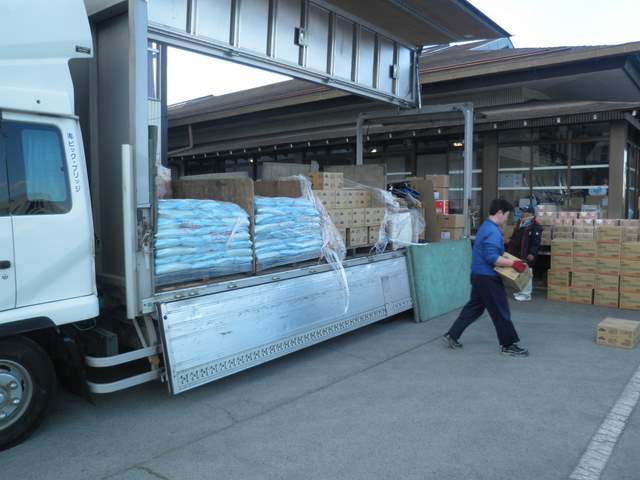
Relief supplies distributed in Japan.

These gaps in the distribution of supplies are causing some hardships, in addition to unmet needs in some areas. Now constituted as Japan Lutheran Emergency Relief (JLER) — a cooperative effort of the Japan Evangelical Lutheran Church, Japan Lutheran Church, Kinki Evangelical Lutheran Church, and West Japan Evangelical Lutheran Church — the churches chartered three trucks to transport both purchased food items and in-kind donations from congregations around the country. These trucks departed from a warehouse in Tokyo on March 28 and headed to three different areas of the affected region. Coordinating with local municipalities and non-profit organizations, food items such as rice, miso soup, water, juice, and non-perishable food were dropped off at local distribution sites. To expedite and streamline the distribution network, JLER is now going to rent warehouse space in the disaster area, and will utilize a small truck and vans to reach communities with the greatest needs in coordination with other actors.

Meeting food, clothing, and other daily needs are just part of an initial response stage. As people start to rebuild their lives, even if by living in temporary housing, further emotional and livelihood questions will surface.  JLER is preparing to meet these needs as well. Counseling centers will be established, with both professional and trained volunteers prepared to engage people’s emotional trauma. The Japan Lutheran College in Tokyo has social welfare and counseling departments, and the college will take the lead in mobilizing necessary people and resources.

While the government will certainly provide much assistance to rebuild people’s livelihoods, there will certainly be gaps. JLER is preparing to provide grants to help selected individuals and families rebuild their lives. This will come after careful analysis of unmet needs as they emerge. Japan is a developed country, and much is happening quickly to address this catastrophic disaster. The scope of this disaster is presenting the greatest challenges. JLER, with assistance from all over the world, including the ELCA, is attempting to do its part in addressing the many emerging and changing needs, coordinating along the way with other actors to promote an effective response.

————-
Gifts to ELCA International Disaster Response allow the church to respond globally in times of need. Donate now.
Japan: Volunteers Filling the Gaps

In a reflection on the situation in Japan by Church World Service Asia/Pacific Emergency Response Director Takeshi Komino, he describes how the situation is understood by those making the decisions and those living the realities in the villages. The opening paragraph is a sobering reminder that human-made security is never absolute.

“Is this really happening in my country of Japan?” was my initial thought. Japan is considered one of the richest nations in the world with probably the best disaster risk reduction measures in the region. And this was certainly my first time responding to an emergency in Japan as a staff member of CWS. As the extent of damage became clearer, I learned that this is actually four disasters happening at once. First a 9.0 Richter scale earthquake, then 20m+ tsunami, then nuclear power plant reactor explosion, all happening in the harsh winter weather of Tohoku region where temperatures nowadays go down below freezing point on daily basis. Can my government respond adequately? The answer, unfortunately, is no.

He goes on later to share about how volunteers are stepping up to help fill the gaps and meet the needs of those affected by this disaster. In the coming days please pray for those in leadership that they may be guided by a spirit of justice and led to decisions of equity. Pray also for these volunteers as they give of time and talent to serve the neighbor.

Read his full report: Takeshi Reflection On Japan (pdf).

————-
Gifts to ELCA International Disaster Response allow the church to respond globally in times of need. Donate now.

Nepal: Fire Displaces About 6,000 Bhutanese Refugees

A March 22 fire broke out in the Nepalese refugee camps of Goldhap and Sanischare displacing about 6,000 Bhutanese refugees. The ELCA, through its World Hunger program, supports human rights advocacy and development in the region. For more information please read this partial report from Marceline P Rozario, Lutheran World Federation Country Representative for Nepal. Let us pray for those who have been affected by this tragedy that the Lord may keep them safe, calm their fears and give strength to those who seek to meet their needs.

———

Dear friends,

About 6,000 Bhutanese refugees, including women and children, were rendered homeless yesterday (Tuesday) after a deadly fire that broke out in Goldhap and Sanischare camps. This is the second deadly outbreak of fire in Gholdap camp in the last three years.

Nearly six hours after a massive fire swept through Gholdap camp of Jhapa, gutting down 516 huts and displacing about 3,500 Bhutanese refugees, another deadly fire on the same day broke out in Sanishchare camp of Morang, burning down 200 huts to ashes and leaving around 2,500 Bhutanese refugees displaced. At least 29 refugees were injured in a stampede triggered by the fire in Gholdhap. No case of injury has been reported in Sanishchare camp.

The fire destroyed Gholdhap camp about two weeks before its planned merger with another refugee camp in Beldangi. Following the departure of many refugees for third country resettlement program initiated by the United Nations High Commission for Refugee (UNHCR), Gholdap camp was all set to be merged with Beldangi.

Most of the refugees could not save their properties because the fire, triggered by a cooking gas leak in one of the huts, swiftly swept through Gholdap camp. The fire was spurred by forceful wind. It took nearly four hours for locals, refugees. agency staffs and firefighters to douse the fire.

All refugees, displaced by the fire, have been kept in nearby schools. The fire has partly damaged local offices of the UNHCR and the World Food Program (WFP), In Sanischare camp, apart from refugees´ huts, offices of Camp Management Committee (CMC), Refugee Coordination Unit (RCU) and Reconciliation Center have been badly damaged. The office of Lutheran World Federation has also been partly damaged.

We are holding urgent meetings with all agencies including the government. We shall inform you about our actions in this emergency.

Best regards.

Marceline

————-
Gifts to ELCA International Disaster Response allow the church to respond globally in times of need. Donate now.

Japan: Reactions and Responses Around the Region

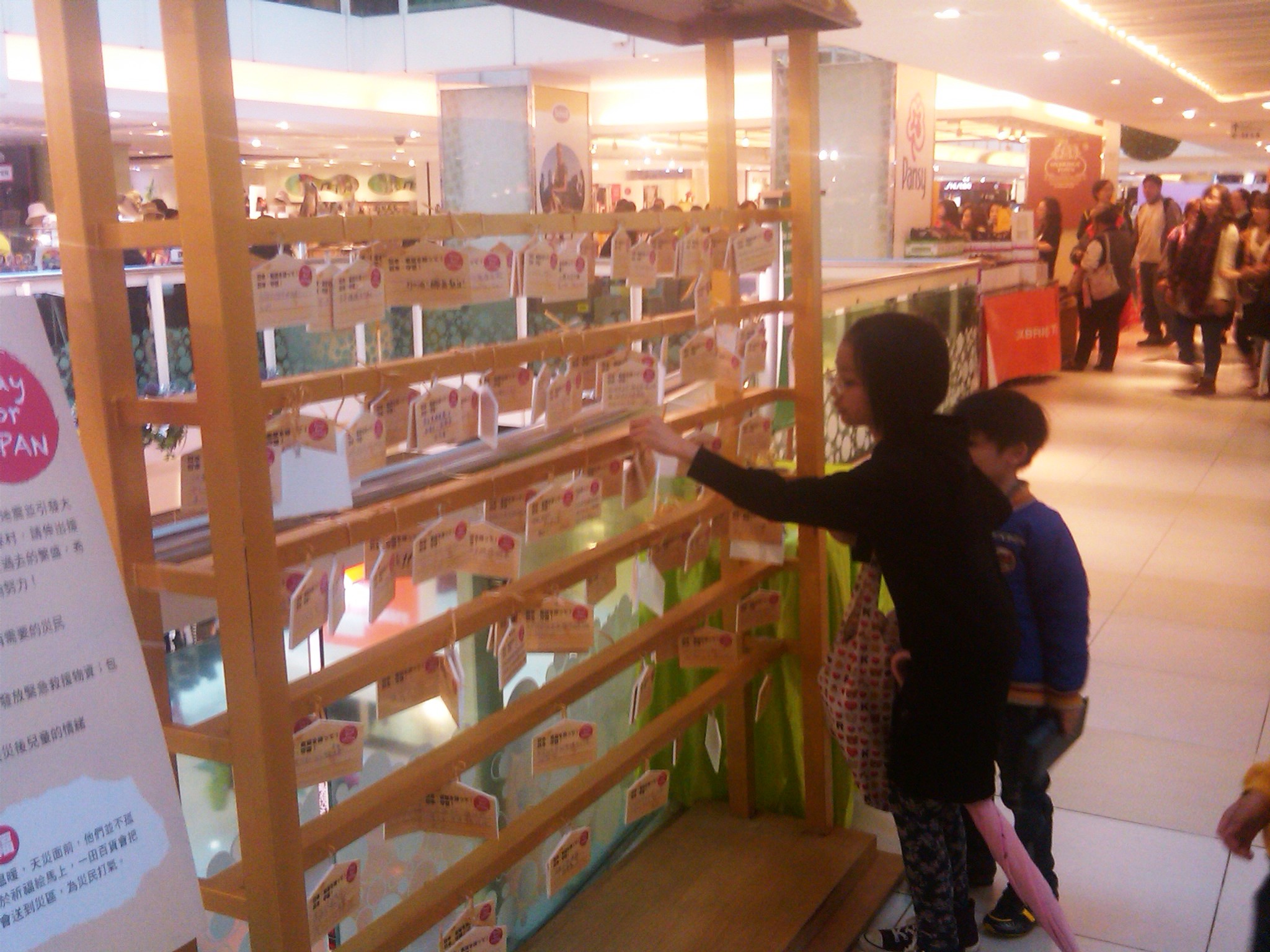
Children in a Hong Kong shopping center hang "ema" (prayers or wishes on small wooden plaques) for the people of Japan

As news and rumors about the situation in Japan after the earthquake, tsunami and continued potential for nuclear crisis there have been mixed reactions and responses from Japan’s neighbors in the region. The following reports from the Rev. Franklin Ishida show the breadth of these two.
———–
Prayers in Hong Kong

During my visit to Hong Kong, I encountered two instances of public display of prayers for Japan.

The Evangelical Lutheran Church of Hong Kong has a newly established school, Lutheran Academy. A special assembly was called on March 17, where students and teachers stood for a moment of prayer. One of this schools expressed values is a global perspective. The students I talked to, without prompting, spoke with eagerness that they had engaged in this prayer for those who lost lives and for survivors of the earthquake and tsunami.

Meanwhile, at a shopping mall in Shatin, a place to hang “ema” (see photo – prayers or wishes written on a small wooden plaque, often seen in Japanese shrines and temples) was located in a prominent place. Children and adults were adding their prayers for the Japanese people, expressed in this Japanese form of prayer.

———–
Radiation, Salt and Formula

In many parts of China, there has been panic buying of salt. This is with the rumored [and mistaken] understanding that iodized salt can help ward off radiation poisoning. This is in reaction to the radioactive plume coming from the tsunami-damaged nuclear reactor in Japan. Store shelves of salt supplies have been emptied in Beijing, Shanghai and other cities.

In southern China, this buying fenzy has spilled over into Hong Kong, causing hysteria and even violent struggles over supplies. In Hong Kong, at least, wild purchasing has stabilized. But newspaper reports point to a lack of trust in the government by Chinese people and a succumbing to a “herd mentality” in such crises.

In a similar way, infant formula, which was widely tainted in China in 2008, is still feared in that country. Even after the problem was resolved, people have tended to purchase Japanese-made formula. Now, with fears of radiation, people are scrambling to secure formula that was produced before the tsunami. Again, many southern Chinese are flooding into Hong Kong to buy up these pre-disaster Japanese formula stock. Stores are keeping formula behind the counter so as to avoid fights over remaining items.

————-
Gifts to ELCA International Disaster Response allow the church to respond globally in times of need. Donate now.

Japan: Stories from the Ground

The following are stories related by the Rev. Franklin Ishida, ELCA Global Mission Director for Asia – Pacific Continental Desk, from individuals affected by and responding to the disaster in Japan, as well as a update from the Rev. Hiroaki Fujii, pastor of Sendai and Tsurugaya Lutheran Churches.

———-

Stories relayed by Rev. Ishida
The Japanese networks are almost nonstop showing images of the disaster area, whether that be earthquake and tsunami related or about the damaged nuclear power plant. Some of this is news, others are story or commentary. In most instances, no voice over announcements are necessary; the stories and images speak for themselves.

A woman who is searching frantically for her husband. She looks over names at refuge points and hospitals. She tries to get to where her home was, but still can’t get close due to the debris. She walks aimlessly, her name pasted on one side of her coat and that of her husband on the other, so people can know what she’s trying to do … one more person seeking the whereabouts of a loved one.

An elderly man seeking his daughter. He looks at the descriptions of each person at the morgues. In so many cases, identifying items were washed away from the bodies, and all there is to go on are the person’s height and particular clothing. He finds one description of a embroidered design on a jacket worn by a deceased woman. He goes in to the morgue, but emerges distraught … it wasn’t her.

A man searches the web for photos taken of name lists posted at refuge points and hospitals. He looks at each one carefully and transcribes the names he finds there to a database, which he posts on the internet. A friend of a friend of a man, who had been separated from his family, sees this list and sends a text message that this man that his wife and two children are alive. Before this, he had no idea whether they were alive or not, as cell phones and other means of communication were not working properly. This was great news.

A university researcher in the area of disaster preparedness had helped plan mitigation efforts in many communities along the coast. One town built a multi-million dollar disaster/evacuation center. A school had a specific plan for evacuating children to higher ground in case of a tsunami. These plans were based on computer models for a large tsunami. The only problem was this tsunami was much greater than anything anticipated: in some places the wave was three or four times higher. People had taken refuge in the evacuation center as they had practiced, to a special room on the second floor. The tsunami overwhelmed the whole building, and even those in the “upper room” were washed away or floated up to the ceiling. One woman survived by grasping a curtain rod up by the ceiling, floating with only her face above the water. Meanwhile the children at the school had taken refuge; but they saw the waters coming up, and they all ran to even higher ground. They were safe. In all this, this researcher both grieves over the failures to prepare for a tsunami that overwhelmed all expectations; and celebrates the human will to persevere and overcome all danger.

In this disaster, there are human stories told over and over again. The words coming from the survivors, the rescuers, the caregivers, and others. These are enough to make this all so real.

———-

Update from Rev. Fujii from Sun, March 20
Today, eleven people attended worship.

Several members had already told me they could not attend because of there being no gas.

We are thankful for everyone around the country for their special prayers for victims of the disaster. We prayed this during worship. We also announced that a group will be coming on the 23rd from the disaster task force.

(Oh, we just had another aftershock.)

In response to the news that task force people are coming, there are differing opinions on this. Some of positive, while others are less so … even though they are victims of a major disaster, they don’t want all the attention.

Some members want as many propane tanks [used for table top cooking stoves] as possible. If you can bring these, it would be very helpful. We also need toilet paper.

While our lives are slowly getting back to normal, there are still many inconveniences.

Just yesterday, I stood in line for over an hour just to get two packages of instant noodles and soup.

At today’s worship, some members brought rice and packaged food. We are grateful.

————-
Gifts to ELCA International Disaster Response allow the church to respond globally in times of need. Donate now.

Japan: Life Continues after Disaster – Update from Sendai

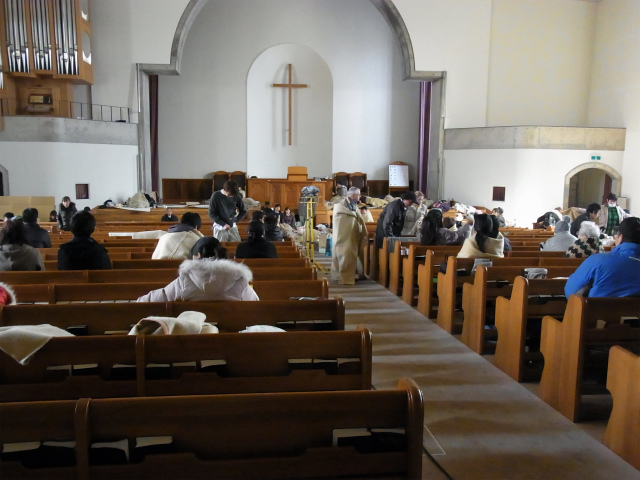
As people affected by the earthquake and tsunami in Japan have had to leave their homes some are finding sanctuary in the local churches. This picture is from a church in Sendai.


Another update from Shinji (Thomas) Nagashima about the situation in Sendai, Japan.

—————

Dear Friends

I am one of the members of Japan Evangelical Lutheran Sendai Church. When this terrible earthquke occured, I was in front of my computer [in] my office. I am an associate proffessor of Tohoku Gakuin University. Tohoku Gakuin University has three campuses. My office is in the Tagajyo campus. Tagajyo is one of the coast areas stricken by [the] tsunami.

[The] Tsunami came near Tagajyo railway station. [The] college chapel [is] filled with people [who got] away from tsunami. One of my co-worker told me that his house was swept away. But his family [is] safe. It’s [a] miracle. Another co-worker told me that he can’t contact his parents. I’m worring about the people who live in the coast area. My many students and co-worker must [have been hit by] the tsunami. I’m trying to contact students. One of them, Abe who lives in Minami Sanriku, which had the largest damage sent me an e-mail. “I am alive! My house was swept away.” I tried to reply [to] him. “If possible, come to my house.” But [my] e-mail couldn’t reach his address.

[The] urban area of Sendai and [the] local area around our house is ok. But as you know, the coast area [has] had terrible damage. The electric power began working in my house, there are few places which electric power is available in Sendai yet. We have to get [in] line to get water and food. I got [in] line yesterday to get food for two hours and I couldn’t stand [the] cold. I called my daughter Maiko by mobile phone to exchange getting [in] line for me. We are managing to survive. There are 6 members in my family. We have parents who need care. They live near my house.

But I would like to go and see my churh, now [that] we have [a] little rice and [a] little gasoline. Newspaper delivery was stopped because of the lack of gasoline. Pastor Fujii let us know that [the] church building is ok. He has the responsibility of two churches (Sendai church and Tsurugaya church) and three nursery schools. He is in need [of] food and gasoline.

We are worrying about the accident of nuclear energy plant too. But our house is far from [the] nuclear energy plant, about 100km(62 miles). Now there is no need to worry about the bad influence on us.

Despite this, we are fine. We eat something everyday. We are laughing everyday. We are praying to God everyday.

Please pray for us. Hope God blesses you all.

Thank you.

Shinji Nagashima

————-
Gifts to ELCA International Disaster Response allow the church to respond globally in times of need. Donate now.