Skip to content
ELCA Blogs

Lutheran Disaster Response

Advocacy: Drought Affected East and West Africa

The following message is from the ELCA e-Advocacy list. This lists is sent out by the Advocacy office of the ELCA to inform people of the what political issues are going on and how people can get involved. This particular message is about the situation of drought in East Africa and now West Africa, how actions within the US Congress can impact the situation and how you can get involved.

Evangelical Lutheran Church in America

Before we turn our hearts and minds to Jesus’ path to the cross and joyous resurrection this holy weekend, we can first follow Christ’s teachings by urging Congress to act on behalf of the millions in Africa living in dire insecurity and uncertainty.

Conflict, draught, and resulting food shortages have left tens of millions of people – from Sahel to Sudan to Somalia – in crisis, facing starvation and malnutrition and forced to leave their homes and relocate in refugee camps. These men, women, and children will face even greater hardship if we do not act to protect U.S. funding for the life-saving programs upon which they depend for food, clean water and secure shelter.

In the Horn of Africa

13 million people are currently living in food crisis, still suffering from the effects of last year’s drought which forced millions to leave their homes to take refuge in camps.

Meanwhile, the plight of famine has spread west, putting 15.5 million people in West Africa’s Sahel region at risk, including eight million who need emergency assistance. Over ten million already face food insecurity and an additional one million children are at risk of severe malnutrition. Chad, Burkina Faso, Mauritania and Niger are all experiencing dangerously high malnutrition levels while in Mali alone, conflict and food shortages have displaced 100,000 people. The crisis is only expected to worsen in the coming months.

Between the crises to their east and west, Sudan and South Sudan suffer while combating their own humanitarian crises. An estimated 200,000 people have been displaced or severely affected by violence in South Kordofan, an area vulnerable to Sudan’s Armed Forces’ aerial bombing, ground attacks, sexual violence, denial of humanitarian assistance, and other tactics which some have dubbed ‘weapons of mass starvation.’ An estimated 28,000 Sudanese have been forced to relocate to South Sudan’s Yida refugee camp.

Through its membership in The Lutheran World Federation, the ELCA is participating in relief efforts with Lutheran churches and partners in these emergency crises.

Yet in the midst of these dire and enduring crises, the U.S. House of Representatives passed the House Budget Committee’s fiscal year 2013 Budget Resolution last week, which cuts the International Affairs Budget by 11 percent. The cuts include the eliminating Feed the Future and cutting the U.S. Agency for International Development’s International Disaster Assistance by 40 to 60 percent. Meanwhile, the President’s fiscal year 2013 budget request proposes cuts to essential poverty-focused programs that provide refugees and displaced people with access to food, shelter, and water, including a 13.3% cut ($250
million) to the Migration and Refugee Assistance.

CLICK HERE to tell your senators and representative to maintain funding for the International Affairs Accounts that provide essential food, water, shelter, and support to the millions of refugees around the world who have been forced to make incomprehensible sacrifices.

Want to do more? Call your senators and representatives, who are at home in your district during recess, and tell them to protect the International Affairs account from the deep, disproportionate cuts made in the House of Representatives’ FY13 Budget Resolution.

RESOURCES

West Africa: 9th LWF Situation Report on Sahel

A new situation report from the Lutheran World Federation give an overview of the political and humanitarian situation affecting the Sahel region of West Africa that is current being affected by drought. The country of Mali is also experience internal conflict, leading to a growing refugee situation alongside the food crisis. This report looks mainly at Mauritania, Mali and Senegal as well as the actions of the LWF in the region.

You can read the report here.

For more information on the situation please visit the ELCA Disaster Response webpage West Africa Sahel Drought Relief. Here you can also find a situation report and bulletin insert to help share the story.

————-
Gifts to ELCA International Disaster Response allow the church to respond globally in times of need. Donate now.

South Sudan: Resource Shares South Sudanese Stories of LWF Work

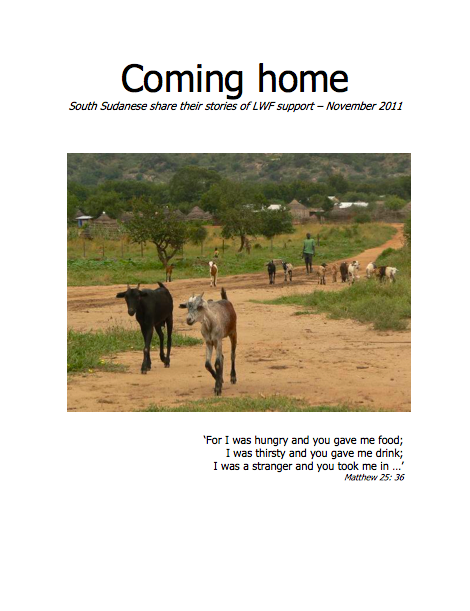
Written by two members of Australian Lutheran World Service on a visit to South Sudan, “Coming Home” is a collection of stories around the work of the Lutheran World Federation (LWF) as it extends back many years in this newly formed country. It is not meant to be systematic or exhaustive and in this way it is actually quite an easy, and extremely interesting, read.

In these pages you will meet indiviudal South Sudanese citizens and hear their stories. What are the major issues that have affected them? How have LWF projects like boreholes and schools been received? What are the benefits of these programs? Who owns them? How have other LWF projects, like Kakuma refugee camp, played a role in the lives of these citizens of the new South Sudan?

If you find any of these questions intriguing than I would recommend give this resource a good look.

Download and read Coming home. (pdf)

West Africa: Response Before Need

Twelve million people across five West African countries teeter on the brink of famine. Drought, crop failure, inadequate recovery from previous crises, and rising food prices have propelled the governments of Burkina Faso, Mali, Mauritania, Chad and Niger to declare states of emergency and call for international assistance.

This is the opening paragraph to an ACT Alliance story from Feb 20th. The story is an interview with Paul Valentin, director of Christian Aid, who was in Burkina Faso. Over all it is an solid piece, giving an overview of the growing crisis in the region and for this reason alone it is worth a listen.

Beyond this though, Paul has some important things towards the middle of the interview of the connection between response and media portrayal of need. Boiled down it’s a look at how we must learn better how to communicate need before pictures of starving people and animals are on the news. This is the heart of disaster risk reduction and prevention, a growing component of ELCA Disaster Response work.

The interview is just over 16 minutes long and I would highly recommend giving it a listen.

Listen to ACT eyewitness account in Sahel.

Madagascar: Cyclone Giovanna Pounds Country with Heavy Wind and Rain

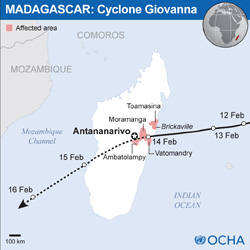
Map of path for Cyclone Giovanna from Feb 14. Credit: OCHA

Monday night Cyclone Giovanna made landfall on the east coast of Madagascar with winds upwards of 120 mph. Over the next two days it dumped up to one foot of rain, with the hardest hit area being just east of Madagascar’s capitol, Antananarivo. The storm led to 19 deaths, nearly 11,000 people displaced and almost 5,000 damaged or destroyed homes. In the hard-hit district of Brickaville 88% of the schools were damaged. The storm moved past the island country on Thursday but there are fears it may double back and hit the southern part of the country.

Madagascar is home to one of the largest Lutheran churches in the world, the Malagasy Lutheran Church, with a population around 3 million members. As this church and the remainder of the country start the work of recovery and rebuilding please keep them in prayer, that God may calm the waters and winds and bring them peace.

To learn how the ELCA accompanies the Malagasy Lutheran Church see the Global Mission page on Madagascar

————-
Gifts to ELCA International Disaster Response allow the church to respond globally in times of need. Donate now.

South Sudan: Helping People Heal

Violence continues to plague the new country of South Sudan as tribal cattle raids have become more frequent and intensified. As the situation unfolds, the Lutheran World Federation is building on its strong presence country to bring aid to those in need. One of the many services is looking towards ways to build sustainable and lasting peace for the people of the region. Towards this end they are working with the Church of Sweden to bring in workers to provide psychosocial support for traumatized individuals.

It is a great example of how international organizations are finding greater opportunities to work together through umbrella organizations like the Lutheran World Federation (LWF) and the Action by Churches Together (ACT) Alliance. The ELCA is a proud member of both.

To learn more of how these two are working together and to learn how and what their peace-building and psychosocial services are, read the LWF newsletter: Helping People Heal

To better grasp the full extent of the LWF’s work in South Sudan see their webpage: South Sudan

————-
Gifts to ELCA International Disaster Response allow the church to respond globally in times of need. Donate now.