
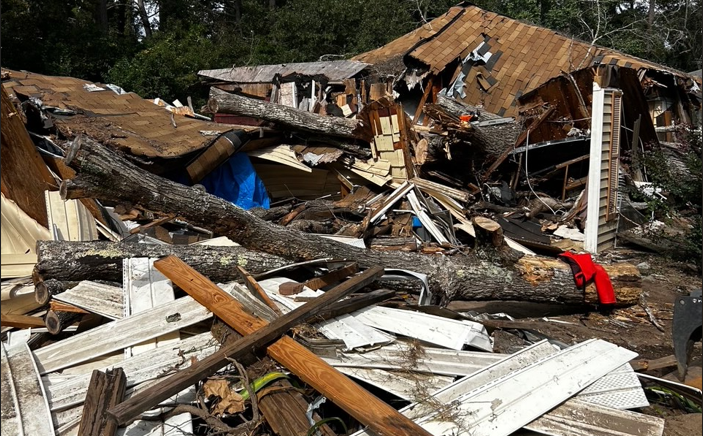
A home damaged by Hurricane Helene | Photo Credit the Southeastern Synod
Almost two years following Hurricane Helene, communities across Georgia are still navigating the long and difficult road to recovery. From Augusta to the coastal counties, the Southeastern Synod’s Disaster Ministry Team continues to walk alongside survivors as they rebuild homes, restore stability, and reclaim hope.
A Wide-Reaching Response
While North and South Carolina have been the focus of much of the nationwide reporting about Hurricane Helen, the scale of devastation across Georgia has been immense. Sixty-two counties were declared disaster areas, with severe damage stretching from inland communities like Augusta to coastal regions including Savannah, Brunswick, and Bryan County.
In the face of such widespread need, response efforts have focused on building strong partnerships and coordinating long-term recovery. While forming local long-term recovery groups (LTRGs) has been challenging in some areas, collaboration across organizations has proven essential.
Among the most promising developments has been the Augusta Response Coalition, where faith-based and community organizations are working together to meet survivor needs and rebuild homes.
Augusta: A Hub of Recovery and Renewal
In Augusta, recovery efforts are moving forward with momentum and purpose.
Advent Lutheran Church has become a central hub for the response, housing volunteer teams, coordinating case management, and supporting construction efforts. Since early 2025, the team has built a strong foundation for long-term recovery, hiring key staff including a construction coordinator, volunteer coordinator, and disaster case managers.
The numbers tell part of the story:
- Over 2,000 survivor households identified for outreach and screening
- 110 total cases, with dozens actively being managed and new cases added regularly
- A steady flow of volunteer teams providing repairs and rebuilding support
Outreach efforts have extended deep into the community through local events, radio interviews, and partnerships with community leaders, to ensure survivors know where to turn for help.
This work is made possible through strong partnerships, including collaboration with UMCOR, Family Promise, and local coalitions, all working together to meet urgent needs and lay the groundwork for long-term recovery.
Coastal Georgia: Challenges and Persistence
In coastal communities, recovery has unfolded differently.
Efforts in Savannah, Bryan County, Brunswick, and Glynn County have included early response support, case management, and financial assistance for survivors. Partnerships, such as those with Family Promise, have been critical in connecting people to resources.
At the same time, challenges remain. Establishing coordinated long-term recovery structures has proven difficult, and progress in organizing unmet needs tables and funding distribution has been slower.
Even so, leaders across the region continue to show persistence and commitment, building the relationships and systems needed to sustain recovery over the long term.
One Story Among Many
Behind every statistic is a story.
One survivor, a veteran living in Thomson County, embodies both the loss and resilience seen across Georgia.
Before the storm, his home represented a fresh start after a difficult season in life. “That was my home,” he said.
Hurricane Helene took it all. A massive tree crushed the house beyond repair, and his insurance company declared it a total loss, canceling his policy the same day. His property was later identified as one of the most heavily damaged in the county.
Today, he lives in a FEMA camper parked in front of the wreckage. From his window, he can see the remains of what he lost, a daily reminder of the storm’s impact. And yet, he chooses to stay.
His next step is clearing the fallen tree so the home can be demolished. Then, he hopes to rebuild, placing a modest modular home on the same land.
“I just want a place to call home again,” he says.
His story is just one of many. Across Georgia, families are navigating similar challenges, each facing difficult decisions, limited resources, and the long wait for recovery.
Moving Forward Together
The work across Georgia is far from finished.
As funding is distributed, partnerships strengthen, and long-term recovery groups take shape, more survivors will gain access to the resources they need to rebuild. Volunteer teams continue to arrive, case managers continue their outreach, and faith communities remain at the center of this work—offering presence, compassion, and hope.
Through it all, the Southeastern Synod’s response reflects a shared commitment: to walk with survivors not just in the immediate aftermath, but throughout the long journey of recovery.
Because rebuilding homes is only part of the work.
Rebuilding lives—and restoring the possibility of “home”—is what truly matters.
Supporting Communities Through Lutheran Disaster Response
In the face of these compounding emergencies, Lutheran Disaster Response continues to walk alongside communities as they respond to immediate needs and rebuild with dignity and hope. Through trusted international partners, LDR supports emergency relief, recovery, and long-term resilience efforts, addressing food security, shelter, livelihoods, psychosocial support, and disaster preparedness.
Supporting Lutheran Disaster Response enables timely, locally led responses that prioritize the most vulnerable and strengthen communities against future crises. As climate impacts intensify and conflicts persist, sustained solidarity and partnership are essential. Together, we can help ensure affected communities are not only supported in times of crisis, but also empowered to recover, rebuild, and thrive. Learn more about how to support the work of LDR here.
