
Skip to content
ELCA Blogs

Lutheran Disaster Response

Unaccompanied and Migrant Children: A safe and caring environment for refugee children

Megan Brandsrud

boy on train tracks

During the past four years, the number of children migrating from Central America (mostly from Honduras, El Salvador and Guatemala) to the United States has been steadily increasing. More than 60,000 children have arrived so far this year, and it is estimated that a total of 75,000 unaccompanied children will have crossed borders to arrive in the U.S. by the end of 2014.

Why are they coming? To put it simply, they are coming because they cannot stay where they are. A host of risk factors in their home countries, including drug trafficking, violence, sex trafficking, poverty and exploitation are compelling these children to flee. They are refugees.

Lutheran Disaster Response has been engaging partners, companion churches and congregations in the U.S. that are in the midst of this situation. As the church, we are called to love and welcome, and we answer that call when children who are running from hunger and harm arrive on our doorstep. Lutheran Disaster Response is helping provide shelter, medical care and schooling to children who are placed at one of Lutheran Social Services of the South’s shelter programs by the Office of Refugee Resettlement.

Lutheran Social Services of the South (LSS) has been working with the U.S. department of Health and Human Services, Office of Refugee Resettlement for eight years to provide a safe place for unaccompanied migrant children. Working with LSS of the South, we will help support a children’s shelter, two transitional foster-care programs and the development of a new shelter site.

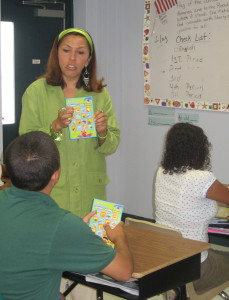
  • A children’s shelter site is for children ages 12-17. While waiting to unite with a guardian or sponsor, children live at these shelters, receive medical care, are connected with a case manager and attend school.
  • A transitional foster care program is for children younger than 12. Children in this program attend school at a day program and live with a foster family while they wait to reunite with a guardian or sponsor.
Bokenkamp class sm

In one year, LSS of the South serves approximately 6,000 unaccompanied and migrant children, which means they are serving approximately 10 percent of children crossing into the U.S this year.

“Lutheran Social Services of the South provides one of the best programs in the country to assist these children,” says the Rev. Michael Stadie, program director for Lutheran Disaster Response. “It only makes sense that Lutheran Disaster Response work in partnership with them.”

We will continue to work with our congregations, companion churches and partners, such as LSS of the South, to help provide education on this situation and ensure that children who are fleeing to the U.S. are treated fairly and receive the care they need.

If you would like to support Lutheran Disaster Response’s work with Unaccompanied and Migrant Children, please visit the response page.
Ebola outbreak: “The church has to help”

Megan Brandsrud

​The 2014 Ebola outbreak in West Africa is the largest and longest-lasting Ebola outbreak in recorded history. To further understand the scale of this disease, the Ebola outbreak is actually the first Ebola epidemic the world has experienced, as the virus has spread to multiple countries, including Liberia, Sierra Leone and Guinea. More than 2,400 people have died from Ebola during this epidemic.

The spread of Ebola presents several more complications than just battling and containing the virus itself. People in infected areas have been quarantined to their homes as towns shut down to try to limit the disease from spreading further. As a result, people are not able to work, harvest fields or purchase food. Other countries that ship food to the region are afraid to dock their ships to deliver food for fear of contracting the virus. The lack of food has been a growing concern as people are now dealing with food security issues that have been exacerbated by the spread of Ebola.

“We need food,” says the Rev. D. Jensen Seyenkulo, Bishop of the Lutheran Church in Liberia. “Our workers from all across the country are being asked to take off work during the crisis. The quarantined communities and stranded travelers are crying for food and water. The treatment centers need food. There is a saying around now that goes like this: ‘If we do not die of Ebola, we will die of starvation.'”

In August, Lutheran Disaster Response committed $10,000 to assist Global Health Ministries in the shipment of Personal Protective Equipment (PPE) to Liberia. Lutheran Disaster Response is now committing $90,000 to assist with food distributions in Liberia and Sierra Leone and with Ebola sensitization and prevention in Liberia, the country that currently has experienced the highest number of Ebola cases.

Food Distributions in Liberia and Sierra Leone

We will work with our companion church, the Lutheran Church in Liberia, to activate food distributions in six targeted areas of Liberia that will assist 999 households with a month’s supply of oil, rice and fish.

In Sierra Leone, we will work with our companion church, the Evangelical Lutheran Church of Sierra Leone, to provide food assistance also consisting of oil, rice and fish to 3,000 individuals.

“With no way to buy food, the church has to help,” says the Rev. Thomas Barnett, Bishop of the Evangelical Lutheran Church of Sierra Leone.

Ebola Sensitization and Prevention in Liberia

Liberia has seen the highest number of Ebola cases since the outbreak reached the country in March. Since the disease presents a 90 percent fatality rate, raising awareness about symptoms and prevention is vital. With our partner, ACT Alliance, we will work with Lutheran Development Services and the Lutheran Church in Liberia to provide Ebola sensitization and prevention training to 4,500 individuals in Lofa and Bong counties.

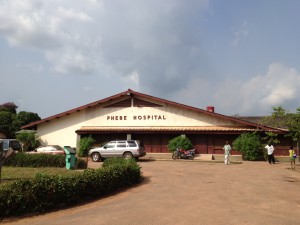
In addition to the training program, we will work with our companions and partners to construct an isolation unit at Phebe Hospital and School of Nursing. This unit will provide significant contributions toward the containment of the disease and the ability to provide life-saving care.

Phebe hospital in Liberia

Please join us as we continue to pray for our brothers and sisters in Liberia, Sierra Leone and the rest of the West Africa region who are daily battling with the risks of Ebola and the many impacts that come with it.

If you would like to support Lutheran Disaster Response’s work in the fight against Ebola, please visit the Lutheran Disaster Response – Ebola Outbreak giving page.

We are afflicted in every way, but not crushed; perplexed, but not driven to despair; persecuted, but not forsaken; struck down, but not destroyed; always carrying in the body the death of Jesus, so that the life of Jesus may also be made visible in our bodies. 2 Corinthians 4:8-10

Long-term recovery in progress following spring wildfires in California

Megan Brandsrud

​In May, a series of 9 wildfires broke out in San Diego County, Calif. Severe Santa Ana wind conditions and a heat wave played contributing factors in the spreading of the fires. By the time all of the fires were contained, more than 29,000 acres of land had been burned.

Through an initial $10,500 commitment from Lutheran Disaster Response, Lutheran Social Services of the Southwest, Lutheran Social Services of Southern California and Inter-Lutheran Emergency Response Team are working together on the Long-Term Recovery Committee to provide assistance in the area impacted by the wildfires.

Long-Term Recovery Committees are essential in the aftermath of a disaster to help impacted communities recover, rebuild and adjust to their “new normal.” Long-Term Recovery Committees provide a place for people who were impacted by disaster to ask questions and get connected with necessary resources for their recovery. The Long-Term Recovery Committee in San Diego County will help people who have been impacted by providing resources for needs that are not met by insurance coverage to assist in rebuilding.

The wildfires not only caused property damage—they caused environmental damage. Rebuilding and new growth will be a long process. We keep the community of San Diego County in our prayers and we walk with them on their recovery journey.

Celebrating Disaster Preparedness Month with new Congregational Disaster Preparedness Guidebook

Megan Brandsrud

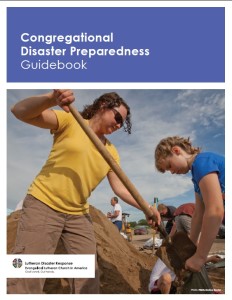
September is National Disaster Preparedness Month, and what better way for us to celebrate than to announce our newCongregational Disaster Preparedness Guidebook!

disaster preparedness guidebook

As the introduction in the guide says, “The purpose of this guidebook is to help congregations take some basic and important steps toward resiliency and intentionality in response to disaster so that they will be better able to serve their communities when disasters strike.”

Categorized into sections, the guidebook provides a step-by-step approach to creating a comprehensive disaster response plan for your congregation.

  • Section 1: “Developing a Congregational Preparedness Plan” – Using corresponding worksheets, this section provides congregations a process for creating their unique preparedness plan.
  • Section 2: “Response” – This section addresses how congregations, communities and individuals achieve a “new normal” after a disaster through long-term recovery.
  • Section 3 and 4: “Emotional and Spiritual Care” and “Worship in times of disaster” – These sections provide tools for spiritual leaders and recognizes that the church is called to provide care through prayer and worship.
  • Section 5: Glossary – The final section provides a glossary of terms, additional resources and the worksheets that are used throughout the guidebook.

This guidebook is a valuable resource for all congregations, even those who have not experienced a disaster first-hand. It is never known when a natural or human-caused disaster could impact your community, but people will turn to the church for answers, whether you are ready or not. By developing a plan, congregations are prepared and able to share the message of God’s gift of hope and promise of new life in the midst of a disaster or crisis.

“We developed this guidebook because we realized it would be helpful for a congregation to have not only the information of how to prepare and respond to a disaster, but some practical ways they could do so,” said Pastor Michael Stadie, program director of Lutheran Disaster Response – U.S. “This is the first comprehensive book from Lutheran Disaster Response that covers these topics and also provides worksheets to walk a congregation through the process of disaster preparedness. We are pleased to make this free download available not only to ELCA congregations but to anyone who has an interest in helping their house of worship.”

To download the guide in its entirety, please click here. To view and download specific sections of the guide, please visitLutheran Disaster Response Resources and click on the “General” tab.