Skip to content
ELCA Blogs

Lutheran Disaster Response

The Journey of Peace Lutheran Church, Joplin, MO

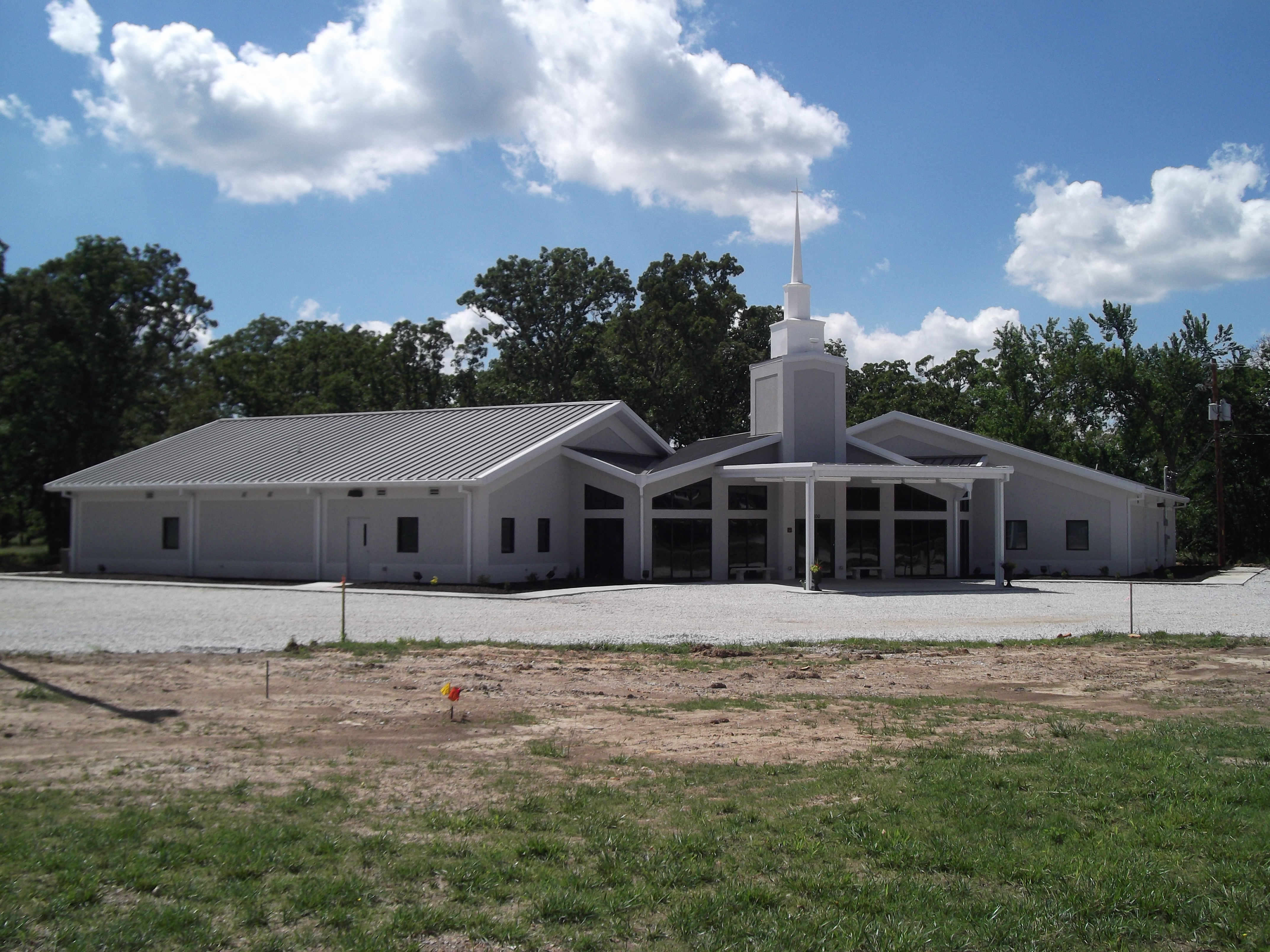
On Sunday, June 23, 2013, Peace Lutheran Church, Joplin, MO celebrated the dedication of their newly completed building. Bishop Gerald Mansholt of Central States Synod was present for the day of great joy and thanksgiving. “It was a marvelous event and we had a full house!” said Pastor Katherine Redpath of Peace Lutheran Church. While the building is charming and lovely, for members of the congregation the journey to reach this milestone has been filled with many twists and turns.

The newly completed building of Peace Lutheran Church, Joplih, MO

The newly completed building of Peace Lutheran Church, Joplih, MO

On May 22, 2011, the EF5 tornado that decimated Joplin, MO also leveled the church. Since then, the congregation has to deal with grief on many levels. One member was killed by the tornado. And due to circumstances beyond their control, the congregation had to find a new location to rebuild.

Although they had to abandon their location, Peace Lutheran Church did not abandon their ministry; immediately following the storm they began to worship at Bethany Presbyterian Church. In August, 2011, they received Pastor Kathy as their pastor. Incidentally, Pastor Kathy is a tornadoes survivor; nearly 40 years ago, her house in Ohio was destroyed by twisters and she lived through the painstaking process of recovery. Unbeknown to her at the time, that experience was good preparation her for the ministry of healing and hope she is bringing to Peace Lutheran.

According to Pastor Kathy, a key turning point for the congregation was the Praise Service they held under the big tent on the parking lot of the old church site on the one year anniversary of the storm. While embracing the pain and sufferings that came with the losses, the congregation recounted God’s grace and rededicated themselves to move forward into God’s unknown future.

For Pastor Kathy, the dedication of the new building marks the beginning of a new phase of ministry. In her most recent newsletter article, she affirms “worshipping and building up the Body of Christ,” as key purposes of the newly relocated Peace Lutheran Church. But citing the story of King Solomon dedicating the new temple in Jerusalem (1 King 8), Pastor Kathy underscores the importance of “inviting and welcoming of ‘foreigners’ [–those who are not already in our faith communities–] who can come and learn more about this God whom they hear about from us.”

For “foreigners” and family alike, Peace Lutheran Church has a very compelling story of God’s Grace and Peace in the midst of chaos and turmoil. May God continue to bless the people of Peace Lutheran as they live into the future God is calling them!

For “foreigners” and family alike, Peace Lutheran Church has a very compelling story of God’s Grace and Peace in the midst of chaos and turmoil.

May God continue to bless the people of Peace Lutheran as they live into the future God is calling them!

A Tribute to Leon A Phillip, Jr.

     With the passing of Leon Phillip last week, the person we consider the founder of Lutheran Disaster Response, we have asked Gilbert B. Furst to share some reflections on his life and ministry. We appreciate Gil taking the time to share these thoughts.

Leon A. Phillips, Jr. was greater than the sum of his parts. Leon, who died peacefully in his sleep last week, was an extraordinary person, family member, pastor, church leader, and director of Lutheran Disaster Response. His love and insight touched countless thousands of lives around the world. He brought hope to the hopeless, help to the helpless.

A brief history of Lutheran Disaster Response will provide a context for Leon’s disaster ministry. LDR emerged after the 1972 Hurricane Agnes flooded northeast Pennsylvania. Leon, who lost his home and most of his possessions, coordinated thousands of volunteers and material donations. In 1973 the Lutheran Church in America, The Lutheran Church-Missouri Synod, and the American Lutheran Church discussed how disaster response could be part of the church’s ministry on a national level. The Lutheran Council USA oversaw an advisory committee of representatives appointed by the three church bodies. Disaster response was a small-scale program providing some training and sending small grants to places where there were disasters. Leon was appointed to be an LCA representative.

In the late ‘70s and early ‘80s many inter-Lutheran programs were cut back due to financial pressures and church issues. As the Evangelical Lutheran Church merger was planned, The LC-MS and the emerging ELCA agreed on three primary areas of inter-Lutheran cooperation: Lutheran World Relief, Lutheran Immigration and Refugee Service, and inter-Lutheran Disaster Response. An LDR board with ELCA and LC-MS representatives met for the first time in December 1987. One-fourth of Leon’s time was designated as LDR director.

Leon visualized a system that could expand during emergencies and shrink when there were none. He believed social ministry organizations could manage local programs, handle finances and volunteers. He trained a group of consultants, many from social ministry organizations. The consultant program worked well following Hurricane Hugo, in St. Croix, in Charleston, the Isle of Palms, and South Carolina coastal islands.

In 1992 Leon’s quarter-time position increased and he became the first full-time director. That year Hurricane Andrew hit South Florida and Hurricane Iniki struck Hawaii. In 1993 a major earthquake hit Oakland and San Francisco.

Lutheran cooperation came quickly and was deep. Leon also reached out to work with other church denominations, as well as FEMA, and the American Red Cross.

Leon was aware of clergy attrition following Hurricane Andrew. He had an LC-MS pastor-psychologist study the situation, and his conclusions led Leon to change response priorities. “Care for the Caregivers” became a primary focus. Over the next decade trained psychologists, counselors, and theologians provided care for pastors and caregivers, working through ELCA Synod Bishops and LC-MS District presidents.

Leon expanded the scope of disaster response to include human-caused intentional disasters (such as the Oklahoma City bombing) and technological disasters (such as the Times Beach chemical leaks).

During his ten years as director and response to 150 disasters, Leon developed a national network of responding agencies. His vision provided LDR with an effective means of carrying out responses, and enabled agencies to draw closer to meet the needs of their communities. When Lutheran Services in America was organized in 1997, a pattern was set to provide for the needs of disaster survivors.

Leon provided a strong confessional-rooted theological approach to disaster response, and he saw LDR as an integral part of the church’s ministry and life. Under his leadership Lutherans were relied upon for case management, rebuilding, advocacy, pastoral care and spiritual care.

The needs of children traumatized by disasters became apparent following tornadoes in southwest Minnesota. In cooperation with LSS-Minnesota, Camp Noah became a ministry program for disaster-affected children across the country.

Leon once told me, “Each disaster was an affirmation that God finds resources and ways of lifting people up…the church in action….”

Leon was not constrained by “ordinary” practices. He often carried a pocketful of cash – much to the consternation of church officials – and distributed it to pastors following disasters. He felt that “$50 now when it is needed is worth ten times that much in two months.”

One agency executive recalls, “In 1997 in the early days of the Red River flood that occasioned the evacuation of 60,000 people, at the NW Minnesota Synod office a pastor and his wife came into the office. Leon was standing by the front desk. Before the pastor said a word, Leon said: ‘do you have a place to stay tonight?’ ‘No.’ Leon turned to me and said, ‘Go get a key.’ Dutifully I went into the conference room and got a key to a motel room and returned. Leon gave the key to the pastor and said, ‘Now, tell me your story.’ The pastor did, confessing his conviction he could be of no help to his people. Leon dug into his pocket and pulled out a thick wad of $50 bills. He said: ‘Here; Take this. Find your people. Tell them the church cares.’ The pastor did and became one of the heroes of the Red River Valley flood.”

If your life was touched by Leon, your life was changed. Many are attesting to the influence Leon had in their lives. Here are some of their remarks:

·       “He was truly and in all sincerity a man with a great heart. And one to be remembered for what he did for others.”

·       “God’s peace to one who was such a gentle spirit among us. Prayers for all who feel the loss of this loved one.”

·       “Leon helped me understand what it meant to be a pastor and what it meant for us to be a community of faith in immediate, concrete ways!”

·       “Rest in peace, brother Leon, God’s servant!”

·       “We are better people knowing him. Working with him over the years was a true blessing.”

·       “We have been blessed and enriched by his life that he shared so generously.”

·       “A great and faithful and graceful guy.”

·       “He was a gentle man full of knowledge and compassion. Enjoyed working with him.”

·       “A fine man who was committed to service. I learned so much from him. Well done good and faithful servant. Rest in peace.”

·       “He changed my life forever as did you Gil. I am so much richer for knowing him. Rest now Leon.”

·        “We all stand on the shoulders of greats who have gone before us in the faith. What a heritage we have!”

I add my simple personal words. It has been my privilege and blessing to know Leon over the years as a colleague, pastor, travel companion, and most-of all, friend. We were together in an amazing number of places and situations, from floods in Fargo to balconies in Budapest; from Virgin Island hurricane destruction to tuk-tuks in Bangkok; from German halls to San Antonio floods; from Denver courthouses to Prague cathedrals; from celebrating life with East Germany colleagues to enjoying friends on his patio. He was my colleague, my mentor, my friend.

So we say “ave atque vale“ – “Hail and Farewell.” Thanks be to God for Leon’s partnership in a multitude of ministries through these years; for his creativity, sensitivity, warmth, support, leadership, guidance; and for his personal friendship. We give thanks for his life, rejoice in his faith, and mourn his passing.

Resilience, Human Kindness and Hope in Oklahoma

When I visited areas decimated by the May tornadoes near Oklahoma City with the Lutheran Disaster Response team last week, I was overwhelmed by the magnitude of the destruction, particularly in the city of Moore.

A familiar scene on the streets of Moore, OK.

A familiar scene on the streets of Moore, OK.

Tributes paid to tornaodes victims at the site of Plaza Towers Elementary School, one of the two elementary schools destroyed on May 20.

Tributes paid to tornaodes victims at Plaza Towers Elementary School, which was destroyed on May 20.

Yet destruction does not have the last word; stories of courage, resilience and signs of human kindness are everywhere.

St. John Lutheran Church is located in Shawnee, about 30 miles east of Oklahoma City. The destructive path of the tornadoes came through Shawnee on Sunday, May 19, killing two residents and destroying nearly 100 homes. Fortunately, neither the congregation nor its members were affected. But when we visited Pastor Karen Fowler-Lindemulder and some leaders of St. John, they spoke passionately about the losses and sufferings of their neighbors and how they were “forgotten” by the media because the destruction in Shawnee was relatively “smaller scale.” Immediately after the event, members of the congregation rose up and volunteered at a local congregation that has set up a disaster relief operation. Working alongside other community volunteers, they delivered relief supplies to numerous survivors and were often amazed by their sense of self-reliance and resilience. 

Located just a few miles from the EF5 tornado’s path, Trinity Lutheran Church of Oklahoma City escaped damage but five member families lost their homes. Another seven families with close ties to the church also had severe damage to their homes. But when we visited with Pastor Roger Bruns, he did not dwell on the losses but spoke of the faith and courage of the survivors. One of the survivors was a teacher at Briarwood Elementary schools, which was destroyed by the twisters. She was injured while trying to protect her students, was taken by ambulance to the hospital, treated and released. She and her young children with special needs are now staying in temporary housing. Another member whose house was demolished by the storms managed to stay on top of her young children to protect them when the storm passed. These two families are now sharing the same temporary housing. 

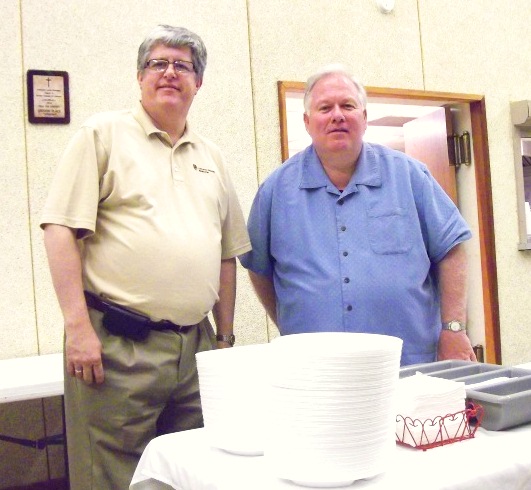
Pastor Michael Stadie (left) Program Director of Lutheran Disaster Response, Pastor Roger Bruns of Trinity Lutheran Church at the table that serves meals to volunteers who come to Oklahoma City to help with clean up.

Pastor Michael Stadie (left) Program Director of Lutheran Disaster Response and Pastor Roger Bruns of Trinity Lutheran Church at table that serves meals to volunteers.

While Trinity Lutheran Church is not a large congregation, its members have a deep sense of service to the changing communities around them and have strong partnership with other congregations and community organizations in the area. Immediately after the May 20 event, the congregation partnered with the adjacent May Ave Wesleyan Church and other small not-for-profit organizations to provide assistance and relief to those whose lives have been turned upside down. In addition, they are actively working together to host volunteers pouring into the area to help with the clean up. We are grateful for the ministries of these congregations. 

Between June 24 and June 28, Camp Noah will conduct a summer camp for children impacted at University Lutheran Church in Norman. On June 28, Presiding Bishop Mark Hanson will visit people and congregations in the Oklahoma City areas affected by the tornadoes.

Lutheran Disaster Response, working closely with the Arkansas-Oklahoma Synod and the Lutheran Social Services of the South are actively assessing needs in the areas.  In collaboration with our partners and government agencies, we will determine the best ways to help those impacted over the long haul.  But we are already in action.  Please continue to keep those impacted by the storms  in your prayers and join us in sharing God’s hope and renewal.

For more information about Lutheran Disaster Response, please look to our webpage: www.elca.org/disaster

To donate, please click: https://community.elca.org/page.aspx?pid=840

Colorado Wild Fires – June 2013

People in Colorado, particularly those affected by the 2012 wildfires that devastated many communities in the state, are again traumatized by major wildfires. The Black Forest Fire and the Royal Gorge Fire have already destroyed more than 480 structures, forcing thousands to evacuate and sadly, causing fatalities.

For members of Christ the King Lutheran Church, in Colorado Springs, the Waldo Canyon Fire of 2012 and the Black Forest Fire of 2013 is personal. During last year’s fire, the areas around the church were under mandatory evacuation. The fire came very close to the church but left it unscathed. Unfortunately, members lost their homes to the fire. Thankfully, this year, the threat of fire is not imminent but members, like the rest of the Colorado Springs community, are feeling traumatized. When visiting with Pastor Julie Bristch of Christ the King about the fire, she used words like stunned, anxious and a deep sense of loss to describe the mood of the community. “There is a lot of Post-Traumatic Stress Disorder around as the same communities are being traumatized two years in a row,” said Pastor Julie. 

On Thursday, June 13, Pastor Julie hosted a special evening prayer service at Christ the King Lutheran Church that was open to the community. During the gathering, participants shared heart-wrenching stories of individuals and families who are deeply impacted. Some of them have left their communities devastated by the 2012 fires and moved to a new area to build their lives; and now they are traumatized again in their new homes. Some church members have family ties with firefighters who have lost their homes as they are giving of themselves to save lives, which only increases the sadness and the stress of the situation.

Yet in the midst of the trauma and chaos, hope and grace abound! Pastor Julie reported she is moved by the selflessness and love in the community through last year’s fires, during the recovery after the fire and now during the current crisis.  An interfaith group made up of 21 houses of worship has risen up to respond to the fires and to assist survivors with their unmet needs.

Pastor Ron Roschke, the Synod Minister for Shared Ministries of the Rocky Mountain Synod, attended the prayer service on behalf of the Synod. He spoke movingly of the experience of the prayer service and highlighted the deep connectedness between individuals and communities in times of crisis and recovery as a source of God’s grace. “In disasters people feel alone. But when we can find ways to let people know that they are not alone, people can find strengths to deal with their challenges,” said Pastor Ron.  

Lutheran Disaster Response, in collaboration with our local affiliate Lutheran Family Services Rocky Mountains, and the Rocky Mountain Synod, have been actively engaged in the responses to the 2012 Colorado fires. Lutheran Family Services Rocky Mountains has offices in areas affected by the fires and is providing disaster case management services to those impacted by the 2012 fires.  Together, we are well positioned to understand the scope of what need to be done. We are monitoring the situations closely and will conduct careful assessments after the fires have been put out. We will then determine our best course of action in cooperation with local authorities and partnering with ecumenical, faith-based and civic organizations. Through Lutheran Family Services Rocky Mountains, Lutheran Disaster Response will be there for the long haul of recovery.

Please keep in mind the Black Forest and Royal Gorge Fires are not the only wildfires threatening lives, there are others in Colorado and New Mexico as well; and new ones are starting every week since the area is very dry. Continue to pray for the evacuees and all who are in harm’s way, especially those who are trying to save lives and homes. May the Grace, Wisdom and Strength of God be with them!

Helpful information about how volunteer organizations work together in Colorado: https://covoad.communityos.org/cms/

Lutheran Disaster Response webpage: www.elca.org/disaster

Donation webpage: https://community.elca.org/sslpage.aspx?pid=358