In the U.S. Hurricane Sandy made landfall on October 29th, 2012 in New Jersey. That makes yesterday 101 days since this event and I figured it was a good time to check in with where we’re at with the response. Now some people really do better with process and others prefer stories. So I’m going to present this in two ways: first by looking at where we sit in the “typical” flow of a disaster response and then by sharing the story of Lutheran HealthCare in New York and how they’ve been affected and responded to Sandy. Feel free to read both or to jump to your preference.
By the Numbers
Those experienced with disaster work like to use a simple tool for explaining the process of disaster response known as the “Rule of 10”. This rule states that as you move through the first three phases of disaster response (incident, immediate response and recovery) the average individual or community will take ten-times longer to move through next phase than it took to move through the previous one. The incident phase is focused on securing safety and involves activities like rescue and first responders. The immediate response phase is focused on setting a secure foundation and involves activities such as assessment, demolition and initial clean up. The recovery is focused on helping people and communities regain their new sense of normal and involves activities like muck out and rebuilding. The benefit of volunteers increases as you move through these phases, with recovery being the greatest phase of volunteer impact.
For Sandy, most people were in the incident phase for two weeks (14 days), meaning the average length of immediate response will be 140 days (4.7 months) and the average length of recovery will be 1400 days (3.8 years). When you add in the nor’easter that hit the region in November, the holiday season and the potential snow storm hitting the east coast this weekend, the definition of what is “average” begins to change and the movement through phases can slow down. So as we sit at 102 days out, the average person and community is about 90 days into the immediate response phase, working to set the firm foundation upon which they can rebuild. Each community and individual was affected differently, so those really affected by the external circumstances may be still in the earlier parts of immediate response while others may already be transitioning into recovery.
Yet wherever a community or individual is at they are their because of the amazing efforts made by individuals, many who will forever remain in the shadows, who have stepped up to give of time, talents and resources. Which brings me to the second part of this post.
Lutheran HealthCare
Lutheran HealthCare is situated in southwest Brooklyn, NY and is no stranger to this churches disaster response work. After the massive earthquake struck Haiti in 2010, Lutheran HealthCare raised nearly $12,000 to support relief efforts their. They also took in many Haitians because of the strong Haitian presence in their already diverse staff of around 5,000. So when Sandy struck they responded, receiving in evacuees from the surround community. And though scattered throughout the five boroughs of New York City with closed roads and shutdown public transit and over 100 employees personally affected by the storm, staff were finding any means necessary to get to work, like $50 cab rides. Many of the staff were working double and triple shifts, sleeping at the hospital, yet making sure needs were being met.
And this generosity was not just from the staff to the community but internal as well with over 250 days off (about $75,000 worth) transferred between staff to members who had destroyed or damaged homes. They also had a massive amount of internal in-kind donations of needed items. They have also raised over $40,000 in financial donations, which were seeded by Lutheran Disaster Response. They also hosted 2 prayer services and support groups through mid-November.
As they and their community move through the immediate response phase they are continuing to be present by offering crisis counseling through Project Hope, a program of FEMA, and case management to help individuals navigate the opportunities for recovery available to them. As they move into recovery they will continue to be there, because really they were already their, living and working in the community to which they belong. And this is the strength of our work, that wherever we respond we are responding locally, from within the community on behalf of the community.
___________
Gifts to ELCA Disaster Response allow the church to respond domestically and internationally in times of need. Donate now.

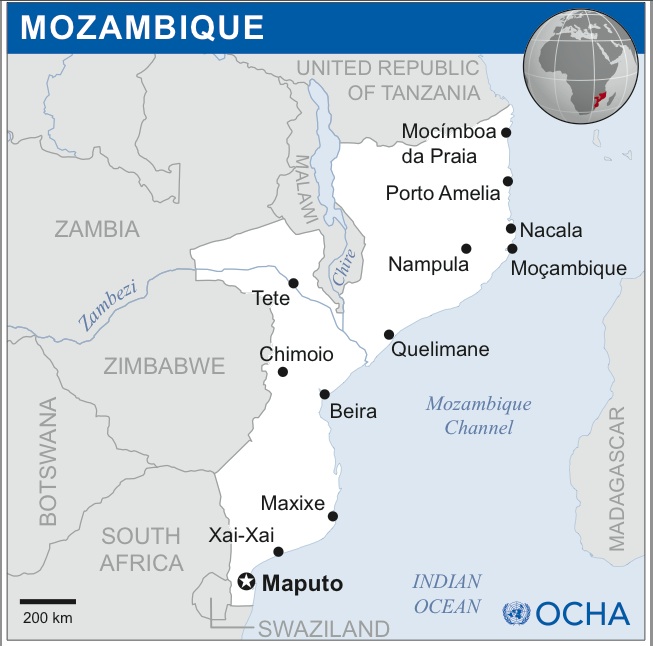 In late January/early February heavy rains in region of southeastern Africa led to swelled rivers and heavy flooding in Mozambique. One of the hardest hit areas has been the Gaza Province in the south of the country, particularly along the Limpopo River. Over 140,000 of the nearly 170,000 people displaced country wide are from this province, as well as 38 of the 55 deaths. The situation is distressing since this is still early on in the rainy season for the region, which extends from January to April. As of this past week there have been reports of coming rains continue to affect the region, with fears of even further flooding.