Skip to content
ELCA Blogs

Lutheran Disaster Response

South Sudan: Healing Through Play

Children playing after school at the Yusuf Batil camp in Maban, South Sudan. Credit: LWF/Melany Markham

Children playing after school at the Yusuf Batil camp in Maban, South Sudan.

The school day has finished and the children are running out the doors to find their favorite jump rope or ball or to join their favorite game. As the children laugh and pant, running around the field the sun finally sets and they head home for dinner, tired but happy.

A pretty common story for many of us as we remember back to our childhood days, as well it should be. These moments of play can have a major impact on the children who engage in them. This fact is not lost on the Lutheran World Federation who has taken seriously the need and impact of play as an act of healing for children in refugee camps, who may be escaping violence or disease. In places like Yusuf Batil camp in Maban, South Sudan the LWF is creating child-friendly spaces and supplying the resources to let kids be kids, in the midst of this major disruption in their lives.

It’s another great example of how the ELCA, through our membership in the LWF, is helping to support more holistic approaches to disaster response and humanitarian aid. In the United States we support a similar program called Camp Noah, to help children process the impacts of disaster upon their lives.

To learn more about how this particular ministry is playing out at the Yusuf Batil camp and why it is so important, read the LWF story Healing through Play.

————-
Gifts to ELCA Disaster Response allow the church to respond globally in times of need. Donate now.

Syria: Cold Temperatures & Warm Hearts

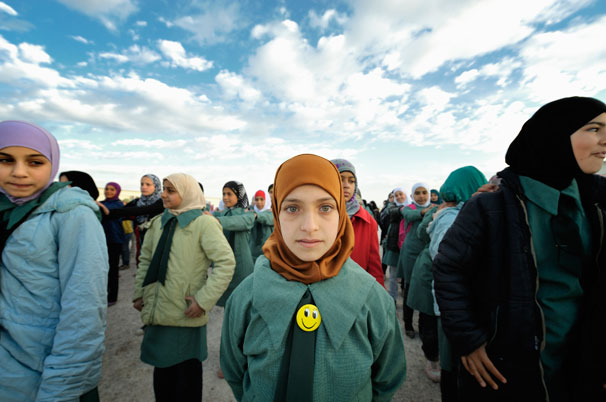
Girls line up before starting school in the Zaatari Refugee Camp, located near Mafraq, Jordan. Opened in July, 2012, the camp holds upwards of 50,000 refugees from the civil war inside Syria, but its numbers are growing.

“Thank God for our humanity.”

This quote is from Isam Alhuniti and is in reference to the Syrian refugee crisis. It is borne from his personal experience. You see, Isam lives in the Jordanian capital of Amman, where he owns an apartment building. Some of his tenants are Syrian refugees who are fleeing the violence in their home country. Though some families, like that of Souad Kasem Issa, her husband and their six children, have not been able to pay their rent in many months he is still helping supply them with food and blankets. He shared that this is because that at one time he had lived in the U.S. and was nearly bankrupted by his daughter’s medical bills. It was only through the help of some Catholics and social service groups that he was able to keep his family surviving.

Isam is not alone in both his personal story of struggle nor in his willingness to extend a helping hand and a warm heart to his neighbors. Dhamyah Mahdy Salih, a volunteer with International Orthodox Christian Charities, which has been working with Syrians both inside and outside Syria, has also connected Issa’s family with assistance. Salih is a refugee from Iraq, whose family has been in Jordan for nearly ten years. She said it was ordinary Jordanians who helped her family make it and now she wants to return the favor.

All of this is happening in the midst of one of the harshest winters in the region with blowing winds, dropping temperatures and heavy rain and snow. Many are suffering from these conditions, particularly the 612,000 Syrian refugees who are trying to find shelter and safety in neighboring countries like Jordan, Lebanon and Iraq. In places like the refugee camp of Za’atari, on the northern Jordanian border, the situation is quite bad, with children and older adults being most susceptible.

Prior to this current situation the ELCA, through generous gifts of people like you, has given $450,000 to address the needs of Syrians within and outside Syria. Through our membership in the Lutheran World Federation, this response been helping to meet the needs of refugees at Za’atari. In the past week the ELCA has committed another $100,000 to the work in the camp to help meet the needs of children, to help keep them “warm and dry”. Yet as the situation within Syria and the weather in the region worsen, the need continues to be great.

As we continue through this season of Epiphany, of Christ revealing, may we stay aware of the needs in God’s world. And in this moment may we particularly lift up or brothers and sisters in Syria and the entire region, that though violence may rage and temperatures may drop, we can still thank God for our humanity and the opportunities will all have to reach out with warm hearts to meet our neighbors in their need.

For more information on the situation please check out the following reports:

___________
Gifts to ELCA Disaster Response allow the church to respond globally in times of need. Donate now.
New Resource: Hurricane Sandy Situation Report #3

A new situation report giving an update on the situation in the northeastern United States and Caribbean as well as the ELCA’s response is now available. Some of the highlights are the joint Lutheran World Federation-ELCA delegation which visited New York and New Jersey in late November/early December as well as the strong outpouring of support from ELCA members, with donations topping $2.4 million. Please help us spread the word of how the ELCA is engaged in the response and what people can do to help.

Here is a link for your convenience: Hurricane Sandy Situation Report #3 (January 11, 2013)

___________
Gifts to ELCA Disaster Response allow the church to respond domestically and internationally in times of need. Donate now.

Crisfield, MD: Field Report

More than a century ago, Crisfield, Maryland, was the “Seafood Capital of the World.” Although its commercial fortune has declined through the decades, it is still a very beautiful small seaside city along the eastern shore of Maryland. On October 29, Crisfield and the surrounding county of Somerset were hard hit by Super Storm Sandy.. Hundreds of homes were damaged and destroyed. Yet, unlike their neighbors in New York and New Jersey, they have been largely overlooked by the media.

In mid-December 2012 I had the opportunity to visit Crisfield, hosted by Pastors Cindy Camp, Phil Huber and Thom Sinnott, our LDR affiliate in the area. On this trip I was able to listen to and learn from local residents and leaders about how they have responded to Sandy.

As is the case with disasters, some of the problems after the event are not really new but are heightened issues which existed prior to the disaster. A couple of these I learned about in Crisfield, were in regard to its demographics as one of the poorest and most ethnically segregated areas on the eastern shore of Maryland. Nearly 20% of residents live below the poverty line (as compared to 9% statewide) and over 42% are African American. This has led to a significant amount of ethnic tension which runs the risk of creating more roadblocks on their road to recovery; Some of the ways this potentially plays out in communities are that the most vulnerable often do not have access to adequate information on how to seek help. And the segregation between groups often prevents the formation of effective Long-Term Recovery Groups, which are the backbone to disaster recovery in communities.

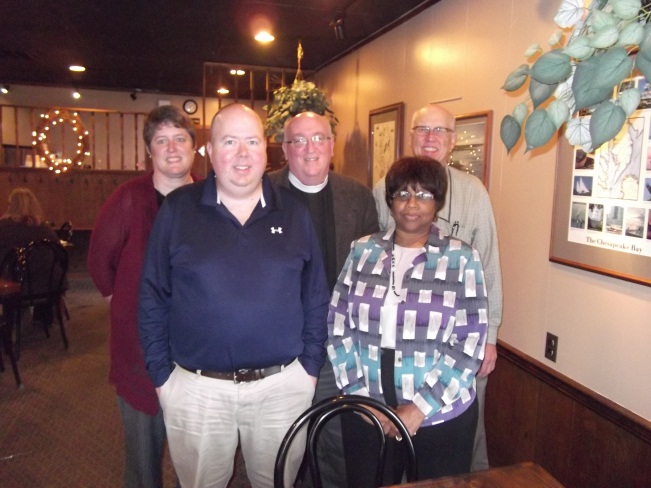
Group visiting with members of Somerset County LTRG. Back row (l-r): Pastors Cindy Camp, Phil Huber, Thomas Sinnott. Front row: key leadersLTRG(l-r): John Phoebus, civic leader, and Rev. Frances Fitchett, Pastor, Shiloh United Methodist Church and President of the Crisfield Ministerium.

Yet, as is also the case in disasters, there resides the opportunity for the Spirit to break through and new opportunities and ways of being to emerge. One such occasion in Crisfield is work of our affiliates Diakon Lutheran Social Ministries and Lutheran Partners in Disaster Response (LPDR). These organizations, were active in this area soon after the storm connecting with the community. Spearheaded by Pastors Phil Huber and Thomas Sinnott, they have also worked diligently to reach out to the different ethnic, religious and civic groups within the community, with the goal of facilitating the formation of a Long-Term Recover Group.

This hard work has begun to pay dividends when in December the Somerset County Long Term Recovery Committee was formed with a membership that truly represents the diversities of the community. This group will work in collaboration to other civic groups, government agencies and churches to provide case management, volunteer support and other vital function to assist families and individuals affected by Sandy on their road to recovery. Our hope and prayer is that this committee will not only be an effective community based organization helping affected residents and family to find their “new normal,” but will also be a forum for community members to have meaningful discussions about their common challenges and shared future.

Haiti: Three Years Later

Today marks three years since the massive earthquake struck Haiti in January 2010. Anniversary moments like this can strike us in a number of ways, as we are called to remember and reflect back. For some this moment calls to mind the tragedy of the event: the 220,000 left dead, the over 300,000 injured and the 1.5 million people left homeless. One can also recall the struggling infrastructure of an impoverished country brought to a standstill or an international community scrambling to respond. Adding to the tragedy, one can also recall the number of subsequent disasters that have stuck the country, from Hurricane Tomas (November 2010) to Tropical Storm Isaac (August 2012) to Hurricane Sandy (October 2012).

When one looks back in this way it a can all seem a little overwhelming and something better forgotten or ignored. Disasters have a way of doing that. They can tax us as they not only bring their own set of problems to the communities they affect, but also have a way of heightening problems that existed beforehand. This is particularly true of those communities and locales which exist in a state of poverty. And so the double tragedy of disaster: those who least can afford the costs of a disaster are the ones most affected by it.

It is a depressing and devastating place to be. And it is here, in these moments of despair and tragedy, that the church is most relevant to the response. For the church can name and acknowledge the reality of these situations while continuing to claim that they are not the final word. That, like many moments in our lives, in the midst of these tragedies God is still present weeping with us at the pain of the events and also calling us to new life in the midst of them.

As we look back on the past three years in Haiti this call to new life urges us to also look forward, formed but not defined by these events. In Haiti this can be seen in the outpouring of support from around the world to come to the aid of our brothers and sisters in need (the ELCA alone saw an outpouring of gifts topping $13 million). It can also been seen in the thoughtful and intentional focus on projects funded by the ELCA that build on assets already available in the community, helping them invest in their own future.

Here are some of these opportunities. A poultry project started by Lutheran Church of Haiti that has brought stability to prices and therefore hope to those in the program. There is the vocational training center where local Haitians are partnering with companions from the U.S. to learn trades that can be used within their local communities. There is the model village in Gressier, which will provide sustainable (financially and environmentally) housing for 200 families structured with community input and control. There is also the cholera work of The Lutheran World Federation and Lutheran Church in Haiti, working to inform and protect local communities from disease unknown to the region before the earthquake.

It is also the presence of a young Lutheran church in Haiti finding its voice as it brings God’s words of hope and healing to God’s communities in need. This is summed up beautifully in the powerful words of the Lutheran Church of Haiti’s president the Rev. Joseph Livenson Lauvanus: “We Haitians will not be defined by the rubble, but by restoration, for we are a people of the resurrection.”

As we take this moment to remember, may we all be led to heed and celebrate the message of hope borne in these words.

Please take a moment of silence and/or prayer at 4:34 p.m. local Haiti time (EST), exactly three years after the earthquake struck.