Skip to content
ELCA Blogs

Lutheran Disaster Response

Japan: JLER Newsletter No. 2

Japan Lutheran Emergency Relief (JLER), which was formed by the Lutheran churches in Japan following the tsunami and earthquake, has been taking a lead role in responding to the continued work of clean-up and restoration within the hardest hit areas of Japan. This second newsletter from earlier this month gives an update to their work. I would especially recommend the first two articles. the first one gives an overview of the first phases of response and the second a field report from Fumitaka Sato.

The point that stuck with me from the field report were that besides decreased populations in hard hit areas, cities were also dealing with the issue of shifting demographics as younger people choose to leave and older adults, to stay. It was an issue I had not heard before and one I hadn’t thought about and gave me pause.

So give it a read and let us know what you think. And please continue to keep the people of Japan and those working on their behalf in your prayers.

————-
Gifts to ELCA International Disaster Response allow the church to respond globally in times of need. Donate now.

Field Report: California and Minot North Dakota

Dear Sisters and Brothers,

My name is Kevin Massey, I am the Program Director of Lutheran Disaster Response.  I’ve just had a great experience meeting wonderful volunteers helping clean up in Minot North Dakota.  I’ll describe my latest travels and the great work Lutherans are doing preparing for and responding to disasters.

I first traveled last week to Los Angeles California  to meet with a group of Lutherans who are volunteers with a special team called the Inter-Lutheran Emergency Response Team (I-LERT).  This team is made up of Lutherans from the Evangelical Lutheran Church in America and the Lutheran Church Missouri Synod who all are committed to helping the Lutheran community in Southern California prepare for and respond from any disaster that may happen there. I-LERT includes Lutherans  from ELCA synods and LCMS districts, Lutheran Social Ministry Organizations, congregations, schools, and other Lutheran institutions.

I shared with the I-LERT team some special training on emotional and spiritual care in disaster.  I believe that the most important thing that the church does in times of disaster is simply to be the church and care for the emotional and spiritual needs of people.

I met Sheila Wenzel, who is the Vice President of the ELCA Pacifica Synod at the I-LERT meeting.  Sheila grew up in Minot North Dakota and had many questions about our response there.  I shared with Sheila that I would be traveling directly to Minot from this meeting, and would share updates on how response is unfolding there. 

The next day I traveled from Los Angeles to Minot North Dakota.  You may remember from previous LDR field reports that Minot was hard hit by flooding this summer.  We asked Lutheran volunteers to head to Minot to help in the clean-up and rebuilding that must happen there.  I will share info at the end of this report how you can help in these efforts. 

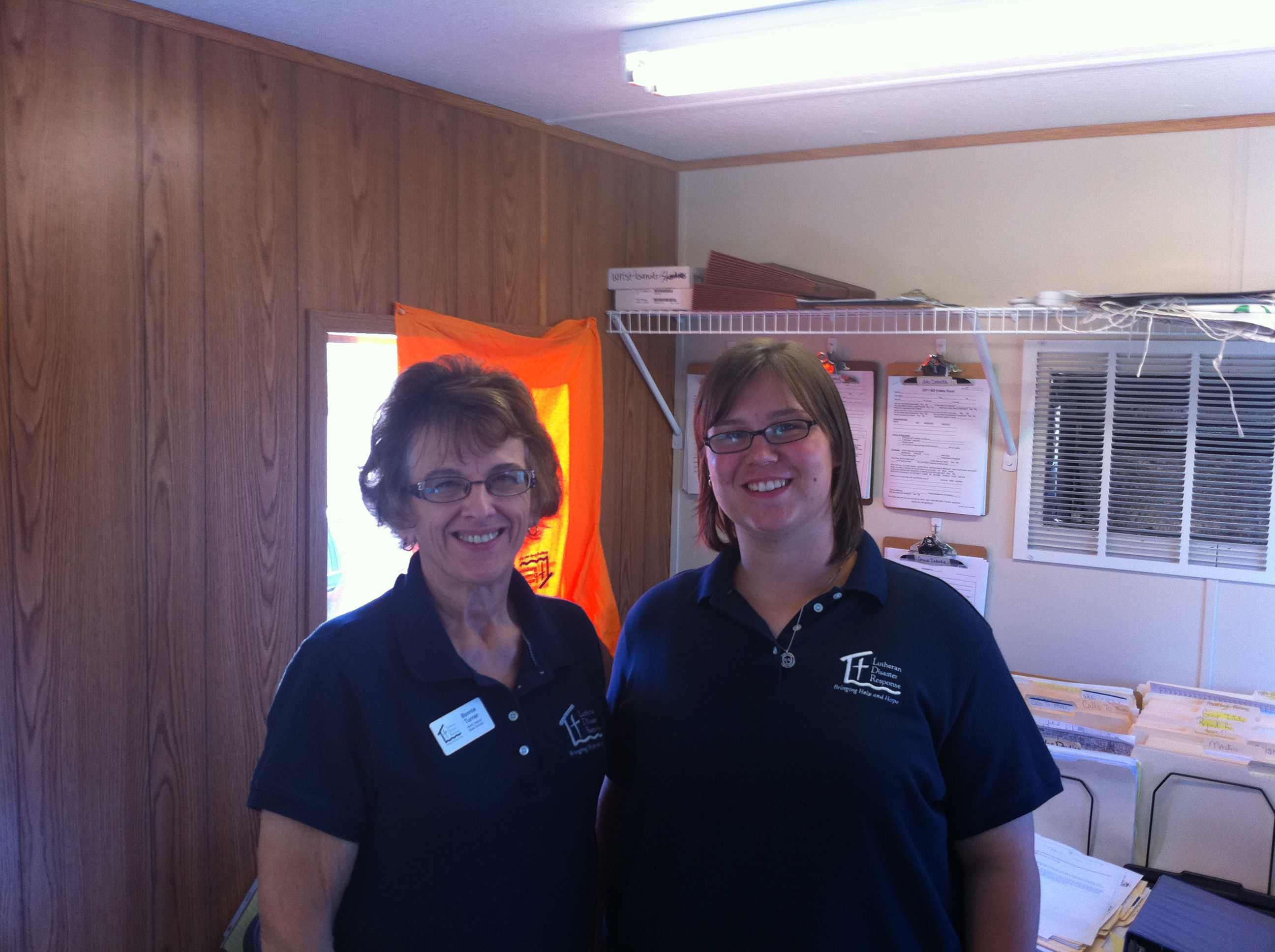
Bonnie Turner and Becky Wynia

Readers of LDR field reports met Bonnie Turner, who heads up LDR in North Dakota, last March when the Red River was threatening Fargo.  I met with Bonnie and members of her staff at our office trailer in Minot.  Bonnie shared that there is a good number of volunteers coming at this time, and we want to keep that interest going as long as we can.   I met Becky Wynia, our volunteer coordinator.  Becky is a graduate of Minot State University and was busy helping volunteers get arranged with their work sites.  I asked Becky what drew her to this work.  Becky shared, “It is meeting real needs for people in Minot.  And it is fun to see all the volunteers come from all over!”  Already, in addition to scores of volunteers from North Dakota, volunteers from places like Michigan and North Carolina and Oklahoma and Minnesota have visited. 

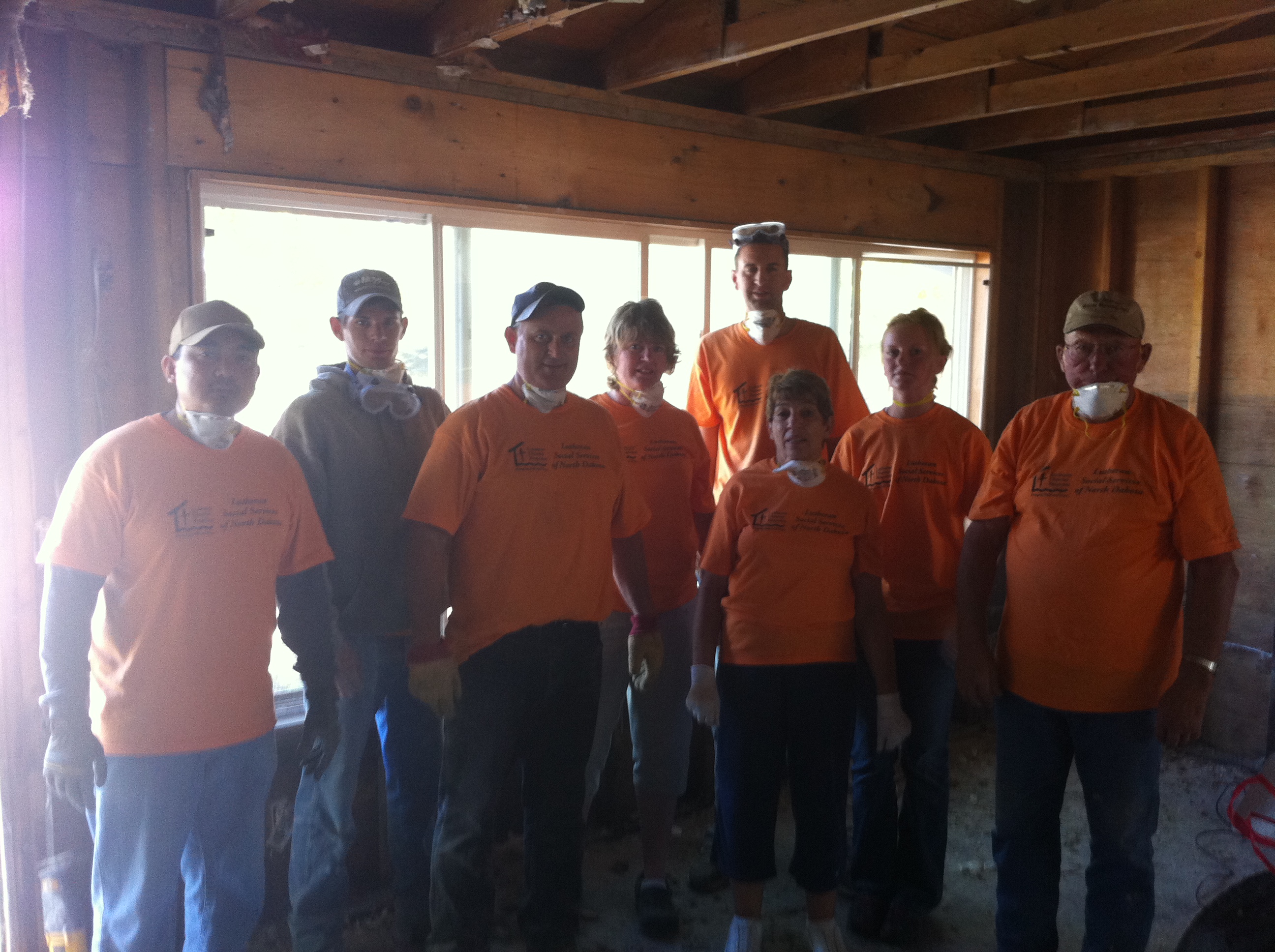
Minot was full of volunteers this weekend!  A group of Lutheran volunteers from Trinity Lutheran in Carrington North Dakota was working last Saturday in Minot.  I was excited to learn that the group was headed by Pastor Bruce Vold, who served near where I did my first parish call in Eastern North Dakota.  Pastor Vold had been dean of the conference at that time and was a great role model to me in my early years of parish ministry.  Pastor Vold and his family and a group from his congregation were working to gut out a home in a hard hit area of Minot.  Some volunteers come from many states away, and some volunteers can come from a couple hours away, and all are needed to help Minot in these difficult times.

Pastor Bruce Vold (third from left) with members of his family and congregation.


Driving back from visiting Pastor Vold I saw something that puzzled me for a moment.  I saw an apple tree in the front lawn of a flooded house.  The tree had a few ripe apples in its branches, but scores of spoiled apples were strewn around the ground at the foot of the tree.  It sunk in to me that no one had been home to pick the fruit.

 My main goal in visiting Minot this weekend was to accompany the congregations in worship.  I attended Saturday evening worship at First Lutheran of Minot.  I visited Bread of Life and Augustana Lutheran congregations worshipping at Bread of Life Sunday morning.  I greeted Christ Lutheran Church worshipping at Bethany, then spoke at an adult forum downstairs with Bethany.  Finally I worshipped with Bethany Lutheran later Sunday morning.  I felt nourished in many ways among these faithful people at worship, prayer, and service.  I was even nourished Saturday afternoon with a lutefisk dinner at Zion Lutheran of Minot!  These congregations are all doing wonderful ministry during these difficult times.  To help them with this work, consider giving a gift to the ELCA Western North Dakota Synod Flood of Love  initiative to restore the damaged churches and revitalize mission and ministry in Minot.

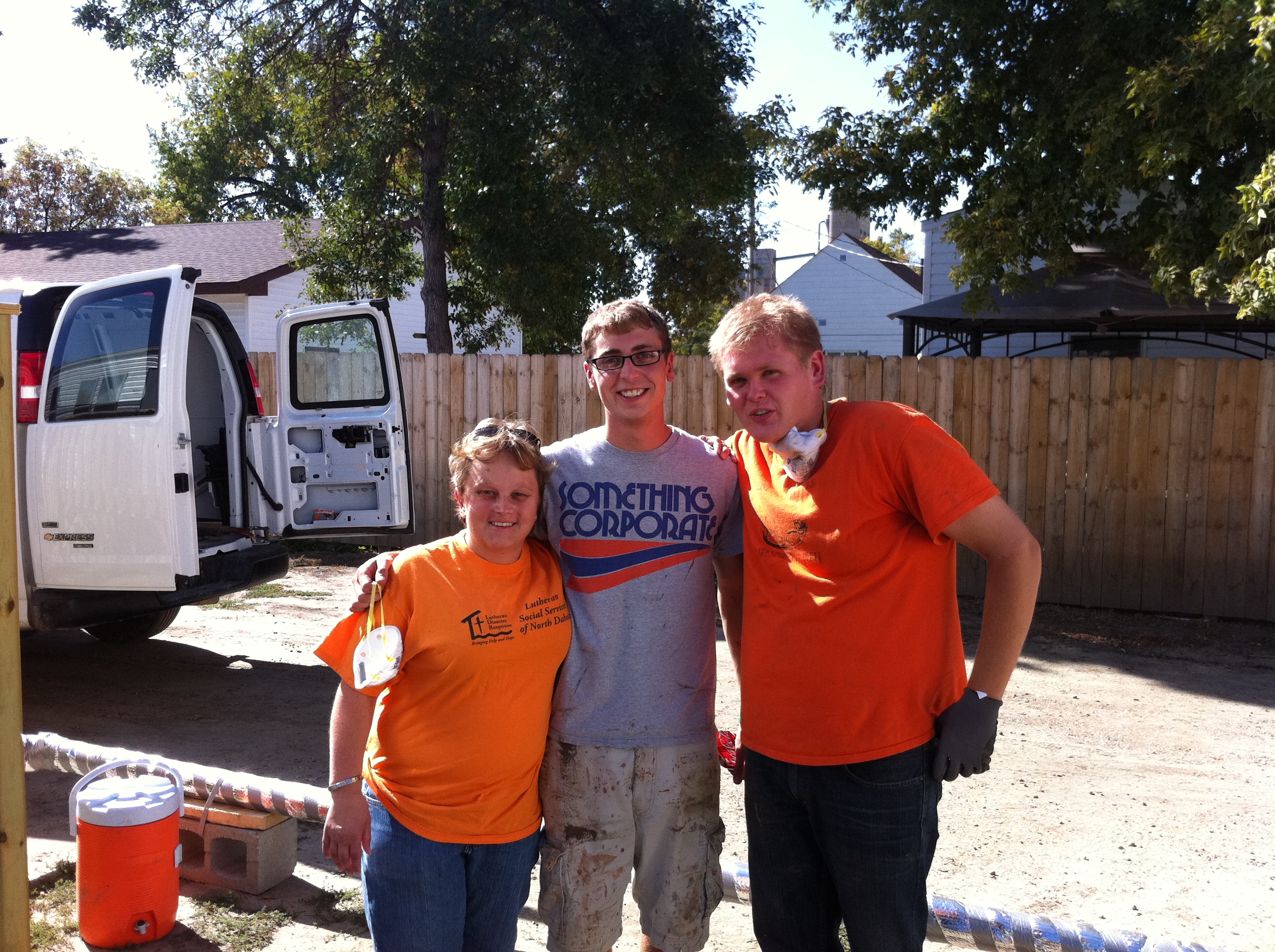
A wonderful group of volunteers turned out in Minot this weekend organized by Lutheran Campus Ministries and Student Government from Minot State University and the University of North Dakota.  Max Buchholz of Minot State and Carter Hill from UND challenged each other in a friendly rivalry to organize as many students as they could to come and work.  About a hundred students converged on flooded homes from these schools.  Many people worked to make this effort a success. 

Pictured left to right: Pastor Kari Williamson, Max Buchholz, and Carter Lee.

Pastor Kari Williamson, the Lutheran Campus Ministry Pastor at Minot State coordinated many details with Lutheran Disaster Response for this effort.  Sherie Heine, the Western North Dakota Synod Vice President organized lunches for the student volunteers, with First Lutheran Church of Harvey ND, First Lutheran Church of Rugby ND, First Lutheran Church of Bottineau ND and Metigoshe Lutheran Church of Bottineau ND all joining in with the lunch making efforts.  To read an article in the Minot Daily News about these volunteers click here.


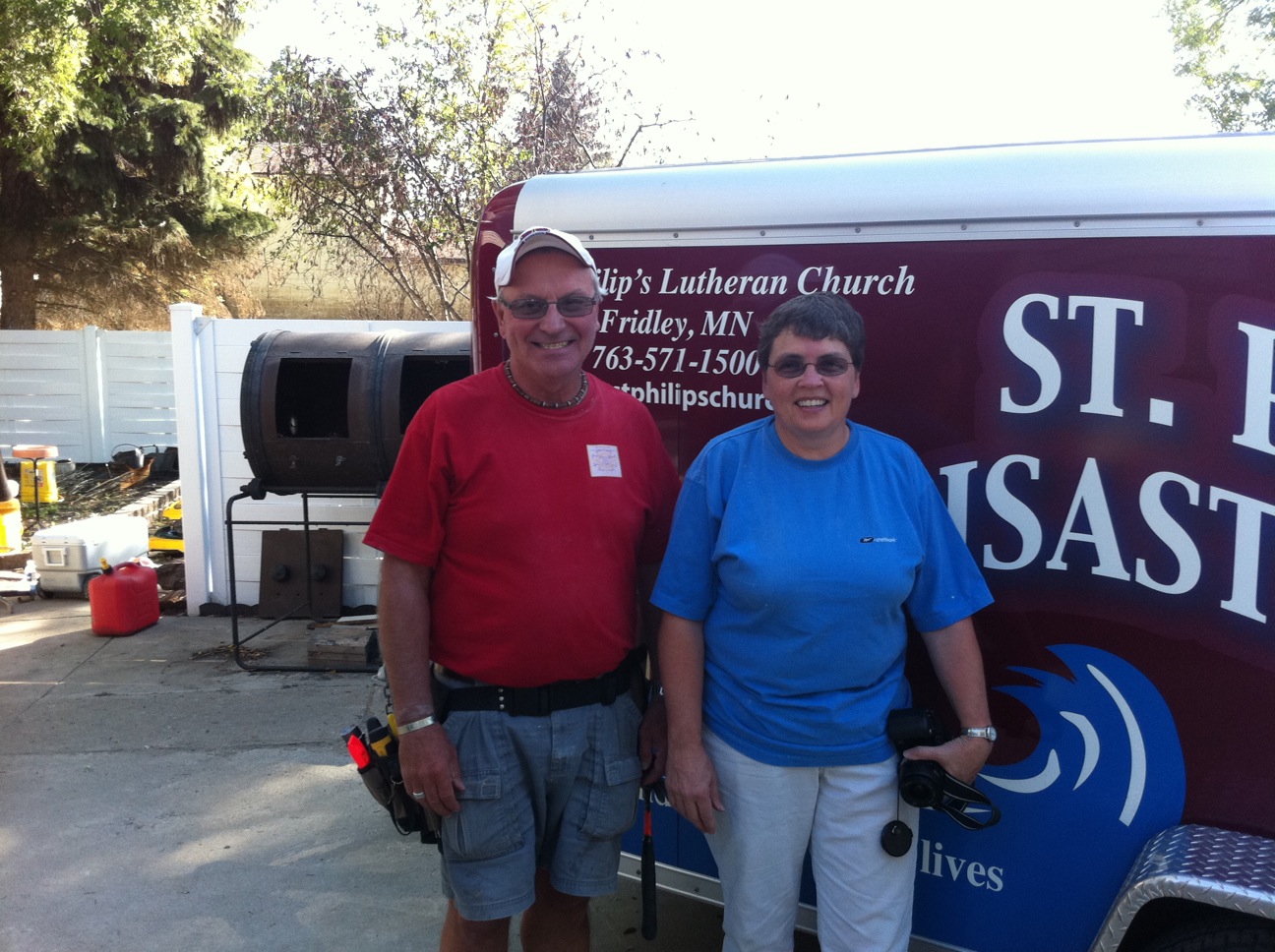
I was particularly excited to visit Lutheran volunteers from St. Philip’s Lutheran Church Disaster Relief from Fridley Minnesota, who are volunteering this week in Minot.  The team from St. Philip’s travels the country responding to disasters of every kind.  They give a great example of the finest efforts of Lutherans loving and serving their neighbors affected by disaster. Team Co-Coordinators Mike Anderson and Renee Johnson showed me a site they were working on.  They are staying this week at First Lutheran Church of Minot, which even still recovering from flood damage in the lower level of the church is pitching in to host recovery efforts.  St.Philip’s Disaster Relief organizes periodic trips of disaster response from the Twin Cities.  If you are interested in learning more about St. Philip’s Disaster Relief, click here.  

St. Philip's Disaster Relief Co-Coordinators Mike Anderson and Renee Johnson.

Volunteers are still urgently needed in Minot.  We will be coordinating volunteers for muck out work for the flood as long as weather permits.  We will be ramping up for the rebuild phase during the winter and spring.  To learn about volunteering in Minot, please visit  Lutheran Social Services of North Dakota or call 1-800-366-9841.

Above all, please pray for people all around the country affected by disasters this year.  People throughout the Southeast have been affected by tornadoes and storms.  People throughout the Midwest and Plains have been affected by flooding. People in Texas are affected by drought and wildfire.  People along the East Coast were affected by Hurricane Irene and Tropical Storm Lee.  Many other people have been affected by tragedies that didn’t make the news.  Pray that help and hope come to those in need.

Japan: Six Months On, Reflecting and Looking Forward

It is hard for me to write about the six month anniversary of the Japan Earthquake and Tsunami without naming that it actually falls on the same day as the 10th anniversary of the 9/11 World Trade Center attacks. I spent the past week feeling a strange tension as my personal life was flooded with conversations and media portrayals of the past ten years here at home and my professional life called for a reflection on the past six months halfway round the world. Two pieces that stuck out to me during this time were the Church World Service’s Japan Situation Report and Rev. Kevin Massey’s Disaster Response blog “Field Report: New Jersey and New York City“. I figured the best way to be honest to myself and get the message across was to talk about how these two documents have fit together in my head.

The CWS Situation Report gives a good update on the continuing work going on in Japan and the fact that the need will continue to be there into the foreseeable future. The major areas of work are around providing shelter, food, pest control, psycho trauma care and debris/home clean up. To date the ELCA has committed $975,000 to this appeal and continues to be present with and through our companions and partners. This report reminded me of the church’s commitment and calling to be present with people in their moments of need and how the gifts of our members can have such a powerful impact in places few of us have heard of, let alone been to.

In Rev. Massey’s (Director for Lutheran Disaster Response) post, I heard of how disaster affects us, not just in the destruction it brings physically but for the gap it can leave spiritually and emotionally. Even ten years later, the disaster and tragedy of 9/11 still casts a shadow across many hearts. Yet, through our communal rememberance of the tragedy there is the chance for solidarity and unity, for pain to be released.

And through both documents I saw how the church is present in disaster. Whether it happened at home or halfway round the world. Whether it happened yesterday, six months ago or ten years ago. The church is present to help in the naming of Christ present in tragedy through word and deed. So as we look back on the past six months of work in Japan, and the past ten years here in the United States, let us thank God for sustaining strength, continued resolve and the space for healing.

Field Report: New Jersey and New York City

My name is Kevin Massey, I am the Program Director of Lutheran Disaster Response, and I am sharing with you a report of my journeys this week in New Jersey and New York.  Even as I share this report I also share that I struggled with how to describe the two very important yet very different parts of my journeys.  I considered sharing them separately but decided to describe this journey together.

 I had been scheduled for some time to participate in a ceremony commemorating the 10th anniversary of the September 11th attacks in New York.  Long before I worked for Lutheran Disaster Response, I had been part of the recovery operation at Ground Zero.  I was a member of a special Red Cross team of trauma experienced chaplains who coordinated spiritual care in mass casualty events.  As a member of this team, I worked at Ground Zero for three weeks, providing chaplain services for fire fighters, police officers, medical examiners, and others involved in the recovery operations.  It was heart breaking work, and it took a terrible toll on all of us who worked in those difficult days.  I can never visit New York without being brought back to those times.

 A few weeks ago, Hurricane Irene ravaged a huge swath of the United States from Puerto Rico to the border with Canada.  The storm’s winds damaged parts of North Carolina and Virginia, but some of the most devastating effects of the Hurricane were the flooding that it caused in parts of New England, New Jersey, and Upstate New York.  Even in recent days, remnants of another storm, Tropical Storm Lee, have brought new torrential rains that reflooded many of these same areas, and other areas including  in Pennsylvania.
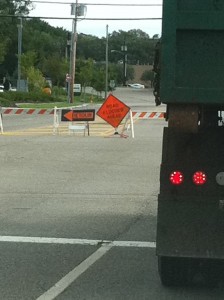
Roads have been closed throughout numerous states from flooding in recent weeks.

 As the extent of this flooding became clearer, I rearranged my schedule to come to visit part of the areas of New Jersey flooded by Hurricane Irene before continuing the visit to New York for the September 11th commemoration.  As I traveled to New Jersey last week, I met Lisa Barnes, the LDR Coordinator for New Jersey who works for Lutheran Social Ministries of New Jersey.  This agency is a terrific organization that provides a wide variety of crucial social ministries in addition to disaster response.  We did planning about the ways that we could best respond to the flooding but wanted to see the worst areas first hand and hear from local Lutherans what their ideas were for the response.

We traveled to Rockaway, New Jersey and met with Pastor John Hansen of Holy Trinity Lutheran Church.  Pastor Hansen and other Lutheran pastors from that area are ministering to communities along the Rockaway River that have all been affected by flooding.  The congregations are providing food and support to their communities during this emergency phase of the disaster.

 I met Roy Provost at his home in Denville New Jersey. Roy is the council president of Holy Trinity Lutheran Church in Rockaway New Jersey where Pastor John Hansen serves. Roy’s home was significantly damaged by the flooding caused by Hurricane Irene. Roy’s wife is a talented artist, and her workshop in the lower level of their home was destroyed by the flooding that ensued by the hurricane.  I was deeply touched however that in the midst of his loss, Roy was very concerned about his neighbors. Roy shared, “The worst part is not knowing where your neighbors are.  This neighbor is in her 70’s, and I don’t know where she is right now.” Roy shared ideas about how we in the Lutheran community could care for those who perhaps can’t care for themselves.  One idea that we surfaced was for designing a Hurricane Response Center in New Jersey where we could teach people who are able to attend to their own homes how to repair them safely and efficiently, and also coordinate volunteers who could help people like Roy’s neighbors who are not able to work themselves.
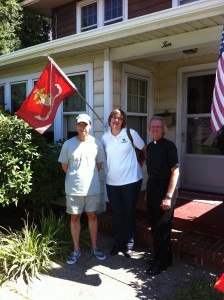
Pictured left to right: Roy Provost, Lisa Barnes, and Pastor John Hansen.

We will work to implement ideas like the Hurricane Response Center in areas affected by these recent storms, and at the end of this report I will share info about how you can help.  As I concluded the visit for assessing this Hurricane damage, I continued on to New York City for the gathering tonight by the Lutheran Community commemorating the September 11th attacks.

 We gathered then this evening at another Holy Trinity Lutheran Church, this one in Manhattan.  Ten years ago, Lutherans had gathered at this congregation to support each other and grieve the terrible losses and fears of that day.  This evening we gathered there to commemorate ten years passing.  The lost are remembered.  The tears often flow anew.  While time assuages some of the sting of the pain, the ache remains.  We will always miss those whose absence leaves a space in our souls.

 I felt great warmth tonight especially in seeing the relationships of collaboration and shared service that the Evangelical Lutheran Church in American and the Lutheran Church Missouri Synod displayed while responding to September 11th.  The service tonight included speakers and participants from both the ELCA and the LCMS.  ELCA Presiding Bishop Mark Hanson and also President David Benke, the President of the LCMS Atlantic District, both spoke.

Work on the new World Trade Center Tower 1 is progressing.

I want our commitment to accompanying those affected by the September 11th attacks to be a signal to those affected by more recent disasters that we will accompany you as well, for as long as recovery takes.  People in Minot North Dakota, and Delville New Jersey, and Joplin Missouri want to believe that they will not be forgotten.  By our standing with the people of New York and Washington DC, and Shanksville Pennsylvania this weekend, we hope that this accompaniment demonstrates this commitment.

 Please pray for the people of New York and other places and people affected by September 11th as they commemorate the passing of 10 years since the horrible attacks.  Please pray also for the many people affected this year by tornadoes and flooding and wildfires and drought in places like Minot North Dakota, Joplin Missouri, New Jersey, Pennsylvania, New England, and Texas.

Volunteers are urgently need right now in Minot North Dakota.  Volunteer opportunities in other areas affected by disaster are being considered and planned, but we are able to host volunteer teams in Minot right now.  Consider traveling there this fall to help with the clean up, and consider returning to Minot next spring to help with the rebuilding.  Please  click here  for information about volunteering in Minot North Dakota

 Funds are also urgently needed to respond to the recent Hurricane and Tropical Storm damage along the East Coast, even as we watch anxiously that other storms can still form and affect the East Coast and the Gulf Coast. Please  click here to give a gift designated to help with these emergencies.

Horn of Africa: Keeping Tabs on Tanzania

One aspect of the ELCA’s unique position within disaster response is the breadth and depth of our direct relationships. With approximately 240 missionaries in 48 countries and 120 companion synod relationships between ELCA synods and other global Lutheran churches, our response to disaster is also a response to the needs of our brothers and sisters. So when we started to hear that the drought in the Horn of Africa might be spreading to Tanzania we turned to this network to learn more.

From the ELCA Regional Representative for Tanzania and Madagascar Barbara Hinderlie (barbara.hinderlie@elca.org) we have been learning of the growing need in Tanzania. She shared that approximately 1.8 million people are affected by drought over three districts, and that the Tanzanian government is assessing the situation with a report expected in mid-September. This report could then open the way for aid organizations like the ACT Alliance, of which the ELCA is a member, to begin responding.

Through a conference call in which 7 ELCA synods in companion relationships with the Evangelical Lutheran Church in Tanzania participated (Delaware-Maryland Synod, Greater Milwaukee Synod, Northern Great Lakes Synod, South Carolina Synod, Southeast Michigan Synod, Southeastern Pennsylvania, Western Iowa Synod), we heard of how these synods have been in direct contact with their companions as the situation has developed. They shared their companions’ concerns of failed crops not harvested, growing inflation of food prices and the particular concern of mandatory energy rationing. Some Tanzanian dioceses were reporting only 1-2 hours of electricity a day. The reason for this is that much of the energy in Tanzania comes from hydroelectric plants, but with lower water levels these plants have not been able to produce enough energy for the country.

As this situation evolves and we learn more, we will continue share the message of our partners overseas and at home. We give thanks for the work of our ELCA missionaries and synods as they continue to live out their relationships with our companions. Please keep them and the Evangelical Lutheran Church of Tanzania in prayer, that these relationships may remain strong and the lines of communication open. So as need becomes known we can respond quickly and appropriately, strengthened by a spirit of mutual understanding and accompaniment.

————-
Gifts to ELCA International Disaster Response allow the church to respond globally in times of need. Donate now.

Horn of Africa: Can We Prevent One Million Deaths Today and Worse Famines Tomorrow?

I just read a transcript of a meeting convened by Laurie Garret, Senior Fellow for Global Health, Council on Foreign Relations. It’s a bit long but is chalk-full of candid conversation about the situation in the Horn of Africa, how the global economy relates and the questions it raises for international aid. I’d recommend checking it out and thinking about what it has to say. I’d be curious what people think.

Here’s Laurie commenting on the fact that we had forewarning of this crisis:

This was forecast a year ago. Everything that has happened has in fact played out precisely as forecast. And yet, we were unable to take a forecast and turn it into some advance pre-emptive action. And that speaks very heavily to where we stand right now as a global community in our sense of humanitarian relief. Why is it we have to wait to see dead bodies? Why is it that we cannot take forecast information seriously and act on it?

Please read the transcript and share your comments/questions below.

————-
Gifts to ELCA International Disaster Response allow the church to respond globally in times of need. Donate now.