Skip to content
ELCA Blogs

Lutheran Disaster Response

Field Report from Joplin, Missouri

Dear sisters and brothers,

The annual conference of the National Voluntary Organizations Active in Disaster (National VOAD) is taking place this week in Kansas City, bringing together the leaders of nearly every faith-based, secular, and governmental disaster response organization.  The conference is a wonderful chance to network with colleagues and learn about the emerging trends in the sector.  This last Sunday evening, the deadliest tornado in recorded U.S. history devastated the city of Joplin, Missouri, just three hours south of where the conference would begin the following day.

Needless to say, the dynamic at the conference has been very different this year.  Those representing early response organizations – groups like the American Red Cross and Southern Baptist Disaster Relief – re-routed staff to Joplin almost immediately, while those of us who remained at the conference were itching to join them.  But all of us have been united in the knowledge that, very soon, it will be time to get to work.
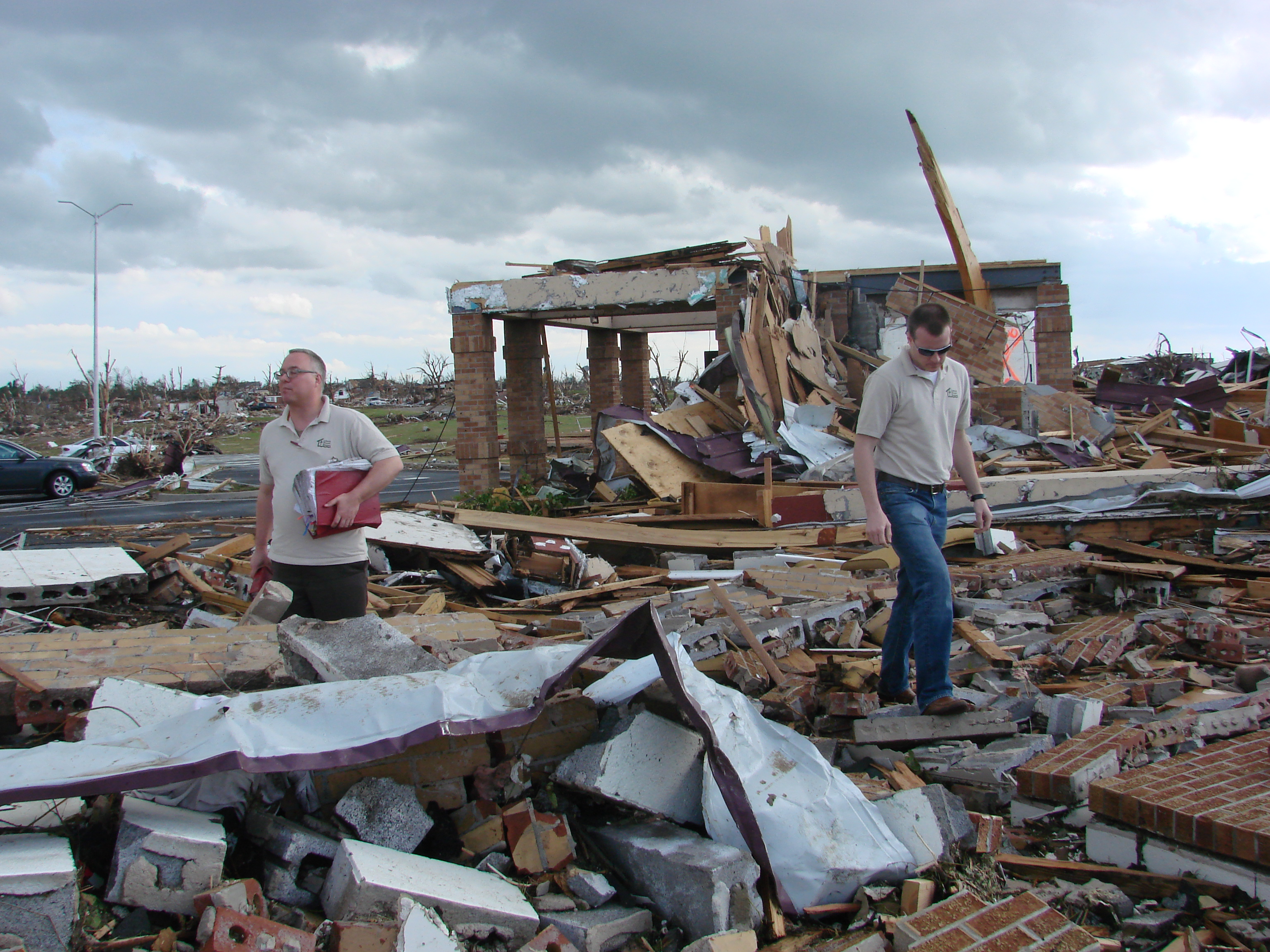
Director Kevin Massey and Associate Director Mike Nevergall stand among what is left of Peace Lutheran Church

Yesterday, I went to Joplin, along with my colleagues Kevin Massey and Maria Maldonado, at the invitation of Bishop Jerry Mansholt of the ELCA Central States Synod.  We traveled with Pastor Bill Pape, who has been serving as interim pastor at Peace Lutheran Church in Joplin for the last few years.  The tornado completely destroyed the church building at Peace Lutheran, but thankfully, all of the members are now accounted for.

We have all seen the images of Joplin on television, with destruction stretching as far as you can see, but there are simply no words sufficient to describe seeing it in person.  The thing that always stuns me with tornadoes is the way they cut a swath of damage but leave surrounding areas mostly untouched.  Driving south on Range Line Road, which runs on the east side of the city, there was not much sign of tornado damage at first. But then we crested a small hill, the disaster area spread out in front of us, and I instantly felt tears well up in my eyes.  Homes leveled to the foundations, cars flipped over as if they were toys, businesses flattened, trees stripped of all leaves and branches.  Block after block after block, there are buildings which will need to be simply demolished and started over again.  For a concentrated area, it may be the worst devastation I have seen in my more than five years with Lutheran Disaster Response.

After a disaster has happened, we receive requests from congregations who want to send supplies into the area.  We also receive requests from
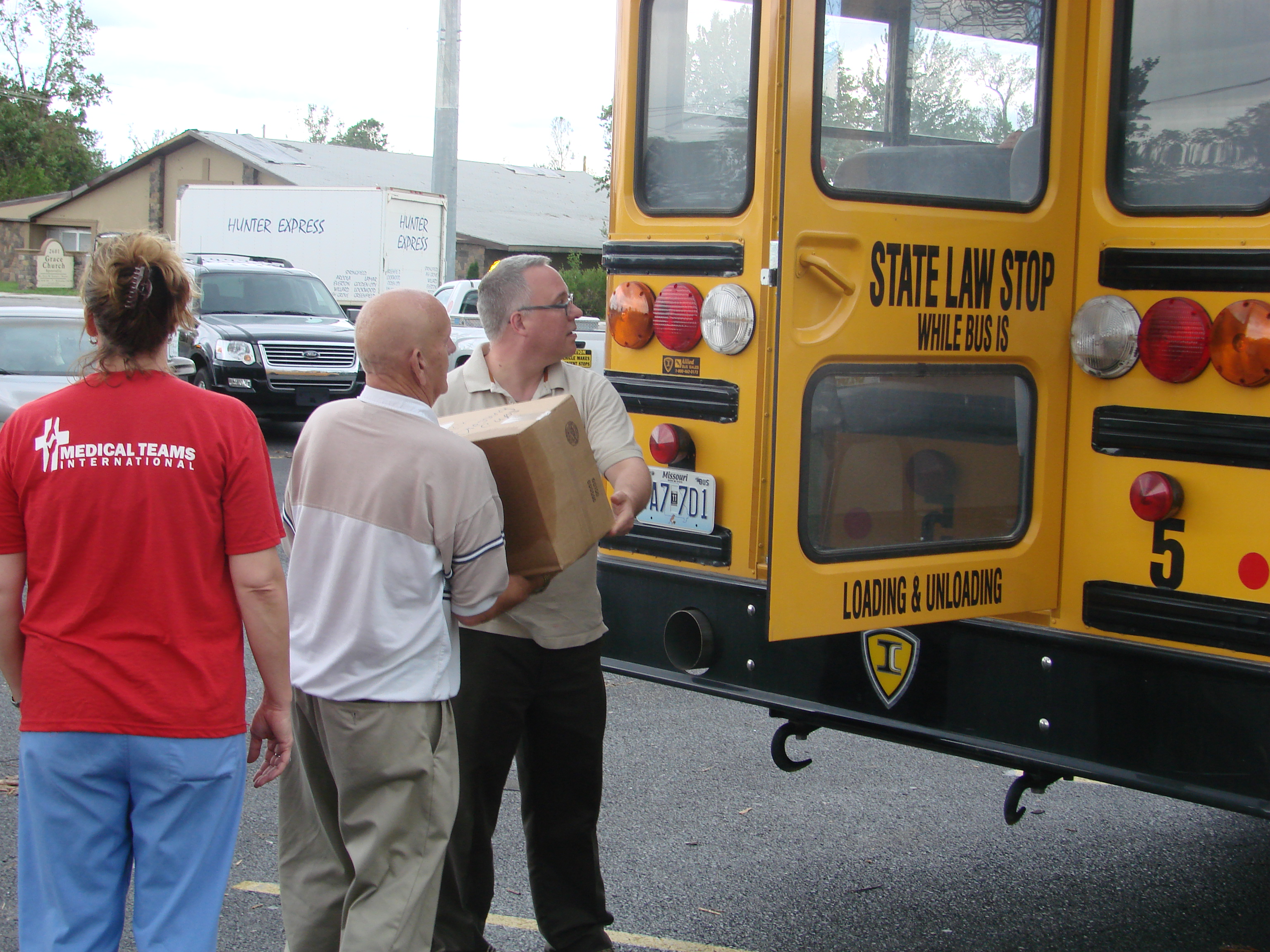
Pastor Bill Pape and Kevin Massey help unload items being collected at a Lutheran elementary school.

volunteers who want to travel to the area to serve, in whatever way they can be helpful.  The early stages of a disaster response can be complicated, as a community figures out how to plan its recovery, and these sorts of well-intentioned offers can sometimes be more of a hindrance than a help.  But today, just three days after the event, we met a couple from Dallas who had driven to Joplin and set up a trailer from which they were distributing grilled hamburgers and hot dogs to anyone who wanted one.  We also helped unload donated goods at a Lutheran elementary school that was receiving things to distribute from neighboring towns.  In this moment, those offers of help were meaningful and appreciated.

At the end of our day in Joplin, we sat with members of Peace Lutheran to talk about next steps for their congregation.  Bishop Mansholt read to us from Psalm 46, and then we heard members of the congregation share their stories about the last few days.  We laughed together, which felt good for the soul in the midst of such a difficult situation, but there were also many tears.  The members of Peace Lutheran are determined to worship together this Sunday, and they hope to do so in the parking lot next to where their church stood less than a week ago.  And they want you to know how important it has been to know that people are praying for them, thinking about them, and asking how to help them, from across the country and around the world.

Bishop Jerry Mansholt meets with gathered members of Peace Lutheran Church

I ask you to continue praying for the people of Joplin, and specifically for Pastor Pape and the members of Peace Lutheran.  Our strength as Lutherans is being there for the long haul, understanding that disaster recovery is a long-distance run and not a sprint.  The people of Joplin will need our ongoing support for months and even years to come.  I hope you will consider a gift to the “U.S. Severe Spring Storms” account, from which we have begun and will continue a meaningful response to this disaster.

Finally, I would like to ask your prayers for me personally and for my disaster response colleagues, Lutheran and otherwise.  This spring has been a steady stream of new disasters, and with hurricane season less than a week away, it feels a bit overwhelming at times.  It is in difficult times like these that I am uplifted by your ongoing support for this important ministry we do together!

In service,

Mike Nevergall
Associate Program Director

Ivory Coast: Updated Refugee Numbers

Map of Ivory Coast refugee locations. Click map to download pdf.

The UN’s High Commissioner for Refugees (UNHCR) has released a new map showing the approximate numbers and locations of refugees from the Ivory Coast. The numbers continue to be high, particularly on the western edge of the country as people continue to be wary of returning. I was struck not only by the high numbers of refugees, but also by the distances some of them had to traverse and that the Internally Displaced People (IDPs) within Cote d’Ivoire.

The ELCA is working with its companions, the Lutheran Church in Liberia, Lutheran Development Service (LDS) in Liberia and the ACT Alliance to help those fleeing from the violence. To date the ELCA has allocated $60,000 towards the ACT appeal to meet the needs of the 175,000+ refugees in Liberia. It has also allocated $10,125 to help the Lutheran Church in Liberia rebuild part of the church’s Lutheran Training Center which was damaged by the war and a severe windstorm.

Hopefully as the new government begins to take form Ivorian citizens will begin to see in their country fertile soil in which to plant their trust and hopes. And perhaps the helping hand shown by neighboring countries may continue in a tradition of good will and friendly relations.

————-
Gifts to ELCA International Disaster Response allow the church to respond globally in times of need. Donate now.

Colombia: And Still the Rains Come

Colombians evacuating their homes as the flood waters rise.

I had the pleasure yesterday of sitting with Bishop Eduardo Martinez of the Evangelical Lutheran Church of Colombia (IELCO) to gain his perspective on what has been happening in his country. Here is a bit of what we covered:

The major point relayed by the bishop is that the situation in Colombia is worsening. With reports that the rains last month were equal to the annual rainfall of Colombia and the excessive rains over the past year, many have been left without access to housing or food as they are forced from their homes by the rising waters and left incapable of harvesting the sustenance crops they live on. There are also dangers for people as the move onto higher ground as mudslides have become more common. This all would be a crisis enough on its own, but with somewhere between 3.5 and 5 million people already listed as IDPs (Internally Displaced Persons) within the country these new additions have begun to overwhelm aid agencies.

With this new situation the government has been calling on the churches to lend a helping hand. The bishop described how the IELCO is historically been focused on responding to the humanitarian crisis but with this new situation they are finding way to build on this work to address the humanitarian concerns of disaster response and development. To this end they are working on a proposal for the Latin American Council of Churches, ACT Alliance and ELCA to help meet the growing needs of the people.

The bishop also attended the synod assembly of the Southeast Synod of Minnesota and will attend the assembly of the South Carolina Synod, both of whom have companion synod relationships with IELCO. His hope is to share the story of his people so that their brothers and sisters in the ELCA may know of their situation.

Please pray for Bishop Martinez, the Evangelical Lutheran Church of Colombia and all Colombians that the spirit of Christ may sustain them through this time of crisis and the Easter message of life from death, creation from destruction, may continue to give them hope.

————-
Gifts to ELCA International Disaster Response allow the church to respond globally in times of need. Donate now.

Field Report from Alabama

Sisters and brothers in Christ,

I am Kevin Massey, Program Director of Lutheran Disaster Response. My colleague Mike Nevergall and I are in Alabama this week to see the extent of the damage from the tornadoes of April 27 and to meet with local Lutherans and others in the affected communities.

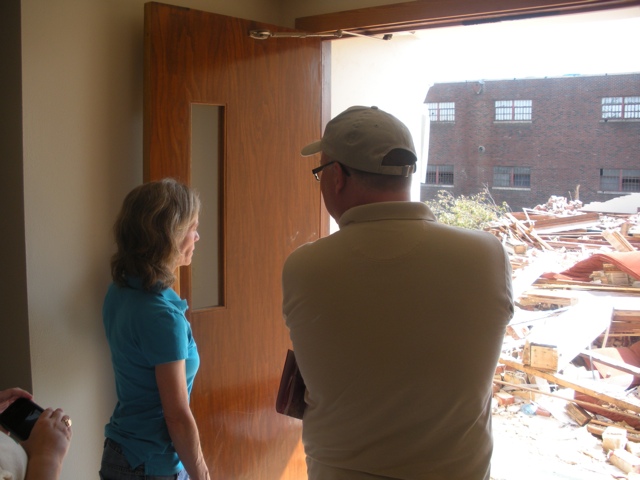
Pastor Sandy Niiler and LDR Director Kevin Massey stand looking at what remains of the sanctuary at Christ Lutheran (Cullman, AL).

When we arrived in Birmingham, I was pleased to meet Ron and Heather Turney, leaders with Lutheran Ministries of Alabama. Lutheran Ministries will play a key role in the long-term recovery projects here. It was also a pleasure to share a meal with disaster response partners from The Lutheran Church—Missouri Synod, including my colleague and friend Rev. Carlos Hernandez, Director for Districts and Congregations.

Driving north from Birmingham to the town of Cullman, I was struck by the natural beauty of this area with its rolling hills, spring flowers, and emerald green trees. But as is the case with tornadoes, we quickly spotted areas where trees had been sheared off and stripped clean by one of the dozens of tornadoes that happened here. It reminded me of our recent trip to Wadena, Minnesota and how, even after homes are rebuilt and businesses have reopened, these stripped trees will be a visible scar of what happened here for many years to come.

When I learned that the tornadoes had destroyed an ELCA church building, I had called the pastor of that congregation, Pastor Sandy Niiler, shared with her our support and prayers, and promised to personally visit with her soon. Yesterday, I had the opportunity to do so. We were joined in Cullman by Pastor Deb Halter, who will be taking on a role with the ELCA’s Southeastern Synod of spiritual and emotional support for the pastors and others affected by these disasters.

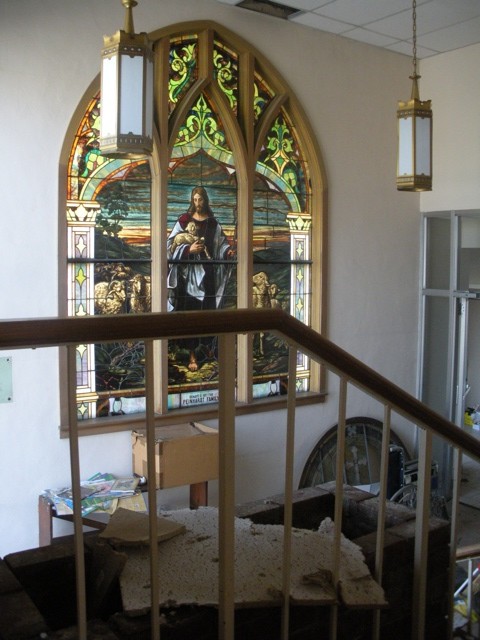
The "Christ the Good Shepherd" stained glass window at Christ Lutheran (Cullman, AL).

Tiptoeing through the debris and rubble of Christ Lutheran Church, I spotted a copy of the ELCA’s “Haiti: One Year Later” update. Pastor Niiler explained that the congregation had prayed for the people of Haiti as part of their Lenten discipline. I was touched by how this congregation had been thinking about their neighbors affected by disasters, without knowing that they would soon experience one themselves.

We stood in the choir loft, virtually all that remains of the building, and looked out over the debris field and the surrounding town. Pastor Niiler pointed out where the pulpit and altar used to stand. Only a fraction of what was Christ Lutheran is still standing, but miraculously, an historic stained glass window of “Christ the Good Shepherd” was undamaged. As we celebrate Christ the Good Shepherd this coming Sunday, it comforted me to see the image of Christ gently cradling the little lamb, just as he now holds this community in his tender embrace. The congregation hopes to incorporate the window someday into a new worship space.

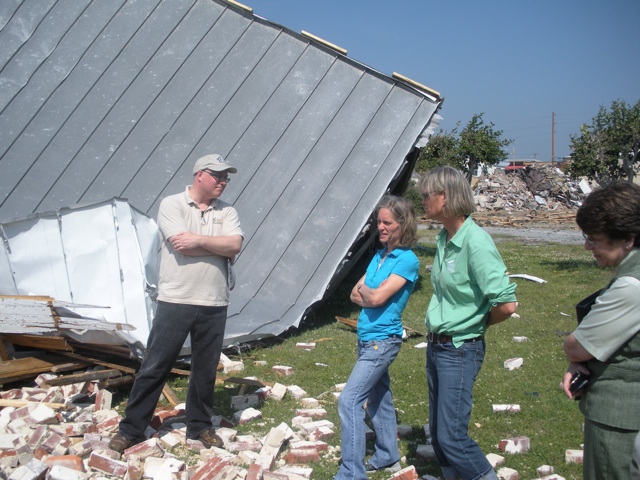
L to R: Kevin Massey (LDR Director), Sandy Niiler (Christ Lutheran), Sandra Braasch (Synod disaster coordinator), and Deb Halter (Synod spiritual care coordinator).

What can you do now? First, please pray for the people here, for their patience and strength, for their emotional and spiritual health. Second, whether by e-mail or on Facebook, share this story with a friend and encourage them to pray as well. Third, I ask you to consider giving a gift to the Lutheran Disaster Response “U.S. Severe Storms” fund, and we will make sure that it gets to those who need it most. Finally, we know that volunteers will be needed here at some point in the near future. Stay tuned for further details about what that will look like.

Thank you for your prayers and support… together, we are Lutheran Disaster Response!

In service,

Rev. Kevin Massey
Program Director

Ivory Coast: Refugees Still Reluctant to Return

Pierre Konkunse, born in a Liberian refugee camp on April 6.

Amid the swirl of events in the Ivory Coast (president-elect Alassane Ouattara to be sworn in today, claims that the last of the forces loyal to ex-president Laurent Gbagbo have been put down and the expected start of trial for Gbagbo this coming week) the Ivorian refugees and internally displaced persons (IDPs) have taken a bit of a backseat. Yet there are still an estimated 177,000 refugees (mostly in Liberia) and 238,000 IDPs (mostly in Western Cote d’Ivoire).

It was expected after the capture of Gbagbo that these numbers would go down, but despite the efforts of those within the Ivorian government and international aid organizations, they have remained fairly constant as the Ivorians who fled fear the violence is not over.

The ELCA has been working with its partners in the ACT Alliance, particularly the Lutheran World Federation, within Liberia to help meet the refugee needs there. It is hoped that as things begin to settle to a new sense of normalcy these refugees and their IDP brother and sisters will feel secure enough to return home to help move their country into its next chapter. During this interim time, let us keep these people in prayer, that the spirit of God may comfort them and ease they fears, that the strength of Christ may steel them for coming months as they begin the long journey to a home that for many may seem more new than old.

To learn more about the situation read the UN OCHA Situation Report #4.

To gain a perspective of what the refugees have gone through read the story of baby Pierre (pictured above). This story, from the ACT Alliance, tells of his birth as a refugee in Liberia and the struggle of his mother, grandmother and great-grandmother to escape the violence.

————-
Gifts to ELCA International Disaster Response allow the church to respond globally in times of need. Donate now.

Japan: Video of CWS Response

ACT Alliance has posted a new video from Church World Services (CWS) outlining their work in Japan. This work has entailed distributing materials, setting up stationary clinics, making connections between those seeking shelter and those offering shelter and providing psychological care for women and children affected by the disaster. To date the ELCA has pledged $175,000 to help CWS with its work. To learn more about the ELCA’s response check out the page ELCA Disaster Response: Japan.

————-
Gifts to ELCA International Disaster Response allow the church to respond globally in times of need. Donate now.