Church of the Apostles (COTA) in Seattle, Wash., does church differently. Embracing the essential Pacific Northwest traits of exploration and self-expression, the church has been drawing in young adults between the ages of 20 and 40 (and now their families) since its beginning as a storefront new start in June 2002. A key part of COTA’s identity is its focus on connecting with ancient church traditions in creative ways to grow authentic relationships with God and each other.
COTA is a mission of the Northwest Washington Synod of the Evangelical Lutheran Church in America and the Episcopal Diocese of Olympia. It became an organized congregation in May 2017. Located in the Fremont neighborhood of Seattle, the church reflects the broader arts culture of its community. COTA seeks to free people to grow in faith by sharing their artistic gifts, boldly, in worship and in life. “We are not about getting to God, but about finding ways for God to get to us,” said the Rev. Ivar Hillesland, pastor.
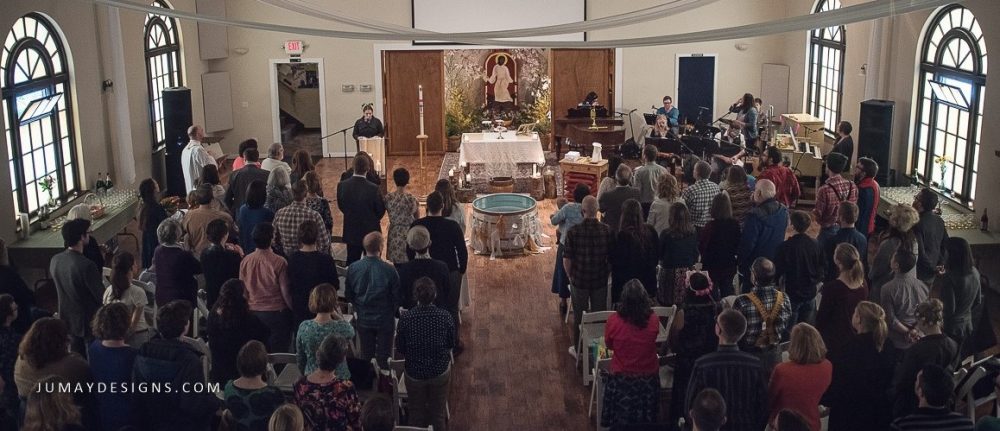
Church of the Apostles calls the beautiful and historic Fremont Abbey (constructed in 1914) its home. In 2005, the Mission Investment Fund of the Evangelical Lutheran Church in America invested in COTA by purchasing it. COTA is currently on track to buy the building from MIF. “Without the support from both the synod and the ELCA we would never have been able to make it to our current thriving state and we are eternally grateful. Because of the support these last 15 years, we have also been able to be the springboard for at least 13 ordained clergy with 3 more currently in the ordination process,” said the Rev. Ivar Hillesland. Photo courtesy of JUMAYDESIGNS.COM and COTA.
Reclaiming the ‘de-churched’
Seattle and the neighborhood of Fremont, in particular, is well-known for large concentrations of unchurched, or “de-churched,” people. “COTA holds a particular mission towards those who are wary of, or direct victims of, the institutional church and the harms that have been caused in its name,” said Hillesland.
Church of the Apostles seeks innovative ways to replace the negatives with affirming alternatives. Church leaders continually reimagine the context and flow of worship services, finding new ways to build on ancient traditions. Hillesland says he is fascinated with figuring out new ways to be and do church. He thinks of the COTA ministry as a sort of church research and development lab. “We have tried to find as many ways as possible to let God speak through our worship and being, and we’ve had many failures along with our ‘successes.’”
In another nod to the past, the church’s home is the Fremont Abbey, a beautiful Lutheran church building constructed in 1914. The Abbey also houses the Fremont Abbey Arts Center, established by the COTA congregation to meet the community’s desire for a place to come together to create and experience the arts. COTA continues to partner with the center, currently under the leadership of an independent director, to integrate the arts into worship and community life.
Priesthood of all believers in action
Taking to heart the theology of the priesthood of all believers, the church strives to have leaders with diverse backgrounds and life experiences. The tasks of planning worship and preaching can be especially meaningful to those who have been unwelcome to use their gifts in the church because of their gender, race or sexual orientation. “Centering the voices of those traditionally marginalized speaks to our intention to expand gender and racial representation and experience, and it gives us a more expanded understanding of the imago dei, or divine image present in all humans,” explained Hillesland.
COTA members and friends come together Sunday evenings for worship—a mix of personal interaction, art, music, a message, and a time of exploration. Opening the pulpit creates space for varying perspectives and authentic reflection. Worship is also a time to experience the divine through creative expression of ancient liturgies. For example, worship music, often written by Music Director Lacey Brown, reflects “themes of ambiguity, expressed spiritual pain or longing, and expanded multigender metaphors for the Divine persons.” Brown also encourages musicians in the COTA community to create songs centered on specific themes or seasons, culminating in projects like the recently released Epiphany Songs.
In an ever-changing world, COTA grounds itself by connecting the past to the present in a way that is authentic to its identity and purpose. According to Hillesland, “As more and more things seem ephemeral, we find ourselves seeking ancient things, things deeply rooted in tradition that can anchor us in the turbulence while at the same time give us more freedom and space to creatively experience God.” It is this connection that inspires the people of COTA to go out into the world as people transformed in Christ.
by Kris A. Mainellis, Program Director for Communication and Events, Congregational Vitality