
Skip to content

ELCA Blogs

April 12, 2026 – Peace Be With You

Prepare:

Jesus’ disciples are familiar with fear. Throughout the gospel of John, we hear that Jesus’ followers are filled with fear, especially of the Jewish authorities. To proclaim Jesus as messiah is to face expulsion from the synagogue and separation from family and friends. Following Jesus comes with fear and risk. This fear is compounded at Jesus’ death. He tries to prepare his disciples for his death and resurrection, but they are unable to comprehend these predictions.

After Jesus’ death, the disciples’ fears are intensified by grief. They had hoped for Jesus to rebuild Israel into a great nation and end Roman occupation. They also had hoped to be at his side when he did it. But now their leader and friend, as well as their status and hopes for the future, are all lost. They are unsure of their standing in the Jewish community and unable to trust in the news of Jesus’ resurrection. Consequently, the disciples have no idea what to do next.

Into this situation of fear and uncertainty, Jesus shows up. Jesus shows up, gifting the disciples with his peace and the Holy Spirit. These gifts empower the disciples to begin planning for a new future of proclaiming Christ’s love to others.

Opening Exercise:

Listen to the hymn Let There Be Peace on Earth or read the lyrics.

Discuss together what you felt and heard as you listened to the hymn.

  • What lyrics stood out to you?
  • What does it mean for peace on earth to begin with you?
  • The hymn emphasizes seeing others as our family. How does seeing others as family help promote peace on earth?

Text Read Aloud:

John 20:19-31

Peace Be With You

If you are like me and my congregation, you have been praying for peace. A lot. Praying for peace in our world is a regular worship practice. It has certainly felt needed in the last month as we have watched the war between Iran and Israel and the United States. Amid the violence and loss of life, we pray for God’s mercy and presence. Among the fear and chaos of war, we pray for Jesus’ peace, hoping this ceasefire holds.

The time after Jesus’ death was filled with fear and chaos. The disciples were hiding in a locked room. They didn’t trust
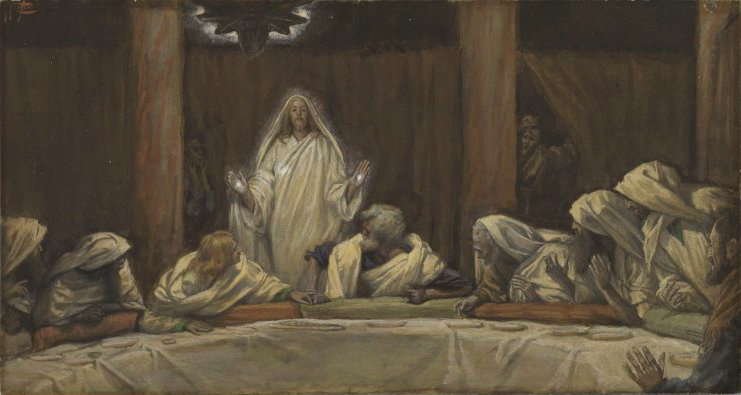
James Tissot, The Appearance of Christ at the Cenacle, 1886–1894. Public domain, via Wikimedia Commons.

the message from Mary Magdalene that Jesus was risen. They were afraid of the religious leaders. They had no idea what to do next. So, alone and afraid, they hid.

Into their fear and chaos, Jesus shows up and proclaims not once but three times, “Peace be with you.” In some ways, we could say Jesus’ proclamation of peace changes nothing. The disciples are still alone in a locked room, afraid of what will come next. Yet, in other ways Jesus’ proclamation of peace changes everything. Jesus’ greeting of peace offers reassurance to the scared disciples. It does not change the disciples’ present circumstances, but it changes the disciples. Blessed with Jesus’ peace, the peace that passes all understanding, the peace that provides calm even in a chaotic world, the disciples are empowered to go out and begin their ministry.

Peace Be With You

Jesus’ peace does not yet equate a world in harmony. We know that on this side of heaven, we will not know a world without war and violence, pain and strife. Unfortunately, this is what we do as humans. This does not mean, however, we are left in fear and despair. Instead, Jesus blesses us with the peace that passes all understanding. Jesus’ peace gives us the ability to trust in God’s presence and provision even when surrounded by fear and chaos. Jesus’ peace gives us hope, even when the world gives us so many reasons for worry and despair. Such a peace moves us to action.

As we await Jesus’ second coming and the redemption of the world, we do not simply accept the violence of the world. We are called to share Jesus’ peace with those around us. As the hymn states, let there be peace on earth and let it begin with me. We, like the early apostles, have received the gifts of Jesus’ peace and are empowered to go out and share that peace with others.

Reflective Questions:

  • How do you think Jesus’ disciples felt before Jesus arrived? How did their emotions change after Jesus arrived?
  • Jesus tells the disciples, “as the Father has sent me, I am sending you.” What are the disciples sent out to do? How are we, as Jesus’ disciples, also sent out?
  • What was a time where you felt at peace? Share what makes this memory special to you. What provided you with peace?
  • What are some ways you find peace when you are feeling anxious?

Closing Activity:

Brainstorm three ways your group can work for peace: one within your congregation, one in your community, and one in our country.

Some ideas to get you started:

  • Write cards to a group or family in need of encouragement
  • Reach out to a different faith community to learn about their ministry and build relationships of understanding
  • Volunteer with an organization working for the good of your community

Let there be peace on earth and let it begin with you!

Final Prayer:

Holy God,

We ask that you draw near to us when we are feeling anxious or afraid. Fill us with your peace and empower us to share your peace with others. Amen.

Bio

Amy Martinell serves as the Associate Pastor of Congregational Care at Gloria Dei Lutheran Church in Sioux Falls, SD. Amy shares her life with her husband, three kids, a disinterested cat, and a disobedient beagle. She loves reading, baking, and swimming.


Share

Conflict and Hunger Part IV: Food Utilization

This post is Part IV of a five-part series discussing the many ways that violent conflict impacts hunger. The next key aspect of food security is food utilization, or put another way, are people able to meet their nutritional needs? Here, we take a look at how conflict impacts this, with specific attention to the crisis in Ukraine. Read Part I and find links to the other posts here.

When it comes to food security, there is a difference between having enough calories and meeting your nutritional needs. An overabundance of calorie-dense food – especially processed and packaged foods that also contain high amounts of salt or sugar – does not necessarily contribute to food security, because part of food security means having the right kinds of food: nutritious, clean and safe. The availability of this food, the ability to safely store and prepare it, and our own confidence as consumers all play a role in food utilization.

Unfortunately, in a violent conflict, when much of the food system and society is unstable, these are the kinds of foods that tend to be less available. During a crisis, people often turn toward shelf-stable,  processed foods that are quick to prepare, easy to carry, readily available and inexpensive. We saw this in countries such as Brazil and Indonesia in 2020, where as much as half of the population turned to eating less overall or eating more highly processed foods to get through the crisis caused by the COVID-19 pandemic.

One of the main concerns in the Ukraine conflict is the nutritional well-being of people displaced by violence within Ukraine and those who have fled the country as refugees. As people are displaced from their homes and local communities, their ability to procure safe, nutritious food is often hampered. In some cases, humanitarian aid can help make up the difference, but not everyone has access to this. We can surmise from recent reports that humanitarian agencies are facing significant obstacles in reaching people who are internally displaced within Ukraine.

The other aspect of food utilization to consider in a conflict is safe handling and storage of food. With attacks impacting both personal security of civilians as well as critical infrastructure that provides power for cooking and sanitation for clean water, conflict increases the risk of illnesses that come from contaminated food. Conflict also makes it harder for people to get treatment for diseases that can impact their nutrition and overall health, such as diarrhea, fevers, diabetes and, of course, COVID-19.

Here, too, the effects cascade to other populations. Host countries welcoming refugees can encounter obstacles in ensuring that everyone – including native residents – has enough food and that there is capacity in the healthcare system to meet the growing need. In addition, countries relying on exports from Ukraine and Russia may turn to less nutritious or less safe food available locally or in alternative markets.

With all of these interconnected systems, one of the most important aspects of food security is how stable and reliable the food system is. We turn to that in the next post on stability.

Share

Conflict and Hunger Part V: Stability

This post is Part V of a five-part series discussing the many ways that violent conflict impacts hunger. The next key aspect of food security is stability. Is access to food reliable, even during a crisis? Here, we take a look at how conflict impacts this, with specific attention to the crisis in Ukraine. Read Part I and find links to the other posts here.

Stability, in short, means that food production, access, and utilization are reliable and resilient. Put another way, if we can eat today, how sure are we that we will be able to eat tomorrow?

There are two reasons this is important. First, instability and unpredictability change the way people behave. Farmers, for example, become more hesitant to trade, invest or diversify their work. For example, after the civil war in Mozambique in the 1980s and 1990s, farmers tended to focus on subsistence farming and reduced their participation in the market, meaning there was less food produced for other people to purchase and consume. Similarly, farmers may shift away from livestock or away from crop diversification, since doing so seems to pose less risk in the short-term, even if it may have longer-term negative effects.

In Ukraine, one of the current concerns is that farmers may not fertilize their grain crops because of high prices and instability. That would lead to a drastic reduction in the wheat crop for 2022, which could cause further shortages and higher prices globally into 2023. Moreover, the International Food Policy Research Institute (IFPRI) notes that fertilizer costs are expected to rise globally, adding to the strain of farmers dependent on them. Russia and Belarus provide a large share of the world’s fertilizer, and their shipments have been significantly interrupted. (Of course, because causes and effects are complex, this situation might actually spawn the positive benefit of focusing attention on increased efficiency of chemical fertilizers and investment in alternative fertilizers that are less destructive to health and the environment, as IFPRI notes.)

The second reason stability is important is because conflict doesn’t happen in a vacuum. Russia’s invasion of Ukraine didn’t bring an end to the ongoing threat of COVID-19 or other diseases. Nor does conflict make climate-related disasters take a hiatus. The most significant risk to food security in a region occurs when multiple shocks coincide.

This is, in part, what makes the food security situation for export-dependent countries so dire right now. In places like Yemen, which depend on grain exports from Russia and Ukraine, the war comes on the heels of a locust swarm that devastated crops and continues to pose a threat to farmland. Moreover, some of the people dependent on exports from Ukraine are in areas facing their own conflict-related crises, such as Afghanistan.

When combined with existing poverty, rising prices, climate events and other conflicts, the shock to the global food system that the war in Ukraine represents could be severe. In the short- to medium-term, the FAO estimates that the conflict could lead to nearly 8 million more people around the world becoming hungry. This is in addition to the refugees and internally displaced people of Ukraine whose lives and livelihoods have been immediately impacted. That increase in hunger would come on the heels of significant growth in undernourishment due to the COVID-19 pandemic.

To sum it up, conflict destabilizes nearly every aspect of our global food system, which is partly why it is often named as the most significant driver of hunger around the world. For most of history, humans could assuage feelings of responsibility or even fear if a conflict emerged halfway around the globe. But our world today is far too connected to believe that borders, oceans or miles can insulate us. The globalized, interconnected food system that each of us is a part of demonstrates politically and economically what we have always known theologically, namely that the safety and well-being of all God’s creation matters, no matter how distant the people involved might seem to be.

The stability of the food system depends on many factors: farmers, workers, bakers, herders and processors who produce food; truck drivers, rail workers, loaders and grocers who make food available; health care workers who tend to nutritional well-being; employers who provide wages to workers so that they can be consumers; utility workers who keep infrastructure running to ensure the safety of food; construction and road workers who ensure there can be adequate transportation of food; and even policymakers who negotiate trade agreements and aid to ensure that the food system is inclusive.

To paraphrase the philosopher Jacques Derrida, when we eat, we never eat alone. We are eating the fruits of God’s creation made possible because of neighbors around the world. And as we eat, we are mindful that the stability of this system on which all of us depend to some extent, depends itself on the truths we are called to pursue: peace and justice.

So, to return to the first post in this series:

The ripple effects of the war in Ukraine could echo throughout the food system for a long time. But we find courage and hope in God who “calls us to hope, even when hope is shrouded by the pall of war” and who, even now, is at work in, among and through peacemakers, supporting neighbors in need and “striving for justice and peace in all the earth.”

What can be done? Providing support to the work that has already begun by giving a gift to Lutheran Disaster Response is one way to help meet the growing need of Ukrainians, especially those who have been displaced by the conflict.

A next step after that is to consider ongoing support of Lutheran Disaster Response and ELCA World Hunger. Some of the long-term consequences described in these posts may be reduced by working with local communities around the world to reduce vulnerability, increase capacity and build resilience against future shocks. This won’t be the last violent conflict; but by working together toward a just world where all are fed – and safe – we can take steps to help prevent the many destructive ripple effects that we may see this year. Supporting food producers; investing in stable, sufficient livelihoods for all people; increasing the capacity of communities to respond to crises; and building a just, sustainable and stable food system will go a long way to ending both hunger and conflict. As António Guterres wrote last year,

We need to tackle hunger and conflict together to solve either.

Share