Skip to content

ELCA Blogs

Welcoming Migrants at the Border and AMMPARO: A Whole-Church Response Mobilized

An increase in unaccompanied children and asylum-seekers arriving at the U.S. border with Mexico has given rise to claims of a crisis. Individuals, families and children seeking protection are no crisis — the crisis is the circumstances they are fleeing and the moral challenge of safe welcome. To offer hope and hospitality to the sojourner in this season of Easter is to bear witness to the suffering that affects the lives of so many. Through acts of love and service, the ELCA, with its strategy of Accompanying Migrant Minors with Protection, Advocacy, Representation and Opportunities (AMMPARO), continues to support migrants and advocate for just and compassionate solutions.


WHAT IS HAPPENING AT THE BORDER?

In recent weeks, growing insecurity has driven more families and children to the border. Not that long ago, Central America was hit with back-to-back hurricanes that caused widespread destruction and massive internal displacement. The World Food Programme estimates that nearly 8 million people in Central America are chronically hungry because of climate-driven events compounded by the pandemic. Targeted violence and crime, gender-based violence, corruption and state repression are additional factors forcing people to leave their homes. Unless these deeper issues are addressed, people will continue to migrate.


To put the situation in context: border encounters have been rising for months despite punitive measures put in place to discourage migration at the start of the pandemic. Between April and December 2020, total apprehension of single adults increased, as did those of family units and unaccompanied children, although by smaller margins. It’s still the case that the majority of people are expelled — most under Title 42, a rule invoked by the Trump administration to expel virtually all border arrivals. This policy has disproportionately impacted Black migrants from African and Caribbean countries. Migration also ebbs and flows — shifts that are based on the time of year and season. It is true that the release of unaccompanied children and a portion of families encountered at the U.S.-Mexico border have increased, but the emergency here stems from the practical challenge of moving migrants quickly through an infrastructure that has been decimated over the years and made even worse now by capacity issues due to the pandemic. The Biden administration policy is to accept unaccompanied children under age 18, which is how so many children have entered the care of the government while they wait to be reunited with their parents or a sponsor. Shelters have struggled to keep up with the new arrivals.


No event or escalation of need warrants calling migrants a crisis. Neither is scapegoating migrants an acceptable message. No significant rise in the spread of COVID-19 has been attributed to recent arrivals.


HOW CAN THE SITUATION IMPROVE?

The United States can protect people seeking safety and also safeguard public health. Rebuilding capacity to humanely welcome and process asylum-seekers and unaccompanied children will take time. With time and resources, the pressure should gradually improve, but long-lasting solutions are also needed to address the root causes of migration as well as the impractical aspects of the U.S. immigration system that hamper family reunification and access to asylum. More unaccompanied children arrived at the U.S.-Mexico border in February 2020 than in any other February on record. (The highest number ever recorded was in May 2019). In the last few years, and especially during the pandemic, the systems of protection available to vulnerable migrants such as children have eroded badly. Any moral path forward must envision a system that humanely welcomes and processes asylum-seekers and unaccompanied children.


HOW IS THE ELCA RESPONDING?

Our congregations and companions are already responding to the needs of families and children after they have crossed the Mexican border into the United States and been released by border authorities. Churches and synods participating in the ELCA’s AMMPARO strategy work to address the critical needs of recently arrived children and families alongside direct-service providers, immigrant organizations and other secular and interfaith partners. This is a whole-church, whole-society mobilization of resources, compassion and expertise to ensure that migrants are treated humanely and granted amparo — refuge.


This witness is complemented by ELCA advocacy efforts that center on protecting the right to seek asylum and apply for refugee status in the face of unprecedented global need. Dubious policies enacted to restrict immigration to the United States conflict with its domestic and international obligations. Any obstacle to a person lawfully seeking protection must be reconsidered. The ELCA advocates for laws that vigorously protect unaccompanied children and families, asylum-seekers and refugees.


BE PART OF THE SOLUTION

This toolkit from the Interfaith Immigration Coalition (IIC) summarizes recent actions and events that people of faith can learn about and join to help respond to the situation at the U.S.-Mexico border. You can stay informed by visiting the AMMPARO Facebook page, where developments at the border are closely monitored by AMMPARO. Building awareness of the plight of migrants, especially those who are Black, Indigenous, LGBTQIA+, disabled, women or unaccompanied children, can counter the stigmatization and discrimination that permeate the public consciousness.


The ELCA social statement For Peace in God’s World (1995) states: “Faith in the crucified and risen Lord strengthens us to persist even when God seems absent in a violent and unjust world, and when weariness and hopelessness threaten to overwhelm us.” We pray that God’s grace and everlasting love will wash over the weary migrant and give us the guidance and wisdom to restore hope at the border.


Share

April 4, 2021–Living Your Passion

Steve Peterson, Moorhead, MN

Warm-up Question

Have you ever been so fired up about something you were doing that you lost all track of time.  You lost any sense of being self-conscious about how you were being seen by others, just getting lost in doing something you believed in, found joy in doing?  Can you describe what you were doing and what that experience was like for you?

Living Your Passion

Who do we think of as influential people, people who make a difference in the world, communities, or among family and friends? What qualities do we think of when we think of influential people?  TIME  magazine in early March of this year published a double issue featuring brief articles about those chosen as the 100 next most influential people.  Many of the articles were written by previous Time 100 alumni. 

For example, Greta Thunberg, TIME’s 2019 Person of the Year, writes about Vanessa Nakate, a 24-year-old climate justice champion from Uganda.  Her African country is one the regions of the world most exposed  to the adverse effects of the climate crisis. Nakate is making a difference through her Rise Up movement.  She started the Green Schools Project to transition schools in Uganda to solar energy and champions education and empowerment for girls and youth women. She is a powerful example of what one young woman with passion for something she believes in can do.

The rest of the TIME’s 100 Next list includes, “doctors and scientists fighting COVID-19, advocates pushing for equality and justice, journalists standing up for truth, and artists sharing their visions of present and future.”   Altogether, TIME describes these Next 100 Influential people as being characterized by, in the words of composer, lyricist and actor Manuel Mirander, “clear-eyed hope.”

Discussion Questions

  • What do you think motivates people who have a great positive influence on the world, their communities, and their friends and families?
  • What do you think either blocks or encourages people from “reaching for the stars” in terms of following their beliefs and passions and using their gifts in influencing positive change in the world?

Resurrection of Our Lord

Acts 10:34-43

1 Corinthians 15:1-11

Mark 16:1-8

John 20:1-18

(Text links are to Oremus Bible Browser. Oremus Bible Browser is not affiliated with or supported by the Evangelical Lutheran Church in America. You can find the calendar of readings for Year B at Lectionary Readings.)

For lectionary humor and insight, check the weekly comic Agnus Day.

Gospel Reflection

Of the four gospel accounts of Jesus’ resurrection (Matthew, Mark, Luke and John) Mark’s resurrection story might seem the least fun and satisfying.   Beyond a few common details, it feels like there is more going on in the other gospel’s.  More conversation, more angel intrigue, more dramatic action.  We get the sense in the other gospels that we can linger a bit in satisfaction and delight.  We feel a little more like celebrating after reading the other gospel accounts of the resurrection.  

In Mark, it’s just the facts:  He’s not dead anymore, he has been raised, tell the disciples, you can see him  back home in Galilee, he’s not here. That seems to be the point in Mark; he is risen, get going and meet him in Galilee!  So, they flee in terror and amazement, afraid to tell anyone.  Full stop.  What is this all going to mean for them?

They knew what he was like before rising from the dead… stirring up all kinds of good trouble, holy trouble.  Healing the sick, feeding the hungry, breaking down barriers between people which some powerful people don’t want broken down.  He brought hope to the broken-hearted and release to all kinds of people, including some people not everyone wanted freed.  He brought the Kingdom of God that he talked about.  If that was what Jesus was like before, they must have wondered, what kind of good trouble will he get into now that he had risen from the dead?  And they are supposed to meet him back in the neighborhood! Maybe that’s part of their terror and amazement, wondering what more might happen!

Maybe this gospel’s resurrection story is pretty exciting after all!  Like the disciples, we are told to meet Jesus in our neighborhoods!  Jesus has risen! He is meeting us in our neighborhoods, calling us to live his resurrection life with him. We are not alone.  He is meeting us there; giving us the passion and gifts to make a difference in the world—feeding the hungry, healing the sick, telling the truth, tearing down walls between people by proclaiming and living Jesus’ love for all people, and giving “clear-eyed hope.” Jesus is risen, and he is calling us to live his resurrection hope and be an influence for his hope in our world today.

Discussion Questions

  • How might Jesus be present now in your neighborhood, school, community, and church?
  • Where might you meet Jesus in your neighborhood?  What are some examples of what that might look like, how that might happen?  
  • How might Jesus use your gifts, talents, and passions  to be his presence in your neighborhood and in the world today?

Activity Suggestions

Ask an adult where they see Jesus in your neighborhood and what they think Jesus is doing or would like to do in the neighborhood.  Take a walk or bike ride around your neighborhood.  Where do you see Jesus?  Where do you imagine Jesus’ resurrected presence might  offer someone “clear-eyed hope” and love?  Imagine other neighborhoods you have seen or heard of, anywhere in the world…imagine Jesus in those places…

Closing Prayer

Risen Jesus, thank you for showing us your power over death and all that brings death, sadness, hurt and suffering in the world.  Make us instruments of your resurrection love and power in the world.  Help us to live your resurrection hope in our neighborhoods. Amen


Share

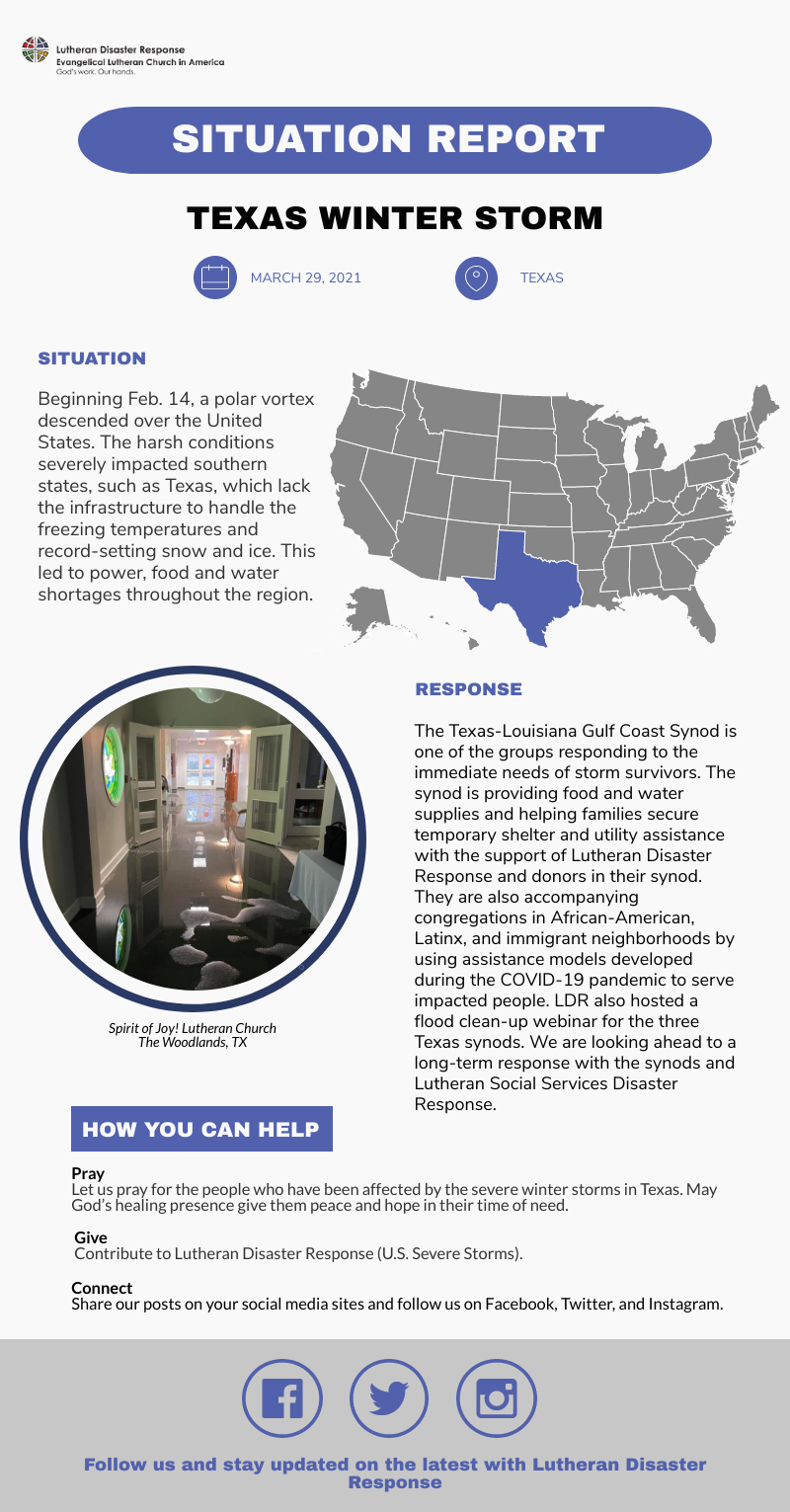
Situation Report: Texas Winter Storm

Be a part of the response:

Pray
Please pray for people who have been affected by the winter storm in Texas. May God’s healing presence give them peace and hope in their time of need.

Give
Thanks to generous donations, Lutheran Disaster Response is able to respond quickly and effectively to disasters around the globe. Your gifts to Lutheran Disaster Response (U.S. Severe Storms) will be used to respond to severe storms around the United States.

Connect
To learn more about the situation and the ELCA’s response:

  • Sign up to receive Lutheran Disaster Response alerts.
  • Check the Lutheran Disaster Response blog.
  • Like Lutheran Disaster Response on Facebook, follow @ELCALDR on Twitter, and follow @ELCA_LDR on Instagram.
  • Download the situation report and share as a PDF.
Share

2021 Easter Message from ELCJHL Bishop Azar

As we approach Holy Week, the Evangelical Lutheran Church in Jordan and the Holy Land’s Bishop Sani Ibrahim Azar shares his Easter message based on Mark 16:3 “Who will roll the stone away for us?”.

Read the full Easter message here.

Share

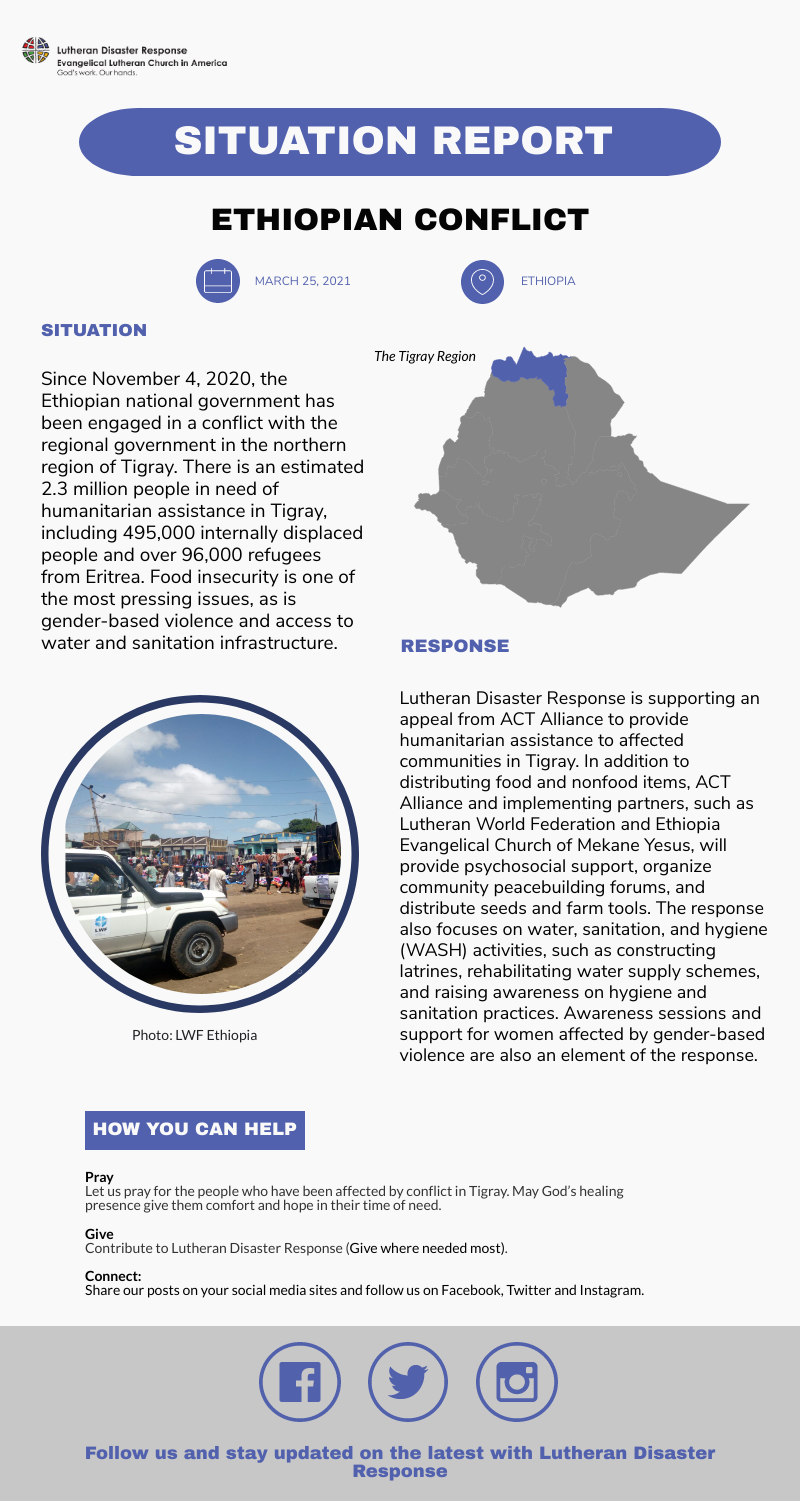
Situation Report: Ethiopian Conflict


Be a part of the response:

Pray
Please pray for people who have been affected by conflict in Tigray. May God’s healing presence give them peace and hope in their time of need.

Give
Thanks to generous donations, Lutheran Disaster Response is able to respond quickly and effectively to disasters around the globe. Your gifts to Lutheran Disaster Response (Give where needed most) will be used where they are most needed.

Connect
To learn more about the situation and the ELCA’s response:

  • Sign up to receive Lutheran Disaster Response alerts.
  • Check the Lutheran Disaster Response blog.
  • Like Lutheran Disaster Response on Facebook, follow @ELCALDR on Twitter, and follow @ELCA_LDR on Instagram.
  • Download the situation report and share as a PDF.
Share

Meet Jess


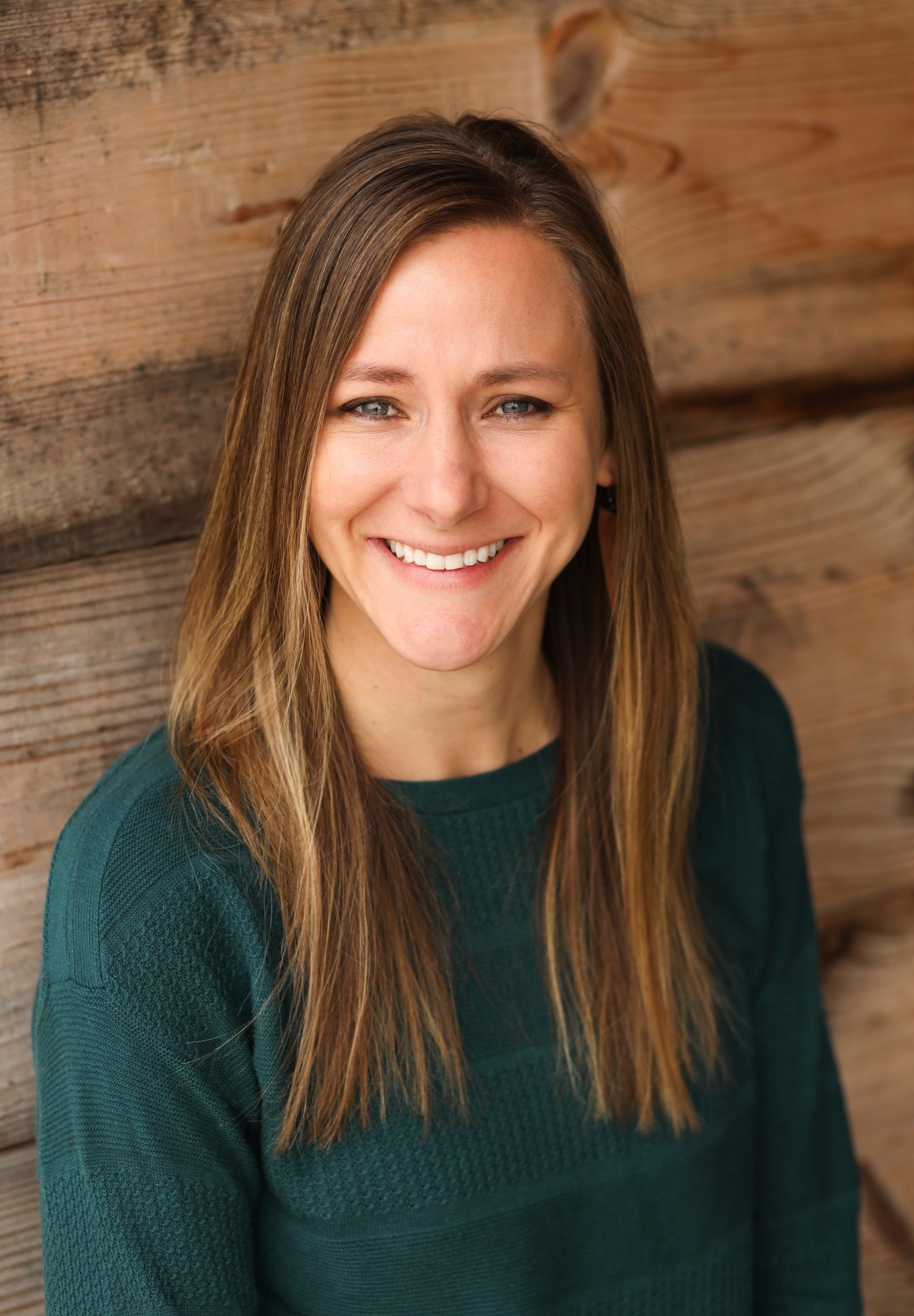
Hi everyone!  I’m Jessica Liles and I serve as the Faith Formation and Education Director at The Neighborhood Church in Bentonville, AR. I recently was ordained as a Deacon in the ELCA! My husband and I planted this church in 2012 and have watched it grow and move by the work of God and God’s people. When we aren’t busy at church, we enjoy spending time with our kiddos, Caylee and Landen going on hikes, playing sports and traveling.

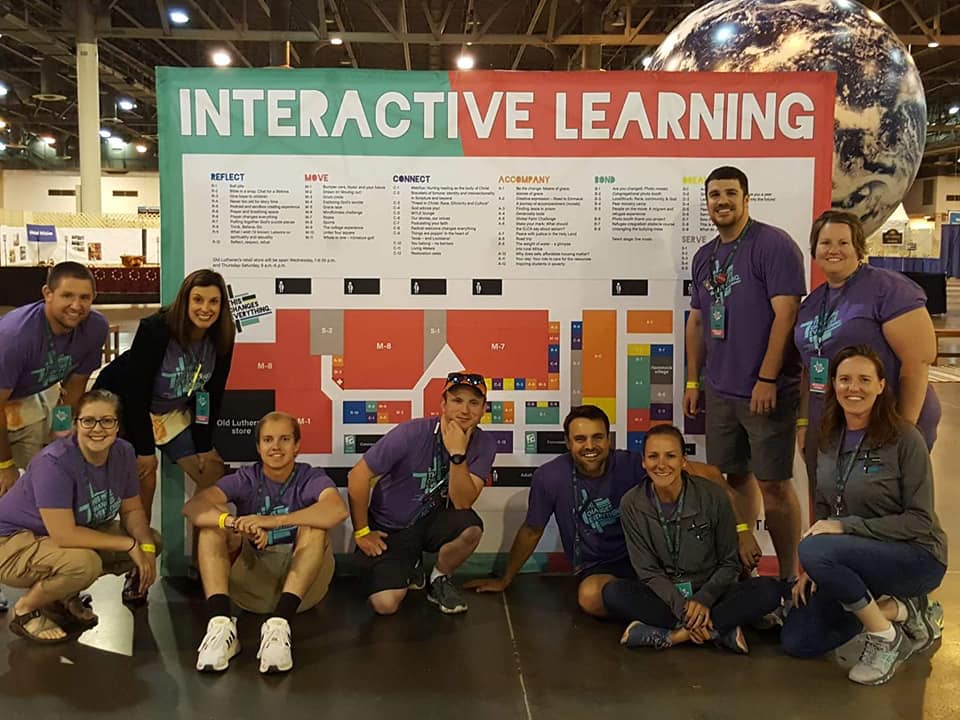
My first experience at the Youth Gathering was in 2009, when I brought a group of high school students from Wartburg Theological Seminary’s program WYLS (Wartburg Youth Leadership School) to help lead a portion of Interactive Learning. I have also had the honor of serving on the Interactive Learning team in 2012, 2015 and 2018 in a variety of different roles. For the 2022 Youth Gathering, I’m excited to serve as Team Leader for Interactive Learning. 

The Interactive Learning team is working hard to provide a variety of activities where participants can express their faith in action. We are working to have our partners intentionally engage with the daily themes in their activities. One of my favorite things about Interactive Learning is having a space for young people to learn what our church is up to in the world and how they can get involved to grow in their faith and to make a difference. What are you looking forward to learning about during your time in Interactive Learning? 

We are so excited for you and your congregation to join us in Minneapolis in 2022 to discover what God will reveal!


Share

Inequitable Vaccine Distribution: Video from Bishop Azar and Action Step

ELCJHL Bishop Ibrahim Azar speaks to us from the Old City of Jerusalem about the ongoing impact of the pandemic and the inequitable distribution of the COVID-19 vaccines. Watch the video here.

Respond by taking action:

Tell President Biden to defend Palestinian human rights. The administration must urge the Israeli government to ensure free and equitable distribution of COVID-19 vaccines.

Use the ELCA Peace Not Walls action alert to quickly send your message to President Biden.

Invite others to respond to this call for advocacy as well.

Share

Transformative Waters: The Flooding of the Umatilla River


“Water represents an integral link in a world view where water is sacred and extremely important in preserving precious balance. Water is the origin of and essential for the survival of all life.”

Confederated Tribes of the Umatilla Indians


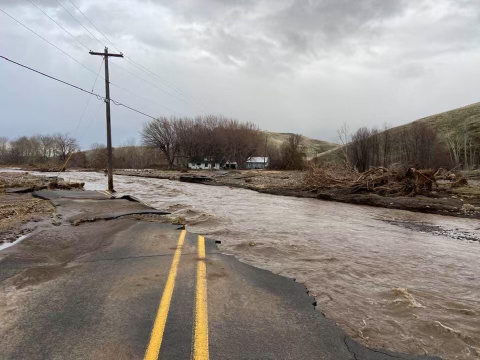
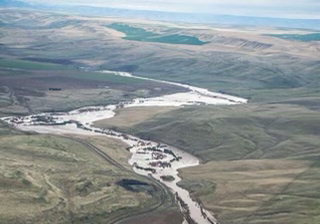
Water is crucial to our survival. But water can also be destructive. During a multi-day warm-up in February 2020, melting snow and heavy rains caused the Umatilla River and its tributaries to overflow their banks. They damaged homes and buildings in the Blue Mountain region of Oregon and Washington, which includes Columbia and Walla Walla counties in Washington and Umatilla County and the Confederated Tribes of the Umatilla Indian Reservation in Oregon.

On both sides of the Umatilla river – Oregon and Washington – multiagency relief centers (MARCs) assembled in the days after the flood. At these locations, residents received immediate, relief  assistance and registered for long-term recovery support from various relief organizations. The state of Oregon declared an emergency and sent funding to each of the affected communities. FEMA offered both public and individual assistance in the days after the flooding. As the Washington side was less affected, they didn’t qualify for any FEMA assistance. In total, 579 homes were damaged, according to Charlene Larsen, a longtime volunteer and associate of the Lutheran Disaster Response network in Oregon and a leader in the Oregon Synod Disaster Preparedness and Response network.

Community

Damage was great and so was the need for a long-term recovery group (LTRG), a common structure in the disaster response community that allows for a holistic response. Representatives from both sides of the river, as well as the Confederated Tribes of the Umatilla Indian Reservation in Oregon, came together to form the Blue Mountain LTRG. It’s a coalition of community organizations, with the local Lions Club, United Way of the Blue Mountains, Community Action Program of East Central Oregon, and the Blue Mountain Action Council involved. The LTRG also includes ecumenical partners and has disaster services from Lutherans, Methodists, Mennonites, Presbyterians, and Seventh-day Adventists represented.

One of the members of the Blue Mountain LTRG is Pastor Joel Ley of Christ Lutheran Church in Walla Walla, Washington, representing the Northwest Intermountain Synod of the ELCA. About the assortment of organizations in the group, he says “We’ve got all these people represented at the table and it’s pretty impressive because that doesn’t always happen. People dig in and do the work and that’s really nice to see.”

By joining forces, the group could do things that one organization on its own could not. Larsen told one story about how members of the Blue Mountain LTRG worked together to get a couple a new pair of recliners. A couple living in a mobile home lost their set of matching recliner chairs and didn’t have the funds to replace them, so a disaster case manager brought the situation to the unmet needs committee. An unmet needs committee focuses on helping people address needs not covered by insurance or FEMA money. One of the members of the committee found an identical set of recliners in Washington and another representative from the committee offered to pick them up. At the home of the couple, yet another member was there to help unload them. The community spirit was present, now on an even bigger scale.

Assistance

2020 was also an unprecedented year for wildfires in the Pacific Northwest. While the fires didn’t affect the same area impacted by the February floods, the Blue Mountain LTRG was in a position to assist other groups in the state. They shared “all the documents we put in place for bylaws and recovery efforts, talking about different committees that need to be in place,” said Larsen, speaking about the process for forming a long-term recovery group. Last February, the Blue Mountain LTRG formed with assistance from another disaster recovery group in Oregon and the wildfires gave them the opportunity to pay it forward and share their knowledge with newly formed disaster groups.

As with all disasters this past year, COVID-19 has affected the recovery process. Doing one-on-one in-person case management interviews became impossible. Rebuilding and repairing homes is more challenging than normal because volunteers are discouraged, and contractors are difficult to find. When it is possible to safely bring in volunteers, they will be busy doing small repairs, especially on fences, wells, septic tanks, and irrigation systems on agricultural land.

Support

People in the area are independent – when in trouble, they believe that their family and neighbors will take care of them. Early in the recovery process, there was a lack of trust by residents for organizations that came to support them, said Larsen. But over time, that trust grew. Out of the original 579 cases, over 300 have been closed. However, many remain open, and for that reason, the Oregon Synod recently received a grant from LDR to continue case management for survivors. The grant will help fund an AmeriCorps position. The staff member  will serve as a case manager and assist with the formation of a Community Organizations Active in Disaster (COAD) for the Blue Mountain region. The COAD is an extension of the existing Blue Mountain LTRG. By building upon the relationships formed during the relief and recovery phases of the flooding, the COAD is preparing to respond to the next disaster right away and in so doing, contributing towards the community’s disaster resilience.

Catalyst

Catalyst. That’s the world Larsen used to describe the role of Lutheran Disaster Response in the Umatilla flood response and recovery efforts. An LDR-supported Oregon Synod Disaster Preparedness and Response network has been working to spread awareness about the importance of being ready for a disaster. At the time of its formation, its main concern was the Cascadia earthquake expected to hit the region at some point. But preparedness quickly turned into response, first with the Umatilla floods, then COVID-19 and wildfires. While there was still much to do to respond to the flooding, the Oregon Synod had a slight head start.

“LDR  is the catalyst in getting that going and now others are supporting with their funds. So, it takes one catalyst to get it started and, in this case, it was LDR,” said Larsen.

The importance of disaster preparedness was one of the biggest takeaways by both Larsen and Ley. In the Blue Mountain region, there was no preparation for flooding, or any other disaster, except for the early stages of the Oregon Synod Disaster Preparedness and Response network. The Blue Mountain LTRG had to form in the midst of the disaster. Ley said that it would be easier if relationships between the organizations were built beforehand. They both realize how unprepared the region was for disasters last February. A year later, with organizations coming together to form the Blue Mountain LTRG and COAD, they are confident in their readiness for the next disaster.

Transformation

Water can give life and take away life. But water can also transform life. The waters of the Umatilla River transformed the Blue Mountain region. They brought different communities and organizations together to help everyone. They led to the establishment of an LTRG and COAD, which formed new relationships and strengthened old ones. The waters led to a transformation of how the region thought about disasters, preparedness, and the importance of long-term recovery.

“LDR has always billed itself as being in for the long haul and I had taken that message in, but I didn’t realize how important that was,” said Ley. “You do the initial work, but there’s a lot of stuff that hangs out there for a long time and without long-term commitment from LDR and other partners, there would just be a lot of issues that wouldn’t be addressed.”

In all responses, LDR strives to transform lives. From immediate relief to long-term recovery, LDR is present to support survivors and communities as they rebuild their homes and lives. Around the United States and around the world, communities impacted by disasters are transforming and becoming more resilient, ready for the next disaster.

Share

March 28, 2021–Provocative Palms

Leslie Weber, Chesapeake, VA

Warm-up Questions

Have participants talk about what their experience of Holy Week has been in the past.  Possible conversation starter questions include:

  • Does the congregation you attend “celebrate” Palm Sunday on its own or combine it with Passion Sunday?
  • What ritual actions are meaningful to you on Palm/Passion Sunday? (waving palms, being part of procession, having a real live donkey, hearing the whole passion story, etc.)
  • Have you ever attended a Maundy Thursday worship service? What do you remember?
  • Have you ever attended a Good Friday worship service? What do you remember?
  • Have you ever attended an Easter Vigil worship service? What do you remember?
  • If you haven’t ever attended a worship service during Holy Week (Maundy Thursday/Good Friday/Easter Vigil), why not?

Provocative Palms

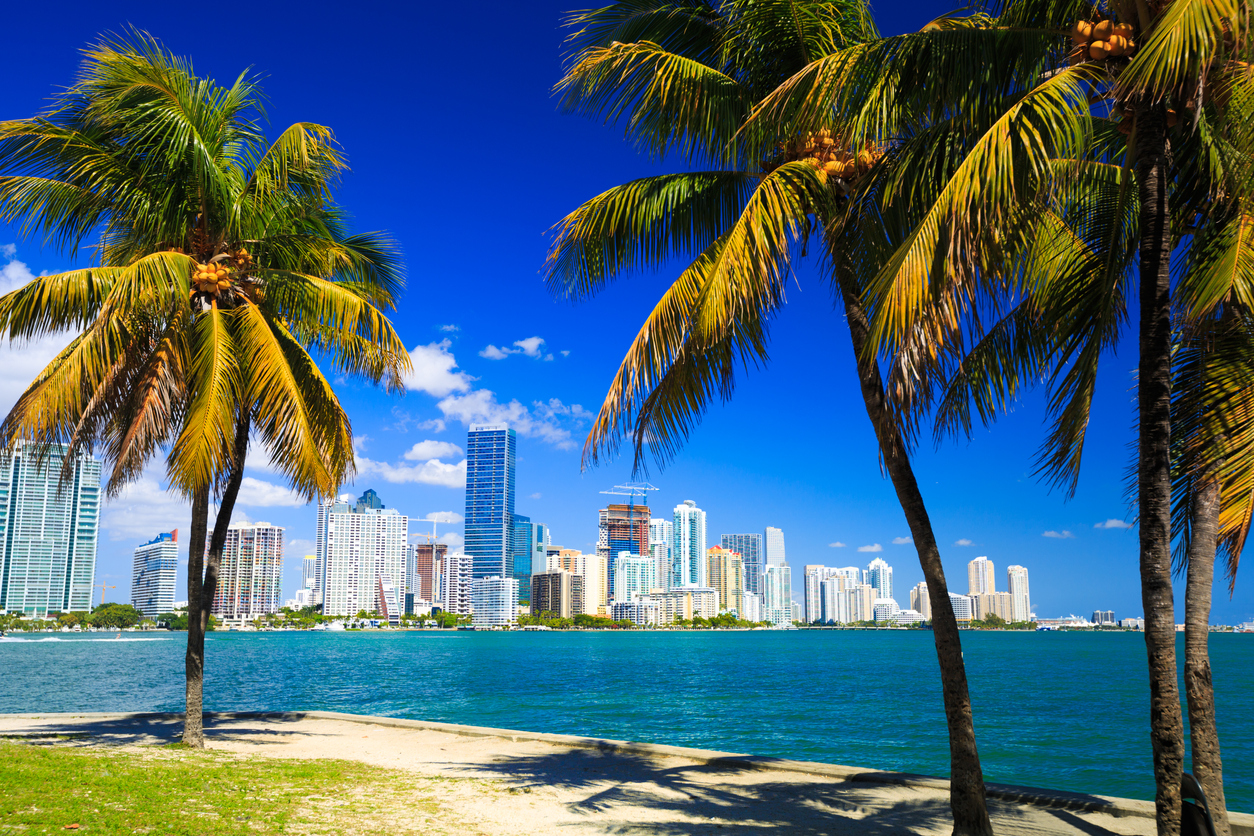
Recently, the Miami Beach City Commission approved an urban forestry master plan.  The goal of the plan is to reduce the proportion of the city’s canopy made up of palm trees to 25% by 2050.  By increasing the number and percentage of other trees that provide more shade in the city, they hope to extra comfort for residents and visitors, while also helping to “reduce urban warming, improve air quality, and absorb more carbon and rainwater.”

The master plan was passed unanimously, but now one city commissioner is speaking out against how the plan is being implemented.  He and his staff are encouraging residents to oppose removal of palm trees as part of construction projects around the city.  He is worried that as the prominence of palm trees diminishes in the city’s overall canopy, the city’s “historic, cultural, and economic brand” will suffer.  The city commissioner’s aide commented “if this plan goes forward, they might as well remove the palm from our City’s official logo.”

The city’s environmental and sustainability director is speaking out in opposition to the city commissioner’s concerns, saying that the “city is not going around chopping down palm trees” and that at 25% of the total canopy, “palms will continue to be a focal point along the city’s roads, greenspaces, and parks,” even while shade trees are planted as a faster rate in order to “maximize the environmental, social, and economic benefits of trees.”

Full article: https://www.miamiherald.com/news/local/community/miami-dade/miami-beach/article249432995.html

Discussion Questions

  • What are the pros/cons of Miami Beach’s plan to reduce the percentage of palm trees in the city’s canopy over the coming decades?  (This is a great chance to practice considering all sides of an argument.)
  • List all the ways that you benefit from trees.
  • What are you, your household, your congregation, and your local government doing in response to or in an effort to slow climate change?

Sunday of the Passion/ Palm Sunday

Isaiah 50:4-9a

Philippians 2:5-11

Mark 14:1—15:47

Mark 15:1-39 [40-47] (alternate)

(Text links are to Oremus Bible Browser. Oremus Bible Browser is not affiliated with or supported by the Evangelical Lutheran Church in America. You can find the calendar of readings for Year B at Lectionary Readings.)

For lectionary humor and insight, check the weekly comic Agnus Day.

Gospel Reflection

Even if you don’t read any of the optional parts (Mark 14 and 15:40-47),  this Sunday’s gospel reading is long.  You may be familiar with the basic story, but the details vary across the four Gospel accounts.  It is easy to overlook some parts during Holy Week.  This is why it is helpful to hear the story as a whole on Palm/Passion Sunday, and then break it up into shorter texts.  During Holy Week we hear short parts of the story, paired with ritual actions (Palm/Passion Sunday—procession with palms; Maundy Thursday—foot washing, Holy Communion, stripping of the altar; Good Friday—procession and adoration of the cross).

It is undeniable that this story is full of people and groups who have different expectations, hopes, and either a readiness or reluctance to change. Just in Mark 15:1-39, we get a glimpse of various people’s values/priorities:

  • The Jewish Leadership (chief priests, scribes, elders, whole council) is in search of a way to get rid of Jesus and keep their position as the religious authority (Mark 14:1).
  • Pilate is amazed by Jesus’ answers (and lack thereof) to the charges brought against him (Mark 15:5) but also wants to keep the crowd calm (Mark 5:15).
  • Jesus Is committed to in-breaking the kin-dom of God. Although he would prefer an easier way, he is committed to doing what needs to be done (Mark 14:36).
  • Barabbas and rebels are willing to kill in order to change the status quo (Mark 15:7).
  • The Centurion sees and confesses that Jesus is “God’s Son,” despite his position and background.

Throughout Jesus’ life, we see God working to turn the world upside down, to reorient people’s priorities, to make our world and lives look a bit more like God’s original intention for a creation where no one lacks anything.

God was never confined to the temple in Jerusalem.  We confess that Jesus is God incarnate, in-fleshed, but the tearing of the temple curtain at the moment of Jesus’ death is a sign.  It wasn’t torn from bottom to top (as it would have been if torn by human hands), but “was torn in two, from top to bottom” (Mark 15:38), as if today God has left the building.  Today God  moves among and through each of us to enact all that for which Jesus preached, worked, and ultimately died and was raised.

Discussion Questions

  • Read the text. What parts of the story jumped out to you as you listened this time?
  • Were there any parts that you did not remember or remembered differently?  (Having a synopsis or parallel edition of the four Gospels would aid in comparing the details between the accounts.)
  • With which character in the story do you most identify and why? How do their values/priorities compare to your values/priorities?
  • How do you feel about change?  Is there is something in your life, congregation, community that might need to end/die in order for something new/better to be established and flourish?

Activity Suggestions

  • Find a creative way to hear and experience the whole Holy Week story.  Examples: there are YouTube videos of the Stations of the Cross, you can a buy or make a set of “resurrection eggs,” or (if it safe to gather and weather permits) walk around the church property or neighborhood, reading a different part of the story in a different location.
  • Make space for everyone to reflect on the story of Jesus’ Passion.  Provide art supplies for doodling, offer paper and pencils for journaling, set up a prayer labyrinth, or any other means of personal or group reflection that your group would find helpful.
  • Palms
    • If you congregation is supplying palms this year, learn about your congregation’s palms:
      • From what company do you order them?
      • Where are they grown?
      • Are they sustainably raised? (think about the environment and labor practices)
    • If your congregation isn’t supplying palms this year, use construction paper (or other craft supplies) to make your own palms to use during the service.  You can search the internet for ideas about how to do this, but an easy one is to trace your hand on green paper, cuts out 5 or so “copies” and then glue them onto a popsicle stick.

Closing Prayer 

Redeeming God, thank you for all that you have given us, especially the gift of eternal, abundant life.  Help us to know and work for your intentions in our lives and our world.  Amen.

Share

International Day for the Elimination of Racial Discrimination

©UNESCO

The UN General Assembly resolution 2142 (XXI)(link is external), adopted on 26 October 1966, proclaimed 21 March as the International Day for the Elimination of Racial Discrimination to be commemorated annually.

Statement for the International Day for the Elimination of Racial Discrimination

3/17/2021 10:20:00 AM
CHICAGO — The Rev. Elizabeth A. Eaton, presiding bishop of the Evangelical Lutheran Church in America (ELCA), and leaders of the Evangelical Lutheran Church in Canada, the Anglican Church of Canada and The Episcopal Church have issued a statement in observance of the International Day for the Elimination of Racial Discrimination on March 21.

The statement follows:

From Churches Beyond Borders: Evangelical Lutheran Church in Canada, Anglican Church of Canada, The Episcopal Church and the Evangelical Lutheran Church in America

In Advent 2020, Churches Beyond Borders expressed a commitment to dismantling racism, combating white supremacy and actively seeking opportunities to engage more deeply on these important issues. In this season of Lent, we continue our journey as we join together in observing the International Day for the Elimination of Racial Discrimination. This is an annual day of recommitment in remembrance of the day police in Sharpeville, South Africa, opened fire and killed 69 people at a peaceful demonstration against apartheid “pass laws” in 1960. (www.un.org/en/observances/end-racism-day) Recognizing that the March 21 International Day for the Elimination of Racial Discrimination is a calling to be lived out every day, we offer this reflection as encouragement to continue the journey with renewed determination.

I have observed the misery of my people who are in Egypt; I have heard their cry on account of their taskmasters. Indeed, I know their sufferings, and I have come down to deliver them
(Exodus 3:7-8a, NRSV)

How do we lament the sin of racism?

Racism and xenophobia have a painful, violent, deadly history that traverses all borders. The institutional church shares in the complicity of the legacies of the Doctrine of Discovery colonization, forced removal and genocide of Indigenous people, the enslavement of African and Indigenous Peoples and injustices  perpetrated against all people of color. The sin of racism is structural, institutional, interpersonal and internalized. It lives in communities inside and outside the church; it continues to inflict harm on a daily basis and generate new history. How do we repent of all of this?

At the burning bush, Moses hears God say, “I have heard the cries of my people.” We who follow the God of Freedom must also hear the cries of God’s people, of each other, and especially those among us who live under the constant threat and violence of racism and white supremacy. For those of us who have the privilege of closing ourselves off, we need to open ourselves to feel the painful truths of the sins of racism and white supremacy in our hearts and bodies and minds and souls. We must create spaces and structures that welcome and include the voices of those most directly impacted by the sins of racism. This message is being shared during the season of Lent, a period of self-examination, reflection, and making amends. We need to lament, repent and be transformed.

Moses is told to take off his sandals. We need to lament in worship: to remove our shoes, to stand in humility, to feel the ashes on our foreheads, to be honest in the presence of God about our sins and shortcomings. Holy Ground is a gift that supports lamentation, repentance, transformation and discernment.

Moses is sent to work for the freedom of people. Oppression is not inevitable or insurmountable. Things can change. Challenging racism and white supremacy calls each of us to deep and honest consideration of perceptions, biases, behaviours and systemic patterns. We echo the United Nations call to take the strongest possible stand against racism, discrimination and intolerance of every kind, to spread the word to fight racism and to take stock of the state of human rights and hate speech today and reflect on how each of us can stand up for rights. In lamentation and repentance, we hear God’s call to act for the dismantling of racism.

Moses admits his own fears and reluctance. God directs Moses to connect with his siblings. God provides Miriam and Aaron to make up for Moses’ weaknesses and to enhance his strengths. The journey is long and the work is hard, crossing many difficult borders in our lives, communities, and our churches. We give thanks for the gift of community on this journey and in this work.

We invite you to join us in prayer:
God of Holy Ground, move us to lament and repent. Open our hearts, bodies, minds and souls to the cries of your people. Transform us by your presence. Drive us into action for the dismantling of racism in relationships, communities and societies. Bless us with companions who support us, challenge us and help us keeping going. We pray for the Elimination of Racial Discrimination. In the name of Jesus. Amen.

We commend to you these resources for further reflection and discernment:

Suggested action from the United Nations High Commission for Human Rights to #FightRacism
Fight Racism | Stand up for human rights | UN Human Rights (standup4humanrights.org)

Explanation of the Declaration of the ELCA to People of African Descent
https://download.elca.org/ELCA%20Resource%20Repository/Slavery_Apology_Explanation.pdf?_ga=2.160292863.337082937.1614267858-176581130.1609883917

“Doctrine of Discovery: Stolen lands, Strong Hearts” is a film about a devastating decision, made over 500 years ago, which continues to profoundly impact Indigenous and Settler people worldwide. https://www.anglican.ca/primate/tfc/drj/doctrineofdiscovery/

Call to Racial Reconciliation: “Litany of Repentance” and “Commissioning for the Ministry of Justice and Reconciliation” from the “10th Anniversary Celebration of Full Communion” between the Episcopal Church and the Northern and Southern Provinces of the Moravian Church
https://drive.google.com/file/d/1bTb_fguBnZJO2xLiPjwpLmSLWYeihNnA/view

Sacred Teachings Podcast: Indigenous Elders all across Turtle Island share teachings, languages, traditions and stories of the Ancestors.
https://www.anglican.ca/im/podcasts/

The Ecumenical Conversation on the International Decade for People of African Descent
Recordings of November 26, 2020 online event and companion study guide.  https://www.interculturalleadership.ca/news/study-guide-recognition-justice-and-development-peoples-of-african-descent-and-canadian-churches

“With Love Before Us, We Are Walking” recoding of Gospel Jam 7 (February 13, 2021) with Archbishop Mark MacDonald and special guest Bishop Michael Curry
https://www.anglican.ca/im/gospeljam/

ELCA Anti-Racism Pledge – Evangelical Lutheran Church in America

Episcopal Church Report for the House of Bishops from its Theology Committee: White Supremacy, the Beloved Community, and Learning to Listen (Fall  2020)
https://www.episcopalchurch.org/wp-content/uploads/sites/2/2020/11/bbc_hob_theo_cmte_report_on_white_supremacy.pdf

Anglican Church of Canada House of Bishop’s Statement on Confronting Racism
https://www.anglican.ca/news/our-own-house-is-not-in-order-bishops-issue-statement-on-confronting-racism/30026802/

Evangelical Lutheran Church in Canada Pastoral Letter regarding the ongoing sin of Racism.
https://www.elcic.ca/news.cfm?article=570

In Christ – Shalom,

National Bishop Susan C. Johnson
Evangelical Lutheran Church in Canada

Archbishop and Primate Linda Nicholls
Anglican Church of Canada

Presiding Bishop Michael B. Curry
The Episcopal Church

Presiding Bishop Elizabeth A. Eaton
Evangelical Lutheran Church in America

– – –

About the Evangelical Lutheran Church in America:
The ELCA is one of the largest Christian denominations in the United States, with nearly 3.3 million members in more than 8,900 worshiping communities across the 50 states and in the Caribbean region. Known as the church of “God’s work. Our hands.,” the ELCA emphasizes the saving grace of God through faith in Jesus Christ, unity among Christians and service in the world. The ELCA’s roots are in the writings of the German church reformer Martin Luther.

For information contact:
Candice Hill Buchbinder
773-380-2877
Candice.HillBuchbinder@ELCA.org

Share