Skip to content

ELCA Blogs

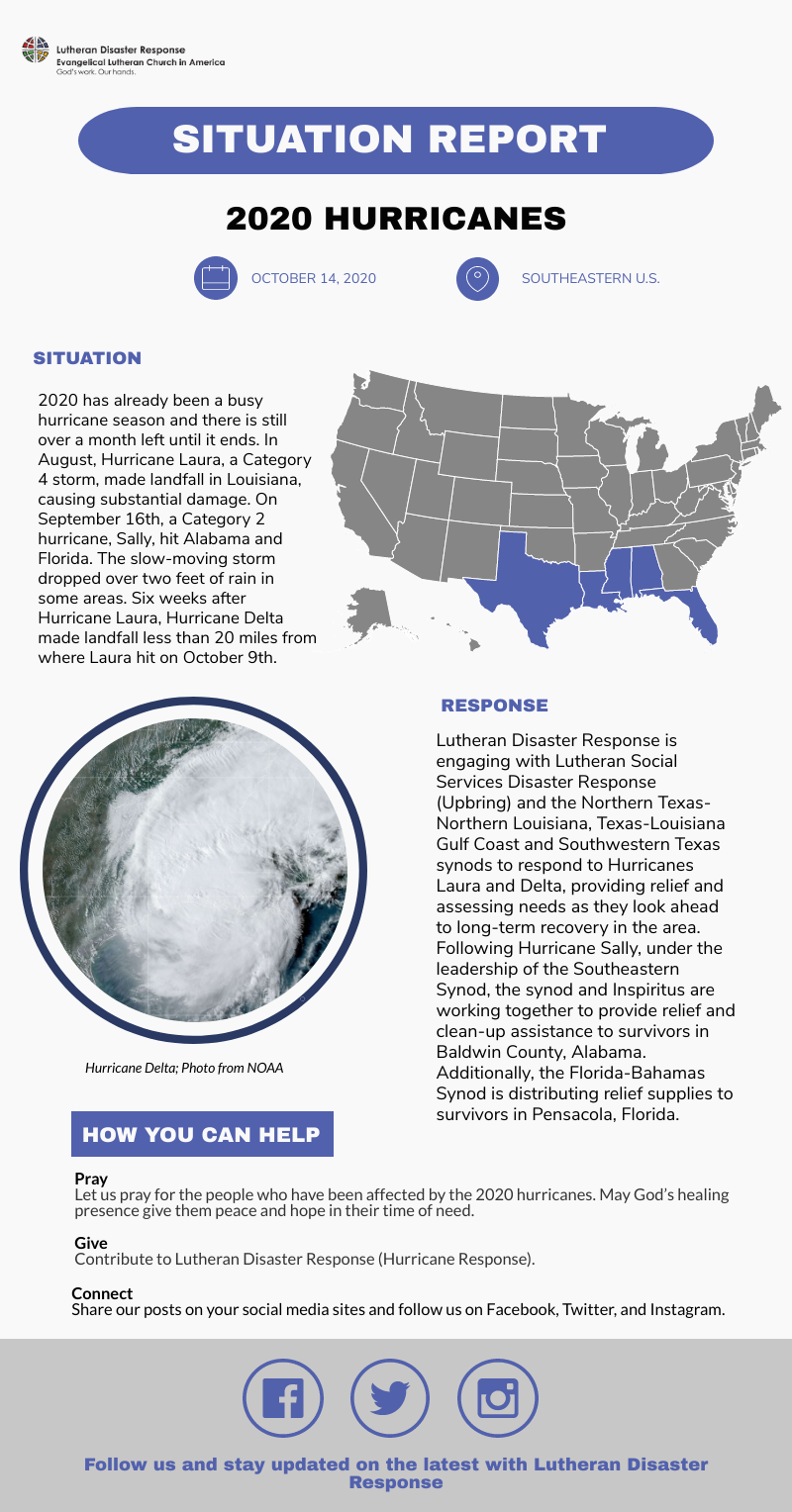
Situation Report: 2020 Hurricanes

Be a part of the response:

Pray
Please pray for people who have been affected by the 2020 hurricanes. May God’s healing presence give them peace and hope in their time of need.

Give
Thanks to generous donations, Lutheran Disaster Response is able to respond quickly and effectively to disasters around the globe. Your gifts to Lutheran Disaster Response (Hurricane Response) will be used where they are most needed.

Connect
To learn more about the situation and the ELCA’s response:

  • Sign up to receive Lutheran Disaster Response alerts.
  • Check the Lutheran Disaster Response blog.
  • Like Lutheran Disaster Response on Facebook, follow @ELCALDR on Twitter, and follow @ELCA_LDR on Instagram.
  • Download the situation report and share as a PDF.


Share

Experiments in Action: Daily Bread Matching Grants

This post features information about ELCA World Hunger’s Daily Bread Matching Grants which support congregations and their partners as they work toward a just world where all are fed. Applications are currently being accepted for a new round of Daily Bread Matching Grants . To find out more check out this blog post from ELCA World Hunger and ELCA.org/dailybread.

A successful pilot

Approximately ninety-six percent of ELCA congregations participate in some form of feeding ministry, from community meals to food pantries and more. Today, ELCA World Hunger is connecting hundreds of those congregations with tools for building sustainability in the midst of the challenges caused by the COVID-19 pandemic through the new Daily Bread Matching Grants. But Daily Bread Matching Grants did not appear as a response to the pandemic overnight. They have been in development for over a year and, based on user feedback, have been able to adapt to best serve congregations with feeding ministries in a changing landscape.

How do Daily Bread Matching Grants work? Congregations raise financial support for their feeding ministry using the ELCA’s online crowdfunding tool. All funds raised by the congregation are theirs to use in support of the feeding ministry. A congregation sets a goal for raising $500 or beyond, and unlock a $500 matching grant from ELCA World Hunger. In just a few weeks, congregations have new connections and new capital to fuel ministry. Back in 2019, ELCA World Hunger piloted Daily Bread Matching Grants as a new way to support congregational feeding ministries.

2019 Daily Bread Matching Grant Pilot Goals & Results:

  1. Goal: Support domestic anti-hunger ministries as they work toward a just world where all are fed in transformative, holistic and integrated ways.
    • Result: 19 of the 20 congregations unlocked their matching grant and together raised a total of $25,480
  2. Goal: Identify, cultivate and engage new local hunger leaders
    • Result: 75% of congregations did not have a designated Hunger Leader before participating.

Responding to covid-19

Fast forward to the beginning of 2020 and the coronavirus began to spread across the United States. Food insecurity followed, and questions began to arise. For meal programs and feeding ministries, how might food distribution need to be adjusted to ensure the safety of volunteers and neighbors? How might the economic downturn increase the need for food?

“We wanted to respond quickly and make sure congregations were getting support as they serve their neighbors. Daily Bread Matching Grants seemed like a great way to do that while also equipping congregations to quickly raise funds in a pivotal moment when many people in the church and beyond were looking for ways to support their local feeding ministries.” said Juliana Glassco, Director, Planning and Engagement, ELCA World Hunger.

As part of the ELCA’s COVID-19 response plan, ELCA World Hunger announced a special launch of Daily Bread Matching Grants with up to 100 grants of $500 each, available to ELCA congregations. One thing was clear: ministries needed quick access to monetary resources to respond to need in their communities. With the unique ministry moment and experience of past iterations in mind, this new version of the grant had a key feature:

  • The $500 grant from ELCA World Hunger was dispersed to congregations immediately once their application was approved. They would receive funds as soon as possible, whether or not they met the $500 fundraising goal. This change was made to specifically address the widespread and immediate need caused by COVID-19.

Interest in the grants was significant and over 250 applications were received in the span of a few days.

In response, the number of grants available was expanded to 200. On April 3rd congregations opened their fundraising pages and began accepting gifts.

Together, congregations raised over $200,000 in support of their feeding ministries. Once the amount raised was matched by ELCA World Hunger the total impact from online giving was over $313,000.

Reflecting on the experience, a congregational leader of Messiah Lutheran Church, Schenectady, NY said “It not only allowed us to add funding for our food pantry, it also helped us raise awareness, which will help us position the pantry to be a long-term solution for our community’s hunger needs.”

Into the Future

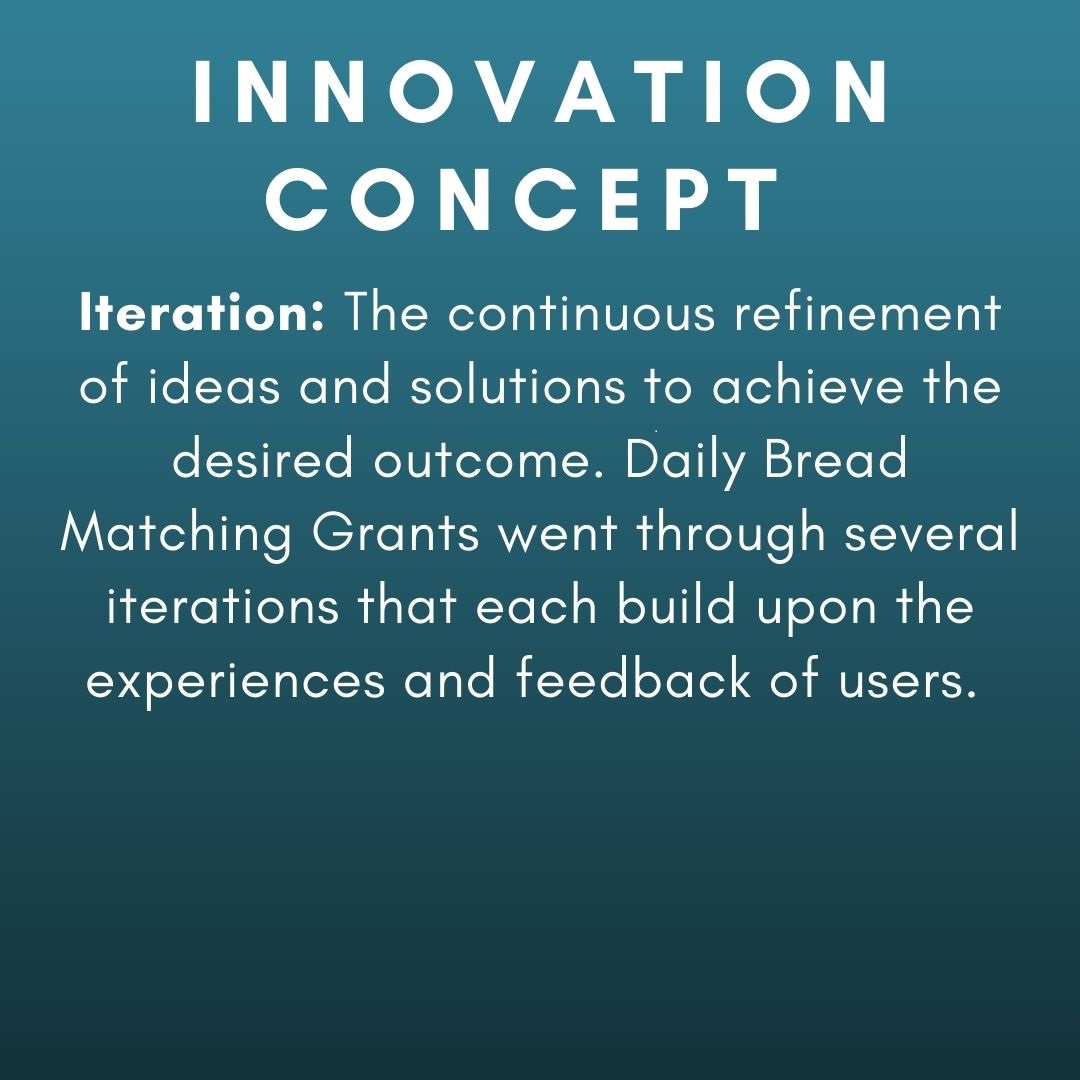
Daily Bread Matching
Learn more about iteration and integrating
feedback here. 

“We’ve learned that, with the right tools and timely support, we can help to unlock the incredible generosity that exists in congregations and communities across the country,” said Glassco.

While online giving was familiar to some congregations and brand new for others, across the board the Daily Bread Matching Grants generated excitement in congregations. In addition to offering future grant opportunities to congregations, ELCA World Hunger is now able to connect with those ministries as they consider their next steps, even offering access to coaching for ministry leaders through ELCA Coaching.

ELCA World Hunger will continue to look for ways to unlock generosity and help ELCA congregations serve their neighbors.

The ELCA Innovation Lab Blog is new! We’d love to hear what you think. If you’ve got a few minutes, complete this short survey. If you have any additional questions or comments let us know at lab@elca.org

Share

Hope and a Second Round of Daily Bread Matching Grants


With gratitude for those who have donated to and participated in the ELCA’s COVID-19 Response Fund, ELCA World Hunger is happy to announce another round of Daily Bread Matching Grants this fall. Grant applications are being accepted on a first-come, first-served basis. Learn more below.

Hope Springs Up Through Daily Bread Matching Grants

Here in Chicago, the days are growing colder, the daylight hours are growing fewer and the impending arrival of a long winter looms large. As the season changes, we are confronted with the undeniable fact that the pandemic remains with us. Economic prospects are bleak, and hunger is on the rise. Many of us are grieving, lonely or afraid; we are isolated from one another in ways that would have felt inconceivable before this year. At the same time, we face such new challenges as managing virtual school, finding safe ways to vote, and adapting ministries to new models. The change is relentless and exhausting, like the political ads on our televisions and the news predicting a second wave of the virus.

On many days we may feel as if God has left us, God’s people, wandering in the wilderness. But God’s promises of renewal and hope for the future hold true: “Do not remember the former things, or consider the things of old. I am about to do a new thing; now it springs forth, do you not perceive it? I will make a way in the wilderness” (Isaiah 43:18-19). This is not just a promise for this pandemic time but a standing promise from God for all time. Especially in times such as these, when hope feels scarce, we need to create a space where we can look a little closer and remember the hope we are called to as Christians.

More specifically, this is a time not only to recall the hope we have in Christ intellectually but to “re-member” hope — to relearn that our Christian hope and God’s promise for renewal come to us through the fellow members of our communities. The hope we share as Christians is an embodied hope that shows us where God is already active in our communities and urges us to lend a hand.

Daily Bread Matching Grants — which launched in April, early in the pandemic — utilize the ELCA’s crowdfunding platform and create giving incentives, in the form of $500 matching grants, that have allowed 200 ELCA congregations with feeding ministries to reach out directly to their communities and raise much-needed funds to meet the increased demand for food. The grants enable ELCA congregations to embody hope by providing actual daily bread to their communities.

We are currently accepting applications for a second round of Daily Bread Matching Grants, to be awarded in November. If you would like to apply for a grant or donate to the program, visit ELCA.org/dailybread.

Success Stories From Congregations

The stories that have emerged from the spring round of Daily Bread Matching Grants truly reveal what it means to re-member hope. ELCA World Hunger staff have celebrated countless stories of communities and congregations mobilizing quickly and pivoting to meet the immediate needs of community members and continue our work toward a just world where all are fed — all while keeping their communities safe. Several of those stories are featured in our “Church Together – Apart” video series, which you can explore through the links below.

In Junction City, Ohio, New Lebanon Lutheran Church re-membered hope by creating an online community. Pastor Kristin Santiago explains, “For the first time in 204 years of congregational history, this congregation now has a website, access to online giving and newer social media, which helped us spread the word about the need for matching funds given to the Daily Bread Matching Grant.” Pastor Kristin notes that the pandemic hit her community hard: “Our southeastern, Appalachian Ohio community has lived with high amounts of poverty for a generation following the closure of coal mining and loss of manufacturing jobs. The onset of the pandemic has exacerbated that with more layoffs.”

With new access to online giving, along with traditional forms of giving, New Lebanon was able to raise funds for Shepherd’s Table, the church’s semimonthly feeding ministry. As a result, New Lebanon has been able to increase from 75 to 150 the meals it serves its neighbors every month. Pastor Kristin hopes that the connections made through this grant will continue to help Shepherd’s Table expand the number of meals it serves.

Hope Lutheran Church in Lynden, Wash, re-membered hope by expanding its “backpack buddies” program, which provides food for students and families who rely on free or discounted school lunches. The program’s founder, Tammy Yoder, explained that her community is home to many farmers and migrant farmworkers who were hit hard by the pandemic due to shifting food demands across the country. Tammy and her team used their Daily Bread Matching Grant to provide patrons with ingredients for two full family meals instead of smaller individual meals.

And in Huntington Station, N.Y, Gloria Dei Evangelical Lutheran Church re-membered hope with its food pantry, which has seen demand double in recent months and is the only ministry in the church building that has continued to operate throughout the pandemic. In fact, with the help of a Daily Bread Matching Grant, the congregation has even grown its ministry by working with food banks and other partners in its community. According to Pastor Joel, the congregation had never before used its Facebook page for fundraising. “Within a day or two, we’d already reached that $500 matching goal,” he said. “By the time we were done, we were up over $4,000.”

All told, through online fundraising the 200 congregations participating in the spring’s Daily Bread Matching Grants more than tripled ELCA World Hunger’s contribution toward domestic, community-based feeding ministries. These 200 congregations remind us that, even when days feel dark, hope is not a scarce commodity but an abundant blessing to be shared widely. God is doing a new thing through the members of this church. Do you not perceive it?

Share

October 18, 2020–Coins Matter

Leslie Weber, Chesapeake, VA

Warm-up Question

Have someone take some coins from their pocket/wallet/purse and talk about them as a group.

  • What do you notice about the coins? What is printed on them?
  • How often do you have coins in your possession? What do you commonly use coins to buy?
  • What is your first memory of coins?
  • If no one or very few people have coins, discuss why that is.

Coins Matter

Due to changes in shopping and banking practices during the COVID-19 pandemic, coin circulation patterns have been disrupted, which has led to many stores preferring exact change and electronic payments. Enough coins exist in the country, they just are not circulating in the same ways, since lockdowns began in March of 2020.  This seems to be the result of a combination of factors—businesses being closed, banks having reduced hours, and people avoiding touching public objects (such as coins) in order to slow the spread of the virus.

The Federal Reserve has formed a task force to “mitigate the effects of low coin inventories caused by the COVID-19 pandemic.”  However, officials believe this to be a temporary issue that will resolve itself as restrictions lift and shopping patterns return to normal.

Discussion Questions

  • The coin shortage does not affect everyone equally.  What populations/groups might might the coin shortage especially impact? (ex: people who do not have credit cards, people who use laundromats, the Salvation Army Red Kettle program, etc.)
  • What are the pros/cons of our society becoming increasingly cashless?

Twentieth Sunday after Pentecost

Isaiah 45:1-7

1 Thessalonians 1:1-10

Matthew 22:15-22

(Text links are to Oremus Bible Browser.  You can find the calendar of readings for Year A at Lectionary Readings.)

For lectionary humor and insight, check the weekly comic Agnus Day.

Gospel Reflection

The saying goes, “The enemy of my enemy is my friend.”  So, two unlikely groups join together “to entrap [Jesus] in what he said”. The Herodians are supporters of the Roman Empire, while the Pharisees are part of the Jewish temple leadership. They disagree about a lot, but one thing they can agree on is that they are not fans of Jesus. They attempt to put Jesus in a lose-lose situation with the question they pose to him. “Is it lawful to pay taxes to the emperor?”   But Jesus answers stealth-fully and ends up entrapping them in the process.  

In order for Jews to comply with the first two of the Ten Commandments (They should  have no other gods or make any graven images), all imprinted money was supposed to be traded in for temple currency before entering the temple complex. The Roman census tax, about which they are speaking, could only be paid with a Roman coin, Most Roman coins contained an image and inscription considered blasphemous by many Jews: Tiberius Caesar Divi Augusti Filius Augustus Pontifex Maximus (Tiberius Caesar, august son of the divine Augustus, high priest) [The New Interpreters Bible Commentary, Volume VIII, p.420].  Therefore, when they hand Jesus a denarius, they show themselves to be breaking the temple rules.  They are trapped instead of Jesus.

Jesus gives a non-answer.  By not giving a “yes” or “no” answer, Jesus avoids angering either those loyal to Rome or the Judean nationalists, who oppose Roman rule. Additionally, his non-answer drives home two points. First, it is lawful, according to the Torah, to pay taxes to foreign governments, like the Roman Empire.  But at the same time, everything is in fact God’s—the creator of everything.  Caesar and everyone else are just temporarily using what is ultimately and always truly God’s.

Martin Luther’s explanation of the Fourth Commandment in the Small Catechism includes “others in authority” (SC I 8) among those whom we are to honor. In the Large Catechism he equates rulers to “fathers of the nation” (LC I 158). However, Luther also charges such authorities to care for those over whom they rule, specifically by ensuring that they receive the daily bread that God provides for them.  

This is why Luther writes, in his explanation to the fourth petition of the Lord’s Prayer, “It would therefore be fitting if the coat of arms of every upright prince were emblazoned with a loaf of bread instead of a lion or a wreath of rue, or if a loaf of bread were stamped on coins, in order to remind both princes and subjects that it is through the princes’ office that we enjoy protection and peace” (LC III 75).

Jesus’s answer is really a “yes-but.”  It is our Christian call to participate in government, because it is one avenue by which God’s provision and protection can be distributed to all in need.  Yet, no government is above God, but is but one of God’s earthly tools.

Discussion Questions

  • As Christians, should we pay taxes? Why or why not?
  • How do you give “to God the things that are God’s”—in other words: How do you use what has been entrusted to you (time, talents, treasures) to do God’s work in the world?

Activity Suggestions

  • Play a board game that includes using money (like Monopoly) but only use a portion of the total bills that are available.  This will cause players to have to get creative about how they save/spend.
  • Asset Mapping—provide each person with a pad of sticky notes and have them write their assets (ex: talents, connections, physical stuff), one per sticky notes.  When everyone has listed as many of their assets as they can think of, have everyone place them up on the wall.  Sit back and appreciate all the gifts God has given to your group.  If time allows—categorize/group them and see if a service project idea emerges.
  • Spiritual Gifts Assessment Tool—have each person complete the linked Spiritual Gifts Assessment Tool (https://www.elca.org/Our-Work/Congregations-and-Synods/Faith-Practices/Spiritual-Renewal/Assessment-Tools). Discuss the results—what did you expect? what was surprising? etc.

Closing Prayer

Creator God, you made all things! Thank you for all the gifts that you have entrusted to us—our time, talents, treasures, and power. Guide us in using all that we have for the good of creation and the in-breaking of your kin-dom. Amen.


Share

Healing Amidst Turmoil


Lord my God, I called to you for help, and you healed me.” 
Psalm 30:2 

Caring for the Caretakers

For decades, the Middle East has been a region of tumult. Civil wars, political instability, and an increased number of refugees and displaced peoples have impacted millionsIn countries like Egypt, Iraq, Lebanon, and Syria, the majority of the population has been affected by some kind of strife. The collective trauma of the region was a sign to the Middle East Council of Churches (MECC), an ecumenical partner of the ELCA, that there was a need for help.  

Leaders in the MECC saw how the turmoil in the Middle East negatively affected the emotional wellbeing of people across the region. In 2018, the Theological and Ecumenical Department of the MECC began a Trauma Healing and Spiritual Counseling program to address the mental health issues in communities throughout multiple countries. A few months after the program began, Lutheran Disaster Response began supporting its development. 

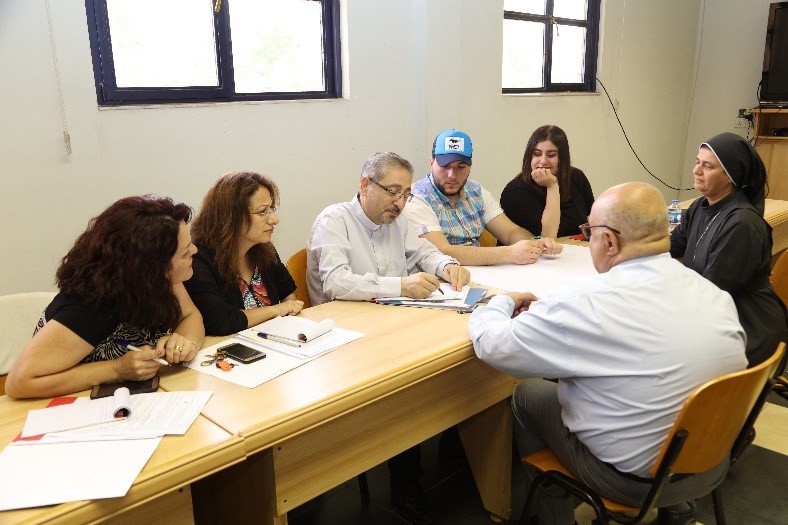
However, healing as a community begins with individualsAs one of the participants statedWe need to be healed at a personal level. Without the [program] I would have run away from the problem.”To address personal emotional and spiritual health, the program had three main objectives: provide psychological, moral, and spiritual healing to participants, provide training to identify strategies and coping mechanisms to respond to trauma, and build a network among ministers and laypeople from different contexts to share their experiences with each otherBecause clergy are often in the position of counseling and supporting those who have experienced trauma yet have no one to turn to in dealing with their own mental health, developing techniques to manage their personal trauma was an important first step in helping entire faith communities heal. 

Addressing Trauma

Since 2018, the ongoing Trauma Healing and Spiritual Counseling program has held multiple workshops throughout the Middle East, originally targeting ordained ministers and later expanding to include laypeopleAs faith leaders, they were able to develop their mindsets to better serve their communities. When asked about the workshop, faith leader said it was new experience, as if I was in a spiritual exercise. I felt that it was important to build myself for the sake of my internal peace. I learned how to transfer the information to the others and how to make decisions without hesitation.  

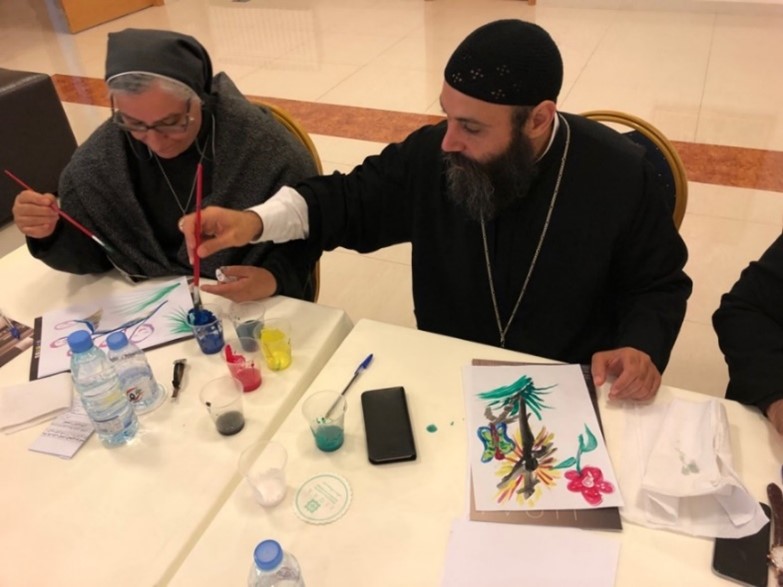
Workshops last five to six days and have group sessions that include an Introduction to Stress Symptoms and Traumas, Emotional Maturity, Emotional Support, Spiritual Accompaniment, Art and Music Therapy, and Physical Activity. Later iterations included one-on-one sessions to work through personal anxieties. 

The array of sessions took varied approaches to address different aspects of trauma, how to work through them and how to build resilience. “I started to better hear what is going on inside me, to think of others, especially my children. I started to feel my ability to confront. I learned to absorb anger,” said one participant. “The sessions – the personal and group sessions – helped to empty myself and to listen well. 

During post-workshop evaluations, many participants voiced similar reactions. The feedback was overwhelmingly positive as faith leaders expressed a new understanding of the trauma they experienced and how to navigate it: “I learned not to exert too much on oneself and to elevate my self-esteem. I learned to take the initiative towards others, but with continuous self-care,” expressed another participant.

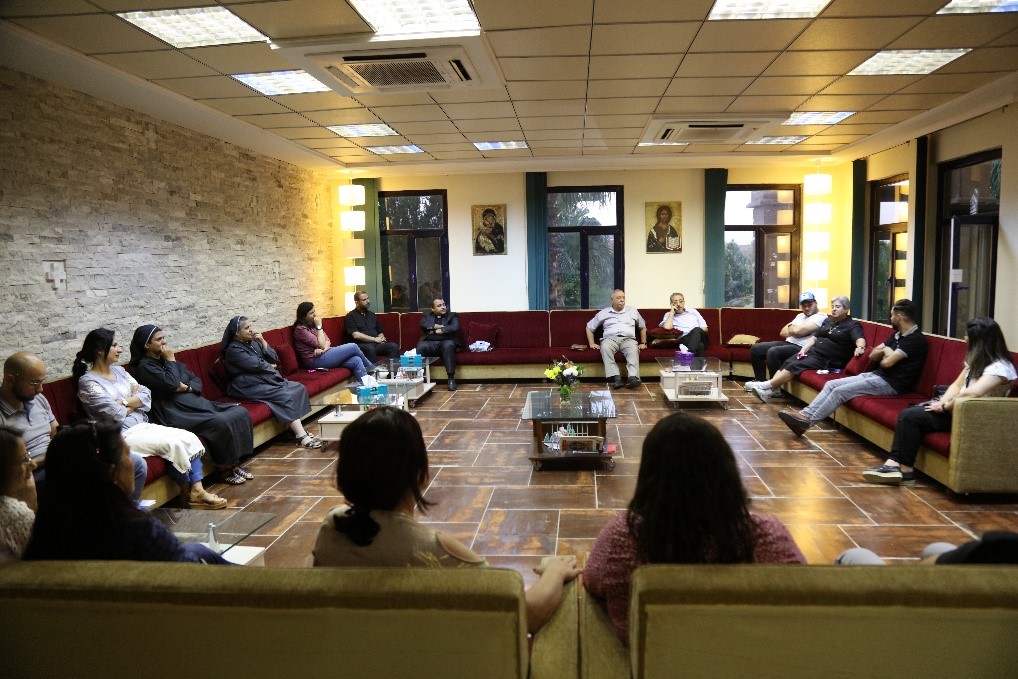
Not only does this counseling program support faith leaders that have experienced trauma, but it also gives them the skills they need to go back and assist their communitiesParticipants were invited to follow-up Training of Trainers workshops to help them engage with those who might come to them for guidanceAccording to Father Gaby Hachem, director of the Theological and Ecumenical Department, many groups are still in contact with one another and have participated in follow-up virtual programs.  

Adapting to New Challenges

With each new workshop, the program evolved. Participants expanded beyond rostered ministers to nuns and laypeople. The first workshops were in Iraq and later ones were in Syria and Egypt. Then, COVID-19 hit, and travel and in-person gatherings were out of the question. While new workshops were postponed, the team continued online follow-up with past participants. The previously planned sessions will continue once travel is viable again, says Hachem. 

In the midst of the pandemic, tragedy struck again in LebanonOn August 4th, a set of explosions in the port of Beirut damaged the city for miles and killed 190 people. It shook the city to the core. “The Trauma Healing and Spiritual Counseling team could not but think of all these people and what could be done to help them,” Hachem said after the explosion. “Many MECC contacts who know about the program are calling for the demand to help in this aspect.” 

A new program is being developed by the team, targeting youth in Beirut. The goals of these workshops are to help participants understand the disaster and accepting the resulting trauma and the impacts of losing loved ones and property. A group of psychotherapists, pastors, and nuns have already been recruited to guide and support participants. Additionally, the youth will receive training on how to accompany their peers on their healing journeys.  

“Our participation was meant by God”

As turbulence continues in the Middle East, the transformative value of the Trauma Healing and Spiritual Counseling program is clear. As one participant stated, “Before the workshop, I was nervous; I used to shout without listening. The workshop gave me a balance within myself. The emptiness and the worries inside me were removed. After the workshop I discovered that I could help [others].” 

As participants face their trauma and start to understand their emotions, they can begin a journey of resilienceThe experience allowed participants to reframe how they thought about daily problems and approach them from a different angle. I gained the audacity, courage and self-trust to speak about what we went through with our friends and people,” expressed a participantOur participation was meant by God.” With continuous self-care, faith leaders will be in a healthier mindset to continue their pastoral roles in helping their communities heal. By taking mental health seriously and building a network of support throughout the Middle East, the MECC is bringing God’s hope and renewal to communities throughout the region.  


Share

Experiments in Action: Tree of Life

This “Experiments in Action” blog series features individuals and communities who are trying something new. This post features a story from Tree of Life, Minneapolis, MN a Lutheran church start-up that is queer-affirming, millennial-led, and for the spiritual but also slightly religious. This post is written by The Rev. Marissa Sotos, pastor at Tree of Life.

Before Covid-19: Background

Before Covid-19, Tree of Life Lutheran was a millennial-focused mission start in the North Loop neighborhood of downtown Minneapolis that was turning toward intentional long term planning. We had established Evening Prayer and Dinner gatherings on the first Sunday of every month that were the anchor of our faith community’s spiritual and social life, with a rotation of other gatherings throughout the month for service, yoga, theology on tap, etc. One major problem we faced was that to create opportunities for invitation, connection to newcomers, and a habitual pattern for participants we needed to have our primary worship gatherings more frequently and make them easily accessible. ​​​​​​​

Tree of Life Worship
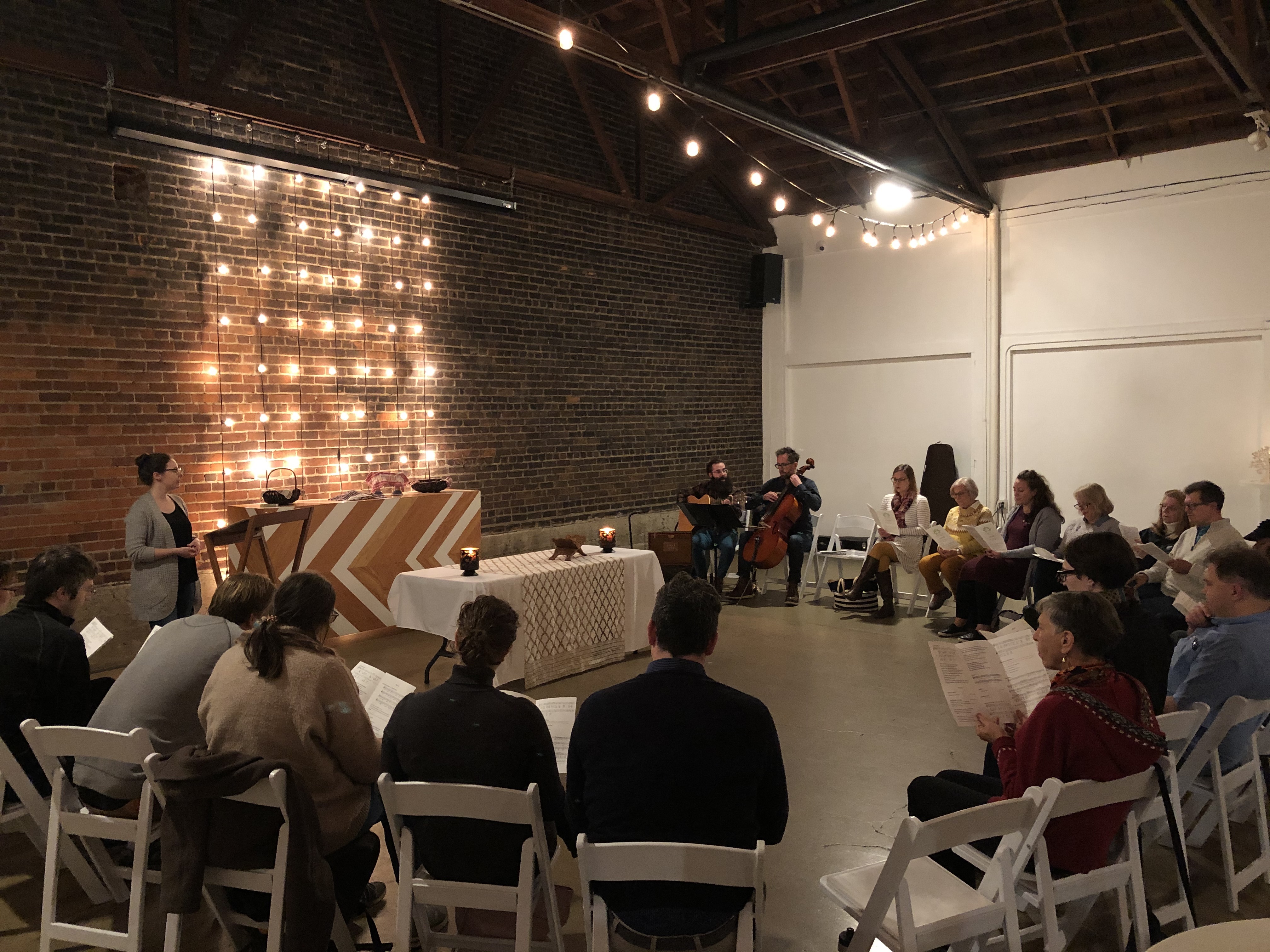
A worship service at Tree of Life

Meeting more frequently posed serious resource problems including a lack of staff time for planning and a lack of funds for worship space rental and food (dinner was always provided). Our worship space also posed several accessibility problems: it was at the back of a building down a hall and had extremely limited parking. Additionally, spreading an average attendance of 15 people over multiple Sunday’s posed a potential risk.

While being intentional about our commitments to worship, prayer, music and rich interaction, we began to plan ways to strip down Sunday gatherings to be group facilitated and easily navigable for visitors. We also decided to try stretching our resources to add another gathering on the third Sunday of every month.

Now: The Experiment

​​​​​​​On Saturday, March 14th, the night before what was to be our first third Sunday together, word of community spread of Covid-19 led Tree of Life to abruptly shift plans to go online the following day. We realized immediately we needed to do two things: first, create high quality and highly interactive online worship that could help provide a communal and spiritual safety net during extreme stress, and second, offer it weekly as members and friends lives began to change by the hour. We chose Zoom as a platform because it was highly interactive, easy to use and easy to share. The first service went ahead with what we had planned for worship that day which was Holden Evening Prayer. Everyone who was planning to attend that Sunday successfully made the last-minute switch to Zoom and we found we could easily converse in a group our size. However, Worship did not go well. We learned very quickly that communal singing was impossible due to lag, and that following along on a PDF bulletin without much interaction or explanation led to people quickly giving up on participating.

Tree of Life

Recognizing these problems, we spent the next several weeks building a format for gatherings that worked with, rather than against, Zoom. We flipped our social and check-in time to be before worship rather than after it so that everyone would know who was in the “room.” We adjusted singing to be either call and response that could be done between two different computers, or easy to sing melodies that everyone except the musician would sing along with on mute. We added a lay-led Bible Study component, continued our tradition of volunteering for first readings but with a wider variety of poetry, and asked everyone to show up with cups and candles. This meant we had some common physical objects to work with: cups to talk about how full our spiritual “cup” was that week and candles to light together at the beginning of Evening Prayer and extinguish together at the end. ​​​​​​​

Then we started inviting people and realized that our new location and format was more accessible to visitors. We could send a link to someone anywhere, it was easy for them to find us, low risk to show up, and interaction over Zoom made it easy for people to participate to their comfort level. We also found that worshipping digitally solved the problem of limited resources. We no longer needed to budget for rent or food or budget time for space set up, and even if our numbers were small there were enough of us every week to make a Zoom call feel full where a physical space might have felt empty.

Into the Future: Learnings

Worshipping weekly and worshipping digitally have become part of our DNA as a faith community. As we anticipated, gathering weekly has made us a stronger and more mature community while also providing more opportunities to invite guests and integrate them. We have found that simple but frequent gatherings work better for us than occasional elaborate ones and being digital gives us the resources to support those. The convenience and untethered nature of digital gatherings also mean that we often have worshippers from a much larger geographical area than we would have before and that our core group shows up more frequently than they would in-person. Finally, we have found that being an online community gives us new options (and new challenges) for outreach and getting to know people.​​​​​​​

There are also many things we lost in moving online: communal singing, regular communion practice, eating dinner together, and passing the peace in-person. We miss those things and still look forward to resuming in-person worship when it is safe. At the same time, we don’t want to lose our new out of town community members, the ease of accessibility and the sacred space we’ve found in our online format, or our ability to stretch our resources. When Covid-19 is no longer such a present danger we plan to shift again and become a hybrid community, worshipping both online and in-person. We don’t know exactly what that will look like yet but have clarified our priorities around weekly worship and broad access. Having pivoted so completely once we know we can do it again to bring together the most important components of our community’s online and in-person life.

The ELCA Innovation Lab Blog is new! We’d love to hear what you think. If you’ve got a few minutes, complete this short survey. If you have any additional questions or comments let us know at lab@elca.org

Share

October 11, 2020–A Place at the Table

Amy Martinell, Sioux Fall, SD

Warm-up Question

  • What is the most memorable wedding you have attended?  What made it so memorable?
  • How have you gathered with family and friends in new ways during this time of pandemic?  What have been the advantages of gathering in new ways?  disadvantages?

A Place at the Table

On September 18th Supreme Court Justice Ruth Bader Ginsburg died.  The country is currently mourning the loss of a legend.  Throughout her career Ginsburg was a champion of gender equality and women’s rights.  Before being appointed to the court, she he argued six sex-discrimination cases before the Supreme Court, winning five.  On the Supreme court Ginsburg continued to fight for equal protection under the law.  In recent years she became famous for her strongly worded dissents, which  gained her status as a pop culture icon known as the “Notorious RBG.”

As we reflect on this parable about  who is in and who is out at the wedding banquet, we remember Justice Ginsburg who worked tirelessly to make room for all at our nation’s table.

Discussion Questions

  • When have you felt something was unfair?  What did you do?  How have you spoken up to work for fairness?
  • When have you experienced or witnessed discrimination?  How did it make you feel?
  • Justice Ginsburg was a hero and role model for many.  Who is someone you admire?  Why?

Nineteenth Sunday after Pentecost

Isaiah 25:1-9

Philippians 4:1-9

Matthew 22:1-14

(Text links are to Oremus Bible Browser. You can find the calendar of readings for Year A at Lectionary Readings.)

For lectionary humor and insight, check the weekly comic Agnus Day.

Gospel Reflection

This is a strange, parable, exaggerated to the point of ridiculous. A king sends out invitations to a wedding banquet, but no one responds.  It is curious that everyone ignores a royal summons, but it gets worse.  The king sends a second invitation, tempting them with the delicious food.  Some ignore the invitation, but many take it to another level.  They seize the king’s slaves, beating and killing them, simply for inviting them to a banquet.  It is quite the overreaction.  Not to be outdone in  overreaction, the king sends troops to destroy the murderers and burns their cities.

The king has set his own city on fire, but apparently the wedding banquet is still on.   Shrugging off his recent acts of violence, the king looks around and realizes he still has lots of food and empty seats.  So he tells his slaves, “Go out again, but this time to the streets.  Invite everyone!”  Soon the wedding hall fills, a great party forms.  As a rule, those on the outskirts and margins know how to party, much better than “proper” guests do.  Still,  the king can’t  relax and enjoy the party.  Instead, he spots a guest not wearing a wedding robe and again he is enraged.  He was Invited at the last minute, but the guest still pays a price for being unprepared.  The king binds the guest and shows him into the outer darkness.

This parable leaves us with more questions than answers.  Why do the guests refuse the king?  Why  both the guests and the king react so violently? Most of all, we wonder what this parable could possibly mean for our life. This parable does not have an easy, clear interpretation.   As scholar Amy-Jill Levine suggests, when we meet a complicated parable, we are better off thinking less about what the parable means and more about what it can do: remind, provoke, refine, confront, disturb.  (Short Stories by Jesus (New York: HarperOne, 2015)

How does this parable make us feel?  Does the disturbing nature of the parable help us recognize the places in our lives and our world where God’s presence has been rejected?  Does it cause us to confront the places in our nation where some are not given a seat at the table.  This parable reminds us that God calls us to live an abundant life.  The kingdom of heaven is a banquet, and Jesus calls us  to put on our party dress and revel in God’s grace.

Discussion Questions

  • Have you ever been invited to a party you didn’t want to attend?  What did you do?  Have you ever had a party and worried that no one would come?  How did that feel?
  • Has God ever called you to a role you did not want to do?  What might God be calling you to now?
  • What emotions did you feel while hearing this parable?
  • Why do you think the man was thrown out of the wedding banquet?  What might it mean for us?  Is it a reminder to dress correctly?  To respond correctly when God calls us?  To worry less and enjoy God’s grace?

Activity Suggestions

During this time of Covid-19 we have not been able to gather as we did before.  Large wedding banquets or parties are no longer safe and we all miss gathering together in our usual ways.  Many people are suffering from loneliness and depression.  As a group brainstorm ways you could reach out to those who are feeling lonely.  You may want to send cards to elderly members of your congregation or make door decorations for your local nursing home.

Closing Prayer

Almighty God, We give you thanks for calling each of us to the heavenly banquet.  Guide us to work to make our lives on earth better reflect your heavenly kingdom.  Amen.


Share

Sifting through misinformation

In weeks approaching the election, we are awash in messaging. Not only are we seeing politician-approved ads, but likely also items in categories* including propaganda, lies, conspiracies, rumors, hoaxes, hyperpartisan content, falsehoods and manipulated media. Such misinformation undermines healthy democratic processes and discourages civic engagement. “The political health of our nation still suffers from the stain of antidemocratic exclusion. Efforts to restrict access to voting should be condemned and resisted,” warns the ELCA social message “Government and Civic Engagement in the United States: Discipleship in a Democracy.” Much misinformation feeds this problem. Guidance to advance our public life in the social message reads, “There is a sharp distinction between public service and private gain, a distinction measured by the straightforward question ‘Whose good is being served?’”


What’s the problem?

Material from The Episcopal Church* cautions: “Audiences that mostly consume mainstream media see far more false insider stories and conspiracy theories than they might realize. While mainstream media itself remains highly reliable, online algorithms that favor content with high engagement instead of content with high veracity make it easier to transmit misinformation to these audiences through widely-used platforms like Facebook, Twitter, and YouTube.”

When Hunger Network in Ohio, part of our Lutheran state public policy office network, reflected on online engagement, they wrote: “Social media offers everyone a chance to help shape the news and the content that each other sees. This is both a blessing and a curse…” They continued, “False news hurts our ability for civil discourse and wrestling with difficult issues to find solutions.”

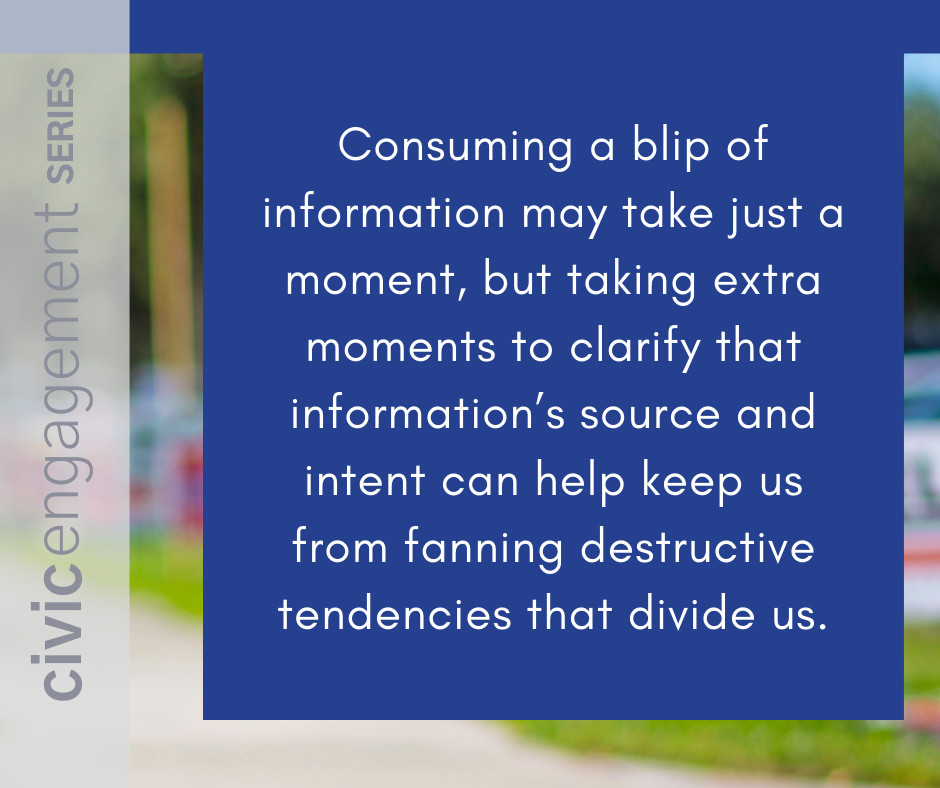
Consuming a blip of information may take just a moment, but taking extra moments to clarify that information’s source and intent can help keep us from fanning destructive tendencies that divide us. “It seems that we want to cut ourselves off from each other,” said Presiding Bishop Elizabeth A. Eaton in her video address “We are in this together” (9/25/20). “Not only do we disagree, but we say the other is wrong, or they say we are wrong, or we accuse each other somehow of mounting a platform – like we want to divorce each other. But this is not possible. In baptism, the Spirit has forged us together in a bond that is unbreakable by any human sin or even by our anxiety or our desire to get away from the other side.”


What can we do about it?

Check out the wide ranging exploration of a spectrum of misinformation, malinformation and disinformation, created and spread by “jokers, scammers, interest-driven entities, conspiracy theorists, ‘insiders’, celebrities, or your friends and family,” available from The Episcopal Church.

Misinformation, Disinformation, Fake News: Why Do We Care?

We won’t catch all that is streaming past us, but we can help stop contribution to the problem.

Among remedying tips in the piece is: “Consuming high-quality, diverse media improves our understanding of the world and equips us to identify and critically evaluate misinformation. Even if you don’t follow every trusted source closely, knowing where to go to find accurate information or a different perspective about a topic is extremely helpful.” Then there are the three questions to run through before you “re-share that tweet, or tell a friend about that surprising headline you saw.” Where’s it from? What’s missing? How do you feel? [See graphic for additional description.]

The feeling when we share should be the affirmation of contribution to constructive discussion. “We are one body in Christ,” proclaimed Presiding Bishop Eaton. “This is the witness we in the ELCA need to give to the world and to understand and live ourselves.”


*”Misinformation, Disinformation, Fake News: Why Do We Care,” post from Office of Government Relations of The Episcopal Church (May 21, 2020 update), content shared by permission

Share

October Update: UN and State Edition

Following are updates shared from submissions of the Lutheran Office for World Community and state public policy offices.

U.N. | Arizona | Colorado | Ohio |Pennsylvania | Washington | Wisconsin


United Nations

Dennis Frado, Lutheran Office for World Community, New York, N.Y. ELCA.org/lowc

UN 75TH ANNIVERSARY COMMEMORATION: The high-level meeting to commemorate the 75th anniversary of the UN was held on September 21st.  The meeting adopted a declaration acknowledging both the UN’s achievements and its disappointments, such as: “Our challenges are interconnected and can only be addressed through reinvigorated multilateralism,” “Strengthening international cooperation is in the interest of both nations and peoples.” It also included twelve pledges “to ensure the future we want and the United Nations we need.”
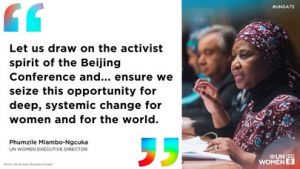
CELEBRATION OF THE 25TH ANNIVERSARY OF BEIJING WOMEN’S CONFERENCE: The UN General Assembly High-level meeting on the 25th anniversary of the Fourth World Conference on Women was held on October 1st. According to UN Women, no country has achieved gender equality. There has been progress since the Beijing Conference held in 1995, but gaps remain, and in some areas these gains are threatened and even reversed. The meeting was therefore being held under the theme “Accelerating the realization of gender equality and the empowerment of all women and girls”. It aimed to “demonstrate the political will and leadership that will bring about the transformative change needed to address root causes, structural barriers, discriminatory practices and social norms that underpin discrimination and inequality.” You can watch the meeting on UN Web TV.
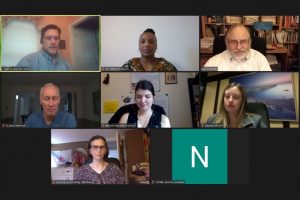
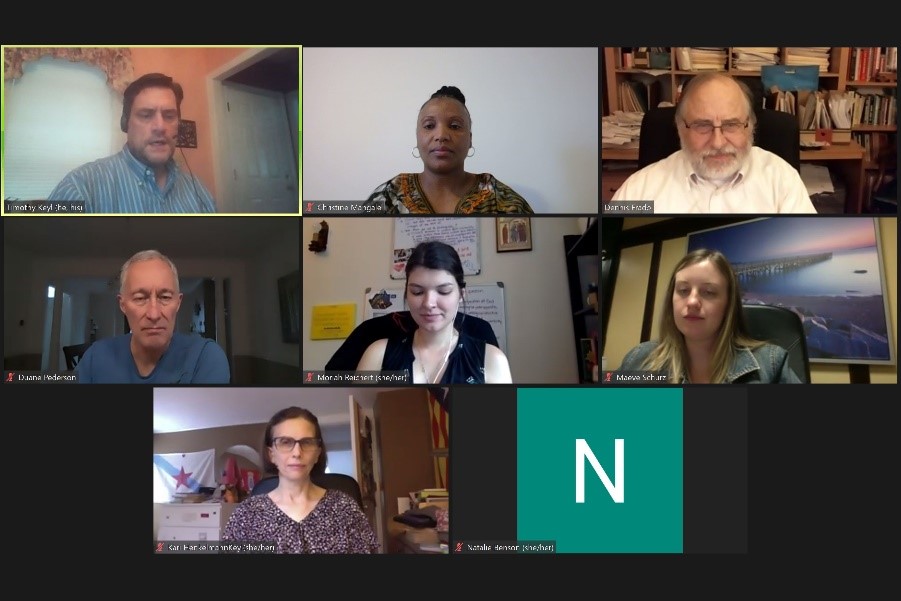
LOWC SPEAKS TO LUTHERAN STUDIES PROGRAM COLLOQUIA 2020-2021 AT YALE: In late September, Christine Mangale and Dennis Frado spoke via Zoom with Lutheran students at Yale University as part of the Lutheran Studies Program Colloquia theme “Public Church.” The LOWC presentations focused on the church’s presence at the United Nations (UN) and the history of the ELCA’s work on human rights, including at the UN.


Arizona

Solveig Muus, Lutheran Advocacy Ministry Arizona  https://lamaz.org/

GETTING OUT THE VOTE: In the midst of racial inequity, an upcoming election, a pandemic, and a climate gone crazy, we in Arizona thank God for forgiveness and mercy, and for the miraculous ways God works in us and through us.

This month, we’re all hands on deck to get out the vote. Every faith community and advocacy group in Arizona seems to be in step; all are publicizing the importance of voting and helping in any way to ensure everyone’s voice is heard. Arizona has an excellent track record for successful mail-in ballot counting. Rev. Mark Holman, Bishop’s Associate for Mobility and Leadership, wrote a study resource titled “How Would Jesus Vote?” for congregational use, and a member of LAMA’s policy team created a voter volunteer recruitment packet for congregations.

Like every other state office, LAMA continues to reach out to our 85 Arizona congregations, and are encouraged that several are considering adding an advocacy component to their social ministry teams. Building our network, producing a weekly newsletter, and feeding social media keep us busy.

UPCOMING EVENTS: We are planning LAMA’s first state-wide summit on November 7, which is to be a virtual event featuring Dr. Ryan Cumming of ELCA World Hunger. Together with Spirit in the Desert Retreat Center and Bread for the World Southwest, we are planning and promoting a Virtual Town Hall on November 17 featuring Rev. Eugene Cho, president and CEO of Bread for the World.


Colorado

Peter Severson, Lutheran Advocacy Ministry-Colorado https://www.rmselca.org/advocacy

BALLOT MEASURES: Coloradans will vote on eleven statewide ballot measures this fall. Lutheran Advocacy is committed to providing Lutherans and all people of faith with comprehensive and detailed analysis of each measure from our perspective. Lutheran Advocacy Ministry-Colorado’s positions on the eleven measures are available now. View them at https://www.rmselca.org/ColoradoBallot2020. Our 2020 Voter Guide with analysis and information will be available on the same site in the first week of October. Ballots will be mailed to all Colorado voters on October 9th.

THEOLOGICAL CONFERENCE: The Rocky Mountain Synod met virtually for its annual fall Theological Conference from September 21-24. Lutheran Advocacy was present alongside hundreds of rostered ministers, lay professionals and other leaders to learn from expert presenters, engage in Bible study, and have in-depth discussions of anti-racism and building up God’s beloved community of liberation with all present.


Ohio

Deacon Nick Bates, Hunger Network in Ohio hungernetohio.com

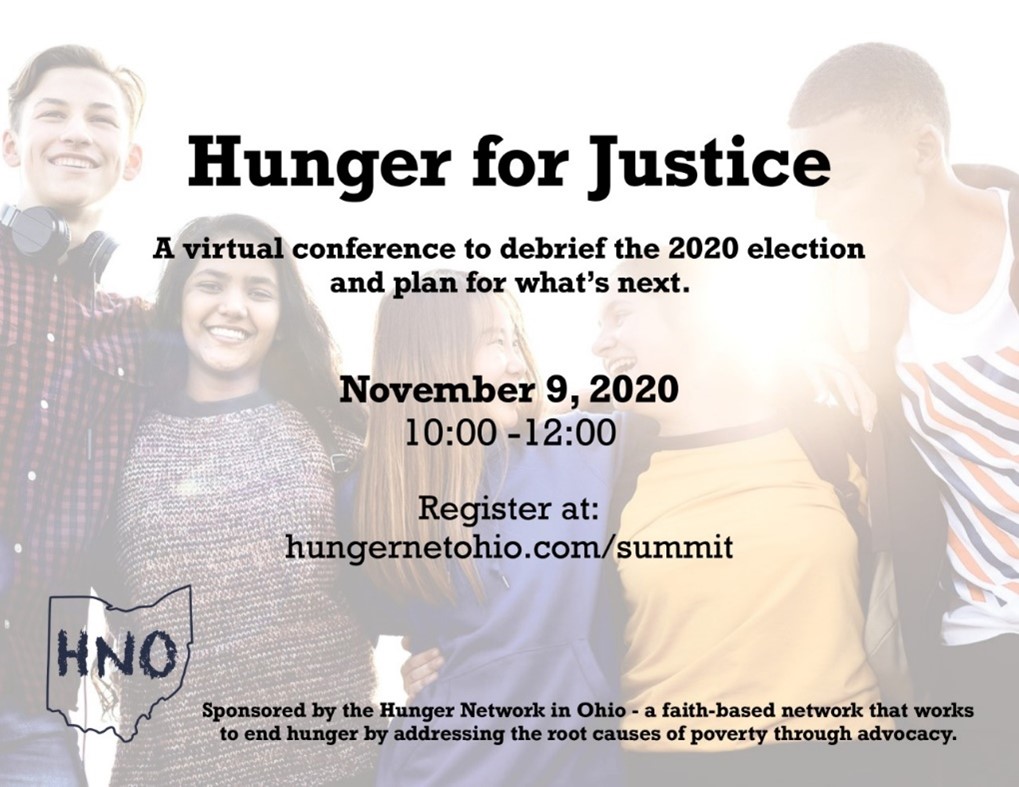
HUNGER FOR JUSTICE VIRTUAL CONFERENCE: As voting begins in Ohio this month, we are all diligently working to discern the best candidates for all positions – including the Ohio Statehouse, State Supreme Court, and community leaders for school board and Township Trustees. Regardless of who wins at the local, state, or national level, our work remains the same – proclaiming God’s desire that all may be fed and have justice and peace in our communities.
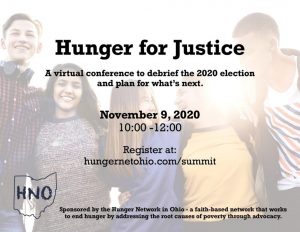
Our two-hour conference will be held on zoom and feature theological reflection to help frame the election results and policy landscape moving forward. We encourage clergy, congregational leaders, judicatory staff, and people curious about hunger and poverty to attend. Register at www.hungernetohio.com/summit.

OHIO COUNCIL OF CHURCHES ANTI-RACISM SUNDAY: HNO is a proud partner with the Council and their efforts to educate and engage congregations throughout the state on issues of white privilege and racism. You can watch the Livestream online here https://www.facebook.com/watch/?v=620062392203248

CROP WALK KICK-OFF: HNO Director Nick Bates will be the featured speaker at the Columbus CROP Walk virtual kick-off on October 11th at noon to discuss our call to advocacy and justice around hunger issues.

PROBLEMS WITH VOTING: HNO is partnering with the Ohio Voter Rights Coalition. You can check your voter registration and find your absentee ballot at https://ohvotes.org/. You can report a problem or concern to 1-866-OUR-VOTE or view their website, https://866ourvote.org/state-information/ohio/.


Pennsylvania

Tracey DePasquale, Lutheran Advocacy Ministry–Pennsylvania (LAMPa) lutheranadvocacypa.org
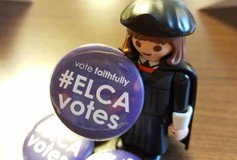
EQUIPPING LEADERS AND VITAL CONGREGATIONS FOR DISCIPLESHIP IN A DEMOCRACY: LAMPa staff and volunteers contacted Pennsylvania’s 67 counties to assess their preparedness for the Nov. 3 election and shared the results with synod leaders to target congregations so that they could support safe access to polls in areas of need. Read more.

POLICY COUNCIL RETREAT: The Rev. Amy Reumann, ELCA Advocacy Director, joined virtually to talk about advocacy as discipleship. She invited the council to imagine how congregational leaders could engage in LAMPa’s ministry as faith formation through the practice of testimony.
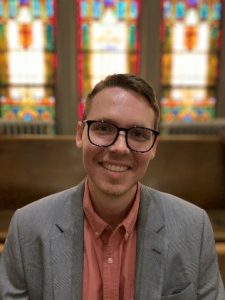
HUNGER ADVOCACY FELLOW: Larry D. Herrold, Jr. joined LAMPa as our ELCA Hunger Advocacy Fellow. A member of Zion, Sunbury (Upper Susquehanna Synod), and active in hunger ministry there, he is discerning a call to ministry. Learn more about Larry.

ADVOCACY ON RENT RELIEF AND SURPRISE MEDICAL BILLS: LAMPa advocates urged state lawmakers to improve and extend the application deadline for the CARES Rent Relief Program and to end surprise medical billing.

UNITED LUTHERAN SEMINARY CONVOCATION: LAMPa Director Tracey DePasquale shared whys and ways of connecting with policymakers as a form of loving our neighbor.

GWOH: Congregations around Pennsylvania added their voices to God’s work. Our hands. Sunday by writing letters to lawmakers addressing issues to which they have been called in service of neighbor.

OTHER WORK: Opposed legislation rolling back clean water protections; Supported use of CARES funding to stop utility shutoffs; Garnered signatures in support of waivers for school nutrition programs; Increased SNAP benefits


Washington

The Rev. Paul Benz and Elise DeGooyer, Faith Action Network fanwa.org
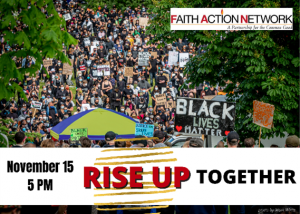

ANNOUNCING FAN’S VIRTUAL ANNUAL DINNER:
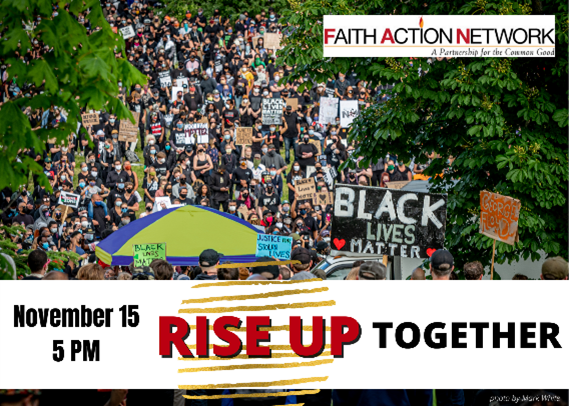
FAN’s Annual Dinner will be held virtually this year on November 15. We hope this change will allow more people from across the state to join in, expanding the traditions of our Renton and Spokane dinners! Our theme is “Rise Up Together,” which speaks to our current and future work in confronting the challenges of multiple pandemics – COVID-19, systemic racism, economic uncertainty, and environmental devastation. Learn more at fanwa.org/annual-dinner.
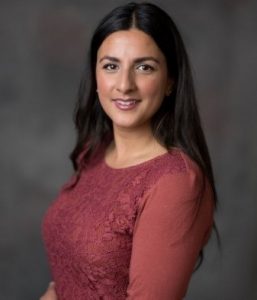
NEW REGIONAL ORGANIZERS: FAN is building our statewide outreach by creating a staff team of Regional Organizers! In Central Wash., we welcome Zahra Roach (pictured here) who is a Pasco City Councilmember and who worked on our Census Equity Team earlier this year. In Western Wash., we welcome Jaspreet Singh who has experience working with the legislative session in Olympia and is representing FAN at the Career and Technical Colleges coalition. More to come as we add University of Washington social work interns and a Spokane area organizer!

WORKING FAMILIES TAX CREDIT: FAN is part of several state policy coalitions – one is the Working Families Tax Credit (WFTC) coalition. Several years ago, our legislature passed this law to provide tax credits to low-income working families, but it has never been funded. Now more than ever in this pandemic where so many households are struggling, funding an emergency cash assistance program like this with an annual credit is critical. Another important piece to make this program more equitable is to statutorily include Individual Tax Identification Number (ITIN) filers so that ALL workers in our state receive this benefit. Learn more at fanwa.org/advocacy/advocacy-toolkit/working-families-tax-credit/ or budgetandpolicy.org.


Wisconsin

The Rev. Cindy  Crane, Lutheran Office for Public Policy in Wisconsin (LOPPW) loppw.org

WELCOME TO LOPPW HUNGER ADVOCACY FELLOW KYLE MINDEN:  Kyle is with us full-time for one year thanks to a generous grant from ELCA World Hunger.  He graduated from Wartburg College with a B.A. in Religion and Business Administration and a Minor in Social Entrepreneurship. Kyle is passionate about solving the systemic inequities and injustices that stem from public policy at the local, state, and federal level.

VOTING: Kyle has developed two voting resources, the Comprehensive can be found at 2020 LOPPW Voting Guide, while the one-page summary can be found here: 2020 LOPPW Voting Overview

HUNGER: We made known information about people eligible for a stimulus check but who have not filed.  Kyle used the center to create this resource:  file:///Users/cynthiacrane/Downloads/Stimulus-Payment-Outreach-Resource-1-1%20(12).pdf

As part of our project to highlight at least one hunger ministry in each synod for others to learn from, we interviewed Bill Binroth, Director of Let’s Eat Community Meals of Chassell, MI in the NGLS.  https://www.facebook.com/LOPPW/videos/377521223250082

CARE FOR CREATION: Our LOPPW statewide climate task force continues to meet.  We sent this press release as a letter to the WI Legislature:  file:///Users/cynthiacrane/Downloads/Revised-Climate-press-release-Team-Bishops.pdf

WEDNESDAY NOON LIVE & IMMIGRATION AND DETENTION: The video of Attorney Mary Campbell, Ms. Marisol Fuentes de Dubon, and Dr. Stephanie Mitchell mentioned last month was published in September: https://www.facebook.com/LOPPW/videos/743410496506120

“LIFTING OUR VOICES DURING THE PANDEMIC”: This Zoom webinar, co-sponsored by East Central Synod Women of the ELCA and LOPPW, will be held on Tuesday, October 13, 2020 from 6:30-7:30 PM. Register here: https://www.loppw.org/evrplus_registration/?action=evrplusegister&event_id=5.

Share