Skip to content

ELCA Blogs

The Importance of Service

by: Kyle Lefler

Jesus walked. Miles & miles across the hills and valleys of the Holy Land. He and his disciples traveled great distances with little comforts to be with, among and beside the people.

While we need not always travel great distances to be of service to others, we are called to be out among our neighbors. We are called to listen for where there is a need, to pay attention to injustice and to respond in ways that further God’s vision of justice on earth.

My own faith journey has been deeply strengthened by participating in acts of service, both in giving and receiving. As a young person, my youth group served through acts of generous charity and our leaders helped us understand how that charity could move into justice work through education and systemic change. Any work of service is best done in mutuality, where we are listening and responding to a need, rather than offering our own solution. The Gospels provide us with dozens example of that mutuality, through Christ’s society-shaking, humble actions.

When I was a sophomore in high school, I attended the 2006 ELCA Youth Gathering in San Antonio and saw service in action on the largest scale I had ever witnessed. There were dozens of organizations educating young people about needs in the world and empowering them to participate in advocating for and serving those in need. Many of us had never had the opportunity to learn and grow in such a way. We saw the Gospel being acted upon in tangible, accessible ways and learned about the calling we have as Christians to do justice, love mercy and walk humbly. 

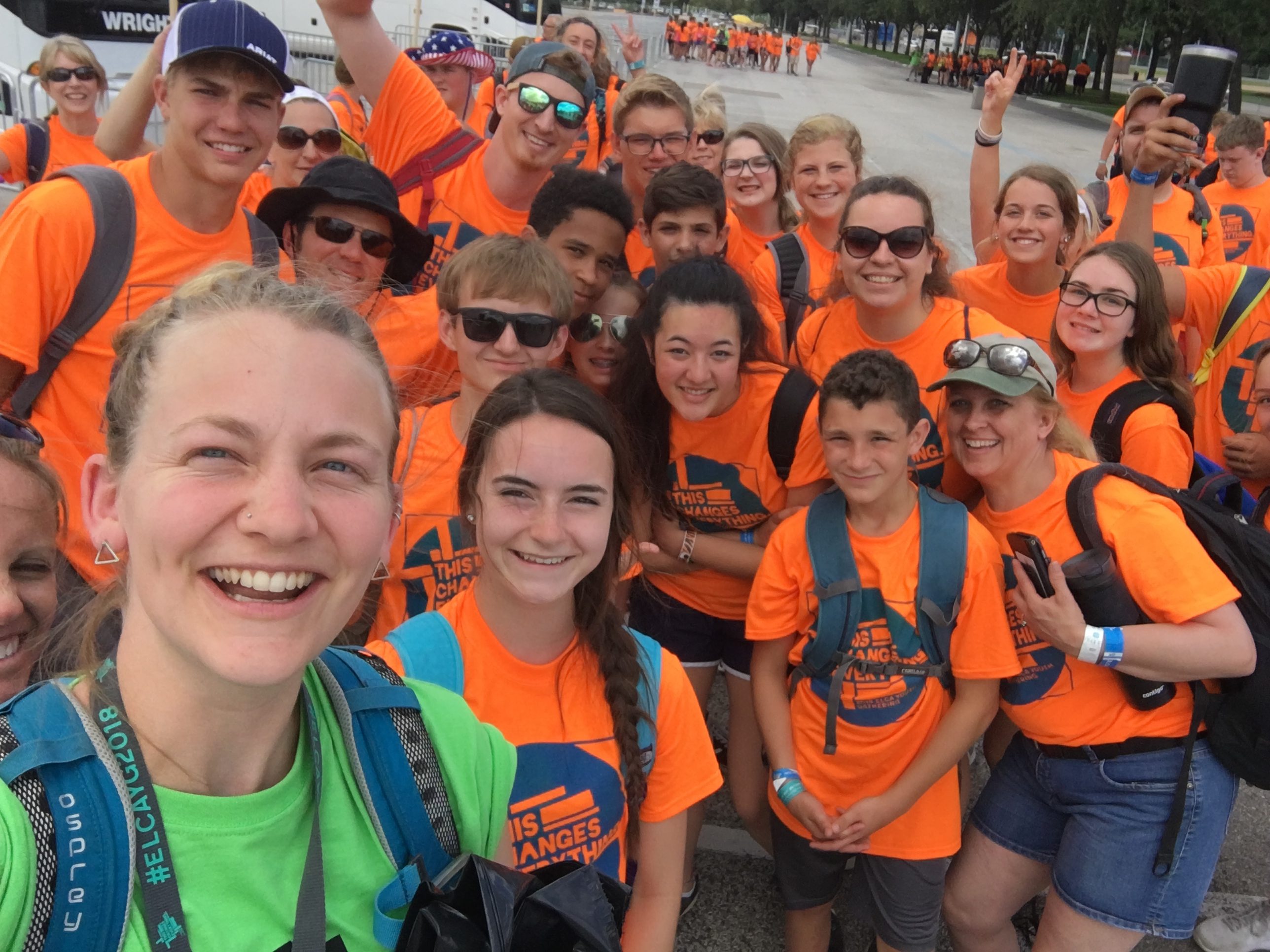
Since then, I’ve had the privilege of leading groups through their Service Learning day at the Gathering. We have WALKED  the streets of cities from New Orleans, Detroit and Houston, listening and learning from those communities, and serving in ways that respond to their needs. I have seen young people’s attitudes transform from tiredness and disinterest to excitement and desire to do more in the course of just a few hours. Together, we become better disciples when we humble ourselves to listen and give of our own gifts of time and privilege. I believe Service Learning can be the most powerful moment of the Gathering for many of the attendees, as they experience a new place and find God’s calling within themselves… then take that calling back home to their own community.

May we always boldly go and do likewise.


Kyle Lefler serves as the year round program coordinator at Flathead Lutheran Bible Camp in NW Montana, overseeing year round retreat programming and onsite summer camp operations. Kyle is passionate about working with young people in God’s Creation and striving to create intentional community spaces where they are unconditionally loved & accepted, empowered & advocated for. She loves early morning lake swims, handwritten letters & the Avett Brothers.

Share

September 1, 2019–It Goeth Before a Fall

Dave Dodson, Houston, TX

Warm-up Question

What ability do you have which you are most proud of?

It Goeth Before a Fall

It was a warm night in Springfield, Illinois on August 16th when the rapper Twista took the stage to perform in front of hundreds of his fans.  The lights were up, the bass was cranked high, and the notoriously fast rapper was spitting bars in his traditionally rapid-fire style.  There was one thing visible that might have drawn attention away from the rapper, though: On the side of the stage stood a sign language interpreter.  Her hair was buzzed short on the sides, a fiery red on top.  Her clothes were all black (interpreters often dress this way to make their signs easier to read).  She was bobbing up and down with the beat and, to everyone’s amazement, keeping up with Twista’s rapid rhymes.

I think it would have been perfectly natural for Twista to have gone on with his concert without much notice of the interpreter.  After all, the fans had paid money to see him, not an interpreter whom no one knew.  But that isn’t what he did.

Purposefully, Twista strode across the stage, still performing, and stood beside and behind the interpreter.  He made sure everyone’s eyes were on her as he laid down the next few lines of fast rap.  Her deft fingers flew through the words, and she didn’t miss a beat as she signed his lyrics.  Still rapping, Twista gestured to the interpreter and led the crowd in a huge cheer for her amazing skills!

Discussion Questions

  • Why do you think Twista chose to direct attention away from himself while performing?
  • Think about your family and friends – have you ever been so proud of them that you wanted to show their skills off?

Twelfth Sunday After Pentecost

Proverbs 25:6-7

Hebrews 13:1-8, 15-16

Luke 14:1, 7-14

(Text links are to Oremus Bible Browser. Oremus Bible Browser is not affiliated with or supported by the Evangelical Lutheran Church in America. You can find the calendar of readings for Year C at Lectionary Readings

For lectionary humor and insight, check the weekly comic Agnus Day.

Gospel Reflection

In cultures around Israel and Palestine, one of the most important virtues anyone can have is hospitality.  The willingness of a person to welcome all of those who would come into his or her home is one of the strongest indicators of that person’s character.  As Jesus gives this metaphor to his listeners, they would have understood that the host in the story would have been obligated to welcome his guests and allow them to sit wherever they pleased.

However, in the metaphor, the first guest makes a critical error: he sits at a prominent seat.  Of course, his host would not argue.  His host would never be so impolite as to deny his guest a seat.  But then, later, someone else arrives whose status is higher than the first guest.  What a disaster!  Now the host is forced to ask the first guest to scoot over, and the first guest is embarrassed in front of everyone else.  (Not to mention a host that is probably REALLY uncomfortable now.)

Even more than hospitality, this story is about pride and humility.  Certainly, we ought to take pride in many things: our family and friends, our faith, and those talents that we have been gifted with.  However, this story illustrates the disaster that can befall us when we seek pride of status.  Let’s take a closer look at the mindset of the guest entering the feast:

Let us consider the first guest, the one who entered and sat at the head of the table.  What was his thought process?  He must have thought, either explicitly or subconsciously, “I am important.  Surely I am the most important person that this host knows.  Naturally, I should sit at the head of the table.”  In this instance, the pride the guest feels is in direct contrast to how he feels about the host.

But what about the second guest?  This guest, the one who sat at the foot of the table, must have thought very differently.  “This host is wonderful,” he must have mused. “Certainly he has many amazing friends and guests.  I will make room for them.”

Often, our pride can make us put ourselves in front of others.  That is the tendency that Jesus is warning us about.  When we think of ourselves as better or more important that others, we cannot serve them.  And remember, Jesus told us that whenever we serve “the least of these,” we serve him.  We must put away our personal pride and take comfort in humility.  We can value others and lift them up.  Then God, our host, will lift us up as well!

Discussion Questions

  • How does being humble make us better servants?
  • Can you think of any other stories from the Old or New Testaments which show great leaders serving others (after all, the humility of great religious figures is an important theme in our faith)?
  • What is the difference between being proud of ourselves in a healthy way and being proud of ourselves in a way that puts others down?

Activity Suggestions

Let’s practice the art of making ourselves humble and, perhaps, a little vulnerable.  Everyone in the group should sit in a circle with an index card.  Write your name on the top, then pass the card to your right.  On the card you receive, look at the name, then write one amazing or wonderful thing about the person whose name is at the top.  Then pass the cards right again, repeating the process until you receive your own card back.  You see, when we prize others, we find ourselves lifted up, too!

Closing Prayer

Heavenly God, your Son humbled himself as he washed the feet of his disciples..He submitted to the judgment of human beings  and let himself be killed by those who should have worshipped him as Lord.  Teach us how to be mirrors of that perfect humility.  Walk with us every day and show us how to serve and lift each other up, as Christ did for us.  In his name we pray. Amen.

Share

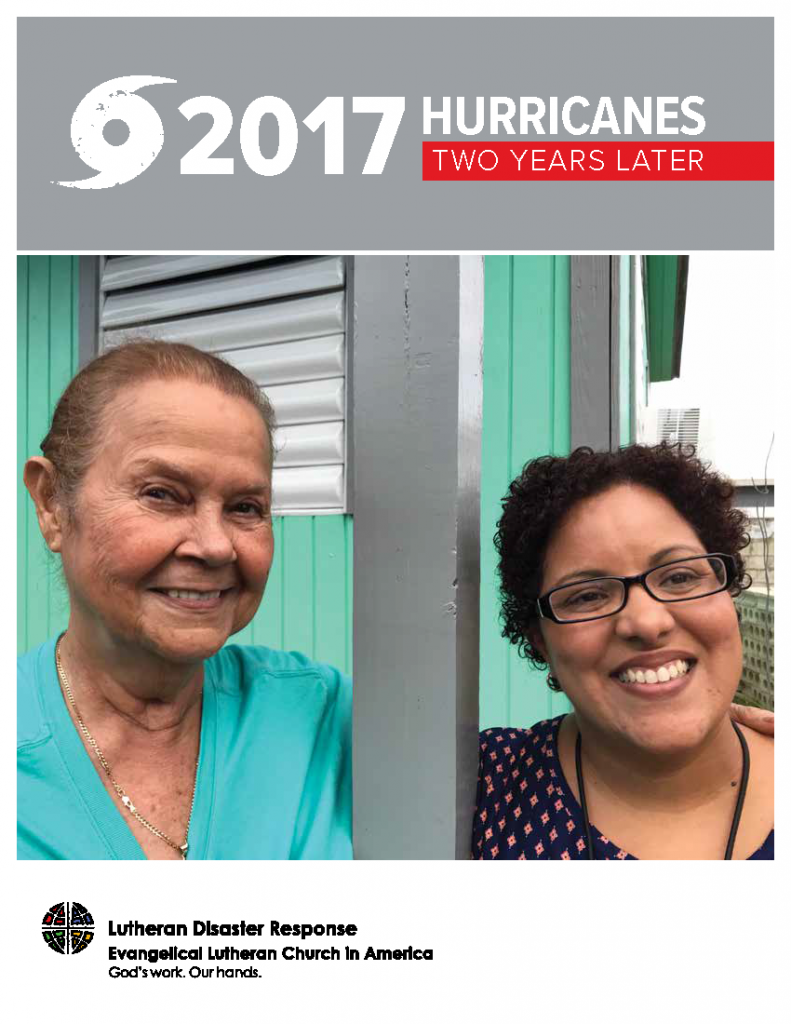
2017 Hurricanes: Two Years Later

In 2017, hurricanes Harvey, Irma and Maria swept through the United States and the Caribbean, causing widespread damage and interrupting the lives of millions. Two years later, Lutheran Disaster Response is still present, working in partnership with congregations, synods, social service organizations and other partners to bringing God’s hope, healing and renewal to affected communities.


Last year, Dennis, a 72-year-old retired Marine living in St. Croix, U.S. Virgin Islands, met an employee of Lutheran Social Services of the Virgin Islands — the local Lutheran Disaster Response affiliate. He told them about the damage to his home, and soon after they came for a visit. “I was hoping to get help from FEMA. I wasn’t expecting the Lutherans,” Dennis said. Last year at the anniversary of the Hurricane, through the LDR supported volunteer rebuild/repair program, Dennis began to rebuild his home and his life. “The house isn’t done, but how it looks now is beyond my wildest expectations,” Dennis said then. Now, two years after the storm, his house is complete. “It [the house] is bringing me joy… “I’m thankful to Lutheran Services for helping me out,” Dennis said.


Lutheran Disaster response, in our commitment to the long-term recovery of Puerto Rico and other hurricane-impacted states/territories, has committed significant funding and other forms of support to help survivors and continue building the capacity of our partners and affiliates on the ground. Thanks to you, survivors like Dennis,  have been connected with needed support — from emergency relief supplies to emotional and spiritual care, as well as the repairing and rebuilding of their homes.

To read our full report – 2017 Hurricanes – Two Year Later, click here.


Be a part of the response:

Pray

Join us in prayer and partnership, and to help spread the word in your congregation. You can find additional resources for worship here.

Give

We invite you to stand by all the communities impacted by the recent hurricanes. Your gifts to Hurricane Relief ensure that our church will be able to provide help and hope for those affected by this disaster for years to come.

Connect

To learn more and Stay connected to the latest events and our response to this and other disasters:

  • Like Lutheran Disaster Response on Facebook and follow us on Twitter.
  • Visit our website at LDR.org.
  • Sign up to receive Lutheran Disaster Response alerts.
  • Click here for information on volunteer opportunities.
Share

My Biggest Takeaway from the Gathering

by: Rev. Daniel Locke

For years, on the dashboard of my first car, sat a green and blue hacky sack. It looked like a small globe. It was well worn and faded by sunlight. This hacky-sack was a reminder of one of the most powerful experiences of my life – the 2003 ELCA Youth Gathering in Atlanta. GA.

When I first met the Gathering in 2003 (“Ubuntu: Do Life”), I was overwhelmed – not only by the immensity of the Gathering – but by life as well. For starters, I was an awkward, too-often-bullied high school band geek, who also kept the bench warm for two varsity sports teams. I was a thespian and a boy scout. And if that wasn’t enough, my dad was commuting long-distance to seminary, my mom was fighting cancer, and my only sibling was attending college. I was wrestling with my identity, longing to find my place and voice in life, and, most of all, I blamed God for it all.

So, I attended the 2003 Gathering with what I consider to be a reasonable amount of skepticism and disdain for faith, as well as a greenish-blue hacky sack. Every spare moment prompted a game of hacky sack, inviting anyone to join. As the circle grew so did my opportunity to meet my peers from around the world – who were also longing to figure out who they were.

It’s been almost two decades since I attended that Gathering and I am still processing the impact of that experience. The more I reflect, the clearer it becomes that the Gathering had such a positive, long-lasting effect not only on my faith formation and relationship with God, but on my understanding of the Church as well.

Obviously, one week in Atlanta did not resolve my struggles. It is 16 years later and I still wrestle. But now I wrestle with confidence and hope. The Gathering invited me into a safe space to wrestle with my identity, not only in Christ but my place in the world as well. It taught me that I am not alone. I left the Gathering with an overwhelming appreciation for the size of the church and my place in it. Lastly, and most of all, the Gathering taught me about the beauty of God’s unconditional grace; for I am named, claimed, blessed, and sealed, and there is no amount of wandering, waiting, or wrestling that can change truth.

The Rev. Daniel Locke lives in Jacksonville, FL with his wife, the Rev. Sarah Locke, and their 1-year-old son, Bennet. Daniel serves the people of St. Mark’s Lutheran Church. In 2018, Daniel served the Gathering as the Technical Manager for the Interactive Learning Center. He is excited to serve the Gathering’s Interactive Learning team once again in 2021.
Share

God Created Abundantly


Another blog post from ELCA World Hunger Education Intern Aml Mohamed. In this blog, she continues to seek answers to the three questions posed in her first blog. This blog is a response to her second question: “Why would I care as a practicing Muslim to work at a Lutheran faith-based institution?” 


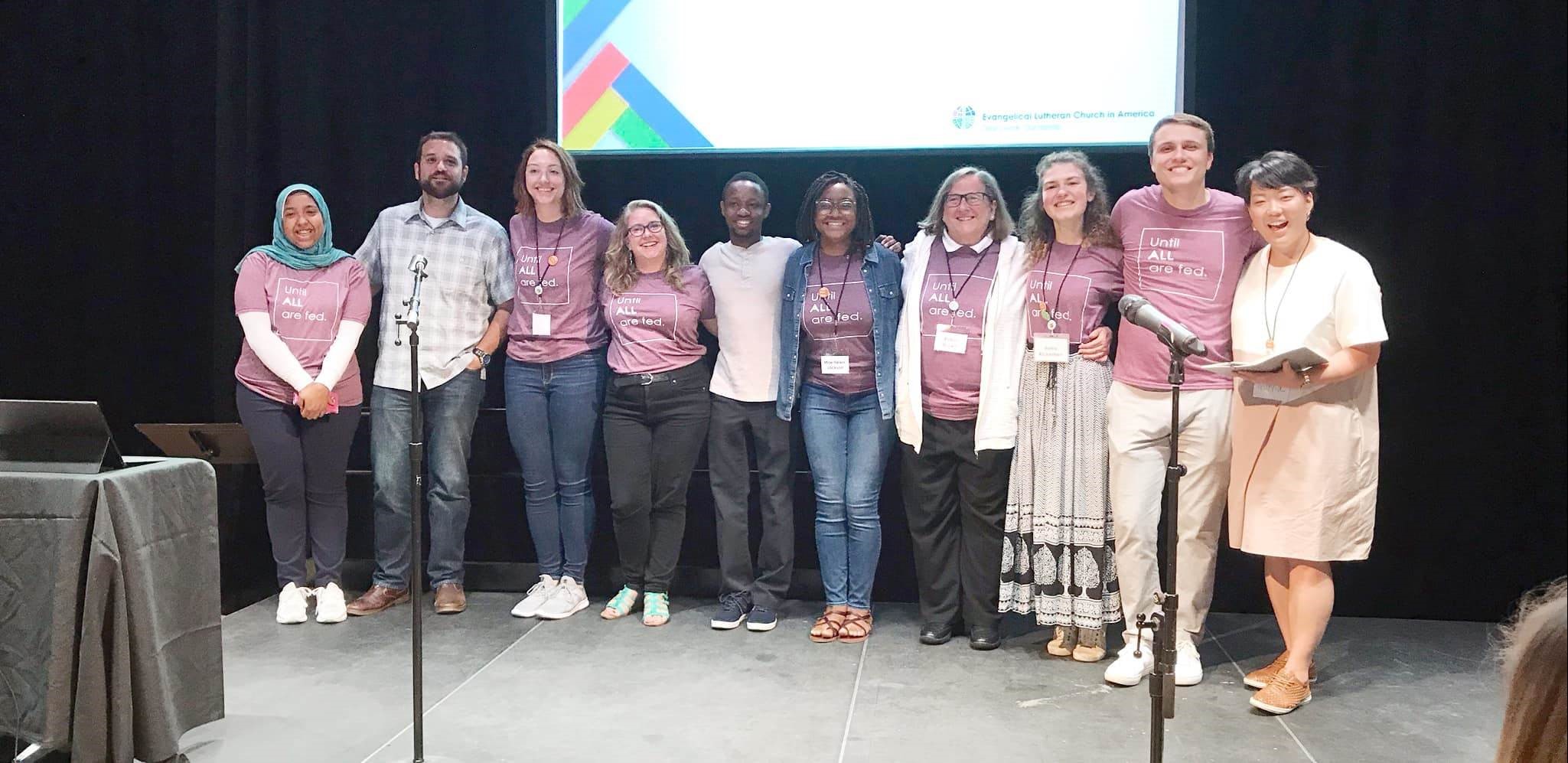
In July, I participated in the ELCA World Hunger Leadership Gathering in Minneapolis, Minnesota. During one of the skill-building sessions, participants and staff members had the chance to practice one-to-one conversations. I had a beautiful chance to discuss faith and how it plays a part in our personal and professional life with a colleague.

I wear my faith on my head. By choosing to wear the Hijab, a hair covering, it is noted by some that I am likely a Muslim. In various settings this is the first thing they notice about me, especially in a large gathering like the ELCA World Hunger Leadership Gathering. Sometimes, I do not think about it much, as it is part of me. However, I welcome those reflective questions about being of a different faith and my work. When the questions are asked properly, they do not reflect bad intentions– they reflect curiosity. They make me reflect on my own experience. I was about to respond to a participant’s question about my experience at the ELCA as a Muslim person, but they soon interrupted me. They said: “I am sure there are common things in our religions that support and encourage community work and care for hunger.” I nodded with a smile. I was happy to see that this was the assumption for why I do the work I do. But, is that enough?

To answer this question, I will return to the conversation about faith I had with my colleague and reflect on this question: do we do the work we do because of our community-driven personalities or because of our faiths?

It is not one answer or the other. I never thought of my religion as the source of my passion to work on community development. I mean, I am just a regular college student who is passionate about making a change in a small way. At the ELCA, the Lutheran faith that shapes the work is clear in many ways, such as praying before a meal or the start of the event. Is that what makes a faith-based organization different? The prayers? During the conference, it was often mentioned that God is a God of abundance. God created so much that there is more than enough to feed everyone on earth, yet there is hunger. I was confused. How can God be a God of abundance and allow hunger in the world? I soon realized in my conversation with my colleague that their work is driven by their faith grounded in hope. I realized that there is energy in people that have hope while their feet are on the ground. They know that there is too much to do, however, there is something that can be done.

I am not an Islamic scholar or a researcher, but when I heard the phrase God created abundantly, I reflected on this verse in Surat Hud 11:6 in the Quran: “And there is no creature on earth but that upon Allah is its provision.” Allah is the Arabic word for God, and it is used by Arabic-speakers of all Abrahamic faiths, including Christians and Jews. This is the English translation of the verse, but the Arabic word for Provision is Rizq. Rizq means so many things, which is the beauty of Arabic. Rizq means livelihood, sustenance, nourishment, daily bread, blessings and more. So, God says that every creature, not just humans, is provided for. God did not even limit the provision meaning to food or wealth, but it takes many shapes.

My personal belief that there are enough resources, ideas and energy is what pushes me to think that is possible to develop and sustain communities. It is not simple or easy to access those resources for many reasons in our world today. But, faith is my source of hope and energy. I know that there is unlimited human energy that should be invested wisely to make positive change. Working with ELCA World Hunger made me realize that faith grounded in hope points us towards change that can be done. This where I found my common ground. I saw that a faith-based organization like ELCA World Hunger achieves so much by reaching out to the community of active and caring individuals and ministries to work together. The source of hope to push and continue working on problems comes from faith in a God who provides abundantly – or for me, faith that one’s rizq is provided by God.

At the beginning of the summer I asked myself as a practicing Muslim, would I care about working at a Lutheran Church? Now, at the end of the summer, I look back, and I see how much I learned about my faith, even while immersed in Lutheran faith. I learned that caring for social change is not an impossible mission if people find common ground in their faith and worldviews to work together.

Share

Of Community and Courage: Responding to Public Charge Rule as a Sanctuary Church


Last week, the ELCA Churchwide Assembly took action be a “sanctuary denomination” – publicly declaring our intent to walk alongside immigrants and refugees as a matter of faith. In response to this action, a well-used question of Martin Luther again began to surface – “what does this mean?”
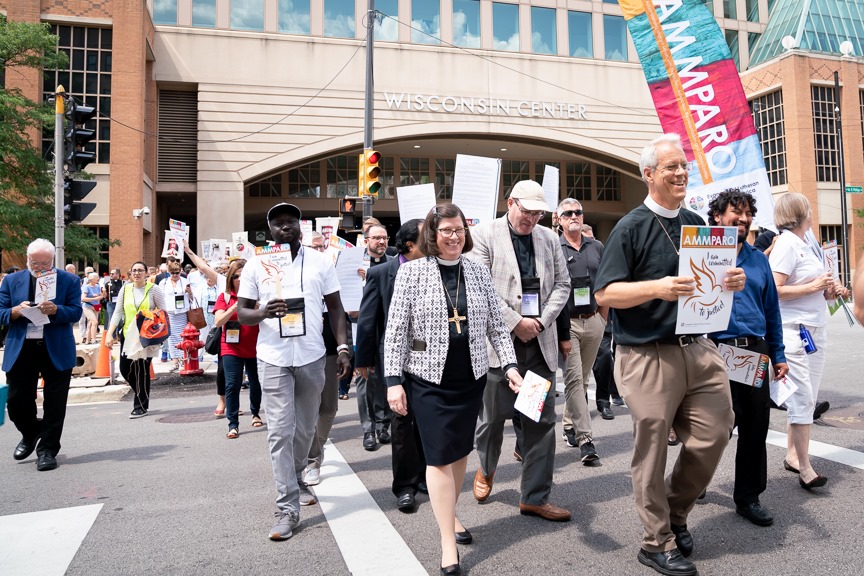
And yet, just as voting members were returning home and news of this action was traveling far and wide, another announcement also hit the news cycle — a final rule that changes the public charge policies used to determine eligibility for people seeking to immigrate to the United States or to change a current immigration status.

In short, the proposed public charge rule change favors wealthier immigrants and will negatively weigh the use of a wide variety of forms of public assistance, including non-emergency Medicaid for adults, low-income housing assistance and SNAP (Supplemental Nutrition Assistance Program; formerly called “food stamps”).

While the rule itself has many nuances and implications laid out in the 800-page document, the question again becomes – “what does this mean?”

First, it’s important to remember that this rule change is not aimed at undocumented immigration, though it may have indirect effects on undocumented immigrants. The people most affected by this rule will be potential immigrants applying for visas, current visa-holders seeking to extend their stay and immigrants applying for a change in legal status (for example, applying for permanent residency.)

One of the most immediate consequences may be a sharp drop in the number of people applying for and receiving benefits like Section 8 housing assistance and SNAP. SNAP is one of the most reliable federal safety net programs for helping people facing food insecurity get through tough economic situations. About 11.7 percent of people in the US rely on SNAP, according to the US Census Bureau. Contrary to rhetoric that suggests people receiving public assistance don’t work, about 79 percent of households receiving SNAP in 2017 had at least one person working in the year they received benefits. By contrast, of the households which did not receive SNAP in 2017, about 86.1 percent had at least one worker. The difference is far from huge. Often, households rely on SNAP to supplemental insufficient income or to pay for food when there is no work, such as during seasonal down-times.

In terms of citizenship status, in 2017, 11.2 percent of native-born US citizens relied on SNAP, while 17.1 percent of foreign-born non-citizens received SNAP. It’s important to remember that undocumented immigrants are not eligible for SNAP benefits, and most documented non-citizens working in the US pay taxes that fund SNAP. According to the USDA, in general, non-citizens must meet one or more of the following criteria to be eligible for SNAP (in addition to meeting limits for income): have lived in the country for at least 5 years, be receiving disability-related assistance, or be under the age of 18.

The decrease of SNAP participation is likely to leave food insecure families relying more heavily on community resources, like food pantries, to help meet their needs. But as most folks working in hunger-related ministries know, community responses to hunger cannot match the capacity of governmental responses. So, another likely result is an increase in hunger in communities across the US.

Community

In defense of the rule change, Ken Cuccinelli, acting director of US Citizenship and Immigration Services, took the opportunity to revise Emma Lazarus’ famous poem etched on the Statue of Liberty. In his rendition, “The New Colossus” reads: “Give me your tired and your poor who can stand on their own two feet and who will not become a public charge…” Self-sufficiency, he claimed, should be a litmus test for welcome.

On its surface, self-sufficiency may seem like a worthy ideal. After all, a lot of anti-hunger and anti-poverty organizations doing great work celebrate the steps they help people make toward self-sufficiency.

For the church, though, it is a matter of faith that we are not self-sufficient. One of the most basic tenets of Christian faith is that humans are created as dependent creatures. We depend on God for our creation and sustenance, on one another to meet our basic needs, and on grace for our salvation. We are created to be in community with each other and with God in part because we are not self-sufficient. Our well-being depends on the health of these relationships.

To be a sanctuary church means recognizing the reality of our interdependence. But it also goes a step further. To be a sanctuary church is to offer a different model of community, one in which welcome is extended to all and one in which our vulnerabilities and dependencies are laid bare. The social ethic the church offers is not merely its public voice but its very self – a community where blessings and burdens are shared.

Courage

As Lutherans, we affirm that one of the institutions on which we are dependent is government. Just laws are gifts from God for our safety, peace and well-being. But we also affirm that laws are not good in themselves. They are good insofar as they reflect justice and equity and insofar as they enable well-being within a community.

Providing public benefits is one way well-being is safeguarded in the US. SNAP benefits, for example, ensure that families have the means to obtain the food they need during hard times. Housing assistance equips people facing financial challenges to live in a safe, stable home. Health care programs like Medicare and Medicaid ensure that the most vulnerable neighbors among us will have access to the services they need to survive. And yet, these same programs are the targets of the new DHS rule. Accessing any of these may mean that a non-citizen in the US will be deemed a liability and barred from full participation in the community.

For many people, the prospect of this new rule is frightening. How can one choose between the help they need now and the legal status they may hope for in the future?

Government is no stranger to fear. Indeed, fear is, to some extent, part of the role of government. Paul’s letter to the Romans, so often tossed about as justification for obedience to government, admonishes that “rulers are not a terror to good conduct, but to bad” (Romans 13:3a). But what happens when rulers become a “terror” to all? Several ELCA pastors and leaders have noted the fear that plagues the people in their communities – fear that a visa may be denied or that an application to stay in the US will be rejected.

We need to bear in mind here that this new rule does not impact undocumented immigrants, who are ineligible for the benefits listed in it. This rule will directly affect the millions of non-citizen individuals and families who are trying to do things “right” but need help along the way.

To be a sanctuary church in this context is to refuse to be comfortable when neighbors among us are afflicted. To be a sanctuary church is to recognize that when government becomes a “terror” to “good conduct,” that government is fundamentally broken. To be a sanctuary church is to, in the words of Martin Luther, to rebuke that government “openly and boldly before God and men” (Luther’s Works 13:49). As Luther writes, this is not seditious but “a praiseworthy, noble, and rare virtue, and a particularly great service to God” (Luther’s Works 13:50).

When the well-being of neighbors is threatened, the church is called to hold government to account, not as a matter of politics, but as a matter of faith in the God who institutes government for the well-being of all.

What Can Be Done

State attorneys general have already begun the process of challenging the rule change in court, and there may be opportunities for advocacy in the weeks to come. Until then, here are some steps to take now.

Reach out to local ministries.

Local food pantries and feeding programs are a critical response to hunger in the US, though their capacity cannot match the need addressed through programs like SNAP. As the new rule is implemented, it is likely that many immigrant neighbors will forego SNAP benefits and need to rely more heavily on community interventions like pantries and soup kitchens. Reach out to local ministries to learn more about their needs and ways you can support them.

Listen to neighbors.

Effective responses to hunger start with meaningful, mutual relationships. The rule change, recent enforcement decisions by the federal government and public rhetoric have fostered fear and uncertainty. Take time to listen to neighbors and let them know our church supports them. Try to identify needs that can be addressed in the short-term as we work together for long-term change.

Share information.

If you are the leader of a community ministry, you may have clients who will be impacted by the new rule. It will be important to provide them with accurate, up-to-date information as the date for implementing the rule (October 15) gets closer. Consider developing handouts or posters that communicate information they may need to know. If your ministry involves caseworkers, be sure that they are equipped to handle questions about the rule. The National WIC Association has some helpful resources for clients and staff of community programs. (WIC is not one of the benefits included in the new rule.) The Protecting Immigrant Families Campaign also has some helpful resources, including newly updated pdfs on the public charge rule.

Be the church.

Much of the work to respond to this upcoming change has already been done – through the building of meaningful relationships with neighbors in our communities. But much more work awaits. In this time, we are called to bear witness to a new type of community – a banquet at which all are welcome. As a sanctuary church, the ELCA is committed to continue accompaniment of neighbors facing adversity, uncertainty and fear. This is lived out through local congregations and the ministry they do every day. Yet still, we must continually remind ourselves that hospitality is not an issue of partisan politics but of faith in the God who transcends all “principalities and powers.” To be a sanctuary church is to enter in to the vulnerabilities of our neighbors as if they were our own and to bear witness to the interdependence with which God has created the world and the diversity with which God has blessed it.

Share

The Mission and Goals for the Gathering


The Gathering’s mission, faith formation in teens, is the hub from which all things come for the tAble, MYLE, and the Gathering. Our goal is to create environments and opportunities for faith formation through worship, Interactive Learning, Bible study, Service Learning, and fellowship. While some of the experiences can be replicated at home, some are unique and special to the Gathering because of the size and scope of this ministry.

There are five core goals that we have for this ministry. We hope that all participants can be both affirmed and challenged in their faith, experience new perspectives, ponder their vocation, bond with their congregational group, and learn more about the Evangelical Lutheran Church in America (ELCA).

While some participants may accomplish these goals during our two pre-events, MYLE or the tAble, some will at Mass Gatherings, where participants come together for music, speakers, and worship. Others might tackle these goals in the Interactive Learning space, where they can experience exciting things that the ELCA and our partners are doing. Or maybe it’s being God’s hands and feet in the Twin Cities on their Service Learning day. It might even be during Synod Day, where participants are in community with those geographically close to them or it might just happen during the nightly congregational devotion and debrief called Final 15.

Wherever it happens, we know that this is a powerful and transformational ministry if you are brave enough to let your guard down long enough for the Spirit to enter in, if you can be quiet long enough to listen to someone different than yourself, if your prayer is to be open to what God is calling you to, if you realize the strong roots of a community will ground you no matter the strength of life’s storms, if you imagine yourself as part of something bigger than you.

Share

Punitive public charge rule slated to take effect

The Trump administration expanded public charge rule is a punitive measure that will stoke fear and increase suffering in immigrant communities. This new policy would impose an unprecedented income test on persons seeking legal entry to the United States and deny entrance if they are judged likely to be or ever in the future become a “public charge” entitled to assistance with nutrition, housing or healthcare. In addition, current lawful permanent residents may have their applications for citizenship denied solely based on using or ever having used certain public programs such as the Supplemental Nutrition Assistance Program (SNAP). This policy will cause a cascade of negative impacts, including increasing hunger, blocking family unification and severely restricting immigration of people who want to come and contribute to our nation.

“This cruel policy change flies in the face of our commitments as a church to people seeking a new home here. Our social message on immigration commits us to ‘work for policies that cause neither undue repercussions within immigrant communities nor bias against them,’” says the Rev. Amy E. Reumann, ELCA director of advocacy. “The public charge rule is an unneeded departure from current practice that prioritizes family unification and humanitarian needs and that values the vitality and contributions of all immigrants regardless of economic status.”

We support benefits for lawful permanent residents as a public good, as stated in the ELCA social message on “Immigration”:

Hundreds of thousands of comments were submitted through a interfaith coalition that included our Lutheran voices when the public charge rule was proposed. The ELCA submission stated that the proposed regulation would harm families by forcing vulnerable people to choose between maintaining or obtaining legal immigration status and meeting their family’s basic needs, including those of children who are citizens. It further noted that the rule would penalize immigrants for seeking the very programs designed to help them attain self-sufficiency. This message that the only ‘worthy’ immigrants in the U.S. are wealthy is not only contrary to the country’s history but also a notion that stands against our faithful teachings as Lutherans.

The rule will go into effect October 15, 2019, unless constrained by Congress or the courts. Please follow along with ELCA Advocacy as we continue to oppose this punitive and unnecessary rule change.

Share

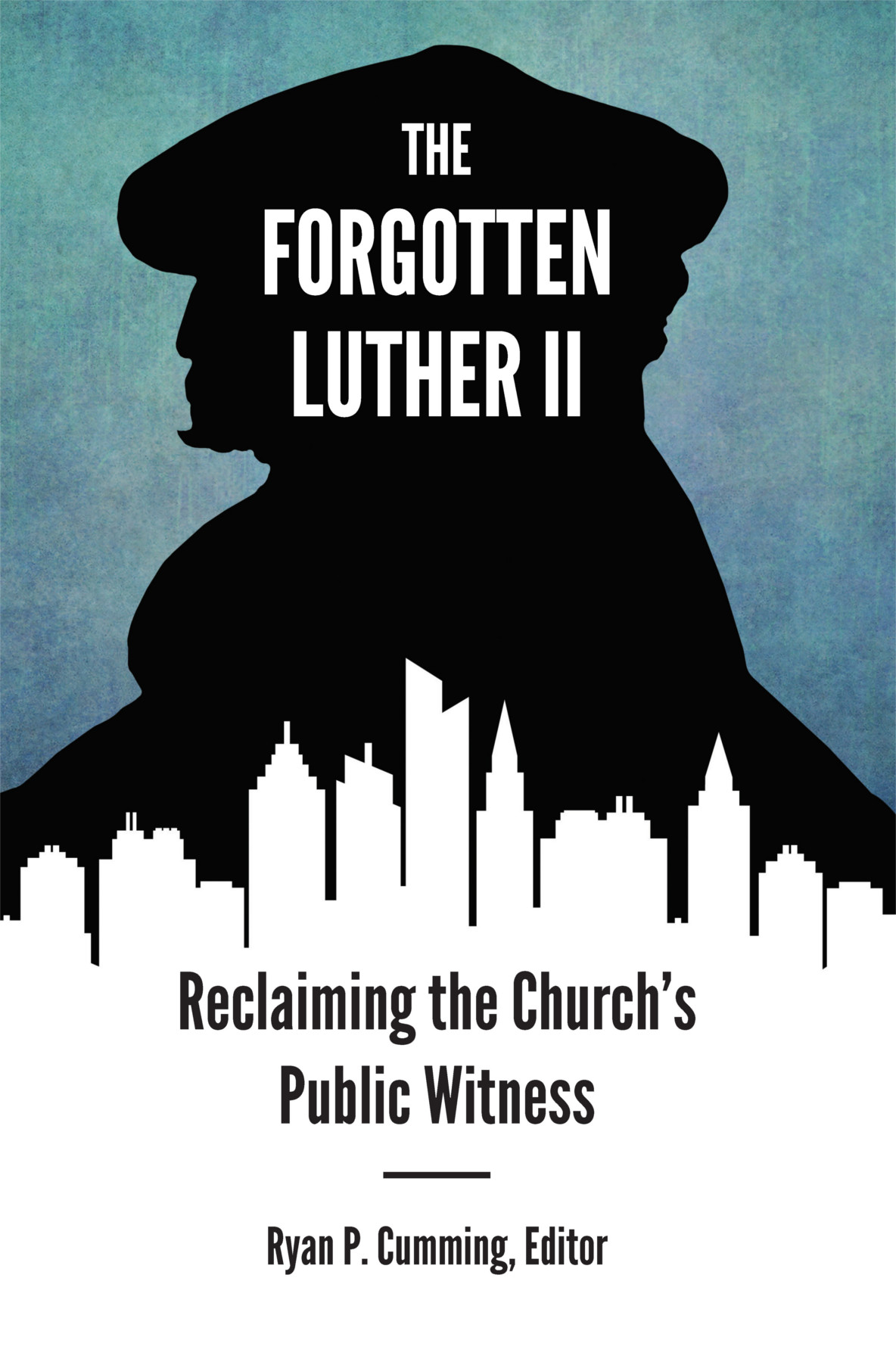
The Forgotten Luther II – New Book in Series


“When we begin to attend as a community to public issues, we exercise faith practices that embody our understanding of the gospel, witness to the world our public commitments, and communicate a different way of being a church.” – Amy Reumann, Director of ELCA Advocacy

Many people – Lutheran and non-Lutheran – are familiar with Martin Luther’s teachings on civil order and obedience to laws. Fewer folks, though, recall the Luther who admonished preachers to use the pulpit to rebuke rulers for injustice, argued for public support for education of girls and boys, and inspired generations of future Lutherans to stand against political oppression and injustice.

The authors of The Forgotten Luther II: Reclaiming the Church’s Public Witness (Fortress Press, 2019) offer this side of Luther and Lutheran faith to congregations today. Featuring chapters by theologians, pastors and teachers in the ELCA, this second volume in the Forgotten Luther series shares the stories of Lutherans from today and yesterday whose faith moved them into public advocacy and activism – and encourages readers to hear the call of faith to “strive for justice and peace in all the earth.”

Carter Lindberg, a contributor to the first Forgotten Luther book, Mary Jane Haemig and Wanda Deifelt deal with issues as diverse as war, education and embodiment, while Amy Reumann, the director of ELCA Advocacy, offers a clarion call to advocacy by congregations, shaped by faith and inspired by the stories of congregations already active in the public square.

Chapters by Kirsi Stjerna and Anthony Bateza recall the dangerous memories of racism and anti-Semitism that have pervaded Lutheran history, sins that have deformed the church’s public witness in history, while offering suggestions for building a more inclusive, just church today.

Together, the authors address critical questions for the church today: When should the church support the state’s agenda? When should it resist? What are the options for critical but constructive cooperation? Their answers are surprising, troubling and inspiring.

Discussion questions accompany each chapter to help guide conversations in education forums, adult Sunday School series and more. Interviews with each of the authors are also available at https://vimeo.com/showcase/5926704.

Order copies for yourself or your congregation from Fortress Press: https://fortresspress.com/forgottenlutherii.

A portion of the proceeds from the sale of this book will go to ELCA World Hunger to support the longstanding work of ELCA Advocacy as part of a holistic and transformative strategy to end hunger.


The Forgotten Luther III symposium is coming! The Forgotten Luther III: Reclaiming a Vision for Global Community will be hosted at Saint Luke Lutheran Church in Silver Spring, Maryland, October 25-26, 2019. Learn more here. Watch for more updates on the ELCA World Hunger blog!

Share

August Update: Advocacy Connections

from the ELCA Advocacy office in Washington, D.C. – the Rev. Amy E. Reumann, director

AUGUST RECESS ADVOCACY OPPORTUNITIES  |  LIMITS PROPOSED TO SNAP HUNGER PROGRAM  |  KEEPING GIRLS IN SCHOOL ACT  |  FAITH-BASED PRESENCE AROUND U.N. CLIMATE CONFERENCE  |  FEDERAL BUDGET DEAL REACHED  |  STANDING AGAINST #CHRISTIANNATIONALISM  | HUNGER ADVOCACY FELLOWS  | VISITING D.C.

AUGUST RECESS ADVOCACY OPPORTUNITIES:  During August Recess, senators and representatives return to their state and/or congressional district and reconnect with constituents. This is a great opportunity for local advocates to engage with elected officials, ask questions and share concerns. Advocates interested in meeting with their members of Congress can find suggested activities, how to set up a meeting with lawmakers, and a timely set of policy questions (link) at the fore of current public discussion in new August Recess resources. Prompting questions and background on gun violence are among those that can be used by Lutheran advocates who encounter their legislators in-district.


LIMITS PROPOSED TO SNAP HUNGER PROGRAM:  The U.S. Department of Agriculture announced in mid-July plans to narrow food assistance eligibility for low-income families. The drafted rule would tighten Supplemental Nutrition Assistance Program (SNAP) benefit access to people applying through “broad-based categorical eligibility,” a method by which households earning slightly above the poverty line can apply if they have exorbitant costs (such as housing or child care) that place them below the poverty line.

Historically, the policy has had popular bipartisan support since it incentivizes families to seek higher-paying jobs or small income increases without immediately losing federal support. Early estimates gauge that over 3 million low-income seniors, working families and those of us with disabilities could be affected. The rule is open for public comment until Sep. 23, and ELCA Advocacy will share an action alert on the issue in the coming weeks.


KEEPING GIRLS IN SCHOOL ACT:  A bipartisan group of lawmakers introduced a new bill seeking to ensure that U.S. foreign assistance programs are designed to address the barriers preventing millions of girls around the world from attaining education. The Keeping Girls in School Act of 2019 would help continue investments in quality and equitable education for girls by leveraging existing funds to support partnerships and encouraging innovative financing approaches.

According to a report by the World Bank (link), less than two-thirds of girls complete primary education in low-income countries, and only 1 in 3 completes lower secondary school. Education is one of the best tools for improving social and economic outcomes for individuals and communities, and equal access to education is critical to development of nations. ELCA Advocacy shared an action alert in support of the bill in July, urging lawmakers to co-sponsor the bill and pass it before the end of the Congress. Advocates can take action at the ELCA Action Center.


FAITH-BASED PRESENCE AROUND U.N. CLIMATE CONFERENCE:  Interfaith events are being planned around the U.N. Climate Change Summit 2019. U.N. Secretary-General António Guterres has called on leaders to come to New York Sept. 23 with concrete, realistic plans to enhance their commitment to reduce greenhouse gas emissions. The Evangelical Lutheran Church in America (ELCA), the Episcopal Church, GreenFaith and others are planning an interfaith service Sept. 20; participating in a youth mobilization, also Sept. 20, declaring a climate emergency; and hosting a faith-based consultation Sept. 24, with the theme: “Climate Emergency: Faith-based Organizations Raising Ambition – Leaving No One Behind.”


FEDERAL BUDGET DEAL REACHED:  Lawmakers in Congress and the administration reached a deal to raise federal budget caps and the debt ceiling, which was signed by President Trump Aug. 2. The bipartisan agreement raises limits on discretionary spending by $321 billion over two years and addresses the issue of the debt ceiling until July 31, 2021.

While the increase in federal funding could help maintain existing low-income and humanitarian programs, a significant percent of the nondefense funding will be allocated to support the 2020 Census, meaning ultimate gains will likely be minimal when the budget process is finalized.

With an ELCA voice through the signature of Presiding Bishop Elizabeth Eaton, an interfaith letter signed by more than 30 heads-of-communion was sent to lawmakers July 25, shortly before the agreement was made. The message highlighted the need to raise spending caps to maintain low-income and community programs that help the most vulnerable among us.


STANDING AGAINST #CHRISTIANNATIONALISM:  The ecumenical letter opposing Christian nationalism was released last week with the launch of the “Christians Against Christian Nationalism” campaign. More than 9,000 Christians have already signed, and momentum from a social media introduction by ELCA Advocacy is strong.


HUNGER ADVOCACY FELLOWS:  Six Hunger Advocacy Fellows are concluding their yearlong positions this summer of transformative experience that combines leadership development and faith formation with impactful advocacy that moves toward an end to hunger and a just world where all are fed. We are grateful for the gifts of these innovative, passionate and dedicated young leaders: Erica Earnest, Lutheran Episcopal Advocacy Ministries of New Jersey; Abbigail Hull, ELCA Advocacy national office; Kelsey Johnson, Lutheran Office for Public Policy – Wisconsin; Jordan Slappey, Southeastern Synod Advocacy; Paisha Thomas, Hunger Network in Ohio; and Sarah Vatne, Faith Action Network

In the D.C. office, Hull has made a great many contributions, including presentations, guidance of groups coming to the nation’s capital, lawmaker visit coordination and many more – all with a faith-driven spark and gleaning from her interests and experiences. It has been a pleasure to work with her.


VISITING D.C.:  Over 100 students, pastors and young adult groups visited the ELCA Advocacy office in Washington, D.C. this spring and summer to participated in direct advocacy. Visitors joined us in a range of activities: combining service with conversations about federal policy, discussion of the role of faith in public life, and meetings with members of Congress. Groups interested with connecting with ELCA Advocacy staff in the nation’s Capitol can schedule a meeting through washingtonoffice@elca.org.


Receive monthly Advocacy Connections directly by becoming part of the ELCA Advocacy network – http://elca.org/advocacy/signup , and learn more from elca.org/advocacy .


Share