Haiti: From Old Sugar Factory to A Center of Hope
A place of hope for my community. I see a community center where my brothers and sisters are learning.
- » Continue reading or Comments (0)

Colonel Hong Woo Lee, ROKENGCOY Engineering Unit of MINUSTAH, speaking at groundbreaking. MINUSTAH is the UN's stabilization mission to Haiti and helped build the roads and prepare the land for the Gressier Model Village. Credit: LWF-DWS/Haiti
Built with community involvement and depending on community management once up and running, it empowers residents to have an active role in building and owning their future. Built with green technologies, it is finding better ways to integrate people with their environment. Built to be earthquake resistant the building practices, it brings a focus on disaster risk reduction. Built in conversation with the national government, local and international non-governmental organizations, it has support and a common understanding from all concerned parties.
And these are just a few of the amazing benefits why the ELCA has committed $3.5 million dollars to the project and has played a leading role in its creation. As the work in Haiti continues to transition from short-term relief to long-term development, it is projects like this that are leading the way. Makes one proud to say this is our church at work and puts a tangible ring to the phrase “God’s work. Our hands.”
To read more about this project, as well as the amazing work to stave off a cholera epidemic being doing by the ELCA and our partners in Haiti, check out the ELCA news release: Lutherans break ground for a new resettlement village in Haiti.
A place of hope for my community. I see a community center where my brothers and sisters are learning.
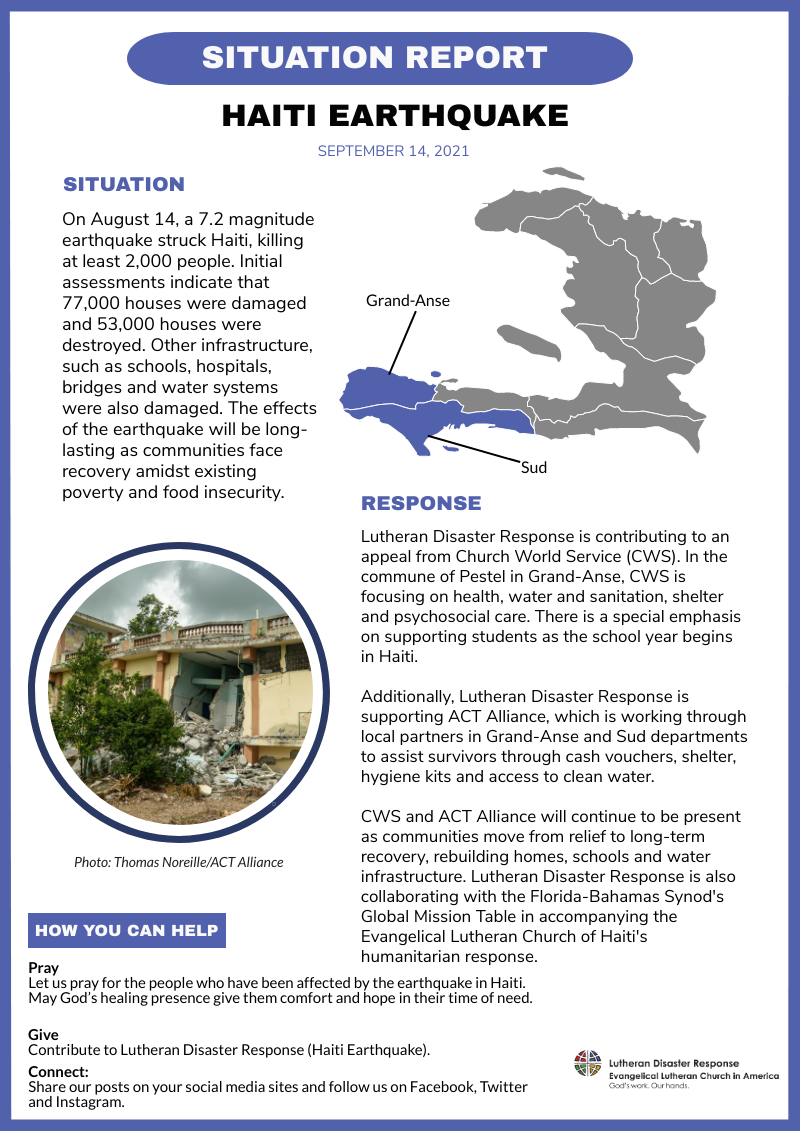
Two years ago today the largest earthquake in over two hundred years struck Haiti. Mixed with the already impoverished conditions of the country, the powerful quake left 220,00 dead (including ELCA seminarian Ben Larson), 300,000+ injured and 1.5 million homeless. The immediate response was overwhelming in size and scope as relief agencies around the world began to respond and people began to give. In the ELCA alone more than 13 million was given through ELCA Disaster Response.
Yet, as the full extent of devastation became known, people realized that much more was at play here than the aftereffects of a major disaster. Part of the issue was that relief work is focused on bringing people back to normalcy as they put their lives back in order after a tragedy. In Haiti the “normalcy” prior to the earthquake was over 70% of the country living on less than $2/day, 86% of the people in the capital Port-au-Prince living in slums where half of the city had no access to latrines and only one-third had access to clean water. As people began relief (short-term) efforts they quickly realized their actions could also contribute to development (long-term) opportunities in the country.
Haiti relief efforts has become a watershed moment in how we understand disaster relief and international development as part of a holistic response. As we look back today in somber remembrance of those lost and the lives impacted by this tragedy, I believe it a fitting tribute to see what we have learned about creating better capacity to mitigate the effects of disasters and learning how to connect this work with longer-range development.
Colombia has had more than its fair share of rain this year. This has also been a region-wide issue with Colombia’s neighbors to the north in Central America (Nicaragua, El Salvador and Guatemala) and southern Mexico, also being it by over 10 days of heavy rain in October. This led to widespread flooding and mudslides. One of the major effects was that much of the year-end harvest and seedlings for next year’s planting were destroyed.
A Lutheran World Federation (LWF) blog posts about Colombia gives an update on how the initial emergency relief work has finished up there. The response was made more difficult because of the armed conflict that has been ongoing for 20 years between guerrillas, paramilitaries and the army in the Choco district of the country. This means that for many in the region it is not safe to venture far from their village. This in a district that is home to some of the hardest hit and poorest people in the country.
To help meet the need the LWF was part of an immediate relief effort to deliver 200 food kits to the hardest hit families in the region. They also helped distribute seeds for subsistence crops to help restore food security. This is particularly important for the indigenous populations subsist off of exchanging food.
You can find the full post here: Food, seeds and hope in the ACT Colombia flood response
Also, check out the ACT Alliance overpage Colombia: Conflicts and Floods to see pictures and a video of situation.
To learn more about the ELCA response in Central America see the ELCA Disaster webpage Central America Flooding.
————-
Gifts to ELCA International Disaster Response allow the church to respond globally in times of need. Donate now.
The following report from the LWF (Lutheran World Federation) gives an update of the situation following the deluge that has been hitting Centeral America since early this month. The issue is not just that it has been raining consistently but that the rains have been extremely intense. This has caused massive flooding and mudslides throughout the region that have led hundreds of thousands to be displaced and over 100 fatalities.
Please remember the people of the region in their time of need.
LWF post: LWF and ACT Take Action as UN Office Says 150,000 Affected in Salvador
ELCA Disaster Page: Central America Flooding
————-
Gifts to ELCA International Disaster Response allow the church to respond globally in times of need. Donate now.
The following testimonials are from people working within the Lutheran church in Nicaragua, ILFE [Iglesia Luterana Fe y Esperanza], after their attempt to bring aid to Aquespalapa, a community affected by severe flooding in their region. May God’s hands continue to hold them in their time of need and may our prayers sustain them in their good work.
“I could see in the journey to Aquespalapa a lot of water, flooding, and that everything in the fields was dead. I saw cattle that were trying to eat the last of what was in the pastures; there was the Estero Real River which had overflowed its borders and flooded the community. We also encountered many people in the area fishing, I imagine that they had probably nothing to eat and were looking to other resources. We finally arrived to the main entrance to the community; we could not advance any further because the water covered the road, created deep holes, and was also in all the houses. It was very sad that we could not enter and help our brothers since they had called us from within the community to ask for our help. We have hope in God that the water ceases and allows us to enter into the community the next trip we make so that we can help our brothers.”
“I started the day with a lot of hope and this hope continues for our brothers in the communities. However my hope does not change the fact that we could not enter into the communities of Aquespalapa and Jicote. We saw many signs of the disaster in our excursion to the communities; flooded fields and houses, destroyed highways, and lost crops. All of these we saw before we even made it to the community. At the entrance to the community we had to stop because the road was underneath water. We saw a tractor pass into the community but it was not possible in our pick-up truck. We were so close but we could not bring the help, the food, nor the hope that we had brought with us to give to our brothers. For me, this was the most difficult; to be so close, but without the power to do anything. However I know that our brothers need and will continue needing our help and the Nicaraguan Church of “Fe y Esperanza” will be present with the helping hand of God for our companions in Christ!”
“My years are already many with my work experience within ILFE and there have been many humanitarian aid activities in which I have participated, however that does not mean I am not impacted of how once again a natural phenomenon can cause such a large disaster and affect the poorest people. Before my visit to Chinandega, I did not believe that the damage was that great because in the city, where I live, even though the rains have been strong, you do not see many effects. I went with much enthusiasm and love to take this small packet of food, but more importantly, to take the word of God and give all the people who are suffering a message of hope. I am full of great sadness that we could not make it to the community because the road was flooded and the current threatened to take our car. The team made the painful decision to not risk it and instead return to Managua until the water subsides so that we can try again to enter the community. I took a camera and tried to capture what most impacted me and now I share that with you all.”
————-
Gifts to ELCA International Disaster Response allow the church to respond globally in times of need. Donate now.

A road outside of San Salvador isturned to mud by torrential rains and has become impassible. Credit: ACT/Thomas Ekelund
The ELCA, through its Internatial Disaster Program, is staying in contact with our companion churches in the region and the Lutheran World Federation to assess the situation and possible responses. The ELCA already has funds positioned in Guatemala(~$20,000) and has released funds for Nicaragua ($3,153) that will be used to help meet the immediate needs of the region. As the situation develops we will be posting information on the ELCA Disaster webpage and here on the blog.
For an initial report from the region, see the ACT article by Thomas Ekelund Central America: death toll from torrential rains rises.

Community health workers speak to residents about steps they can take to prevent the spread of cholera. Credit: ACT/Paul Jeffery
The Lutheran Church in Haiti is responding in two of the hardest hit areas, targeting 17,000 families (approx. 100,000 people), by providing management of patients and prevention education and efforts. This new phase, running from May to October, is a continuation of an earlier phase that ran from February to May. The focus of both phases is on educating and supporting families by sharing ways to prevent the spread of cholera and what to do once a person becomes infected. As part of this effort a mobile medical and paramedical team of 90 health agents, 2 doctors and 4 nurses has been mobilized. So far the earlier intervention has led to 430 lives saved and 3,100 cases of cholera contained.
————-
Gifts to ELCA International Disaster Response allow the church to respond globally in times of need. Donate now.
I had the pleasure yesterday of sitting with Bishop Eduardo Martinez of the Evangelical Lutheran Church of Colombia (IELCO) to gain his perspective on what has been happening in his country. Here is a bit of what we covered:
The major point relayed by the bishop is that the situation in Colombia is worsening. With reports that the rains last month were equal to the annual rainfall of Colombia and the excessive rains over the past year, many have been left without access to housing or food as they are forced from their homes by the rising waters and left incapable of harvesting the sustenance crops they live on. There are also dangers for people as the move onto higher ground as mudslides have become more common. This all would be a crisis enough on its own, but with somewhere between 3.5 and 5 million people already listed as IDPs (Internally Displaced Persons) within the country these new additions have begun to overwhelm aid agencies.
With this new situation the government has been calling on the churches to lend a helping hand. The bishop described how the IELCO is historically been focused on responding to the humanitarian crisis but with this new situation they are finding way to build on this work to address the humanitarian concerns of disaster response and development. To this end they are working on a proposal for the Latin American Council of Churches, ACT Alliance and ELCA to help meet the growing needs of the people.
The bishop also attended the synod assembly of the Southeast Synod of Minnesota and will attend the assembly of the South Carolina Synod, both of whom have companion synod relationships with IELCO. His hope is to share the story of his people so that their brothers and sisters in the ELCA may know of their situation.
Please pray for Bishop Martinez, the Evangelical Lutheran Church of Colombia and all Colombians that the spirit of Christ may sustain them through this time of crisis and the Easter message of life from death, creation from destruction, may continue to give them hope.
————-
Gifts to ELCA International Disaster Response allow the church to respond globally in times of need. Donate now.
During an interview with Orion Samuelson for “This Week in Agribusiness” (video), Bishop Hanson took time to speak about his experiences visiting Haiti in February. He told stories of seeing a people “defined not by the rubble, but by restoration,” a quote he got from the president of the Lutheran Church in Haiti, Rev. Joseph Livenson Lauvanus. He shared of the forest restoration project funded by the ELCA and partners like Lutheran World Federation and the Lutheran Church in Haiti to replace trees cut down for survival after the earthquake, of a coffee cooperative that was funded in part by the ELCA prior to the earthquake that still thrives after, and of other farming, vocational and housing projects underway.
To learn more read the ELCA News Release.
————-
Gifts to ELCA International Disaster Response allow the church to respond globally in times of need. Donate now.