Prepare
The Road to Emmaus story is chock-full of theological imagery and imagination. We meet disciples and Jesus on the road and yet something is keeping the disciples from recognizing Christ. There’s a lot that could be explored as to why the disciples don’t recognize Jesus throughout their entire conversation, especially in light of other resurrection stories we have about Christ where folks recognize him immediately. Moreover, it is theologically significant that his identity is revealed through the Eucharist. It is as they break bread that Christ is recognized for who he is. The meal is the disciples “touching of the wounds” moment that Thomas was so desperate for. The meal is where Jesus is the most recognizable version of himself.
The gospel of Luke, more than the other gospels, emphasizes roads and journeys for both Christ and people of faith. It is fitting, therefore, that we meet Christ on the road as the disciples’ doubts, questions, and pain swirl around them. Their movement in the passage reflects where the disciples are in their processing. They are moving and progressing forward as they are vulnerable with each other and this stranger. When they cry out that they had hoped Jesus really was the messiah, they reveal their underlying fear: it now appears he was not. It isn’t until right before Christ is revealed to them that they find a place to stop and sit with their grief. Once he is revealed, the disciples are on the road again, this time to redeem the story that was told as they left.
Opening Exercise
Are you currently hoping for anything in particular? What does it feel like to hope for something with true hope (something you cannot work towards on your own, but something you have to trust God, or someone else, to come through for you?).
Read the Text:
When Easter Hope Isn’t all Shiny and Pastel
A few years ago I was talking with a friend about her husband’s cancer diagnosis. In this conversation I could feel the
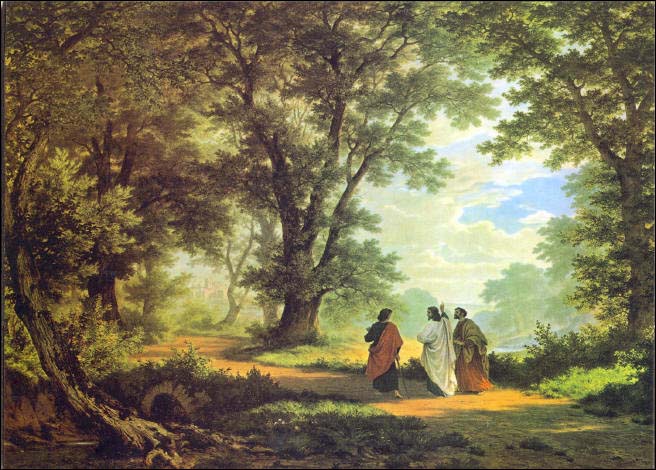
The Road to Emmaus (Gang nach Emmaus), 1877, by Robert Zünd. Public domain, via Wikimedia Commons.
sadness and frustration starting to get me down so I said something along the lines of “but we’re hopeful the next treatment will work!” I am ever the person to add sugar to a terrible situation. Luckily, my friend was willing to be honest and vulnerable with me. She said, “honestly, I’m feeling kind of burned by hope. I’d rather not.” I was stunned…Isn’t hope a good thing?
But she shared that they’d been hoping. That they had hoped the tumor wasn’t cancer at all and then it was. They had hoped the cancer wouldn’t progress and then it did. They had hoped chemo would work and then it didn’t. She, like the disciples on the road in our story, was tired of hope.
When you think about it, hope sets us up to be burned a time or two because, when we start hoping, our whole demeanor changes. We go from a place of accepting our circumstance to dreaming about what things could be like if God, or someone more powerful than we are, stepped up. It’s the dreaming that makes hope dangerous. The disciples who met Jesus on the road had been hoping that Jesus was going to redeem Israel. When it looks like that hasn’t and won’t happen, they are down worse than they were before they met Jesus. They are more upset than when they had no hope.
Easter Hope
What really gets the disciples is that they assume this is the end of the story. They have left the other disciples, wallowing as they walk back towards their lives before hope. But that isn’t how Jesus works. They stop having hope because they tied their hope to very specific outcomes. They hoped that Jesus would redeem them in an earthly battle. They hoped Jesus would never die. They hoped in far smaller ways than our God works.
When Jesus is revealed in the meal, what the disciples start to see is that their hope made Jesus way too small. They didn’t need to hope he wouldn’t die, because he overcame death. They didn’t need to hope that Jesus would win some earthly battle leaving some new people to be corrupted by power while others struggled. Christ brings the Kingdom of God in which there is abundance for everyone and nobody is lesser than anyone else. This story shows us the danger of hope in our world, not because we might be disappointed (though that’s always a bummer), but because if we hope with too much specificity we might miss who God is altogether.
When we hope, we hope in a God who is doing far bigger things than our imaginations can handle. The same God who has kept my friend’s husband alive and well for far longer now than any doctor expected.
Reflection Questions
- What do you think the disciples had hoped would happen instead of the cross?
- When have you missed, or almost missed, something really good because you were hoping for something else?
- How can we hope while being faithful to how gigantic our God is? How do we make sure our hopes aren’t putting God in a box?
Closing Activity
Have students get into pairs and share their hopes. Invite them to gently “correct” each other until their hope is Christ sized, not limited to our own imaginations.
Here’s an example:
- I hope my friend gets better.
- I hope my friend is no longer in pain or the hospital.
- I hope my friend is able to live a rich and happy life with/without their illness.
Once each student has a God-sized hope, share them with the group.
Closing Prayer
Prayer of Good Courage:
O God, you have called your servants
to ventures of which we cannot see the ending,
by paths as yet untrodden, through perils unknown.
Give us faith to go out with good courage,
not knowing where we go,
but only that your hand is leading us
and your love supporting us,
through Jesus Christ our Lord. Amen.
Bio
Lindsay Batesmith is the pastor of Rejoice Lutheran Church in Erie, CO. She is consistently in awe of the power of vulnerability to connect us to each other and invite the Holy Spirit to transform lives. When not at church or her favorite coffee shop, Lindsay is usually playing with her dog, Echo, or watching the Great British Bakeoff with her wife, Tillie.