
Skip to content

ELCA Blogs

November 16, 2025 – My Greatest Fear… Realized

Prepare

This lesson from Luke comes just as Jesus turns toward the cross. The dark times he alludes to are not in some far-off future. His arrest and crucifixion are only days away.

These verses are not a springboard to the future, a map to God’s plan for this world, nor a dire warning to God’s people of what lies ahead. They point not to some future time but to our present fears, addressing the deepest parts of our doubt, grief, anger, guilt, and pain, whether we believe them deserved or not, whether the source lies within us, or with someone who has hurt us deeply.

Jesus’ words, and more importantly, Jesus’ promise, are about today, this day.

Opening Exercise:

What is it you worry or wonder about the most? Your deepest fear, the recurring doubt, or insecurity you hold?

Don’t share this with the group but be mindful of it as you listen to Jesus speak to his disciples about dark times ahead. He gives them only one instruction, listen for it.

Text Read Aloud

Luke 21:5-19

My Greatest Fear… Realized

The passage begins with the disciples admiring the beauty of the Jerusalem temple, recently renovated by Herod the Great. It was a structure many saw as a testimony to God’s power and providence, and, as public works often are, a reminder of Herod’s own power and ambition. Things quickly turn grim as Jesus speaks of the temple’s destruction and dark times ahead for not only the world, but for those who follow Jesus’ teaching. He tells them they will endure great suffering.
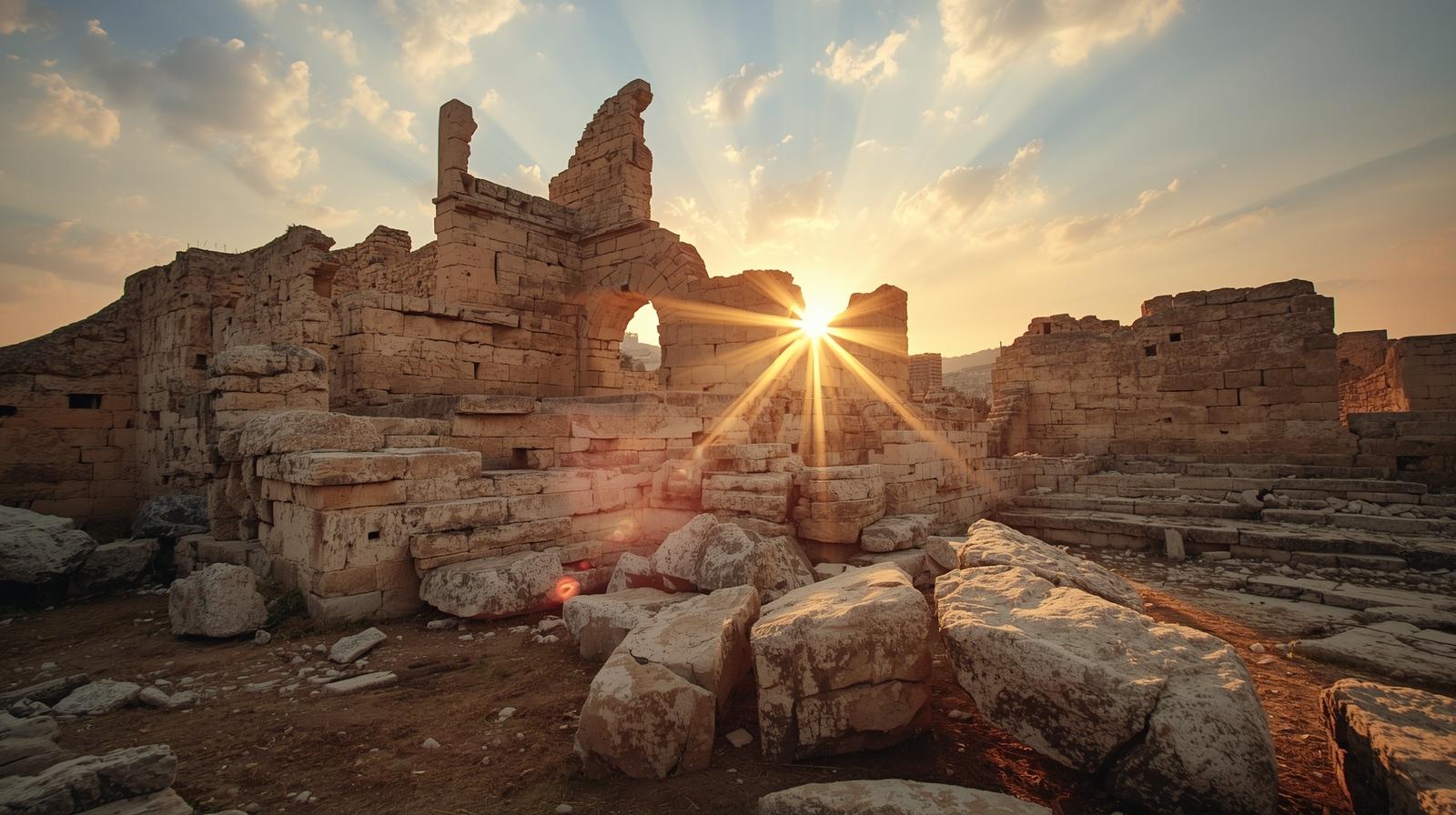
The disciples are quick to ask when this will happen and what signs to watch for. However, the signs Jesus speaks of are vague and imprecise enough to fit all times throughout history. There has never been a time when the world was free of war and insurrection. The darker truth is that there is never time when those who follow Jesus have lived problem free lives.

Jesus never hid the high cost of discipleship. Persecution need not come from those lording over us. Fear, doubt, and insecurity relentlessly pursue us in life. As to suffering and betrayal, those too, wait in ambush throughout our life’s journey. Not in the abstract but in our families, our relationships, our lives.

Following these grim and dire words, Jesus surprises once again with a prescription and a promise. The odd prescription, “…make up your minds not to prepare…” is more of a non-prescription. In essence, “Don’t worry about it.” And the promise is Jesus himself, “…I will give you words, I will give you wisdom… not a hair of your head will perish.”

Reflective Questions

  • What kinds of hardship or warning does Jesus say his followers will face, and what does he promise them in return?
  • Why do you think Jesus tells his followers to “make up your minds not to prepare your defense”? What do you think that means?
  • Jesus gives what sounds like an impossible task, not to worry when our hopes and dreams lie shattered and crushed. Who comes to mind as someone who has exhibited faith, trust, or hope in the face of great adversity?
  • What person or place can you turn to today with the troubled parts of your life?

Closing Activity

Two Options:

  1. Think back to when you were very young, before school or in early childhood. What was something you were afraid of then that turned out not to be true or not worth fearing? Share that story with someone else or the group.

Then, reflect together:

    • What helped you realize you didn’t have to be afraid?
    • How might that experience help you trust God now when fears or worries rise up?
  1. Give each person a small stone (to represent the temple’s destruction). Ask them to hold it while reflecting silently on something in life that has felt like it’s “falling down” or uncertain. Then, read aloud Jesus’ promise: “Not a hair of your head will perish.”
    Invite participants to set down their stone in front of a cross or candle as a symbol of placing their fear and trust in Christ.

Final Prayer

God,

Help us trust your promises when they don’t feel real in our lives. Thank you for those people in our lives whose wisdom and faith strengthens ours. Open our ears and our hearts so we can reach out with words and actions encouraging others when they feel helpless and hopeless. Amen

Bio

Pastor Bob Chell’s Dad took him to watch fire fighters train on an abandoned house when he was very young. He thought—and worried—for years that fire fighters drove around in their trucks looking for houses that were in disrepair burn down. Now retired, he pastored congregations, campus ministries and a prison congregation.


Share

October 1-8, 2008 – After 85 years, Yankee Stadium closes

Warm-up Question: Have you ever thought you did a good job following directions only to find out that you missed the bigger picture or objective? What were you doing? What were you were missing that was right in front of you the whole time?

Derek Jeter stood on the mound with teammates to begin the final farewell. Over 54,000 fans listened, as many had for decades to the voices of great baseball players like Lou Gehrig, Babe Ruth, Joe DiMaggio, and Mickey Mantle. The pre-game celebration included 21 retired players, six who are Hall of Famers, and the 92-year-old daughter of Babe Ruth who threw out the ceremonial first pitch.

Jeter encouraged the fans to take the memories from the old stadium to the new, which will be completed across 161st Street at a cost of $1.3 billion. While the new stadium will also be called Yankee Stadium, it just won’t be the same for longtime fans, who lingered in the stadium after the game. Even Yankee staff and interns stayed as late as 4:00am the next morning as they struggled to let go of the traditions and past.

Every aspect of the night was full of nostalgia, from Yogi Berra, now 83, appearing in a full vintage uniform, to the 1922 American League pennant being unfurled in center field. The Yankees have won more World Series than any other baseball team. The marquee outside the stadium simply read, “Thanks for the memories.”

Roger Clemens was not invited to attend, nor was his name mentioned during the ceremonies. His name has been clouded by accusations that he used performance-enhancing drugs.

But there was more to celebrate than not, and by the time the grounds crew dug up home plate in the early morning following the game, a picture of Babe Ruth winking played on the video board, “See you across the street!”

Discussion Questions

  • Do you care about or pay attention to baseball traditions and history? Why or why not?
  • What traditions in your personal family have changed since you were young? Why did they change? Were the changes positive or negative for you? Why? How have you handled or adapted to the changes?
  • Name three rules or routines you have to follow on any given day — because you choose to or are required to do so. Why do you follow them? What seems to be important about maintaining the rules or routines?

Scripture Texts (NRSV) for Sunday, October 5, 2008.
(Text links are to oremus Bible Browser. Oremus Bible Browser is not affiliated with or supported by the Evangelical Lutheran Church in America. You can find the calendar of readings for Year A at Lectionary Readings.)

For lectionary humor and insight, check the weekly comic Agnus Day.

Gospel Reflection

Change is in the air. In the world of professional sports, where financial sponsorship is essential to survival, old stadiums are being torn down and replaced with new facilities named after corporate sponsors in most cases. (Even some public schools are using corporate sponsorships to fund buildings and programs.) One does not have to be a New York Yankee fan, or even a baseball fan to understand that one era has come to an end and a new era has begun.

One thing is for certain, no matter how exciting games may be at the new Yankee Stadium, cries will come from those who attended games at the old stadium: “It’s just not the same.” And with the Yankees missing the playoffs for the first time in 13 years, the legacy and history of success truly gives way to a new beginning. There is a tremendous opportunity to be a part of the new face of success, a new future. Still, there will be people who don’t understand and won’t participate in or support the new direction the organization is going, even in a beautiful brand new facility.

In our Gospel lesson today, we probably identify with the answers given by the crowds to Jesus’ question (vs. 40). Everyone understood that the wicked tenants mentioned in the parable were deserving of punishment; the point of the parable was so obvious!

The people listening felt connected to Jesus’ message, but they didn’t seem to realize that they were in the presence of the living, promised savior. How surprised they must have been, especially the chief priests and Pharisees, to realize that Jesus was talking about them when he said the kingdom of God would be taken away and given to those who produced the fruits of the kingdom.

These leaders who had been charged with keeping of the long history of Jewish tradition and teaching the rules missed the point though. Change wasn’t coming; change was present and happening. The fulfillment of God’s promises, and the continuation of God’s new relationship with his people, was standing right in front of them — Jesus.

Their role in the history of God’s chosen people was in jeopardy. They knew their duties and routines, but they did not yet know the savior and fulfillment of God’s promise, who was teaching right there in their midst. They thought Jesus was just another prophet, and that nothing had changed.

You and I have the benefit of living in a post-resurrection world. We are guided by the Holy Spirit to understand God’s will and relationship with us, and to produce the fruits of the Spirit. Even more so, we live as forgiven servants, met by Christ at every moment in every day. Christ finds us were we are and guides us to participate in the promises of his resurrection: new life, hope, and the ability to dramatically change how we live knowing that we are forgiven children of God.

How will we respond?

Discussion Questions

  • The chief priests and the Pharisees were the caretakers of Jewish law and traditions. How do you view their desire to arrest Jesus as he told the parable of the wicked tenants? Read Matthew 21:43-44. Does that change your opinion in any way? How?
  • Have you ever questioned the authority of someone else? What motivated you to stand up against them? Why was it important to speak up? Thinking about it now, would you handle it the same way today? Why? Why not?
  • If it is our responsibility to ‘produce the fruits of the kingdom’ (vs. 43), how do we define them; what are they? What are you/we called to do with the help of the Holy Spirit in this day and age?

Activity Suggestions

  • Split into two groups. Role-play the parable and the reaction of the chief priests and Pharisees. One group watches and one listens. Switch groups and act out the parable and reactions a 2nd time. Does your opinion change depending on the role you played? Why? Why not?
  • Find out what your congregation’s mission statement says. Take a moment to quietly write your interpretation of the mission statement. Share your comments as a group. How do the actions of individual members and the entire congregation compare to the statement? What are you doing well? What might need to change?
  • Take a few moments to quietly write your own mission statement as it relates to your faith in action today. Share your individual mission statements. Keep them, and check in at a later date to see how your everyday life compares to your intended mission. Do some rewriting and revising, if you need to.

Closing Prayer

Merciful God, speak to us daily through your Spirit and guide us through your sacrifice in Jesus to be productive and loving servants in your kingdom. Amen

Contributed by Matthew R. Nelson
Walla Walla, WA

Share