
Skip to content

ELCA Blogs

January 11, 2026 – Preparing the Way for New Things

Prepare

This week’s Gospel reading is brief and familiar, so looking back at Matthew’s opening chapters helps us see the context for Jesus’ baptism and the figures who prepared the way.

Matthew begins with a genealogy, reminding us that Jesus’ story is rooted in humble beginnings. Then we meet Joseph, who responds to angelic messages with courage—adopting Jesus, honoring his vow to Mary, and protecting the Holy Family from Herod’s wrath. Next comes the Magi, who defy Herod’s orders through civil disobedience, ensuring Jesus remains safe.

Finally, some years later, John the Baptist appears in the wilderness, preaching repentance and baptizing in the Jordan. Crowds gather—Jews and Gentiles alike—as John calls out injustice among both the royal family and religious leaders. Like the prophets before him, John points beyond himself to the One who is greater, preparing hearts for Christ’s arrival.

As many worshipping communities affirm baptismal promises on this Baptism of the Lord Sunday, these chapters remind us that even Jesus entered the waters with guidance and support. From the start, Matthew shows that discipleship is communal—woven through family, neighbors, and prophetic voices. Jesus’ life bears witness to this truth: we walk the journey of faith together, grounded in God’s promises and strengthened by one another.

Opening Exercise

Did you make a resolution this year? Maybe your resolution matches one of these most popular resolutions from a recent YouGov.com US poll.

  • What immediate thoughts do you have about this list? 
  • How many of these most popular resolutions are personal or internally focused? 
  • How many are community-based or externally focused? 
  • What do you believe these resolutions say about our society or culture?

Texts to Read Aloud

Isaiah 42:1-9

Matthew 3:13-17

Preparing the Way for New Things

A power couple in the ancient Roman pantheon, deities Janus and Jana were guardians of beginnings, transitions, and
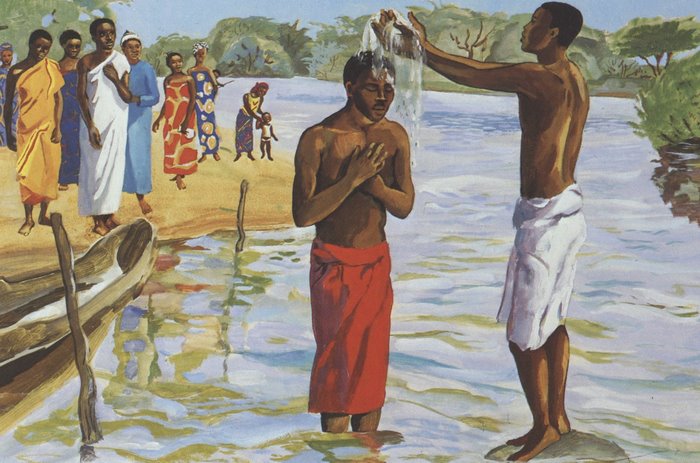
John baptizes Jesus*

doorways. They were often depicted with two faces—one older, looking backward, and the other younger, looking forward—symbolizing reflection on the past and anticipation of the future. This duality makes them central to the New Year, as January—the first month—is named after Janus. Since before Jesus’ time, people have embodied this double gaze at the start of a new year: looking back with wisdom and forward with hope. That perspective helps us read today’s Gospel, where something new happens at the Jordan River.

Matthew’s brief account of Jesus’ baptism is a hinge moment. Jesus arrives from Galilee; John hesitates. Jesus insists. The waters receive him. The Spirit descends like a dove, and a voice from heaven declares, “This is my Son, the beloved.”

Why does Jesus insist on baptism? He does not need repentance like the others John baptized. Yet, Jesus chooses solidarity—stepping into our story to launch God’s new creation. As at Christmas, this is another incarnation moment. “To fulfill all righteousness” is not a checkbox; it’s a covenantal act—God joining humanity and opening a path forward. The Spirit’s descent and God’s voice make this a communal blessing: God’s life poured out for the world in a very public way for the first time in Matthew’s Gospel. This is not just an origin story for Jesus’ public ministry—it’s a sacramental reveal of God’s way in the world: relational, embodied, transformative.

Standing beside Jesus in the water is John—a trending wilderness prophet dressed in camel’s hair, eating locusts, and calling out the injustices perpetrated by kings and religious elites. John is popular—very popular. Crowds flock to him: Roman soldiers, Jews and Gentiles, rich and poor. He calls people back to covenant faithfulness, modeling a kind of fiery devotion to God and neighbor that is not dressed in fancy robes or crowns.

John could have refused to baptize Jesus because this was a new and different kind of baptism. He could have grown jealous or seen Jesus as a threat. He could have capitalized on or even monetized his wilderness fame. Instead, he uses his influence to spotlight Jesus. His viral quote: “He must increase, but I must decrease” (John 3:30). Instead of trying to gain more followers, John freely chooses to point many away from himself and loose his flock to Jesus’ care. That’s not just humility—it’s a countercultural resolution in a world obsessed with riches, followers, and fame. If John had a New Year’s resolution, it might read: “Less me, more Messiah.”

So what does this mean for our double gaze this January—looking back with wisdom and forward with hope? This new year and this holy day give us a chance to revisit our baptismal identity. It’s an opportunity to reaffirm our baptism daily and to let the promises made at baptism define this new year. It’s an invitation to posture ourselves like John in practicing prophetic hospitality—using your influence to point to Jesus in tangible ways for the good of creation or aligning more fully to what the Church is already doing, bringing justice to broken systems and communities. 

Finally, may we stay open to the new things God may be doing in our life together, even if it causes a moment of hesitation, as we look to Jesus daily and follow after his ways in 2026.

Reflection Questions

  1. What all happens at Jesus’ baptism in Matthew 3:13–17? 
  2. Why does John the Baptist hesitate to baptize him?
  3. How does baptism reflect both remembrance and new beginning?
  4. John uses his influence to point others to Jesus instead of building his own fame. This year, what is one concrete way you could “decrease” and point others to Jesus—one action you can commit to for the next month (examples: a weekly act of service, a social-media habit, inviting a friend to church or youth group, joining a justice project)?

Closing Activity

Ask each person to choose one promise from the Baptismal covenant (“Affirmation by the Assembly,” Evangelical Lutheran Worship, p. 237), or to create a new year’s resolution based upon one of these promises. Write it down or discuss ways that the group might make these resolutions come alive and really stick in 2026.

Closing Blessing or Prayer

Consider closing with a Remembrance of Baptism. Prepare a bowl of water and use the words from the Thanksgiving for Baptism in Setting One (ELW, p. 97) or a similar liturgy. After speaking the liturgy, make the sign of the cross on each person’s hand or forehead with water, encouraging them to remember their baptism. Use chosen names to honor each person as they present themselves today.

If a Remembrance of Baptism is not possible or is already part of your worship, consider another closing. Psalms are not just ancient poetry—they are prayers. Psalm 29 offers a powerful reminder that, despite the turmoil in our world and nation, God reigns above all. God does not condone evil but calls us to honor God’s will and partner with our Creator in bringing wholeness to a broken world. Close by reading Psalm 29 together as a prayer.

Biography

Aaron Shoppa serves as the Program Director for Youth Ministry with the ELCA. His greatest joy in this vocation is connecting with other youth leaders across the nation and deeply listening and engaging with their hopes and concerns as they live out this important ministry. While not at work, Aaron keeps busy chasing three young kids around the house and attending to his millennial midlife-crisis by planting way too large of a vegetable garden. 

* JESUS MAFA. John baptizes Jesus, from Art in the Christian Tradition, a project of the Vanderbilt Divinity Library, Nashville, TN. https://diglib.library.vanderbilt.edu/act-imagelink.pl?RC=48290 [retrieved January 7, 2026]. Original source: http://www.librairie-emmanuel.fr (contact page: https://www.librairie-emmanuel.fr/contact).


Share

December 7, 2025 – Repentance and Rest

Opening Activity Part 1

Set Up: As you gather with people, have a jar of gummy worms and a jar of honey at each table being used for this activity. Hand out at least two gummy worms, if not more, and preferably blue in keeping with the Advent season. The jar of honey is only for decoration purposes, reminding everyone of John the Baptist’s meal of honey with locusts.

Invite all participants to think of each gummy worm as a physical reminder of something that they have done over which they feel grubby. They do not have to share what these are. Remind them that we are all human, make mistakes, and need to reassess our words and actions. Some examples could be:

  • a mean word shouted at someone
  • a nasty comment left on social media
  • not sharing from our abundance
  • holding ill-will towards those who are different

Remind all the participants that these grubby feelings and actions are a part of what makes us messy humans. It is important, then, that we accept that we have made mistakes and will continue to make mistakes in the future. When we do, we will feel grubby again and again. Instead of being afraid to come to terms with our words and actions, our faith teaches us to face them head-on, make amends, and choose a different future.

Read Text Aloud

Matthew 3:1-12

Rest as Repentance

This gospel lesson reminds us that the holiday season is not simply about beautiful lights and presents. Our faith tradition also invites us to pause, reassess our words and actions, and take corrective action. Amid cheerful music and tinsel-covered trees, we hear the strong words from John the Baptist:

“Repent, for the kingdom of heaven has come near.” … “You brood of vipers! Who warned you to flee from the coming wrath?  Therefore, bear fruit worthy of repentance …” (Matt. 3:2, 7b-8a)

In not mincing words, John the Baptist firmly invites us to reconsider what it means to live as messy humans all the while claiming to be followers of God. He is inviting us into repentance as part of what people of faith are called to practice.

According to the likes of the Apostle Paul, Saint Augustine, and Martin Luther, sin is selfishly turning inwardly into one’s own self. Adversely, Repentance is generously turning outwardly towards God and the neighbor.

Repentance looks like letting go of our angry comments, setting aside our selfishness, and then choosing to be kinder, more generous, and open to what God might want us to do. In a seemingly strange way that can only be experienced by those who choose this path, repenting allows us to rest.

Through repentance we are freed from anger, selfishness, and hatred. In repenting and bearing new fruit, we taste the sweetness of what being a follower of Jesus is and can be for us in this world.

In my context (Minneapolis, MN), many of my beloved neighbors are being demonized. Angry, selfish words have been shared from the highest levels of power. This implicates all of us, whether we agree with the words or not, because we are all a part of this society. The prophet John is inviting us to remember that, as people of faith, we need to repent. What will it look like for us to set aside the angry, selfish words put forth by our leaders so that we can rest in the sweetness of a new way?

Opening Activity Part 2

Focus on how important it is to remember that we are not broken, but simply human. And that even in our biggest mistakes we are still beloved children of God. Not only that, but we will continue to make mistakes (big ones and small ones) over and over again. However, as people of faith, we are asked to always be reassessing our words and actions, make amends, and choose a different future.

This is the way that God invites us into deep rest. Repentance actually frees us from the words, actions, and feelings that often weigh us down. Repentance is a sweet gift from God who understands (and loves) the humans God created.

  • What does repentance look like for Jesus followers today?
  • Once again, think about the words, actions, and/or feelings that are making you feel grubby today.
    • Remind them that, even in our deepest mistakes, God still loves us. However, as people of faith, we have the sweet release of repentance.
  • Finally, invite participants to silently set aside their angry thoughts, words, and actions. Then, lead them in a prayer of repentance such as:

“Most merciful God, we confess that we are captive to sin and cannot free ourselves. We have sinned against you in thought, word, and deed, by what we have done and by what we have left undone. We have not loved you with our whole heart; we have not loved our neighbors as ourselves. For the sake of your Son, Jesus Christ, have mercy on us. Forgive us, renew us, and lead us, so that we may delight in your will and walk in your ways, to the glory of your holy name. Amen.[1]

Closing Activity

Invite all participants to think about how they might make amends and/or choose a different future way of speaking, acting, thinking, or feeling.

If anyone is comfortable sharing their thoughts, have them do so. If not, share that they can talk to a pastor, deacon, or lay leader so that they can come up with plans for amends privately.

Remind them that repentance is not to shame us for being human, but it is a sweet release that allows us to rest. It is also a part of what we are called to do as people of faith, especially during the Season of Advent.

Ending Prayer

It is very important that the pastor, deacon, or lay leader speak the words of forgiveness to everyone who has participated. They may choose to say:

“God, who is rich in mercy, loved us even when we were dead in sin, and made us alive together in Christ. By grace we have been saved. In the name of + Jesus Christ, our sins are forgiven. Almighty God strengthen us with power through the Holy Spirit, that Christ may live in our hearts through faith. Amen.[2]

Immediately after this, invite all participants to eat their gummy worm(s) and enjoy the sweetness of repentance as they rest in God’s forgiveness.

[1] Evangelical Lutheran Worship, pg. 95

[2] Evangelical Lutheran Worship, pg. 96, edited.

Bio

David Larson-Martínez is a consecrated deacon of the Lutheran Diaconal Association and an ordained pastor serving at Holy Trinity Lutheran Church in Minneapolis, MN. A graduate of Valparaiso University and Luther Seminary, he grew up in Cuernavaca, Mexico and now happily calls the Twin Cities home. David treasures his large cross-border family—his mom, five siblings, and a growing crew of nieces and nephews who live in both Mexico and the United States.

Share