In observance of Arab American Heritage Month, ELCA Racial Justice Ministries invited Dr. Ryan LaHurd to share his thoughts on this topic with our readers.
April is Arab American Heritage Month. As an Arab American, I might be expected to write about all the great things Arab Americans have contributed to our culture. But as I think about anti-Arab attitudes in the United States and the massive destruction of innocent lives in the Middle East, I must focus on something more substantial.
We used to hear that Inuit people have hundreds of words for snow. The later correction is that they have dozens. But the principle remains: people have words for things that are important to them. In the U.S., we have no useful word for prejudice against Arabs. Some people speak of “anti-Arab racism.” But Arabs are not a race. Arabs are a cultural group from many different countries whose primary language is Arabic. Others describe such prejudice as “orientalism.” But that term denotes anti-Arab stereotypes from early colonialism: the belly dancer, the “camel jockey.” People uneducated, uncultured and unclean. Since 9/11, we have heard about “Islamophobia.” This word refers not to Arabs but to the religion of most Arabs. Unhelpfully, using it reinforces a common misunderstanding that all Arabs are Muslims and that all Muslims are Arabs. In fact, an estimated two-thirds of Arab Americans are Christian.
So what’s the problem with our having no word for such prejudice? Back to linguistics. We have words for things that are important to us. No word = not something we care about. Furthermore, studies have demonstrated that we notice the things for which we have names. For example, study participants who spoke Russian — which has separate words for blue, light blue and dark blue — were much more likely than English speakers to distinguish lighter or darker hues on blue-colored paint chips.
Prejudice against Arabs and Arab Americans tends to be ignored — except, of course, by its victims. But it exists, and, like all ethnic and racial prejudice, it matters. In the U.S., such prejudice goes back to the earliest Arab immigrants, considered nonwhite and from “inferior” cultures. For example, my family name is transliterated from the Arabic as “Lahoud” (rhymes with “the food”). It means “the one who stands alone” and refers to Jesus, identifying our family’s roots in early Christianity. My grandfather had so much trouble getting jobs because of anti-Arab prejudice that he changed our name to “LaHurd” to make it look and sound French. He got jobs but lost our history.
People whose lives we do not see, attend to or care about are much less likely to be considered the neighbors Jesus commands us to love and are much more easily dehumanized. We have seen the tragic effects of such dehumanization recently in Israel, Lebanon and Palestine, where tens of thousands of innocent people, mostly children and women, have died and where millions more lives have been disrupted. Israel encouraged such dehumanization when it built walls and passed laws that eliminated contact between Jews and Arabs. Studies have unfailingly shown that having even a single personal connection with someone of another religion, race or ethnic group significantly reduces one’s prejudice against that group. Social psychologists call this the “contact theory.”
So I urge you to meet an Arab American, preferably a recent immigrant, and to hear their story. If that’s not possible, read such a story. Just be sure it’s a story written by an Arab. In his book The Message, U.S. writer Ta-Nehisi Coates argues, “If Palestinians are to be truly seen, it will be through stories woven by their own hands — not by their plunderers, not even by their comrades.”
As the great 12th-century Muslim philosopher Ibn Rushd wrote: “Ignorance leads to fear, fear leads to hatred, and hatred leads to violence. That is the equation.” That word “equation” reminds me of one last thing — Arabs invented algebra! We’re awesome.
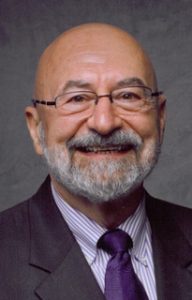
Ryan LaHurd is president of the ELCA’s Association of Lutherans of Arab and Middle Eastern Heritage (ALAMEH). He retired as president of the James S. Kemper Foundation in Chicago. Previously he was president of the Near East Foundation, an operational foundation doing development work in the Middle East and Africa. From 1994 to 2002 he served as president of Lenoir-Rhyne University in Hickory, N.C.
For more information: please visit Arab & Middle Eastern Ministries in the ELCA



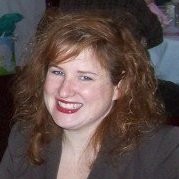 Robin Lauermann holds a Ph.D. in political science and is currently completing a certificate in theological studies at United Lutheran Seminary. She teaches and researches political behavior, institutions and change in U.S. and comparative politics. Robin currently serves as a board member of the ELCA Association of White Lutherans for Racial Justice.
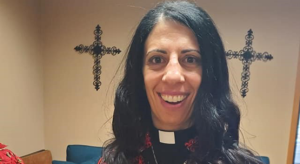 The Rev. Niveen Ibrahim Sarras was born and raised in Bethlehem, Palestine. She is the first Palestinian woman ordained to the ministry of Word and Sacrament in the ELCA. Her passion for the Bible started through attending Sunday school at the Lutheran Church of the Reformation and attending Lutheran school in Bethlehem.