Skip to content

ELCA Blogs

Steady faith, strong traditions, lasting impression

In honor of Arab American Heritage Month, ELCA Racial Justice Ministries will be elevating the voices of our Arab and Middle Eastern Descent peers and reposting their works from other sources around the ELCA. The following article is cross-posted from the Voices of Faith section of Living Lutheran online. The original post can be found here.
Steady faith, strong traditions, lasting impression

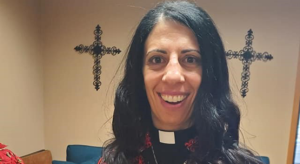
Courtesy of Grace El-Yateem

STEADY FAITH, STRONG TRADITIONS, LASTING IMPRESSION

An Arab American Christian reflects on her community’s quiet but profound impact on the American Lutheran life


April is Arab American Heritage Month in the United States. While this is a celebration of all Arab Americans—Christian and Muslim alike—I’m going to focus on Christians. As an Arab American Christian myself, I share this history to highlight the significant role this community has played in shaping American society and culture.

Arab immigration to the United States began in the late 1800s. The majority of these immigrants were Christians from Syria, Lebanon and Palestine, seeking economic opportunity, religious freedom and relief from political instability in their homelands. Most belonged to Maronite, Catholic and Greek Orthodox churches. These churches became more than places of worship—they provided spiritual guidance, helped newcomers find employment and fostered strong, cohesive communities. In this way, Arab American Christians maintained their heritage while adapting to American life.

When we think of American Lutheranism, it’s natural to picture the legacy of German or Scandinavian immigrants. Yet a small but vital part of the Lutheran story in America belongs to the Arab and Middle Eastern community. Though smaller in number, their contributions to education, social justice and interfaith dialogue have left a lasting mark on the Lutheran churches in America.

The roots of this community trace back to the mid-19th century in the Holy Land, where German and English missionaries established the Evangelical Lutheran Church in Jordan and the Holy Land (ELCJHL). Lutherans in Palestine and Jordan embraced a calling to diakonia, or service. They built world-class hospitals and schools that served all people, regardless of religion. When Lutheran Palestinians began immigrating to the United States—especially following the conflicts of 1948 and 1967—they brought with them this enduring spirit of service and a deeply rooted sense of identity.

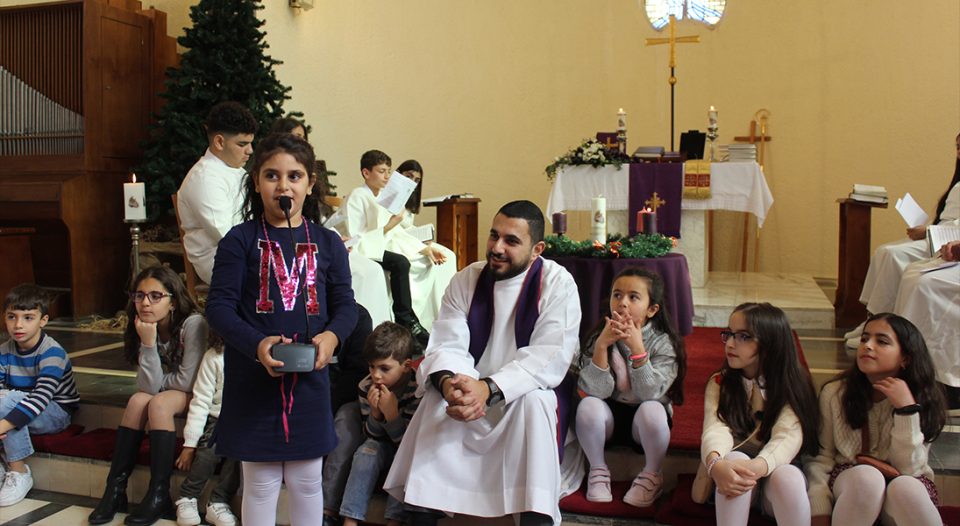
In the United States, Arab American Lutherans have established vibrant centers of community, including Salam Arabic Salam Arabic Lutheran Church in Brooklyn, N.Y., and Mother of Our Savior Lutheran-Episcopal Church in Dearborn, Mich. These congregations continue to nurture faith, culture and connection across generations.

One of the most significant expressions of this leadership is the Association of Lutherans of Arab and Middle Eastern Heritage (ALAMEH). Through its work, ALAMEH encourages the broader church to grow in understanding, strengthens community ties and amplifies voices that too often go unheard.

Arab American Christians have long served as cultural ambassadors, bridging American society with the rich history and traditions of the Arab world. Their witness demonstrates how diversity strengthens a nation, fostering both innovation and mutual understanding. Though a minority group, their impact is profound. Through their commitment to education and advocacy for the marginalized, they remind us that the story of Christ’s church is a global one—spoken in many languages, including Arabic.

As we observe Arab American Heritage Month, we are invited not only to celebrate but also to recognize the enduring contributions of immigrant communities to our shared life—both in this country and across the world.

Share

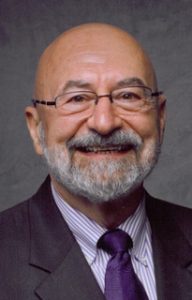
Happy Arab American Heritage Month by guest author Dr. Ryan LaHurd

In observance of Arab American Heritage Month, ELCA Racial Justice Ministries invited Dr. Ryan LaHurd to share his thoughts on this topic with our readers.


April is Arab American Heritage Month. As an Arab American, I might be expected to write about all the great things Arab Americans have contributed to our culture. But as I think about anti-Arab attitudes in the United States and the massive destruction of innocent lives in the Middle East, I must focus on something more substantial.

We used to hear that Inuit people have hundreds of words for snow. The later correction is that they have dozens. But the principle remains: people have words for things that are important to them. In the U.S., we have no useful word for prejudice against Arabs. Some people speak of “anti-Arab racism.” But Arabs are not a race. Arabs are a cultural group from many different countries whose primary language is Arabic. Others describe such prejudice as “orientalism.” But that term denotes anti-Arab stereotypes from early colonialism: the belly dancer, the “camel jockey.” People uneducated, uncultured and unclean.  Since 9/11, we have heard about “Islamophobia.” This word refers not to Arabs but to the religion of most Arabs. Unhelpfully, using it reinforces a common misunderstanding that all Arabs are Muslims and that all Muslims are Arabs. In fact, an estimated two-thirds of Arab Americans are Christian.

So what’s the problem with our having no word for such prejudice? Back to linguistics. We have words for things that are important to us. No word = not something we care about. Furthermore, studies have demonstrated that we notice the things for which we have names. For example, study participants who spoke Russian — which has separate words for blue, light blue and dark blue — were much more likely than English speakers to distinguish lighter or darker hues on blue-colored paint chips.

Prejudice against Arabs and Arab Americans tends to be ignored — except, of course, by its victims. But it exists, and, like all ethnic and racial prejudice, it matters. In the U.S., such prejudice goes back to the earliest Arab immigrants, considered nonwhite and from “inferior” cultures. For example, my family name is transliterated from the Arabic as “Lahoud” (rhymes with “the food”). It means “the one who stands alone” and refers to Jesus, identifying our family’s roots in early Christianity. My grandfather had so much trouble getting jobs because of anti-Arab prejudice that he changed our name to “LaHurd” to make it look and sound French.  He got jobs but lost our history.

People whose lives we do not see, attend to or care about are much less likely to be considered the neighbors Jesus commands us to love and are much more easily dehumanized.  We have seen the tragic effects of such dehumanization recently in Israel, Lebanon and Palestine, where tens of thousands of innocent people, mostly children and women, have died and where millions more lives have been disrupted. Israel encouraged such dehumanization when it built walls and passed laws that eliminated contact between Jews and Arabs. Studies have unfailingly shown that having even a single personal connection with someone of another religion, race or ethnic group significantly reduces one’s prejudice against that group. Social psychologists call this the “contact theory.”

So I urge you to meet an Arab American, preferably a recent immigrant, and to hear their story. If that’s not possible, read such a story. Just be sure it’s a story written by an Arab. In his book The Message, U.S. writer Ta-Nehisi Coates argues, “If Palestinians are to be truly seen, it will be through stories woven by their own hands — not by their plunderers, not even by their comrades.”

As the great 12th-century Muslim philosopher Ibn Rushd wrote: “Ignorance leads to fear, fear leads to hatred, and hatred leads to violence. That is the equation.” That word “equation” reminds me of one last thing — Arabs invented algebra! We’re awesome.


Ryan LaHurd is president of the ELCA’s Association of Lutherans of Arab and Middle Eastern Heritage (ALAMEH). He retired as president of the James S. Kemper Foundation in Chicago. Previously he was president of the Near East Foundation, an operational foundation doing development work in the Middle East and Africa.  From 1994 to 2002 he served as president of Lenoir-Rhyne University in Hickory, N.C.


For more information: please visit Arab & Middle Eastern Ministries in the ELCA

Share

My take: We are not newcomers Let us not just celebrate Arab American heritage—let us be changed by it

In honor of Arab American Heritage Month, ELCA Racial Justice Ministries will be elevating the voices of our Arab and Middle Eastern Descent peers and reposting their works from other sources around the ELCA. The following is cross-posted from Living Lutheran. You can find the original post here.


My take: We are not newcomers

Let us not just celebrate Arab American heritage—let us be changed by it

By Khader Khalilia | April 28, 2025

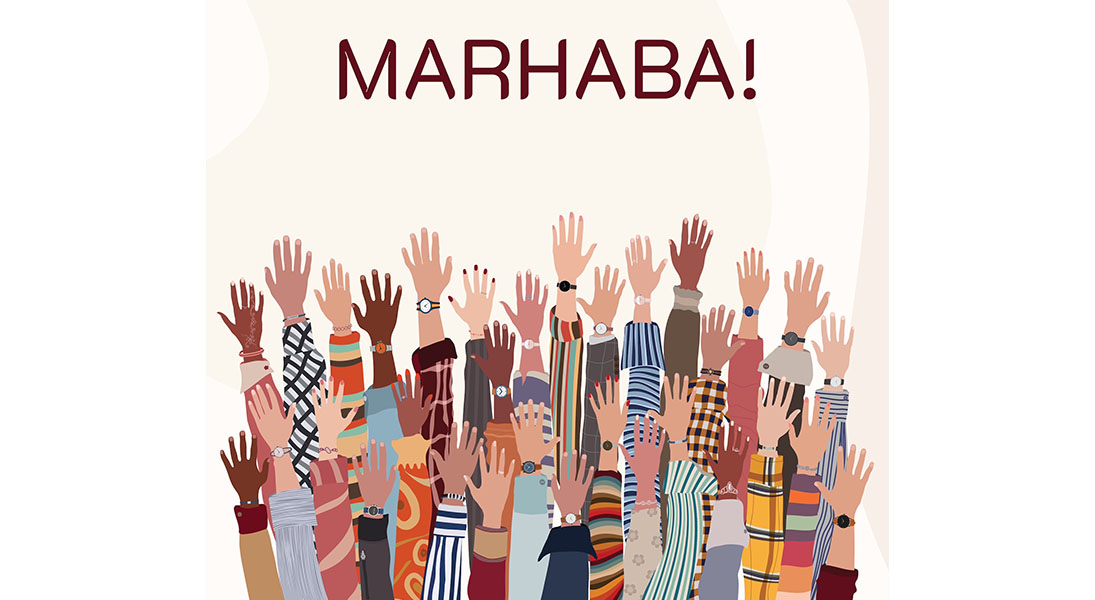
Marhaba (mar-huh-bah or mar-ha-bah). A simple word, ancient and powerful. Rooted in Aramaic and Syriac languages of early Middle Eastern Christians. It means more than just “hello.” It means God is love. It’s a greeting, a theology, a word grounded in relationship, faith and belonging.

April is known as Arab American Heritage Month, but the church is invited to not only observe one month out of the year but to reclaim marhaba as a spiritual practice of welcome, belonging, dignity and solidarity.

At the heart of our culture is hospitality. The moment a guest walks into our home or church, we no longer see them as a stranger—they are part of our family. We don’t just offer food, we offer belonging. You’re not just a visitor, you’re embraced with dignity and love. That spirit of open doors and open hearts mirrors the gospel: there are no outsiders in the body of Christ. The church is called to do likewise—not only to welcome the stranger but to receive them as part of the body of Christ.

But for too long, Arab Americans have been painted as the “other.” Our stories flattened and identities misrepresented. Whether Muslim, Christian, Druze or otherwise, in Hollywood and other places, including the church, we’re cast as villains, terrorists, foreigners or footnotes. These images have real consequences—from hate crimes and surveillance to erasure and isolation. Even indigenous Arab Christians who are descendants of the earliest followers of Christ are often invisible in American Christian spaces.

That’s why this month matters.

It’s why we give thanks to the ELCA, specifically the Ministries of Diverse Cultures and Communities (MDCC), for opening its doors to Arab American communities. For making space not only for our language, culture and style of worship but for our leadership, theology, story and witness. Through the MDCC’s support, Arab Lutheran congregations are taking root in places where the gospel is preached in Arabic, where Dabke is danced in celebration and where marhaba is lived out loud. These congregations aren’t side projects—they are essential to the church.

Arab Americans have helped build this country. We are doctors, engineers, teachers, artists, small-business owners, veterans and public servants. We’ve enriched American cuisine, contributed to scientific breakthroughs, helped shape national policy and led movements for justice. Arab Americans have woven their lives into every part of this nation’s fabric.

We are not newcomers—we are neighbors.

Let us remember: marhaba is not just about welcome. It’s about belonging.

Representation shapes how we see God and how we see each other. To support Arab American ministries is to proclaim that Christ speaks every language, eats every dish and walks with every people. It’s to remember that Christianity was never Western to begin with, and we did not convert from Judaism or Islam. Jesus was born in my hometown, Bethlehem; grew up in Nazareth; and was crucified in Jerusalem. And Christianity first spread across lands now called Syria, Palestine, Lebanon and Egypt.

Marhaba is more than a greeting. It’s an invitation to reimagine the church as a place where no one is foreign. It’s a call to resist tokenism and performative inclusion and instead build real relationships rooted in listening, trust and shared struggle.

So this month, let us not just celebrate Arab American heritage—let us be changed by it.

Let us teach and preach about the early church as a living legacy still carried in Arab American communities. Let us teach our congregations that when Jesus said to love your neighbor and the stranger, he was talking to a people who knew what it meant to flee, to be displaced, to be labeled othered. Let us break down the walls that separate us from our neighbor and dismantle racism, support Arab-led ministries and show up in solidarity when our siblings are targeted or dismissed.

Let us remember: marhaba is not just about welcome. It’s about belonging.

To my beloved ELCA, we thank you for making room at the table for us. For helping Arab American congregations not just survive but thrive. For reminding the whole church that inclusion reflects the kingdom of God.


Khalilia
Khader Khalilia
Khader Khalilia is program director for ELCA Arab and Middle Eastern Ministries.
Share

Steadfast accompaniment: ELCA Sumud initiative seeks just, lasting peace in Holy Land

In honor of Arab American Heritage Month, ELCA Racial Justice Ministries will be elevating the voices of our Arab and Middle Eastern Descent peers and reposting their works from others sources around the ELCA. The following article is cross-posted from Living Lutheran online. The original post can be found here.


Steadfast accompaniment

ELCA Sumud initiative seeks just, lasting peace in Holy Land

By Anne Basye | April 1, 2025

Rodny Said, a pastor of the Evangelical Lutheran Church in Jordan and the Holy Land (ELCJHL), leads a children’s sermon at the Church of Hope in Ramallah. Photos: ELCJHL

Said leads a bible study with youth during a youth retreat in Jordan.

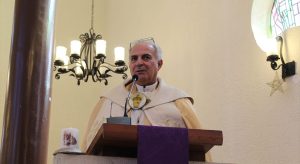
Sani Ibrahim Azar, bishop of the ELCJHL, delivers a sermon at the Church of Hope.


Two spouses living in two places—kept apart by two kinds of government ID.

It may sound like Romeo and Juliet, but that was life for Rodny Said, a pastor of the Evangelical Lutheran Church in Jordan and the Holy Land (ELCJHL).

With a Jerusalem ID, Said could cross the checkpoints between his East Jerusalem home and his congregation, the Lutheran Church of Hope in Ramallah. His wife lived with her parents because she couldn’t enter East Jerusalem with her Palestinian ID.

“We started the process of reunification, as the Israeli government calls it,” he explained during an Advent Pilgrimage 2024 webinar, “but it can take years for a person from East Jerusalem and a person from the West Bank to live together.”

Fortunately, Said’s wife received her permit shortly after the webinar, and the couple can now live and travel together between the two communities.

The webinar series was a program of Sumud, the ELCA’s initiative for justice in Palestine and Israel. Previously the ministry was known as Peace Not Walls, named after the 440-mile barrier wall that the Israeli government was building to separate Palestine from Israel. The wall is complete today.


“To us, sumud means to in our country and continue bearing witness.”


Sumud, an Arabic word meaning “steadfast,” conveys the determination it takes to be a Palestinian Christian. “Palestinians struggle to get to work, to universities, to churches and schools,” Said noted in the webinar. Since the onset of the Gaza War in 2023, many lost their jobs because they are no longer allowed to work in Israel. Many families are separated even though they live just a few blocks apart.

Life has gotten so difficult that the number of Christian families—already only 1% of the West Bank population—who are leaving is increasing. “They don’t see a future,” he said.

Emigration “means more pressure on us as a Christian community,” Said noted—especially for the ELCJHL, whose six congregations and four schools are supported by only 2,000 members.

“I think the easiest way is to leave,” Said added, “and the hard and painful way is to stay.”

Staying put, enduring and never giving up hope—that’s sumud. Through the initiative, the ELCA seeks to accompany Palestinians in their daily lives and advocate for peace with justice in Palestine and Israel.

Creating possibilities

For Maddi Froiland, program director for Sumud, a prime goal is making ELCA members more aware of what life under occupation is like.

As someone who spent four years in East Jerusalem and the West Bank—one as a Young Adult in Global Mission (YAGM) volunteer and three years as communications officer for the ELCJHL—Froiland watched Christians live out Luke 6:31 (“Do to others as you would have them do to you”) even with soldiers who had arrested their sons. “The experience,” she said, “made me redefine what it means to be a Christian.”

Froiland said Sumud’s webinar series drew over 100 viewers who heard ELCJHL pastors and youth group members share stories of “resistance through existence” by living and worshiping together under occupation. Attendees heard their main message: Christians living in the Holy Land need to know someone is listening to and supporting them.

The Sumud initiative, Froiland said, “underscores that justice in Israel and Palestine means everyone has dignity and human rights. Right now the people who are lacking human rights are our Palestinian partners.”

Froiland is building synod-level networks of Palestinian Christians, YAGM alumni and others who can share their experiences in the region. “These networks will build communities that are both aware of the context of our siblings in the ELCJHL and are empowered through their faith to advocate for justice in Palestine and Israel,” she said.

A new ceasefire currently being negotiated between Israel and Hamas could open the door for healing and recovery from a war marked by violence and displacement. The ELCA supports that process through Sumud, Lutheran Disaster Response, the ELCA Middle East and North Africa desk, and deployed personnel in the region. Witness in Society, the ELCA’s public advocacy team, continues to advocate for a negotiated resolution to the Israeli occupation of Palestine and to ongoing acts of violence.

On the ground, the ELCJHL creates possibilities for Palestinian Christians. “We do this through offering quality education for our youth, diaconal ministry for the vulnerable, environmental ministry for God’s creation, gender justice ministry and supporting our youth,” said Sani Ibrahim Azar, bishop of the ELCJHL.

“To us, sumud means to stay in our country and continue bearing witness as the Indigenous Christians of this land. This important and meaningful Arabic word … gives us strength—that we are not alone, we have our partners, our brothers and sisters, who will be steadfast in accompanying us.”

Anne Basye
Basye, a freelance writer living in Mount Vernon, Wash., is the author of Sustaining Simplicity: A Journal (ELCA, 2007).
Share

Who Are the Arab Christians? By Guest Blog Writer Rev. Dr. Niveen Ibrahim Sarras

In observance of Arab American Heritage Month, ELCA Racial Justice Ministries invited Rev. Dr. Niveen Ibrahim Sarras to share her thoughts on this topic with our readers.


People in the West often assume that Arab Christians were converted from Islam to Christianity by Western missionaries. However, Arab Christians have always existed in the Middle East and have enjoyed significant influence in the Arabian Peninsula.

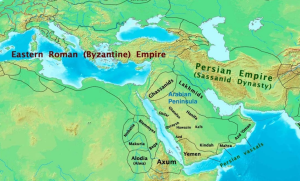
To understand Arab Christians, it helps to know the geography of the peninsula. Arabia, known as Jazīrat Al-ʿArab (“Island of the Arabs”) in Arabic, extends beyond present-day Saudi Arabia, encompassing the Arabian Peninsula (bordered by the Red Sea to the west), the Gulf of Aden to the south, the Arabian Sea to the southeast, and the Gulf of Oman and Persian Gulf (also known as the Arabian Gulf) to the east.

Arabia was inhabited by nomadic bedouins who survived through hunting, mercenary work, trade and raids on other tribes. As noted in Acts 2:11, Arab merchants traveled to Palestine for business. Christian tribes such as the Ghassanids, Lakhmids, Banu Taghlib, Banu Tamim and Nabataeans were spread across the peninsula, originating from Yemen and migrating to the Levant after the destruction of the Marib Dam in the sixth century BCE. By the fifth century CE most of these tribes had converted to Christianity. Arab Christians in the peninsula spoke and prayed in Arabic, yet their liturgical and confessional writings were in Syriac.[1]

In 732 CE, Arab forces influenced by Islam conquered the Levant, a Greco-Roman region that had previously been part of the Byzantine Empire. Muslims spread their Arabic language with each conquest. The Levant was predominantly inhabited by non-Arab Christians, possibly descendants of various ancient civilizations. Christian communities in the conquered territories spoke Greek, Syriac, Coptic, Armenian and Ethiopian languages.[2] Communities in Damascus and Baghdad were predominantly Arameans, using Aramaic for theology and liturgy, whereas those in Palestine, Jordan and Sinai utilized Greek ecclesiastically but Aramaic/Syriac locally. Over time Christians in the Levant and Egypt became Arabized through the imposition of the Arabic language. The Melkite Church was the first to adopt Arabic for worship.[3]

In the eighth century CE, Arabized Christian families in the Levant were drawn to Muslim power, leading them to convert to Islam. Christians held high positions and contributed to intellectual life under Muslim rule but faced pressure to convert. Muslim authorities imposed a poll tax on Arab Christians who refused to convert,[4] so they translated their religious texts into Arabic and developed apologetics to defend their faith. After the Crusades, Muslims imposed harsh policies on Christians, prompting resentment. Arabization accelerated through translation efforts and Islamic influences.

The Ottoman Empire’s occupation of the Middle East, which lasted from 1516 to 1917. led to “Turkification” efforts, and this cultural oppression provoked an Arab nationalist movement. Arab Christians revived the Arabic language and culture, but tribalism frustrated their efforts to form a unified Arab identity. Despite these differing identities, Islam’s influence remains strong among Arab Christians.

In sum, Christians in the conquered territories became Arabized when the Arabic language was imposed upon them. In other words, they are not Arabs by ethnic or race bound but by the Arabic language.


The Rev. Niveen Ibrahim Sarras was born and raised in Bethlehem, Palestine. She is the first Palestinian woman ordained to the ministry of Word and Sacrament in the ELCA. Her passion for the Bible started through attending Sunday school at the Lutheran Church of the Reformation and attending Lutheran school in Bethlehem.

Hungry for a deeper knowledge of Scripture and eager to answer God’s call to ministry, Rev. Sarras earned her Master of Divinity degree from Pacific Lutheran Theological Seminary in Berkeley, Calif., laying the foundation for her ministry of Word and Sacrament. Her academic pursuits led her to the Lutheran School of Theology at Chicago, where she earned a Doctor of Philosophy degree in Old Testament.

Rev. Sarras loves to teach Scripture and theology. She shared her knowledge through programs such as the Lay School of the ELCA East-Central Synod of Wisconsin, where she taught feminist, womanist and mujerista theology. She expanded her horizons by teaching courses such as “Introduction to Feminist Theology” and “An Introduction to Judaism, Christianity, and Islam” in Marathon County, Wis., through the Extension program at University of Wisconsin-Madison.

Rev. Sarras’ scholarly contributions challenge traditional biblical commentaries and offer fresh perspectives on matters of faith and society. Notable among her publications is “Jesus Was a Palestinian Jew — Not White,” which challenges traditional misconceptions about Jesus’ identity and roots. Her scholarly article “Refuting the Violent Image of God in the Book of Joshua 6-12” was anthologized in The (De)legitimization of Violence in Sacred and Human Contexts (Palgrace Macmillan, 2021), offering fresh insights into the violence depicted in the book.

Beyond academia, Rev. Sarras finds pleasure in hiking, biking, baking and immersing herself in books on politics, faith and Scripture, as well as watching documentary movies. In her roles as a pastor and as a scholar, Sarras advocates for critical thinking and encourages others to deepen their understanding of faith.


[1] Sidney H. Griffith, The Church in the Shadow of the Mosque: Christians and Muslims in the World of Islam (Princeton: Princeton University Press, 2012), 9.

[2] Griffith, The Church in the Shadow of the Mosque, 8

[3] Ibid., 49

[4] Kenneth Cragg, The Arab Christian: A History in the Middle East (Louisville: Westminster John Knox Press, 1991), 54.


Share