
In honor of Juneteenth, ELCA Racial Justice Ministries invited Dr. Denise Rector to share some thoughts about this federal holiday that many mark as the official end of legalized human enslavement in the United States. For more information on Juneteenth, visit What Is Juneteenth? | HISTORY.
Let’s take a trip back to high school history class:
- The history of enslaved people on what would become U.S. soil goes back to 1619.
- The Civil War (1861-1865) was fought over slavery. Those of us who were raised in the deep south grew up learning something different. I was taught that the Civil War was about “states’ rights.” The curriculum never bothered to specify that states were fighting for the right to continue enslaving people.
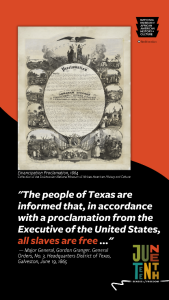
- The Emancipation Proclamation declared freedom for enslaved people in Confederate-controlled areas on Jan. 1, 1863.
- Before the Emancipation Proclamation, enslavers followed the law when the law supported slavery. Then enslavers broke the law when the law criminalized slavery; many never told those they enslaved that the Emancipation Proclamation had gone into effect in 1863.
- In Galveston, Texas, on June 19, 1865, Union troops were the ones who told enslaved people that not only were they free, they had been legally free for nearly two and a half years. The 13th Amendment finally completed the work of the Emancipation Proclamation in 1865.
- For extra credit: Stream Ava Duvernay’s stunning documentary 13th and learn the history of the short-lived Reconstruction in Ta-Nehisi Coates’ We Were Eight Years in Power.
Juneteenth is one of many portmanteaus necessary to convey the unique Black American experience throughout U.S. pre-history and history.
I am Black, Lutheran and a historian. No surprise that, for me, freedom and identity are mixed in with thoughts about Juneteenth, my bitterness at the denial of freedom, and the amazing gift of justification by grace through faith.
I have a scene in my imagination. Imagine with me: An enslaved young woman in 1863 or 1864 has heard about emancipation and yet has an enslaver and a Confederate soldier (maybe both) standing in front of her, denying her knowledge of freedom, denying emancipation and restricting her freedom physically.
This imagined scene reminds me that freedom isn’t just a concept. It’s not just philosophical.
Freedom is real. Our freedom in Christ is real. There is no earthly parallel, and I will not cheapen Christ’s gift by forcing a parallel out of the Juneteenth event.
Freedom in Christ is what allows me (and you) to answer profound questions and speak truth in difficult spaces. I can rest in the faith of knowing that Christ has given me a more wonderful, more valuable gift than any of the pain or loss of status I may experience. The actions we Lutherans take are a response to freedom in Christ; they are a way of loving God by loving our neighbor, not a way to earn or deserve that freedom (because we will never earn or deserve it).
There may be people who tell you that you are not free. Know, and live, your freedom in Christ. The things that would deny us our freedom lead us to shrink away from the gift and not serve our neighbor. And if we ever needed to be here for each other — to see, hear and love each other — that time is now. Through this, we can celebrate the justice of Juneteenth and serve this world that God, indeed, loves.

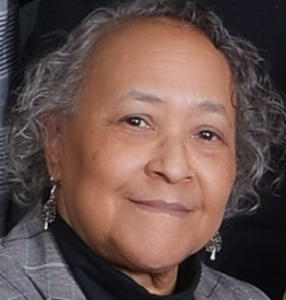
Dr. Denise Rector is an instructor at Trinity Lutheran Seminary at Capital University, where she teaches in the History, Theology, and Society division. She recently earned her Ph.D. from the Lutheran School of Theology at Chicago. Her dissertation focuses on the pastorate and impact of Rev. Earlean Miller, the first African American woman pastor in the LCA/ELCA. Dr. Rector is contributing to a forthcoming essay collection on Black Lutheranism.

 Dianne R. Browne, Ph.D., CFLE, CSE, Chair, ELCA New Jersey Synod Anti-Racism Team