Skip to content

ELCA Blogs

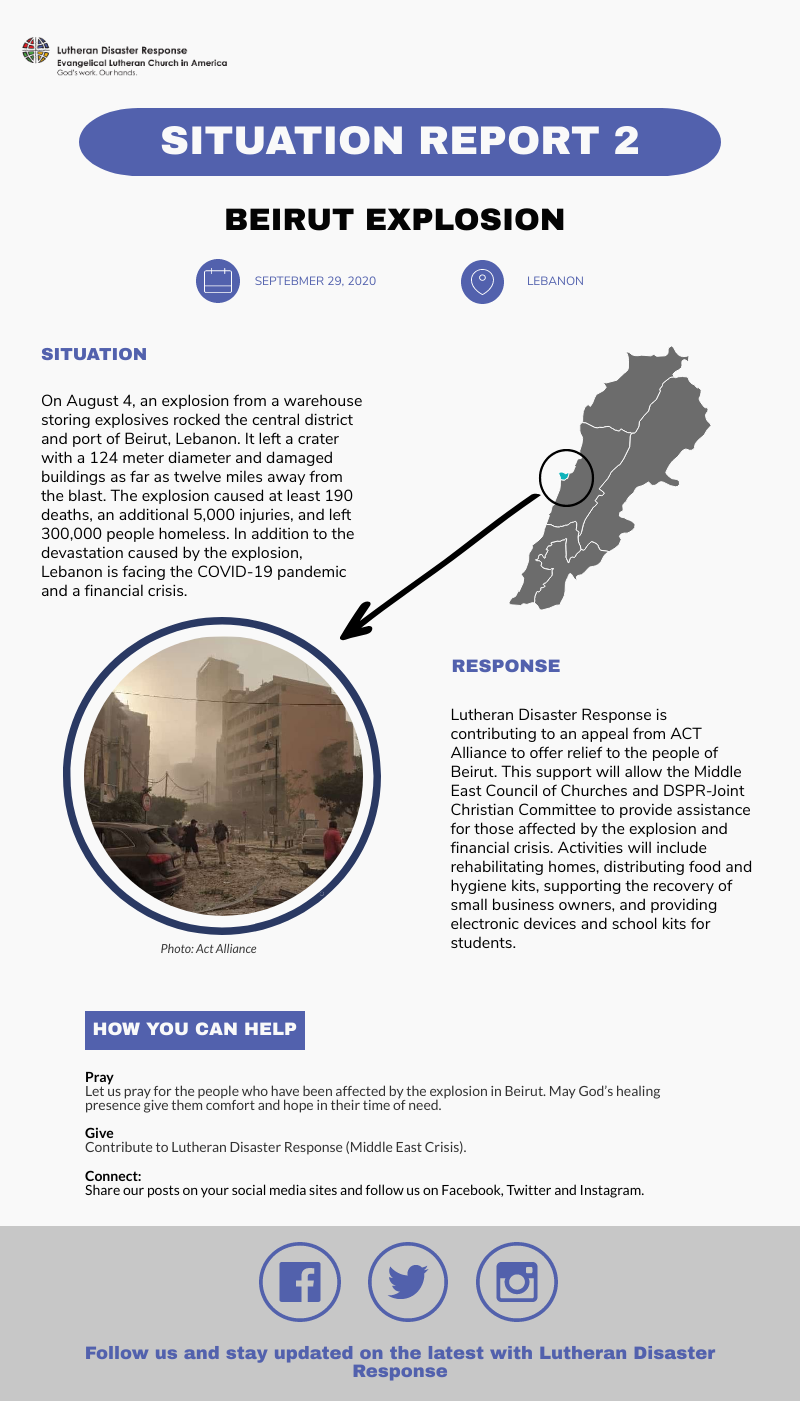
Situation Report 2: Beirut Explosion

Be a part of the response:

Pray
Please pray for people who have been affected by the explosion in Beirut. May God’s healing presence give them peace and hope in their time of need.

Give
Thanks to generous donations, Lutheran Disaster Response is able to respond quickly and effectively to disasters around the globe. Your gifts to Lutheran Disaster Response (Middle East Crisis) will be used to assist those affected by the explosion in Beirut until the response is complete.

Connect
To learn more about the situation and the ELCA’s response:

  • Sign up to receive Lutheran Disaster Response alerts.
  • Check the Lutheran Disaster Response blog.
  • Like Lutheran Disaster Response on Facebook, follow @ELCALDR on Twitter, and follow @ELCA_LDR on Instagram.
  • Download the situation report and share as a PDF.
Share

International COVID-19 Relief – Why We Should Commit

By the Rev. Kaari Reierson, contractor with ELCA advocacy

The impacts of COVID-19 on U.S. citizens are simply unfathomable. Over 200,000 people have died. Unemployment is the highest it has been in the last 70 years. Tens of thousands of businesses have closed.

As difficult as COVID-19 and its many effects have been for those in the U.S., the effects have been multiplied in other parts of the world. As of this writing, the death rate in the United States is eleventh globally. The world’s economy is predicted to be pushed to a recession greater than any since World War II, putting millions more people into poverty.

As the U.S. Congress debates how to assist its citizens, Lutherans are reminded that whatever is happening on U.S. soil is happening elsewhere in the world, in many cases amplified. Unemployment is confronting people with no savings – and no social safety net. Illness is afflicting people with minimal health care. Food scarcity is threatening people with no resources.

In response to a desperate world in 1939, Lutherans in the United States founded Lutheran Immigration and Refugee Service to assist Europeans displaced by World War II. Lutherans continue to participate regularly in international efforts to serve the neighbor and guard human dignity, through presence at the United Nations (U.N.), post-war relief in Europe, and engagement in development work and disaster response among many ways. ELCA social teaching recognizes that the U.S. plays a vital leadership role in world affairs and also has an obligation to share its resources with less wealthy nations.

Will our nation respond to the suffering imposed by COVID-19 outside of U.S. soil, or will we only take care of “our own?” Will the U.S. participate fully in international organizations working to quell the pandemic as our Lutheran history and social teaching would urge us to do?

To turn the tide of a virus as contagious as COVID-19 requires a coordinated effort by the international community. The pandemic respects no national boundaries. If the U.S. refuses to engage with and help resource multilateral organizations such as the World Health Organization and U.N., it is not only failing to fulfill its moral obligation, it is endangering its own future. “U.S. support through bilateral foreign assistance programs is also vital to heavily impacted low-income countries,” says Patricia Kisare, ELCA Program Director for International Public Policy. “As members of Congress work on the next COVID-19 stimulus package, they must include funding for international response to address the tremendous needs caused by this pandemic.”

Illustrated by the history of Lutherans in the U.S., expanded in our Lutheran teachings, and sourced in the words and life of Jesus, caring for others is God’s work. “For the Christian, empathy is one way in which love and compassion (Matthew 25:31-46) may be embodied in the world of civil authority, through God’s left-hand work,” reads the ELCA social message “Government and Civic Engagement in the United States.”

You are invited to use “Take Action on the Next Coronavirus Supplemental Bill” in the ELCA Action Center to ask Congress to incorporate international relief measures as it moves our nation’s pandemic response into law.

Share

October 4, 2021–Is It Really Stealing?

Sylvia Alloway, Granada Hills, CA

Warm-up Question

“My boss owes me for all my hard work.” “The company is insured.” “Nobody will notice.”

These are some of the excuses employees make to justify stealing money, merchandise, office supplies, and more from their employers. Incidents of employee theft are on the rise. Do you think there is ever a valid excuse for employee theft? If so, what might it be? If not, why do you think more and more people are stealing at work?

Is It Really Stealing?

A 2019 survey revealed that 75% of those surveyed admitted to stealing from their employers at least once and 37.5%, at least twice. Why do they do it? Some can’t be bothered to buy the product. Some blame lack of supervision and poor enforcement of consequences or a sudden financial need Others believe the company can afford it. But the most common reason is employees feeling overworked and under-appreciated.  They believe they deserve more.

This sounds reasonable from the point of view of one person. But 75% of individuals taking what they think they deserve adds up. Almost a third of small and mid-sized business owners who declare bankruptcy say that employee theft was a direct cause. The more businesses fail, the more people are left jobless and unable to feed their families. Soon, the whole economy begins to break down.  Yes, taking an employer’s property really is stealing.

The Eighth Commandment says, “You shall not steal.” There is no “unless” – unless I’m not getting paid enough, unless I’m in terrible financial need, unless the boss isn’t paying attention. God wants Christians to fulfill our responsibilities no matter how we feel, no matter who is or isn’t looking. When God gives us a job, He expects us to give it our best. “So… whatever you do, do everything for the glory of God.” (1 Corinthians 10:31 NRSV). God’s economy isn’t based on deserving. If it were, no one would get anything but God’s wrath. Since Christians have received grace, let us behave graciously.

Discussion Questions

  • If you are able, follow the links in the article above. Think again about the Warm-up Question. Most people would say that stealing is wrong. So, why are more and more people stealing from their employers?
  • What do you think employers should do to prevent employee theft?
  • What do you think it means to “do everything for the glory of God”?

Eighteenth Sunday after Pentecost

Isaiah 5:1-7

Philippians 3:4b-14

Matthew 21:33-46

(Text links are to Oremus Bible Browser. Oremus Bible Browser is not affiliated with or supported by the Evangelical Lutheran Church in America. You can find the calendar of readings for Year A at Lectionary Readings.)

For lectionary humor and insight, check the weekly comic Agnus Day.

Gospel Reflection

Jesus is having another run-in with the religious leaders, the aristocrats of the Jewish culture. They challenge his authority. What right has he, humble carpenter’s son, to teach and preach to them, the ones who have studied God’s law all their lives? This upstart must be challenged!

As he often does when questioned, Jesus tells a parable, two in fact, and this is the second one. Both have to do with authority. We may think Jesus is using hyperbole, literary exaggeration, to make his point. How on earth could the tenant farmers of the story believe they’ll get away with beating and killing the owner’s servants and even his son? With stealing, not just a little produce, but the entire vineyard?

When the prophets of the Old Testament speak of a vineyard, they often mean the Jewish people, the ones God chose to hear and live out his words. So, as the leaders listen to the story, they can hardly miss the fact, that the keepers of the vineyard are them.  They are supposed to care for the people, using their knowledge of the law to help the people grow spiritually. 

At times, the Old Testament leaders did  beat, torture, and even kill God’s messengers, the prophets. They wanted to use their power as they saw fit. Instead of paying attention to God’s messengers, they abused and them. They thought they deserved the honor and power which belong only to God. So what if, for lack of someone to tell them the truth, the “vineyard,” God’s chosen ones, withered and died on the vine.

The ones hearing Jesus’ words are no better than their ancestors. Jesus’ words come true. They kill the Son rather than give up their positions of authority.  So who are the people who will receive the vineyard in the end? Those who, in following Jesus, do the work of tending God’s people, not for their own glory, but for God’s.

Discussion Questions

  • Jesus tells a story about irresponsible leaders, who did not care for God’s people as they should. What would a good leader do? In what way would a good leader “tend the vineyard,” that is help God’s people to grow spiritually?
  • The news article talks about how little thefts can add up and bring serious consequences. What wide-spread consequences for God’s people might result from an increase of selfish actions in the church?
  • How did Jesus’ audience react to his parable? Why do you think they reacted as they did?

Activity Suggestions

  • Have the class discuss and list what they think today’s leaders (political, school, or church) need to hear. Have them choose one idea and make up a parable about it.  A parable is a simple story with a spiritual meaning using two or three (no more) symbols to get a single point across. Act the parable out.
  • In what ways, individually and as a group, can members of the class care for God’s people? Write down the ideas. Plan to carry out at least one of them individually and one as a group.

Closing Prayer

Father of All Good, we ask you to forgive us for the times when we have acted selfishly and hurt others. We thank you that we can be sure of your forgiveness because of Jesus’ death and resurrection. Turn us outward to see others’ needs and help us to meet them when we can. May the people around us see the love of Christ in our words and actions. In the Name of your Son, Amen


Share

17th Sunday After Pentecost: The Marshmallow Challenge

The ELCA Innovation Lab is partnering with the fall intensive of “Leadership On the Way.” Leadership On the Way (LOTW) seeks to offer creative space and supportive relationships for early-career leaders as they learn, innovate and adapt to their unique settings. This past session, the LOTW cohort focused on design-thinking and equity-centered design, and LOTW coach Pastor Bradley Schmeling, Gloria Dei Lutheran Church (St. Paul, Minnesota) found himself exploring the connections. In his own words, “The whole design conversation became a way for me to explore the gospel text in a new way.” Check out Pastor Schmeling’s sermon below and on the Gloria Dei website. 

Matthew 21:23-32

Maybe you’ve heard about the marshmallow design challenge. It’s a teamwork and design exercise. Groups are given 20 pieces of spaghetti, one yard of tape, one yard of string, and one marshmallow. The goal is to build the tallest structure you can in the time allotted. The only rule is that the marshmallow must go on the top and must be in one piece.

You probably won’t be surprised to learn that all usually goes well until the last minute. With the clock ticking, the group adds the marshmallow. Very often, the whole structure collapses. It can’t handle the weight. You may also not be surprised to learn that recent graduates of an MBA program, and probably seminaries, have some of the worst track records. The best?

Kindergartners!

Why do kindergartners perform better than adults? The adults jockey for power, spend a lot of time talking about process, try to get around the rules, or just cheat. The kindergartners succeed because usually none of them is trying to be the CEO. They share equally in the task. But mostly, it’s because they start with the marshmallow. They build under it, and when something doesn’t work, they dismantle and start over. The marshmallow is always on top in their project.[1]

Marshmallow Challenge
“Marshmallow Challenge 6” by MTa Learning
is licensed under
CC BY 2.0

I sometimes wonder if Jesus would have had a more supportive team had he invited twelve kindergartners to join on the way to Jerusalem. A group willing to be closer to the ground than scraping the sky; a group that values each member of the team and knows that God’s wisdom is always collaborative.

In today’s gospel text, we hear the final conflict between two design processes. By the end of the week, Jesus will be lynched and buried. He just entered Jerusalem, to great acclaim and the waving of palm branches. He overturned the tables in the temple, a pretty clear symbol of what he’s about. And now this is the first argument with the authorities, likely with the police who were sent to disburse the protesters.

On one side: Jesus’ project to build a structure that beats with God’s heart. On the other side: the institution, political and religious, that resists change, silences dissent, and rewards the wealthy and powerful. [Let me be clear about one thing: The temple doesn’t represent Judaism, as if Christianity is somehow the real spiritual project that gets rid of some rigid Jewish system.]

Here the temple represents the world that we’ve all been schooled to believe is the real one, or, at least, the only practical one. If you want to hear what the temple-reality looks like today, get on Twitter or turn on the TV or open the newspaper. You’ll find it on just about every page. I like to call it “an accumulation system”; an endless, frantic, and finally murderous race to have more and more. It’s literally a dead-end.

The entire gospel text for today turns around the question of what kind of authority will re-make the future. In Matthew’s gospel, this a moment of crisis, a turning point. In fact, even the way he tells this story, compels the reader to choose a side. Do you want to end up like the leaders, the ones who have everything but really nothing, or the prostitutes and the tax collectors, the judged and despised, but are open to discovering the deepest truth? Will you be the child that nods their head at the request but never does anything about it? Or the one, who may not get it at first, even arguing with the authority, but tackles the work, anyway?

I can’t help but think that Jesus overturning those tables and now confronting the authorities is an iconic image for the time we’re living in right now.

Part of building the world that God intends means we have to work at dismantling another one. Maybe that’s what it means to be the faithful child, the one trying to follow the guide: to be constantly deconstructing those things that kill the least among us, and building something that brings good and deep life for those same people.

Cynthia Moe-Lobeda says that if God is the creator, we have become the “un-creators” in our destructive and unstainable use of the earth. When I first heard the term in a talk about Jesus, I misunderstood.  I thought they said that Jesus was an un-creator, overturning the systems that we have built, by initiating his own design process to heal, and feed, and welcome; building a community that has a wide-generosity of heart and energy.[2]

Maybe that misunderstanding was a little inspiration. (Don’t tell the preachers that often it’s a good idea only to half-listen what they’re saying!) In the work of creation, God designed a spirit of un-creation, to keep death from having the last word. Maybe Lutherans hear it as reformation. Maybe on the streets today, we hear it as protest or breaking down privilege. Maybe it’s a growing awareness of the need to make reparations for centuries of injustice. Maybe it’s just the old church term is repentance and making amends. Or the Christ pattern of dying and rising.

The kindergartners knew this, breaking apart a little bit of their work in order to keep it moving taller, always keeping the marshmallow—that sweet and beautiful goal—at the very center of their task.

This time feels like a big design project that we’ve been all been given in order to learn something about collaboration and design and truth. It’s the pandemic challenge; the white supremacy challenge; the getting-through-until-tomorrow challenge. Name your own marshmallow!

The gospel news is that the Christ who stood in the temple is the one standing among us, sending us out into this field. We’ve been given some tools, a few directions, a lot of grace to make it up with our friends, and one sweet vision of love and mercy and justice that will crown it all.

It’s also gospel news to remember that the conflict in the temple didn’t end on Friday, but on a Sunday.

In the name of the Creator, the Un-Creator, and the Wisdom to Build, Christ is risen!  Alleluia!

[1] https://elearningindustry.com/marshmallow-challenge-can-learn-kindergarten-students-team-collaboration
[2] Thank you to Mikka McCracken, Director of Innovation, at the Evangelical Lutheran Church in America for pointing me to Dr. Moe-Lobeda’s work.

The ELCA Innovation Lab Blog is new! We’d love to hear what you think. If you’ve got a few minutes, complete this short survey. If you have any additional questions or comments let us know at lab@elca.org

Share

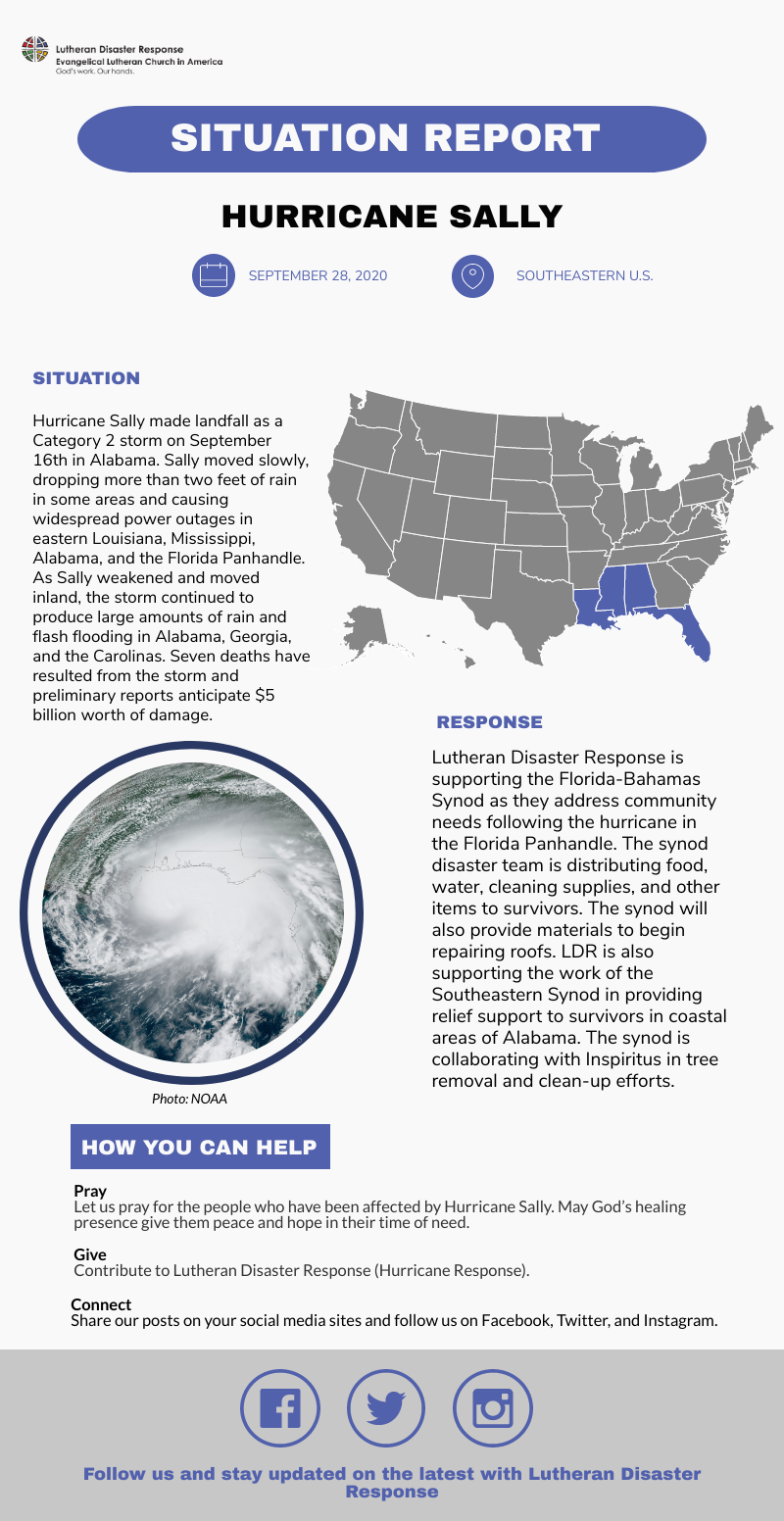
Situation Report: Hurricane Sally

Be a part of the response:

Pray
Please pray for people who have been affected by Hurricane Sally. May God’s healing presence give them peace and hope in their time of need.

Give
Thanks to generous donations, Lutheran Disaster Response is able to respond quickly and effectively to disasters around the globe. Your gifts to Lutheran Disaster Response (Hurricane Response) will be used to support survivors of Hurricane Sally.

Connect
To learn more about the situation and the ELCA’s response:

  • Sign up to receive Lutheran Disaster Response alerts.
  • Check the Lutheran Disaster Response blog.
  • Like Lutheran Disaster Response on Facebook, follow @ELCALDR on Twitter, and follow @ELCA_LDR on Instagram.
  • Download the situation report and share as a PDF.


Share

September 27, 2020–Another Alarm Bell

Scott Mims, Virginia Beach, VA

Warm-up Question

  • Take a few moments to check in with one another.  What have been some of the “highs” and “lows” of the past week?
  • What is one thing you used to think or believe as a small child that you find funny now?

Another Alarm Bell

Recently, a massive section of Greenland’s ice cap broke off in the northeastern Arctic.  This section of ice, measuring 42 square miles, is a dramatic example of the accelerated melting of Arctic ice that scientists say is evidence of rapid climate change.  As one observer put it, “This is yet another alarm bell being rung by the climate crisis in a rapidly heating Arctic.”

In fact, the effects of global warming are so severe that they are reshaping the climate of the region. As one study in August concluded, Greenland alone lost a record amount of ice during a record-breaking 2019, resulting in a melt massive enough to have covered the whole of California in 4 feet of water.

Elsewhere, a rapidly warming climate is also being linked to conditions that make for more intense wildfire seasons in the American West, and more active hurricane seasons in the Atlantic and Gulf Coast regions.

For more:

https://www.nbcnews.com/science/environment/dismay-huge-chunk-greenlands-ice-cap-breaks-rcna117

see also:

https://www.nytimes.com/2020/09/14/climate/arctic-changing-climate.html#:~:text=The%20Arctic%20Is%20Shifting%20to,a%20new%20study%20has%20found.

Discussion Questions

  • Despite an ever-growing body of evidence that our planet is warming rapidly, why do you think some people have a hard time accepting that climate change is real?
  • Who has the most to gain from people and nations working together to address climate change?  Who might have the most to lose from the actions and policies that could be called for?
  • Are you optimistic about the future of our world and our ability to successfully tackle the complex issues around climate change?  Why or why not?

Seventeenth Sunday after Pentecost

Ezekiel 18:1-4, 25-32

Philippians 2:1-13

Matthew 21:23-32

(Text links are to Oremus Bible Browser. Oremus Bible Browser is not affiliated with or supported by the Evangelical Lutheran Church in America. You can find the calendar of readings for Year A at Lectionary Readings.)

For lectionary humor and insight, check the weekly comic Agnus Day.

Gospel Reflection

As we head into the last weeks of the church year, our gospel readings jump to Jesus’ final days before his crucifixion.  Jesus’ triumphal entry into Jerusalem and “cleansing” of the Temple (Matthew 21:1-16)  set the stage for his confrontation with the chief priests and elders.

“By what authority are you doing these things, and who gave you this authority?”  That is the question put to Jesus by Jewish leaders who are obviously upset at what they perceive as an attack against both the Temple and their own authority. Yet, their question is not an honest one.  That is, they are not really seeking knowledge and understanding, but are looking to trap Jesus.  Indeed, they are well aware of what his actions imply – that he is the Messiah, God’s anointed one.  They hope, in answering this question, Jesus will give them something they can use against him.

Jesus  is wise to their ploy.  And while his counter-question hangs them on the horns of a dilemma, it is more than simply a clever way out.  This question concerning John the Baptist is a clue to the answer Jesus would have given, had his questioners been open to the truth.  If they truly understood what John was about (see Matthew 3:11-17), they would know where Jesus gets the authority to say what he is saying and do what he was doing. 

In sharing a parable about a man with two sons, Jesus goes on to underscore the fact that they have chosen to ignore John’s message and, therefore, Jesus himself .  After all, what does it say that even people whose daily lives seem to be  a big “No!” to God believe John’s message of repentance and renewal, when the religious leaders do not?  What does it say that even tax collectors and prostitutes “get it,” when those who should most welcome the Messiah refuse to see God at work?

This is not simply a story from long ago.  Jesus continues to challenge us to open our eyes to what God is doing in the world, calling us to view our lives through our “faith lenses”.  How we answer the chief priests and elder’s question as it pertains to Jesus is critical.  What does it mean for the church that Jesus is Lord?  And, more personally, what does his authority as God’s Messiah mean to each of us?

Discussion Questions

  • What do you know about John the Baptist?  Read Matthew 3:1 – 17 together.  Who was John, and what was he about?  
  • Think about what you know about Jesus.  What are some of the other pieces of evidence that point to who he is and to the authority that he has?  
  • Why do you think the religious leaders and authorities had a hard time accepting Jesus?  What did they have to lose?
  • What does the word “authority” mean to you?  In what ways does Jesus have authority in our lives?  

Activity Suggestions

One Small Change:  How do we connect our faith to the needs and challenges of our world?  Where do you see God at work, and what do you think he may be calling us to care about and do?  Explore some possible actions, activities or service projects that your group might do related to your conversation.  Choose one thing and go for it!

Closing Prayer

Gracious God, in your love you have given us gifts of abundance – ourselves, our time, our abilities and possessions.  Help us to say “Yes!” to your call to share these gifts in the work of your “vineyard,” that we may be signs of your gracious love.  Give us wisdom and reverence for our planet, and help us to work for a future in which generations yet to come may continue to praise you for your bounty.  We pray this in Jesus’ name.  Amen.  


Share

Webinar: COVID-19 and the Ongoing Challenges in the Ecumenical Community


As COVID-19 continues to spread throughout the world the disease is challenging individuals and societies in new and varied ways. Our social interactions, economic wellbeing, and community engagement have all been strained over the past six months. Churches are also experiencing challenges as they seek to adapt.

The National Council of Churches USA and the Orthodox Christian Studies Center of Fordham University are presenting the second in a series of webinars highlighting some of these ecclesial challenges. The discussion will also examine how churches are striving to meet these challenges, as well as the opportunity to do this ministry together.

The webinar will be livestreamed and is free and open to the public, though participants will need to pre-register for the event here. The event will include some time for audience questions and will feature the following speakers:

  • Metropolitan Nathanael of Chicago – Greek Orthodox Archdiocese of America
  • Kathryn Lohre – Evangelical Lutheran Church in America
  • Senior Bishop Lawrence Reddick, III – Christian Methodist Episcopal Church
  • Rev. Monsignor J. Brian Bransfield – General Secretary of the US Conference of Catholic Bishops

We hope you’ll join us on September 30, 2020, 5 pm ET

Register today by following the link: REGISTER


Share

Churches as polling places

According to data presented by the U.S. Election Assistance Commission, over 230,000 polling places were used in 2018. Less than 1% of those were located at election offices. Most were at schools, community centers… and churches.


The need

Experience during primary elections in our nation have led some to conclude more polling places are needed before the November 3, 2020 general election. Myrna Perez, director of the voting rights and elections program at the Brennan Center for Justice at NYU School of Law, is quoted in an AP news article saying, “In the best of times, really long lines are deterring and disenfranchising. In the time of the coronavirus, long lines can be deadly.”

Several ELCA congregations have opened their facilities as polling places in previous elections. Is this a way your congregation wants to steward its building in 2020? State laws govern where polling places can be located, but ELCA Legal and Risk Assessment colleagues also have some advice to share on churches serving as polling locations.


Some considerations

Before your church responds to a request or steps out to offer to be a polling place, key issues must be considered in addition to operating by COVID-19 guidelines and mandates: (1) accessibility, (2) security, and (3&4) insurance/liability.

(1) If the municipality uses the church as a polling place, it should be accessible. Officials should make an accessibility determination in the portion of the building and parking lot being used for voting. Additionally, it is always a good idea to inventory the property for safety hazards.

(2) If the church has a preschool, school or similar activity in the building that is still open, security steps must be taken to make sure that there is separation between the operating school and parts of the building accessible to the public. For example, voters may be directed to a specific door and part of the building but not be allowed access to the other portion. Some churches just close the school for election day (like many public schools do).

(3) Make sure the congregation’s insurance carrier is aware of the facility’s use as a polling place to assure coverage if something happens. The aforementioned safety hazards inventory of the area being made accessible to the public can be assuring.

(4) Proof of insurance for a location as a polling place should be available from the voting authority.

    • Request that the voting authority provide the respective church with a current insurance certificate evidencing the following type of insurance and coverage.

Commercial General Liability:

(a)  Bodily Injury and Property Damage Liability with a $1,000,000 limit per occurrence
(b)  Personal and Advertising Liability with a $1,000,000 limit per person or organization
(c)  Products and Completed operations with a $1,000,000 limit per occurrence and in the aggregate
(d)  General aggregate with a $3,000,000 limit

    • It is very important to confirm that the church is indicated as being insured on the certificate. This confirmation may look something like: (INSERT Name of Church) is named as an additional insured under the (INSERT Name of Voting Authority’s) commercial general liability policy.

Uniquely this year, being a polling place means observing best practices in this time of pandemic. Request that the voting authority comply with all federal, state and municipal COVID-19 guidelines and mandates including those regarding masking, social distancing, equipment wipe down and sanitizing product availability. Guidelines to minimize the risk of transmitting COVID-19 at the polls are discussed in a joint release from The Brennan Center and the Infectious Diseases Society of America.


Taking the next step

“For Lutherans, one way Christian vocation finds expression is through dedicated, competent public service,” states the ELCA social message, “Government and Civic Engagement in the United States: Discipleship in a Democracy.” No voter should have to choose between their safety and their fundamental right to vote in November states BrennanCenter.org which shares the joint guidelines. The ELCAvotes initiative grew from the social policy resolution, “Voting Rights to All Citizens,” which calls on us to engage in local efforts and support legislation guaranteeing the right of all to vote. With planning and awareness of best practices, your congregation may be just the place to help facilitate democratic expression in your community and be of public service.

Contact your county Board of Elections to find out how to designate a place you are connected with as a polling site. The American Association of People with Disabilities also has tips on making this connection.

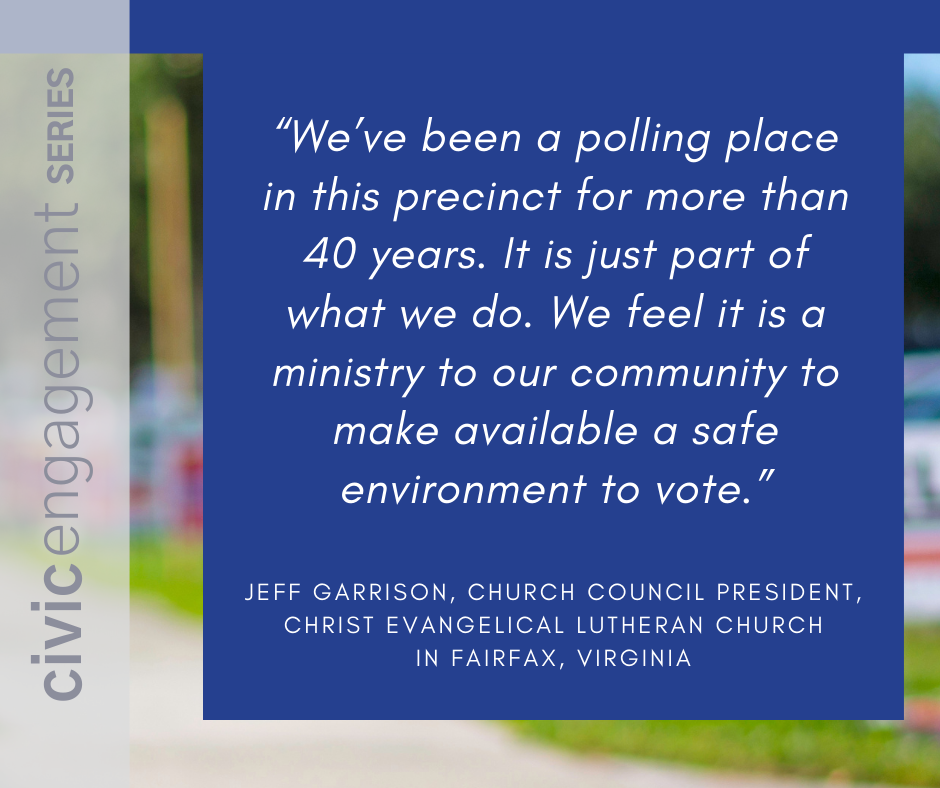
“We’ve been a polling place in this precinct for more than 40 years,” said Jeff Garrison, Church Council President of Christ Evangelical Lutheran Church in Fairfax, Virg. “It is just part of what we do. We feel it is a ministry to our community to make available a safe environment to vote.”


This text will soon be available as a pdf from ELCA.org/votes and ELCA.org/resources/advocacy.

Share

Innovation Insights: Collective Genius Innovation + Lutheran Theological Thinking

This post builds on concepts introduced in its sibling post, “The ELCA Innovation Lab: An Origin Story.”

You might know it as a remix, mashup, medley or cover, but some of my favorite songs come from the process of adding or rearranging the original tune to include something new or different. Sometimes a fresh take on an old classic brings new inspiration.

As the ELCA Innovation Lab has begun to imagine ways to help the church reclaim relevancy, we have tapped into our deep reformation roots. After all, Lutheranism is a tradition founded on the new and useful ideas of Martin Luther that changed not only the church, but much of western society.

This post features three innovation insights presented as a “remix” of Lutheran theological concepts and Dr. Linda Hill’s work on collective genius innovation.

Insight 1 – Vocation and the priesthood of all believers

Innovation (something new and useful) is not about solo genius but focuses on building the culture and context for collective genius. For Hill and associates, each individual person has a unique slice of genius – their ideas, experience and way of seeing the world. To build an innovation culture, each person’s individual slice of genius must be unleashed and harnessed as part of the “collective.”

For Lutherans, this individual slice of genius might be likened to understanding vocation — the call  to faithful expression of the one’s God-given gifts poured out for the well-being of the neighbor. And so, the collective for Lutherans might be akin to the body of Christ and priesthood of all believers. In the collective Body, all members have varying gifts and equitable share and responsibility.

Insight 2 – Leadership: The role of co-creators

Leadership today does not seem to be getting any easier. COVID-19 has certainly proven this point.

Gone are the days when a solo leader could look out the front door and see clearly for miles, easily lining up the community in rank and file to march toward a destination. Today’s world is increasingly complex. Solutions to the biggest challenges facing communities are often opaque and unknown. Innovation — the iterative process of rooting down in purpose and moving ahead step by step — becomes the ministry imperative. The type of leader needed, according to Hill’s work, is the co-creator – someone who sets the context for the hard work of innovation and works alongside others to get it done.

Similarly, Lutheran theologian Philip Hefner (The Human Factor) suggests that humans are to be co-creators in the creation God has purposefully brought into being and that humans have freedom to participate in fulfilling God’s purposes in the world. God is Creator, and as humans created in that image.

How might we faithfully lead by walking alongside and cultivating the context for others to do the hard work of developing new and useful things so more people might know the way of Jesus and God’s love?

Insight 3 – The Gift of Paradox

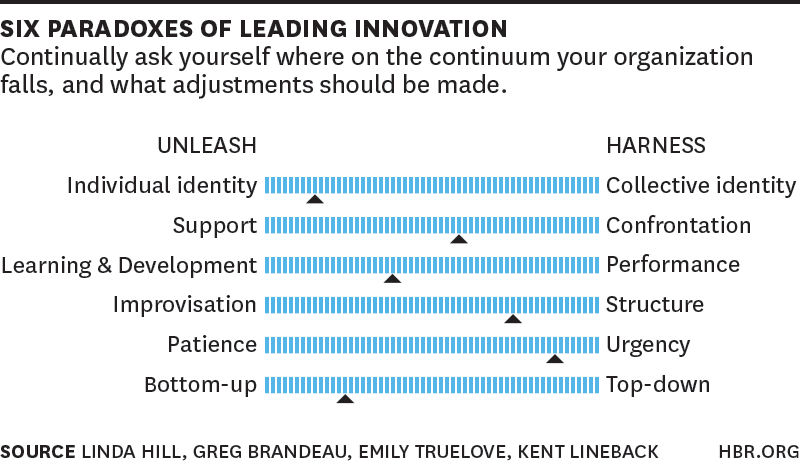
Hill and associates have uncovered six essential “paradoxes” for innovation.


“remix” of Lutheran theological
Source: Harvard Business Review, HBR.org


For Martin Luther, the paradoxical nature of being both saint and sinner, free and bound, is where the freedom of the Christian lies. As challenges and issues in both church and society become more complex and ambiguous, the presence and expectation of paradox is a theological gift.

In the end, remixes come and they go. But the tunes often continue to ring true. What rings true for you in this remix? What new questions or ideas come to mind?

Mikka McCracken, Executive for Innovation & Director, ELCA Innovation Lab

The ELCA Innovation Lab Blog is new! We’d love to hear what you think. If you’ve got a few minutes, complete this short survey. If you have any additional questions or comments let us know at lab@elca.org

Share

2020 Hurricane Anniversary Reports


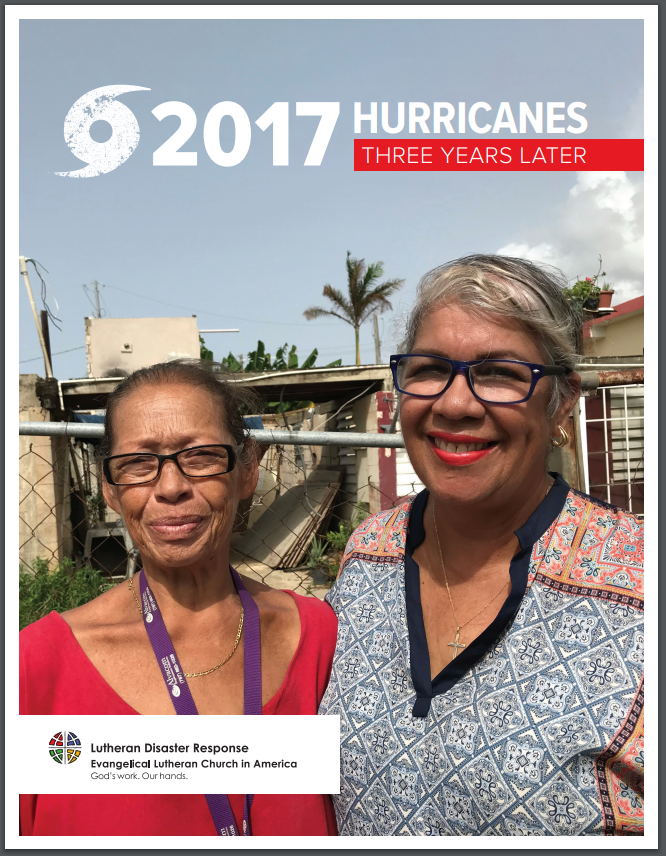
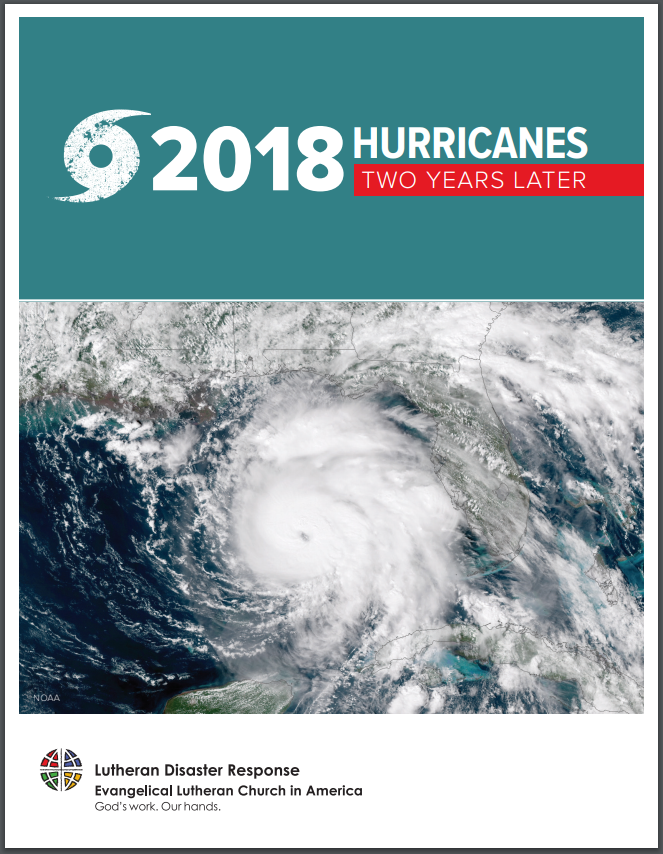
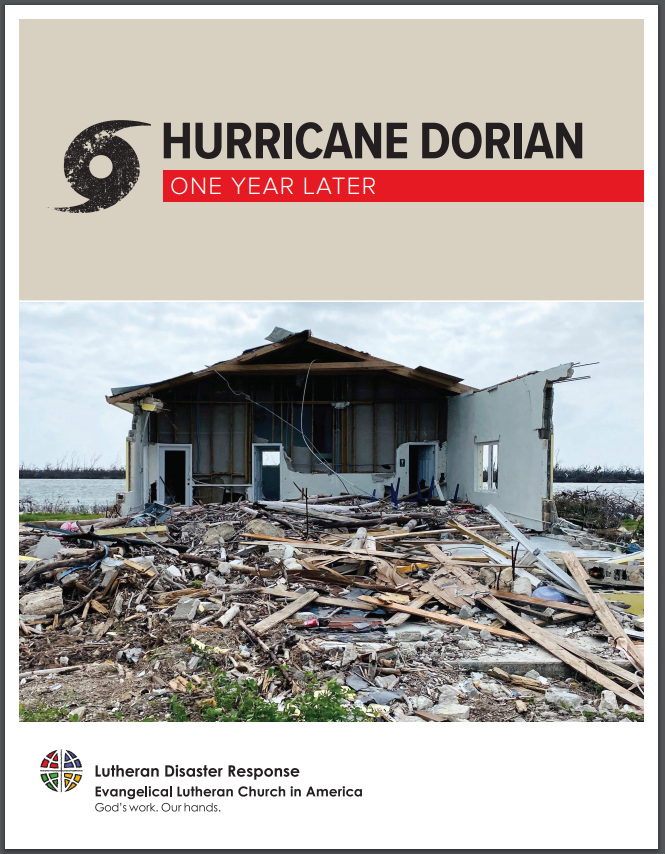
In the midst of a record-setting hurricane season, we are reminded of past events of devastation. In 2017, Hurricanes Harvey, Maria, and Irma impacted the Caribbean and the Gulf Coast of the United States. Hurricanes Florence and Michael hit the southeast U.S. in 2018, and last year, Hurricane Dorian struck the Caribbean.  Click on the anniversary reports below to read more about Lutheran Disaster Response’s work following the major hurricanes from the past three years.


Share